Category Archives: Literature in Translation

Comites Camillae: Some thoughts on Companions by Christina Hesselholdt

In her narrative that follows the lives of five close friends living through the trials and tribulations of middle age in the 21st century, Hesselholdt includes a conflated translation of two of the most famous poems by the Roman poet, Catullus: “My girl’s sparrow is dead…It would not leave her lap, but hopped around now here now there…He chirped constantly to his mistress alone.”  The poet engages in a passionate, tumultuous love affair with a married,  Patrician woman named Clodia (disguised as Lesbia in his poetry) and in Poem #2 he writes about his lover’s sparrow with whom she enjoys playing and teasing. (The poem is commonly view as an erotic metaphor—Lesbia plays with her “bird” when she is missing her poet-boyfriend, Catullus.)  The tone of Poem #3 changes dramatically as Clodia’s sparrow has now died and Catullus’s words serve as a mock eulogy for the dearly departed little pet.  The death of the sparrow is also foreboding, it shows Catullus’s angst about his relationship with this woman whom he knows, on some level, will bring him grief and suffering.  It is his friends, his companions (as he calls them in Poem #11—comites in the Latin ) that he relies on to get him through the rough times.

Much like Catullus, the characters in Companions struggle with loneliness and isolation in their love lives but their friendships are something to which they cling for security and reassurance amidst their various crises.  Hesselholdt’s narrative explores different types of love—romantic, filial, platonic—and the existential angst that these emotions cause.  Time and again the theme of death is considered in the author’s fragmented, intertextual, and postmodern writing.  Forty-year-old Camilla is the central figure in the narrative—or her thoughts, at least, get the most attention.  She is married to Charles who suffers from chronic, debilitating back pain and his illness has put a strain on their relationship.  Camilla’s mother is also troubled by various afflictions, both mental and physical, which are a constant source of stress for Camilla.  In addition, her dear, depressed friend Edward lives alone with his dog in the house in which his parents committed suicide by hanging themselves.  Camilla is surrounded by weakness, illness, and sadness and her thoughts are often about mortality— that of her own and those around her.

Early in the novel Camilla takes a trip to Belgrade to give a lecture and loneliness and isolation weigh on her.  Her thoughts apply to her trip as well as her current state of mind at this point in her life:

Why does the journey reinforce this existential loneliness—never am I closer to death and the abyss than when I am alone on a journey.  I know the answer already.  An unknown among unknown faces.  And unknown, unmemorized stretches.  Kingdom of the dead, glittering, indistinct features, averted eyes, withdrawal, fleeting shadows, bloodlessness.

When she is back home interactions with her mother and her husband also evoke images of death.  She says about her mother:

The other day I saw a painting by Kiefer, a painting of an enormous sunflower at the foot of which, a man is keeled over, (the title of the painting is Sol Invictus) I thought, that was how it was to be a child of hers.  The sunflower head looked like a shower head.  One moment warmth, the next in danger of drowning.  I am the one who is keeled over at the foot of the flower.  I have died the sun death, I have died the flower death.

She says about Charles and their relationship:

Married life with Charles is linked to the Osama bin Laden era, we were so in love in September 2001 that it was not until late morning on the twelfth that we realized what had happened on the eleventh, and the dissolution of our relationship took place in the days around bin Laden’s death.  Two images frame it:
1. Bodies in Free fall
2. A face shot to pieces
The end of him. And us.

And other intermittent thoughts that Camilla has that threaten to consume her and pull her down into the abyss:

I need to keep my mind active, give it something to work on, just like you use prayer beads or knitting needles to prevent your hands from becoming pendulums that heavily and resignedly pull the body down or on the contrary swing into the air or rub and pick and chewing gum for the mouth, otherwise it (the mind) fiddles with catastrophes like the outcome of which always results in coffins or in any case deathbeds or farewell letters, immensely trivial, but for that reason no less troublesome.

Camilla describes Alma, her life-long, closest friend as blonde, “my GPS, my light in the darkness.”  It is Alma that shows up in Belgrade to help her navigate the city and it is Alma who is a comforting presence throughout her childhood while she is dealing with her mother’s various issues.  Edward, Kristian and Alwilda are also close companions that provide her with support and distraction and we get their points-of-view from time to the in the text as well; they themselves are dealing with the ups and downs of various relationships.  But it is Alma who is the companion that is her constant source of solace.  They are friends from childhood and there are, fittingly, many descriptions of their traveling adventures–from England to Belgrade to Greece.

Companions is laden with references to other authors and pieces of literature; Woolf, Plath, Bernhard, Nabokov, and even a quote from Epicurus can be found within the pages of Hesselholdt’s narrative.  I had wondered if the character of Camilla is in any way autobiographical as it is evident that the author inserts her own literary preferences into the text.  Hesselholdt has especially tempted me to read Woolf’s The Waves and Durrell’s The Alexandria Quartet before I return to Companions for a second read as her multilayered and nuanced book is worthy of, and in fact demands, more than one reading.  The author, in discussing Durrell’s novels through the thoughts of Camilla, subtly shows us how we ought to approach and read Companions:  “The existence of the absolute unique frame of reference is rejected; all depending on where the events in the books are seen from, they appear different.”

I apologize for my scattered thoughts about this book.  I found it overwhelming to think about.  Please visit Times Flow Stemmed for Anthony’s more coherent and enlightening ideas about this book: https://timesflowstemmed.com/2017/10/23/christina-hesselholdts-companions/

10 Comments

Filed under Dutch Literature, Literary Fiction, Literature in Translation, Literature/Fiction

Love Stories Must Never be Left Unfinished: Irretrievable by Theodor Fontane

“Love stories must never be left unfinished and when harsh reality has cut the thread before its time, then it must be spun out artificially.” This seems to capture perfectly the sad fate that Fontane writes for the married couples in both Effi Briest and Irretrievable. Each story features a marriage in which, although a minor indiscretion has occurred, one of the spouses chooses a desperate and unnecessary end to their relationship, their family and their lives.
Set between 1859-1861 in Schleswig-Holstein, five years before the German-Danish War, the novel  deals with Count Helmut Holk who has been married to his beautiful and devout wife Christine Arne for twenty years. Even though they have very different personalities—he is easygoing, indecisive and not spiritual, she is moralistic, self-righteous and cold— their attraction, admiration and affection for one another, at first, was rather strong.  They build and move into a beautiful castle that overlooks the sea.  And they have two teenage children, a boy and a girl, for whom Christine is searching out boarding schools that will provide them the best education.  Schleswig-Holstein at this point in time is still ruled by Denmark and the Count has an important position as an attendant at the court of the Danish princess.  Just before the Count leaves his family to serve the princess in Copenhagen for several months, there are signs that the Holks’ marriage is starting to show signs of wearing thin on both of their nerves.  Fontane describes Christine’s thoughts just before the Count is called to Denmark:

In spite of having the best of husbands whom she loved as much as he loved her, she yet did not possess that peace for which she longed; in spite of all their love, his easy-going temperament was no longer in harmony with her melancholy, as recent arguments had proved to her more than once to an ever-increasing degree and even though she would strive with all her might to resist her tendency to disagree.

I felt that Holk was the more sympathetic of the two characters throughout the story.  Fontane lets us view the marriage from the outside, through the eyes of Christine’s brother and two local clergymen, who all agree that her moralizing and constant judgment of her husband is too much and is driving them further apart.  When Holk goes to Copenhagen, the time, distance and experiences with the Princess force him to realize that what he really wants is a partner who gives him warmth, affection and understanding;

Ah, all that bickering and nagging! I’m longing for a new life, one that doesn’t begin and end with religious tracts, I want harmony in my home, not a harmonium, joy and mutual understanding and air and light and freedom.  That’s what I want and that’s what I have always wanted, ever since the first day I arrived here, and now I’ve been given the sign that I’m going to be allowed to have it.

I also found the Count’s naivete, especially when he encounters the women in Copenhagen, to be amusing and even endearing.  He is especially captivated by Ebba, the princess’s lady-in-waiting, who flirts with him and uses him for one night of unbridled passion which the Count is clearly not accustomed to.  But he figures out too late that Ebba is just using him as a temporary amusement and his wife, for the better part of a year, will not forgive his indiscretion.  Holk is a character that develops a great deal of personal knowledge and growth in Fontane’s narrative so I found it disappointing that he would even consider going back to Christine; she is still the same dour, melancholy woman he married and their time apart didn’t change that.  He learns the hard way that any happy times that they had previously are irretrievable, there is no way back to the past.

As Fontane says in the novel, a love story can’t have a non-ending—the author couldn’t possibly allow Holk and Christine to live together in their castle, no matter how miserable they make each other.  It’s interesting to note that in Effi Briest, it is Effi’s husband that is the morally stringent, destructive force in the novel because in Irretrievable it is the wife that plays this role.  It is Christine that makes a fatal, ruinous decision (I won’t give it away) that brings a definitive end to their love story, their marriage and the novel.

I am thoroughly enjoying Fontane’s novels and I have a volume of his shorter works that is published by The German Library to look forward to.

(I read the NYRB Classics translation entitled Irretrievable but this novel has also been translated into English as Beyond Recall and No Way Back.)


7 Comments

Filed under Classics, German Literature, Literary Fiction, Literature in Translation, New York Review of Books

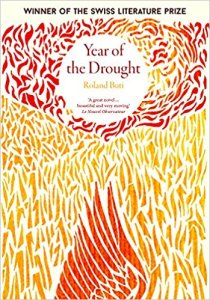
Year of the Drought by Roland Buti

Thirteen-year-old Gus Sutter vividly remembers the summer of 1976 not just for the preternaturally harsh drought, but also for the incidents leading up to the disintegration of his family.  Gus, his mother and father, his older sister Lea, and a mentally challenged worker named Rudy live on the family’s farm in the Swiss plateau.  Buti’s take on a coming-of-age story is captivating because of the impending sense of doom and ruin that he weaves throughout Gus’s narrative.  All of the nature around them foreshadows the sad fate of this family; the crops are burning in the sun, the family dog, Sheriff, keeps fainting and their chickens are dying by the dozens in the heat.  The Sutter’s ancient mare, Bagatelle, who never moves from her barn has broken free from her rope and made her way down to the local river to die.  And finally, perhaps the most eerie omen of all, is that Gus has found a dove that cannot fly because its fail feathers have been destroyed by a predator.

The arrival of a strange woman named Cecile, an employee at a neighboring post office, is the first hint that something is wrong with the Sutter family unit.  Cecile seems  oddly close to Gus’s mother and he can’t quite figure out why their relationship makes him so uncomfortable.  His mother has never shown very much affection or emotion towards her family.  Gus’s description of her, the morning after he finds the wounded dove,  is particularly sad since it comes from her thirteen-year-old son who clearly craves his mother’s affection:

I was glad that she had petted my dove, accepted its presence without argument.  Mum was always busy with a multitude of tasks that no doubt helped to keep her from feelings of despair.  I would have liked to be in the bird’s place.  I would have liked her to set down her towel and dry her hands, to come over and kiss me, stroke my hair, tickle my neck with the tips of her fingers.  When I left for school, she would give me a dry peck on the cheek, a kiss from the very tip of her lips that echoed in the cool morning.  Lingering on my skin for less than a millisecond, her mouth imparted no sense of its moistness.  She never gave me a tender pat of encouragement to send me on my way.

She is too busy playing the role of mother, housekeeper and accountant to enjoy anything else in life, but Cecile awakens something in her that Gus has never seen before—genuine happiness.  Gus slowly realizes that Cecile is a threat to his family when he discovers that since Cecile has moved in, Gus’s father is sleeping in the guest room.  When Gus questions his father about it, he is ruthlessly scolded for not minding his own business.

The character for whom I had the most sympathy was Gus’s father, Jean.  He inherits his farm from his own father and works from sun up until sunset to make barely enough of a living on which to sustain his family.  He is a man of few words, so it is through his actions that he demonstrates his unique, unconditional love for his wife, even when she abandons him, their children and the farm.   One night at dinner when Cecile encourages Gus’s mother to get a job, Jean nearly chokes Cecile to death in a fit of rage.  Later on, a group of neighbors make fun of Jean because of his wife’s indiscretions with Cecile and he punches and kicks these men until they can no longer stand.  But as revenge, those same men beat Jean with farm tools until he can’t walk and has to stay in bed for days.  Even Gus himself, who makes a disparaging comment about his mother after she leaves, is punched in the mouth and knocked out by his father.  As his wife drifts further and further away from him, he seems to be preparing himself for the inevitable.  Gus observes about his father:

He seemed to have decided that only objects and animals were worthy of his consideration.  He would carefully examine each tool he picked up, as if a pitchfork or a shovel could bring some answer to the problem of suffering.  He had taken to sitting down in front of Sheriff and staring at him, which made our dog uncomfortable, unused as he was to being treated as anything more than part of the furniture.  He would hang his head to the side quizzically, tongue hanging out, as if waiting for an explanation.  The truth was that Dad was training himself for solitude.

Gus’s father, after his wife leaves and the children are on their own, spends his days alone at the farm.  A very sad fate for a kind, honest, hardworking man who loved his wife, his family and his land.  Buti has created a memorable group of characters whom he fittingly sets among a vivid and harsh landscape.

Thanks to Grant at 1st Reading for recommending this book to me.  Please stop by his blog and read his wonderful review of this novel: https://1streading.wordpress.com/2017/09/07/year-of-the-drought/


6 Comments

Filed under French Literature, Literature in Translation

The School for Misfit Children: Such Fine Boys by Patrick Modiano

The Modiano titles that I’ve read so far, Little Jewel, Suspended Sentences, and this latest novel published by Yale University Press, all have a mysterious yet emotionally languid quality to them.  It is both odd and compelling to mix these tones in a narrative but the author does it, quite successfully, in all three of these books.

Such Fine Boys describes a French boarding school for boys in the mid-twentieth century.  Modiano’s description of The Valvert School in the first few pages of the book is strange and even a bit dark:

The Valvert School For Boys occupied the former property of a certain Valvert, who had been an intimate of the comte d’Artois and accompanied him into exile under the Revolution.  Later, as an officer in the Russian army, he fell at the Battle of Austerlitz, fighting against his own countrymen in the uniform of the Izmailovsky Regiment.  All that remained of him was his name and a pink marble colonnade, now half ruined, at the back of the park.  My schoolmates and I were raised under that man’s morose tutelage, and perhaps some of us, without realizing it, still bear the traces.

The fourteen chapters in Such Fine Boys each contain a different story about a boy who attended the school.  The young men that attend Valvert come from wealthy, aloof families who don’t have very much time to spend with their children and as a result they become melancholy, feckless adults.   Most of the stories are told from the first person point-of-view by a man who is a former student at the school named Patrick.  The author shares more than a name with his protagonist since Modiano also spent most of his young life in a French boarding school and saw very little of his parents.  Another oddity of the novel is that two of the stories are told by a different narrator, another former student named Edmond who becomes a minor actor in a traveling theater troupe.

The narrator’s interaction with each of the boys at Valvert is overshadowed by a mysterious set of circumstances.  A boy named Michel Karve, for example, is described as having a cold and formal relationship with his parents who don’t visit very often.  Even though Michel’s parents are wealthy, the boy wears badly fitting clothes and is fed simple meals while his parents dine out with friends.  Michel sends the narrator to his parent’s apartment to retrieve his few belongings and never wants to have anything to do with his parents again.  As is typical in all fourteen vignettes in the book, the narrative raises many questions about Michel’s circumstances that are never fully explained.

The chapter that best illustrates the languid tone of Modiano’s stories is the one which describes an old schoolmate named Alain Charell. When the narrator meets Alain by chance at the Gare du Nord he reminisces about the boy he knew at school: “What had become of his parents? His father, with his saffron-yellow hair and mustache, looked like a major in the Indian Colonial forces.  Had they disappeared, like their lawn and their Trianon?  I didn’t dare ask.”  Alain and his wife, Suzanne, have a bizarre open marriage and have sex with random strangers while the other spouse listens in the next room.  They both seem to take quite a few drugs and one night, in particular, Suzanne suffers from the affects of whatever substance they are ingesting as she must be held up and taken to the restroom by her husband.

One night while the narrator is sleeping he receives a startling phone call from Alain who insists that he and his wife must see him. Alain says on the phone, “Come right away.  It’s urgent.”   When the narrator arrives at a brassiere, no details about the importance of such a sudden meeting are given; they sit for a while in the crowded restaurant and they eventually take a walk around the deserted city.  The only word I could think of to describe these bizarre events and the tone with which they are conveyed is languid, unexpectedly languid:

After a while, Suzanne rested her head on my shoulder.  They surely didn’t want me to leave, and I suddenly thought we might spend the entire night on this bench.  On the other side of the empty street, from a tarpaulin-covered truck with its lights out, two men in black leather jackets were unloading sacks of coal with rapid, furtive movements, as if on the sly.

What was so urgent that the narrator was suddenly woken out of a sound sleep?  Why didn’t he ask his friends these questions immediately?  Perhaps, once again, it is something he didn’t dare ask.

Trevor at “The Mookse and the Gripes” has also reviewed this title as well as Modiano’s other latest release, Sundays in Augusthttp://mookseandgripes.com/reviews/2017/08/30/patrick-modiano-such-fine-boys/


5 Comments

Filed under France, French Literature, Literature in Translation

To Capture Someone’s Heart: North Station by Bae Suah

Korean author Bae Suah’s latest writing, although a collection of short stories, is equally as experimental, cutting-edge, and captivating as her novels. Each story in this volume, brilliantly translated by Deborah Smith, is laden with her poetic images and philosophical meditations. One theme that she returns to throughout the writing is that of reconnection after a long period of separation that involves both distance and time.  As in her previous novels her characters are consumed by wanderlust.

In the title story “North Station,” a man and a woman stand silently on a train platform in an unnamed city. As they wait for the train to arrive the gentleman has a strong desire to kiss this woman but the reason for their awkwardness is hinted at later in the narrative: “Young women of a certain type were both recurring characters in his life and predators who preyed on him, and even now he remembers them well.” As is typical with Suah’s writing, one must pay very careful attention to every detail on the page in order not to miss the most interesting parts and striking images of the story.  Daniel Green has written an insightful series of essays at The Reading Experience about innovative female authors and I would include Suah as one of the writers whom he describes as experimenting with the “Movement of Language.”  His description of the writings of Noy Holland as “using an alternative mode of composition through which ‘character’ and ‘story’ are not abandoned but emerge as the afterthought of the movement of language, the characters and plots subordinated to the autonomy of that movement” is also apt for characterizing the language of Suah’s stories in this collection and her novels.

While the narrator in “North Station” is waiting for the train, his lover’s presence causes a series of memories to invade his mind.  During his short time on the train platform, the man recalls a collection of writings by a suicidal, exiled author with whom he greatly identifies; he remembers a woman he met in a different city whose address is the only tangible thing he knows about her anymore; he reflects on the attic room he stayed at during his university days in which he reads passionate poetry.  One of my favorite passages is one in which he reflects on relationships and the metaphor of lover as hunter:

Who would have first used the expression “to capture someone’s heart?” A hunter, perhaps, who would know deeply how it feels to capture a beating heart, a living thing, how the one doing the capturing finds himself captivated, in thrall to the sense of his own omnipotence?  Like capturing a fawn or kit still warm from its mother’s heat.  Someone who, like the hunter, introduces himself into his victim’s eyes at such an early stage.  Who deploys his imagination to render in his mind’s eye that state of utter despair to which the lack of any exit, the terrible clarity of this fact, gives a paradoxical sweetness.  Who reproduces this state through what we call a verbal expression.  In such a way, the expression would have been born not through those who are captured, but through those who do the capturing.  Since the victim has no time for song.

Suah’s greatest strength as a writer lies in her ability to take what at first appears to be disjointed images and scenes and weave them together into a singularly beautiful story. The attic room, the poetry, the woman on the platform he longs to kiss are all connected in her character’s mind with a meditation on time and space: “When was it that he had last kissed a woman so ardently, his lips as passionate as when they pronounced poetry? In that city or this, at the house of his acquaintance or on the platform in the north station, while waiting for the train.”

The entire collection is as riveting and poetic as the title story: an author recalls several visits to her mentor, a young man is reconnected with a former lover while struggling with questions about his sexuality, a playwright experiments with how to portray time on the stage. These stories are a great place to start for those looking to get a taste of Suah’s innovative style of writing. For those of us already familiar with her previous novels, it is exciting to once again encounter more of the author’s intriguing and thought-provoking prose.

Photo credit:  Wellcome Library, London. Wellcome Images images@wellcome.ac.uk http://wellcomeimages.org Cupid, armed with a bow and arrow, flies in through the window to a room where two naked lovers lie asleep on a couch. Etching.

8 Comments

Filed under Literary Fiction, Literature in Translation, Short Stories