Category Archives: Literature in Translation

Review: Dry Season by Gabriela Babnik

I received an advanced review copy of this title from Istros Books.  Dry Season was the winner of the European Union Prize for Literature in 2013.  This book was originally written in Slovene and this English translation has been done by Rawley Grau.

My Review:
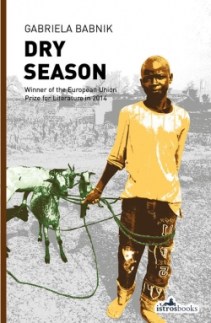
dry-season-cover_54aff6fb99d92_250x800rI have to admit that before I read this book I really knew nothing about the small West African nation of Burkina Faso.  The setting alone of this story in this small and politically volatile country taught me so many things, but the book as a whole is also a fantastic read.

From all outward appearances, the two main characters of this story could not be more different.  Anna is a 62-year-old white woman from Slovenia who has had a successful career as a textile artist.  Ismael is a 27-year-old black man from Burkina Faso who has grown up on the streets and has never had any real job or career.  It is surprising, even shocking that Anna and Ismael become lovers, but the author weaves their tales together so perfectly that in the end we are convinced that this relationship has had a powerful impact on both of them.

The narrative alternates between the point of view of both main characters.  We learn that Anna was rescued from an orphanage by her parents who, in a last ditch effort to save their marriage, agree to adopt a child since they cannot have one of their own.  But her parent’s strained relationship takes an emotional toll on her as a little girl as she is mostly left to be raised by a housekeeper.  Anna’s father is busy with his multitude of extramarital affairs and Anna’s mother remains aloof from her daughter while she constantly works at her sewing machine making women’s lingerie.  Anna eventually falls into an unhappy marriage with a man whom her mother chose for her and her only son from this marriage ends up in a mental institution.  Anna abandons her home, her family and her past to find some peace and quiet in Africa.

Ismael, when he was very young, lived in a remote African village with his mother who was an outcast.  Ismael never knew who his father was and he is constantly witnessing his mother being abused by fellow villagers as she is tied to the “shaming pole” and spit upon.  We are never told exactly what his mother’s sin is in the eyes of the villagers, but there is reason to suspect it has something to do with Ismael’s lack of a father.  Ismael and his mother eventually migrate to the streets of Ouagadougou, the capital city of Burkina Faso, where they live in cardboard boxes under a bridge.  When Ismael’s mother is killed and he is left alone in a city full of dangerous people, he is taken in by strangers who never really fulfill the role of a family for him.  He stays with an “ebony” woman and her husband for a while who have lost their own son and are trying to keep Ismael as their surrogate child.  Ismael also stays with a man named Baba who has been the only positive male role model in his life.  But Ismael gets pulled into the illegal and dangerous activities of Baba’s son Malik.

Even though they are born on different continents and decades apart there are some important ties that bind Anna and Ismael together.   They both feel abandoned and isolated, neither of them knows their real father and both of their mothers are emotionally distant. Anna and Ismael have separate and distinct stories told in alternating chapters, but the way in which the author gradually weaves together their stories is brilliant.  At first appearance it would seem that Anna and Ismael are using their sexual relationship to suppress their feelings of abandonment and isolation.  But as they share their stories with one another a deeper, emotional bond is forged.

Set against the backdrop of the harmattan, the dry season in West Africa, this novel  is a must read for anyone who enjoys brilliant literary writing with strong and intense characters.  I kept asking myself throughout the novel why, of all places on earth, Anna would pick this obscure West African country to flee to.  The dry season is one of extremes: extreme amounts of dust, extreme changes in temperatures, extreme fog and eventually extreme downpours of rain when the season ends.  This is the perfect setting for two characters who are, much like the dry season itself, both going through the extremes experiences of human existence.

This is my first title from Istros Books, an Independent British publisher that specializes in translating books from Eastern Europe into English,  and I am very excited to see what else they have in their catalogue.

About the Author:

gabriela-babnik_54d0fce19b0a4_250x800rGabriela Babnik was born in 1979 in Göppingen, Germany. After finishing her studies at Ljubljana University, she spent some time in Nigeria before working on a master’s degree on the modern Nigerian novel. Since 2002, she has regularly contributed articles to all major daily and weekly publications in Slovenia. In 2005, Babnik graduated in Comparative Literature and Literary Theory at the University of Ljubljana.

Her first novel Koža iz bombaža (Cotton Skin) was published in 2007 and was awarded the Best Debut Novel by the Union of Slovenian Publishers at the Slovenian Book Fair. In 2009, her second novel V visoki travi (In the Tall Grass) was published, which was shortlisted for the Kresnik Award in 2010.

Babnik lives with her family in Ljubljana.

13 Comments

Filed under Literary Fiction, Literature in Translation

Review: War, So Much War by Mercè Rodoreda

I received an ARC from Open Letter Press through Edelweiss.  This English edition has been translated by Martha Tennent

My Review:
War So Much WarAdrià Guinart lives in Barcelona with his mother and adopted younger sister.  But at the first chance he gets he leaves his home and joins an unnamed war that is ravaging the countryside.  He is only fifteen-years-old and what he sees while the war is raging forms the bulk of this bizarre and surreal narrative.  The book almost reads like a series of shorts stories, each of which is based on a different character that Adria meets while he is away from home at war.

There is very little fighting or war that Adria actually sees while he is roaming the countryside.  He stumbles upon the after affects of the war by meeting some wretched people along the way.  He meets a woman named Eva who is a miller’s daughter.  The book reads like a fantasy and sometimes the story is very disjointed and his episode with a woman named Eva is a perfect example.  As he is wading in a river with her for a while he learns that she is a miller’s daughter.  Their time together is very brief and when he parts from her he makes his way to the mill that her father owns.  At the mill he is tied up and beaten by the miller and eventually escapes.  He later meets up with Eva again, which second encounter seems even more random than the first.  They have a brief conversation and she leaves him again.

Another strange episode that Adria experiences takes place at a farmhouse that he stumbles upon in the woods.  When he first sees the owner of the house he is mercilessly beating his dog who has stolen a morsel of food.  The farmer explains that there is nothing in this world that he despises more than a thief and so he unleashes his anger on the family pet.  Adria stays with the farmer and his family for about two weeks doing chores for them in exchange for food and shelter.  One night the farmer’s daughters take Adria to a hidden pantry where Adria steals a ham.  When the farmer finds the ham, Adria suffers the same type of vicious beating that the dog received.  At this point he is forced to leave the farmhouse and once again roam the countryside.

The randomness and lack of smooth transitions from one scene to the next give the book a dreamlike quality.  It’s as if we have a front row seat to a viewing of Adria’s never ending nightmare.  Adria comes upon a castle whose owner has been tied up and held hostage in his own home.  He then wanders off once again and finds a girl on a beach who pledges her undying loyalty to him.  When he rejects her, she walks into the sea and commits suicide.  While walking along the sea Adria encounters a beach house where the owner welcomes him and feeds him.  He ends up staying with the man who owns the beach house, Senyor Ardevol,  for weeks and when the man dies he leaves his home and his possessions to Adria.

For the second part of the book Adria meets a series of interesting characters on the road whose stories are told in greater length.  Adria starts with Ardevol’s story and how he came to live in the beach house and how he came to see the strange image in the mirror in his foyer.  Adria also meets a cat man, a hermit and a man with a never-ending appetite, all of whom have strange tales to tell.  Even with the shift of focus in the book from Adria himself to the people he meets on the road, the stories in the second part of the book are just as fantastical and surreal as Adria’s experiences in the first part.

I have mixed feelings about this book but I think that is due to my preference for more realistic fiction.  The overall idea of the book is interesting but some of the shorter encounters of the main character, especially in the first half of the book, did not keep my attention.  Has anyone else read any other books by Mercè Rodoreda?  I am wondering if they are similar to this title.


About the Author:
Merce RMercè Rodoreda i Gurguí was a Spanish / Catalan novelist.

She is considered by many to be the most important Catalan novelist of the postwar period. Her novel “La plaça del diamant” (‘The diamond square’, translated as ‘The Time of the Doves’, 1962) has become the most acclaimed Catalan novel of all time and since the year it was published for the first time, it has been translated into over 20 languages. It’s also considered by many to be best novel dealing with the Spanish Civil War.

5 Comments

Filed under Classics, Literature in Translation, Novella, Spanish Literature

Review: Montaigne by Stefan Zweig

I received an advanced review copy of this title from Pushkin Press through Edelweiss.  Montaigne was originally written in German in 1941 and this English translation is done by Will Stone. This is my second contribution to German Literature Month, hosted by Lizzy’s Literary Life and Beauty is a Sleeping Cat.  Please visit their blogs for more great German Literature in translation and to see the full list of blogs that are participating.

My Review:
MontaigneStefan Zweig was forced to flee his home in Austria as the Nazis were taking control of his motherland.  For years he wandered around Europe as a nomad with no real place to call home.  As Europe is ravaged by war, he finds his way to the German community of Petropolis in Brazil and in 1941 he decides to write this brief biography of Michel de Montaigne with whose life he identifies on many levels.

Montaigne comes from a long line of hardworking ancestors.   His father’s family were fishermen and made their fortune by eventually owning their own fleet of ships.  His mother’s family were Jewish bankers from Spain who fled that county to avoid the Inquisition.  Montaigne’s grandfather buys a chateau and a vast estate in Bordeaux and intends to further the family’s aristocratic status through his purchase of land and a title.

Montaigne is brought up in the lap of luxury and it was very important to his father that his eldest son receive the best education possible.  As a result it was mandatory that Montaigne be fluent in Latin, for which purpose his father hired a German tutor when Montaigne was only four years old.  Montaigne was only allowed to speak in Latin and even the rest of the family and the household servants were required to learn some basic Latin phrases in order to communicate with the young boy.  As a result of this immersion in the language Montaigne is said to have been more comfortable speaking and writing in Latin than in his native French.  As a classicist I couldn’t help but simile at and appreciate this part of Montaigne’s story.  If only it were possible to educate all of my students in this way!

When Montaigne’s father dies he takes over as the head of household..  This foists a large responsibility on a man who sees his familial and civic responsibilities as mundane and tiresome occupations.  Zweig highlights Montaigne’s detachment from his family whom he even seems to view at times as a burden.  He never has fond words for his wife or the institution of marriage and at one point Zweig says that Montaigne is not even really sure how many children he has that are still alive.  Montaigne’s isolation from his family is further deepended when, at the age of thirty-eight, he decides that he wants to retire from his life, lock himself in the study in his tower, and read the precious books with which he has surrounded himself.

Montaigne’s view of books and reading is also noteworthy in Zweig’s account of his life.  Montaigne wants to absorb as much information and knowledge as possible and he scribbles notes in his books as various thoughts occur to him.  Montaigne states about his collection: “Books are my kingdom.  And here I seek to reign as absolute lord.”  It is during this time of self-imposed retreat and isolation that Montaigne tries to attain individual freedom and seeks to know himself as a man and as a human being on a deeper level.  His intentions, like other philosophers, is not to give his readers a specific ideology to follow.  Instead his thoughts and writings are introspective and intensely personal.

Ten years later, at the age of forty-eight, Zweig decides that he has had enough of his retirement and so decides to travel across Europe.  This journey becomes very painful for him since he suffers debilitating pain from kidney stones.  While he is away on his journey, the citizens of Bordeaux elect him in absentia as their mayor so at this point he decides to go back and serve his people.  Zweig reminds us, though, that Montaigne is no hero and his selfish habits come to the forefront once again when the plague breaks out in Bordeaux and he abandons his people to find for themselves.

Whether or not one is familiar with Montaigne, Zweig’s account of him is definitely worth a read.  Zweig was at a critical point in his life where he saw the world erupt in violence because of fascism and communism.  He commiserated with Montaigne who also saw his world torn apart by religious wars and fanaticism.  Zweig commits suicide in 1942 and this was one of the last things that he wrote.  Many believe that Zweig took Montaigne’s advice as far as death is concerned and decided to die on his own terms instead of living through a miserable exile imposed on him by outside forces.

About The Author:
Stefan Zweig was one of the world’s most famous writers during the 1920s and 1930s, especially in the U.S., South America and Europe. He produced novels, plays, biographies and journalist pieces. Among his most famous works are Beware of Pity, Letter from and Unknown Woman and Mary, Queen of Scotland and the Isles. He and his second wife committed suicide in 1942.

Zweig studied in Austria, France, and Germany before settling in Salzburg in 1913. In 1934, driven into exile by the Nazis, he emigrated to England and then, in 1940, to Brazil by way of New York. Finding only growing loneliness and disillusionment in their new surroundings, he and his second wife committed suicide.

Zweig’s interest in psychology and the teachings of Sigmund Freud led to his most characteristic work, the subtle portrayal of character. Zweig’s essays include studies of Honoré de Balzac, Charles Dickens, and Fyodor Dostoyevsky (Drei Meister, 1920; Three Masters) and of Friedrich Hlderlin, Heinrich von Kleist, and Friedrich Nietzsche (Der Kampf mit dem Dmon, 1925; Master Builders). He achieved popularity with Sternstunden der Menschheit (1928; The Tide of Fortune), five historical portraits in miniature. He wrote full-scale, intuitive rather than objective, biographies of the French statesman Joseph Fouché (1929), Mary Stuart (1935), and others. His stories include those in Verwirrung der Gefhle (1925; Conflicts). He also wrote a psychological novel, Ungeduld des Herzens (1938; Beware of Pity), and translated works of Charles Baudelaire, Paul Verlaine, and mile Verhaeren.

Most recently, his works provided inspiration for the 2014 film ‘The Grand Budapest Hotel’.

German Lit Month

9 Comments

Filed under German Literature, Literature in Translation, Nonfiction

Review: Nagasaki by Éric Faye

I received an advanced review copy of this title from Gallic Books through NetGalley. This book was originally published in French and this English translation is done by Emily Boyce.  This is also my first post for Novella November hosted by Poppy Peacock Pens.  Please visit her site for more great reviews of novellas throughout the month.

My Review:
NagasakiShimura Kobo leads a very quiet and regimented life in the suburbs of Nagasaki.  He is a meteorologist who avoids the company of his coworkers and every night returns to his neat, orderly and lonely apartment.  When food starts to disappear from his refrigerator and items appear out of place in his apartment he takes notice and is really bothered by this disruption in his organized life.  At first he thinks that he is just going crazy but in order to verify his missing items he starts cataloguing the contents of his refrigerator and measuring the liquid in his juice containers.  He finally decides to buy a webcam which is linked to his laptop so he can spy on his visitor while he is at work.

Shimura eagerly watches his laptop at work waiting for the intruder to appear on his screen.  He has to wait several days but he finally glimpses a woman standing in his kitchen, enjoying the sunlight and making herself a cup of tea.  He immediately calls the police who go over to his apartment to catch the suspected intruder.  But when the police arrive, there are no signs of a break in.  The doors and windows are locked and the police are about to give up their search when they discover a woman hiding in the closet in Shimura’s spare bedroom.

The woman, as it turns out, had lost her job in the economic recession and had to give up her apartment.  She was living on the streets of Nagasaki until one day she noticed Shimura leave for work.  She also noticed that he left the door to his house unlocked and so she let herself in, just intending to have a warm and dry place to stay for a few hours.  But when she discovers Shimura’s extra bedroom which is rarely used, she basically lives with him unnoticed for the better part of a year.

The most fascinating part of the story is the lasting psychological impacts that their inadvertent cohabitation has on both of them.  Shimura is forced to contemplate his lonely and solitary existence and he never feels comfortable again living in his apartment.   The woman does a short stint in jail and writes Shimura a very detailed letter about why she chose his house to stay in.  But she too is changed from her sojourn at Shimura’s home.  Their individual isolation and loneliness is cast into sharp relief when they each see how the other one lives.

This is a quick yet powerful read that I highly recommend. My only complaint is that I didn’t want the book to end; I wanted to know more about the fate of Shimura and his secret roommate.   This is a fantastic choice to kick off Novella November!

About The Author:
Eric FayeBorn in Limoges, Éric Faye is a journalist and the prize-winning author of more than twenty books, including novels and travel memoirs. He was awarded the Académie Française Grand Prix du Roman in 2010 for Nagasaki.


13 Comments

Filed under Literature in Translation, Novella

Review: The Last Weynfeldt by Martin Suter

I received an advanced review copy of this title from New Vessel Press through Edelweiss.  This book was originally written and published in German and this English translation has been done by Steph Morris.

My Review:
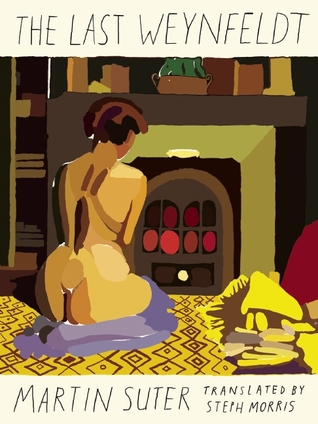
The Last WeynfeldtNew Vessel Press will publish the English translation of this book in February of 2016, but the book was so good that I couldn’t wait that long to review it.  The central figure of the book, Adrian Weynfeldt, is just what the title suggests: he is the last of his family and he is not married and has no children.  Adrian’s parents had him later in life and when they died they left Adrian an extensive inheritance which includes two buildings that are prime real estate in Zurich.

Fifty-year-old Adrian lives alone on the top floor of one of his opulent buildings.  His massive apartment is filled with costly art work and antique furniture.  Because of his family’s wealth Adrian doesn’t have to work, but he does because he loves his occupation as an expert art historian for an auction house in Zurich.  The descriptions of various artwork and the process of art auctions is a fascinating aspect of the book that captivated my attention.

Adrian is mannered to a fault.  He doesn’t ask questions when he should and he is always paying for his friends’ lavish dinners and funding their attempts at careers.  Every Thursday is lunch with his younger friends and Adrian always excuses himself towards the end of the meal and quietly pays the very expensive bill.  Adrian is kind, polite and unassuming and it as very sad to see his so-called friends take advantage of his good nature.

This book is one of those page turners that grabs you right from the first scene.  Adrian is sitting at one of his favorite bars in Zurich when in walks an interesting woman, in her mid-thirties who basically invites herself up to Adrian’s apartment.  He realizes that she is rather intoxicated, so in true Adrian fashion, he feels it would be wrong to sleep with her.  In the middle of the night, Adrian wakes up to find this woman, whose name he figures out is Lorena, standing on his balustrade and ready to jump to her death.  After he talks her off the ledge, Adrian finds that he can’t stop thinking about Lorena even though he doesn’t know very much about her.

It turns out that Lorena has tried to barely squeak out a living by modeling for small companies and catalogues.  She has had a tough life and her latest relationship ended disastrously when she found out her boyfriend had a wife and three children.  Lorena teams up with a small-time con artist named Pedroni and together they decide to try and swindle Adrian out of some of his money.  But Lorena seems to have fallen for Adrian, more so than she is willing to admit to herself, and we are left wondering if she can really cheat him after all.

Adrian and Lorena also become involved in an attempted art forgery and a great part of the suspense of the book lies in wondering whether or not Adrian’s keen eye for art will be able to detect the forgery and stop the sale of this piece before it ruins his career.  But Lorena’s influence has most definitely thrown some chaos into his otherwise ordered and neat life.  The circumstances surrounding the forged art, the sexual tension between Adrian and Lorena and the fascinating character of Adrian himself kept me wondering what was going to happen and wanting more.

I highly recommend that everyone put this on their “to read” pile for 2016.  There are just so many interesting aspects to this story-from the strong characters to the intricate descriptions of art to a mystery of an art fraud.  New Vessel Press has quickly become one of my favorite independent presses and with THE LAST WEYNFELDT they have chosen another fantastic book to bring us in translation.

About The Author:
M SuterMartin Suter (b. February 29, 1948, Zürich) is a Swiss author. He became known for his weekly column Business Class in the Weltwoche newspaper (1992–2004), now appearing in the Tages-Anzeiger, and another column appearing in “NZZ Folio”. Suter has published seven novels, for which he received various awards. He is married and lives in Spain and Guatemala.


8 Comments

Filed under German Literature, Literary Fiction, Literature in Translation