
Macrobius was a Roman grammarian, philosopher and author who lived and produced his most important work, the Saturnalia, in the early part of the 5th century A.D. The Saturnalia is a symposium, a conversation among friends, that takes place on the day before and three days during the Saturnalia, the festival dedicated to celebrating the harvest and the Roman god Saturn. The conversation encompasses a wide range of topics that include religion, literature, philosophy and rhetoric. In Book 1, a dinner guest describes the Egyptian belief that four important deities preside over the birth of every human (this translation is my own):
The Egyptians explain the significance of the Caduceus at the begetting of all humans, which is called genesis, by saying that there are four gods present at the birth of each person: Daimon (Spirit), Tyche (Chance), Eros (Love), Ananke (Necessity). The first two they wish to be understood as the sun and the moon, because the sun is the source of spirit, heat and light and both the procreator of human life and its guardian, and thus it is the Daimon or the deity of a person being born; the moon, however, is Tyche, because she is the guardian of bodies which are thrown about by the varieties of fortune. Love is signified by a kiss; nesessity is signified by a nod.
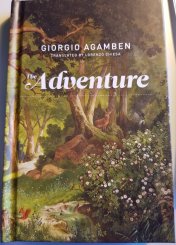
Giorgio Agamben, in his latest short philosophical work entitled The Adventure (trans. Lorenzo Chiesa), borrows these four gods from Macrobius to build his discussion and definition of the word “adventure.” And following the example of Goethe, who, in his Urworte, adds Elpis (hope), Agamben translates these deities as Demon, Event, Love, Necessity and Hope. He writes, “Every human is caught up in the adventure; for this reason, every human deals with Daimon, Eros, Ananke, and Elpis. They are the faces—or masks—that adventure—tyche—presents us with at each turn.” Agamben argues against the modern definition of adventure, which is seen as an event that is strange and out-of-the-ordinary, and wants to replace it with a more universal term that corresponds to our everyday Being and experience in the world. “The idea that adventure is something external—and therefore eccentric and bizarre—with respect to ordinary life defines its modern conception,” he asserts.
Agamben begins, as usual, with the history and etymology of the word “adventure”; previous authors have argued that the term comes from the Latin advenio as the neuter, plural, future, active participle—adventura. But, Agamben points out, there is no proof of its use in Classical Latin. He concludes, “Whether it derives from the classical and Christian Latin adventus (the advent of a prince or a messiah), as is likely, or from eventus, as the late Du Cange suggested, the term designates something mysterious or marvelous that happens to a given man, which could be equally positive or negative.” And in the love poetry of the troubadours, adventure is used to describe not only the event but also the story that is told about the event:
The aventure (or aventiure) may be marvelous or fortuitous (in which case it means “chance”), beneficial or malefic (one will then call it bonne or male aventure; the term seems to be equivalent to “fate” or “fortune”), or more or less perilous (it will thus stand as a challenge to the knight’s courage); however, it is not always easy to distinguish between the event and its transposition into words.
It is this medieval idea of adventure towards which we ought to return, Agamben argues. In the next two chapters he elaborates on the influence that Eros (Love) and Tyche (Event) have on the concept of adventure. Eros is the very thing that gives life to the demon, it is Eros that drives us to abandon ourselves to the adventure and the event without reservations. Eros and adventure are intertwined “..not because love gives meaning and legitimacy to adventure, but, on the contrary because only a life that has the form of adventure can truly find love.” And, as far as the event is concerned, “Not only are the event and speech given together in the adventure but—as we saw—the latter always demands a subject to whom it must be told.” A refreshing, hopeful, even playful definition of adventure emerges from Agamben’s essay. In the concluding chapter, Elpis (Hope), is the concept that links all of the other ideas together. But this is not the modern concept of hope from silly Internet memes or self-help gurus; it is more immediate, in the here and now, the hope that affects the essence of our Being daily: “Just as hope overcomes its satisfaction, so too does it surpass salvation (and love).”
I have read this delightful book a few times since last week and one thing that has bothered me about it is the translation of the Ancient Greek word daimon as “demon.” Although it can be used as an alternative for “daemon” (a spirit or numen), demon, in the monotheistic, Christian sense, has a decidedly negative connotation as something evil. In Ancient Greek daimon is used to denote a spirit in relation to a deity, and can also be translated as “power” or “fate”. Macrobius’ description, cited above, of the Egyptians belief that it is the source of heat, light and a guardian for humans at birth is very similar to the Ancient Greek understanding of it. (I’ve discussed the word daimon more thoroughly elsewhere in the context of Ancient Greek tragedy in a review of Anne Carson’s translation of Euripides Bakkhai.) Agamben is arguing that this spirit, this Being, present at birth is the every day, driving force behind adventure. Maybe I am mistaken, but it seems that an English speaking audience would automatically assume that demon is used in the negative, Christian context. I don’t have access to the Italian text, but I wonder what the word for daimon is in Italian and if it is closer to the original Ancient Greek meaning? Perhaps it would have been more beneficial for the sake of his argument if the translator used the Latin word daemon or, better yet, left it untranslated as daimon?
 The Ancient Greek goddess Demeter (Ceres to the Romans) was associated with the harvest and agriculture and was worshipped at her temple in Eleusis. The Homeric Hymn to Demeter tells us that the goddess has a daughter, Persephone or Kore, fathered by Zeus, who was abducted by Hades and forced to live in the underworld with her husband for part of the year. The story of Demeter and Persephone can be viewed as a nature myth—Persephone represents the seed, planted under the ground and fertilized by Zeus, that grows in the spring as the harvest and whose maturity is represented by Demeter herself. The story can also be viewed as an etiological myth whereby the seasons are explained—the months in which Persephone spends with her husband in Hades Demeter does not let anything grow and thus it is winter. Finally, the story of Demeter can be viewed as a charter myth that explains the origins for the rituals that take place during the Eleusinian Mysteries at the temple of Demeter.

 In Bergeners, Tomas Espedal describes his various travels which include sojourns at places like New York and Berlin. At the center of the book is an extended description of his hometown, Bergen, Norway, which city, as a fifty-year-old man, he is drawn back to settle in. I read the book in two evenings over the weekend and part of what draws me into Espedal’s writing is the way in which he varies his style; reading his books are like unpacking a treasure chest, one never knows what beautiful short story, poem, or anecdote one will find on the next page.
 The stereotypes of country dwellers being crass and uncouth and city dwellers being urbane and sophisticated is one that reaches all the way back to Ancient Rome. In Carmen 22, Catullus describes his good friend Suffenus whom he admires for being venustus et dicax et urbanus (charming, well-spoken and sophisticated). The Latin word urbanus, from which the English word urban is derived, literally means a person from the city who is sophisticated. But Catullus sadly notes that Suffenus is an awful poet and when one reads his compositions he appears to be caprimulgus aut fossor (a goat herder or a ditch digger) and he is infaceto est infacetior rure (duller than a dull hick). Rus, ruris becomes in English the word rural which is associated with someone who lives in the countryside and is decidedly unsophisticated.


 The Book Binder's Daughter