Category Archives: Literary Fiction

Review: The Life and Loves of Lena Gaunt by Tracy Farr

I received an advanced review copy of this title from Gallic Books through NetGalley.

My Review:
Lena GauntWhen we first meet Lena Gaunt, she is a lonely octogenarian who has been invited to play her theremin at a music festival near her home in Perth, Australia.  Lena has had a long and interesting life and her most notable accomplishment has been as an innovative musician.  After her performance on her theremin, a odd looking electric instrument that one plays by manipulating one’s hands in the air without touching it, she relaxes in her trailer by smoking some heroin.  At first this seems funny that a woman her age is engaging in such extracurricular activities; but as we learn more about Lena’s life, we come to understand that her dependence on mind altering drugs helps numb the pain of the  devastating losses she has experienced.

Lena is actually born in Singapore in 1910 where her father is a successful and wealthy businessman.  When Lena is only four-years-old she is shipped off to Australia to attend a boarding school.  This is the first experience of lost love that Lena experiences.  She is alone at this school, far away from any family and her only comfort is her music.  Her mother’s brother, Uncle Valentine, drops in on her every once in a while and it is Uncle Val that eventually introduces her to the cello.  Music becomes, for Lena, an escape, a comfort; it soothes her and gives her something on which to focus.

When Lena is a young adult she finally settles in Sydney among a group of artists and their patrons.  It is during this period where she is introduced to a professor who has invented the theremin and her expert playing and manipulation of this innovate instrument are what launches her into the spotlight.  It is also during this time that Lena meets the love of her life, Beatrix, who is a talented painter and artist in her own right.

Lena has a full life during which she is showered with accolades and acknowledgement for her musical talent.  But despite her success,  a feeling of loss and loneliness pervade her life.  She moves around the world, from Paris to London to New York City, but in the end she finds her way back to Perth and to the beach and ocean which she loves so much.

This seems, at first, like a quiet and slow book but about half way through it grabs you and sneaks up on you until you can’t put it down because you so desparately want to know what happens to Lena and those she loves.  I will admit that I had to wipe a tear or two from my eyes after finishing her story.

Gallic Books has brought us another brilliant, character centered story that I highly recommend.  They were one of my favorite publishers last year and their winning streak continues with me.  Kudos to Tracy Farr for a successful first book that is being published not only in her native Australia, but in England and the United States as well.

About the Author:
Tracy FarrTracy Farr is an Australian novelist, short story writer, and former research scientist. Since 1996 she’s lived in Wellington, New Zealand

Tracy’s debut novel The Life and Loves of Lena Gaunt is published in Australia and New Zealand by Fremantle Press (2013), and in the UK by Aardvark Bureau (2016) for international release (excl. Aus/NZ).


4 Comments

Filed under Historical Fiction, Literary Fiction

Review: Our Spoons Came from Woolworths by Barbara Comyns

My Review:
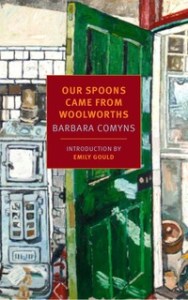
Our Spoons come from WoolworthsThis book is narrated by Sophia Fairclough, the main character of the book and deals with her rather difficult life during the 1930’s in London.  The language is very simple and straightforward, which is so fitting for Sophia; it’s as if we are reading her diary or sitting and listening to her story over an afternoon cup of tea.

Sophia meets Charles and they instantly fall in love and decide that they want to get married.  Even though they are only twenty-one years old and his family does not approve of her at all, they decide to get married.  They settle on a “secret” and “private” marriage at the local church, but they tell so many people that on the day of the ceremony the church is full of friends, family and odd acquaintances.

The book starts out on a very humorous tone as Sophia is extremely naïve about marriage, sex and motherhood.  Charles is an artist, a bit of a delicate genius, who can’t possibly put aside his art to get a proper job to support his wife.  Sophia is the main bread winner of the family and Charles is a terrible manager of their money.  Whenever they have a few extra shillings he spends it on frivolous things like painting supplies, wine and dinners.  Sophia is too naïve about living life as an adult to ask that her husband go out and get a job.  When she becomes pregnant and is forced to quit her job Charles is annoyed at having a baby in the house and having his only source of income cut off.

The scenes in which Sophia finds out about her pregnancy are absolutely hilarious.  She is genuinely surprised that she could be having a baby at all;  she thinks that if she wills herself not to be pregnant then she won’t have a baby.  When she goes to the hospital to have the baby she is shocked by the poking and prodding and the indignity of the whole process, right down to the horrible hospital bed clothes that she is forced to wear.

It is obvious from the very first sentence of the book that Sophia and Charles’ marriage does not end well.  As their marriage becomes increasingly difficult financially, emotionally and physically, Charles stays away from their home for longer and longer periods of time.  The humor that was spread throughout the first part of the book is noticeably absent in the send half of Sophia’s tale.  She suffers a great deal as her marriage disintegrates.

But in the end, Sophia learns an important lesson about resiliency and happy endings.  Even though she has suffered many trials and tribulations with and because of Charles she never becomes jaded or bitter.  She is guarded, yes, but never bitter.

The New York Review of Books has brought another brilliant classic to our attention.  I highly recommend this book for its humor, interesting storyline, and strong female character in the form of Sophia.


About the Author:
B ComynsBarbara Comyns Carr was educated mainly by governesses until she went to art schools in Stratford-upon-Avon and London. Her father was a semi-retired managing director of a Midland chemical firm. She was one of six children and they lived in a house on the banks of the Avon in Warwickshire. She started writing fiction at the age of ten and her first novel, Sisters by a River, was published in 1947. She also worked in an advertising agency, a typewriting bureau, dealt in old cars and antique furniture, bred poodles, converted and let flats, and exhibited pictures in The London Group. She was married first in 1931, to an artist, and for the second time in 1945. With her second husband she lived in Spain for eighteen years.

11 Comments

Filed under British Literature, Classics, Literary Fiction, New York Review of Books

Review: Dry Season by Gabriela Babnik

I received an advanced review copy of this title from Istros Books.  Dry Season was the winner of the European Union Prize for Literature in 2013.  This book was originally written in Slovene and this English translation has been done by Rawley Grau.

My Review:
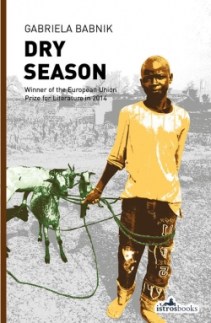
dry-season-cover_54aff6fb99d92_250x800rI have to admit that before I read this book I really knew nothing about the small West African nation of Burkina Faso.  The setting alone of this story in this small and politically volatile country taught me so many things, but the book as a whole is also a fantastic read.

From all outward appearances, the two main characters of this story could not be more different.  Anna is a 62-year-old white woman from Slovenia who has had a successful career as a textile artist.  Ismael is a 27-year-old black man from Burkina Faso who has grown up on the streets and has never had any real job or career.  It is surprising, even shocking that Anna and Ismael become lovers, but the author weaves their tales together so perfectly that in the end we are convinced that this relationship has had a powerful impact on both of them.

The narrative alternates between the point of view of both main characters.  We learn that Anna was rescued from an orphanage by her parents who, in a last ditch effort to save their marriage, agree to adopt a child since they cannot have one of their own.  But her parent’s strained relationship takes an emotional toll on her as a little girl as she is mostly left to be raised by a housekeeper.  Anna’s father is busy with his multitude of extramarital affairs and Anna’s mother remains aloof from her daughter while she constantly works at her sewing machine making women’s lingerie.  Anna eventually falls into an unhappy marriage with a man whom her mother chose for her and her only son from this marriage ends up in a mental institution.  Anna abandons her home, her family and her past to find some peace and quiet in Africa.

Ismael, when he was very young, lived in a remote African village with his mother who was an outcast.  Ismael never knew who his father was and he is constantly witnessing his mother being abused by fellow villagers as she is tied to the “shaming pole” and spit upon.  We are never told exactly what his mother’s sin is in the eyes of the villagers, but there is reason to suspect it has something to do with Ismael’s lack of a father.  Ismael and his mother eventually migrate to the streets of Ouagadougou, the capital city of Burkina Faso, where they live in cardboard boxes under a bridge.  When Ismael’s mother is killed and he is left alone in a city full of dangerous people, he is taken in by strangers who never really fulfill the role of a family for him.  He stays with an “ebony” woman and her husband for a while who have lost their own son and are trying to keep Ismael as their surrogate child.  Ismael also stays with a man named Baba who has been the only positive male role model in his life.  But Ismael gets pulled into the illegal and dangerous activities of Baba’s son Malik.

Even though they are born on different continents and decades apart there are some important ties that bind Anna and Ismael together.   They both feel abandoned and isolated, neither of them knows their real father and both of their mothers are emotionally distant. Anna and Ismael have separate and distinct stories told in alternating chapters, but the way in which the author gradually weaves together their stories is brilliant.  At first appearance it would seem that Anna and Ismael are using their sexual relationship to suppress their feelings of abandonment and isolation.  But as they share their stories with one another a deeper, emotional bond is forged.

Set against the backdrop of the harmattan, the dry season in West Africa, this novel  is a must read for anyone who enjoys brilliant literary writing with strong and intense characters.  I kept asking myself throughout the novel why, of all places on earth, Anna would pick this obscure West African country to flee to.  The dry season is one of extremes: extreme amounts of dust, extreme changes in temperatures, extreme fog and eventually extreme downpours of rain when the season ends.  This is the perfect setting for two characters who are, much like the dry season itself, both going through the extremes experiences of human existence.

This is my first title from Istros Books, an Independent British publisher that specializes in translating books from Eastern Europe into English,  and I am very excited to see what else they have in their catalogue.

About the Author:
gabriela-babnik_54d0fce19b0a4_250x800rGabriela Babnik was born in 1979 in Göppingen, Germany. After finishing her studies at Ljubljana University, she spent some time in Nigeria before working on a master’s degree on the modern Nigerian novel. Since 2002, she has regularly contributed articles to all major daily and weekly publications in Slovenia. In 2005, Babnik graduated in Comparative Literature and Literary Theory at the University of Ljubljana.

Her first novel Koža iz bombaža (Cotton Skin) was published in 2007 and was awarded the Best Debut Novel by the Union of Slovenian Publishers at the Slovenian Book Fair. In 2009, her second novel V visoki travi (In the Tall Grass) was published, which was shortlisted for the Kresnik Award in 2010.

Babnik lives with her family in Ljubljana.

13 Comments

Filed under Literary Fiction, Literature in Translation

Review: Bird by Noy Holland

I received an advanced review copy of this title from Counterpoint Press through Edelweiss

My Review:
BirdThis is a bizarre and surreal book that follows two different periods in the life of a woman named Bird.  And actually Bird doesn’t even seem to be her real name, but a strange nickname given to her by a former boyfriend named Mickey.  When the book opens, we are given a glimpse into a typical day in the life of Bird, a housewife and a mother of two young children.  Her oldest child, although a little boy of an indeterminate age,  is apparently old enough to go to school, is getting ready to catch the bus.  Bird is trying to get her son ready for his day at school and make him breakfast while also dealing with the needs of her infant daughter.  From all outward appearances, Bird seems to have a happy and content domestic life.

But in between her domestic tasks Bird keeps remembering the time she spent with her old boyfriend named Mickey.  Bird met Mickey when she was very young and they lived on very little money in horrible, decrepit apartments.  For quite some time, they carried on a vagabond existence fueled by drugs and sex.  When Bird finds out that she is pregnant, she and Mickey could not be happier and they immediately name their unborn child Caroline.  Even though they have little money and no jobs, they are happy and want to make a life together with their baby.  But when Bird has an unexpected miscarriage, things begin to come apart in their relationship.  Mickey starts wandering off for days at a time and his moods and behavior become unpredictable and erratic.

After the miscarriage, Bird and Mickey go on a road trip, traveling part of they way in his old car and eventually ending up on foot and hitchhiking.  The parts that describe their journey are very strange and disjoined, especially when compared against the backdrop of Bird’s current, orderly life.  At one point when Bird is home alone with her baby, she drinks rum and takes a hot bath with her baby.  This episode of drinking during the day makes us wonder if there is some discontent in Bird’s life, or if she maybe at least has a longing for the chaos and freedom that she experienced with Mickey in her youth.  Bird also revisits her past through conversations with her old friend Suzie with whom she speaks to a several points throughout her day.  And Bird further recounts letters that she has written to her mother which express the extremes of happiness and sorrow that she experiences in her life with Mickey.

I also have to mentioned the language of the book which takes some getting used to.  When I first started reading the story I almost gave up because I found the disjointed and choppy sentences very distracting from the story.  Some paragraphs even go on for half a page with single words that serve as sentences.   However, as I read the more cohesive parts of the story, I  became very interested in Bird’s narrative.  I also started to view the disjointed language as something very fitting for the turmoil that Bird feels in her mind.  On the one had she loves her husband and children, but on the other hand she can’t help but feel pulled back by the memories of her past.  I don’t think Bird would give up her family to find and be with Mickey again, but her time with him has left an indelible and ineradicable impression on her memory and on her soul.

About the Author:
Noy HollanNoy Holland’s debut novel, Bird, is forthcoming from Counterpoint in Fall 2015. Her collections of short fiction and novellas include Swim for the Little One First (FC2), What Begins with Bird (FC2), and The Spectacle of the Body (Knopf.) She has published work in The Kenyon Review, Antioch, Conjunctions, The Quarterly, Glimmer Train, Western Humanities Review, The Believer, NOON, and New York Tyrant, among others. She was a recipient of a Massachusetts Cultural Council award for artistic merit and a National Endowment for the Arts Fellowship. She has taught for many years in the MFA Program for Poets and Writers at the University of Massachusetts, as well as at Phillips Andover and the University of Florida. She serves on the board of directors at Fiction Collective Two.

Leave a comment

Filed under Literary Fiction

Review: The Blue Guitar by John Banville

I received an advanced review copy of this title from the publisher through Edelweiss.

My Review:
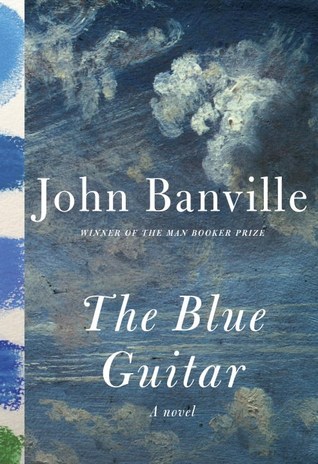
The Blue GuitarOliver Orme, in the opening part of the novel, is fleeing his home, his career and his life.  He has had an affair with his friend’s wife and the torrid details of the tryst has been uncovered.  Oliver is not sure how his own wife, Gloria, will react and he isn’t even sure how his lover, Polly will react to his sudden departure.  All Oliver knows is that his life is spiraling out of control and his instinct is to flee.

The first part of the book describes Oliver’s relationship with his wife and his meetings with his lover.  Oliver has fled to his boyhood home so there are also many scenes in which Oliver reminisces about his family and his childhood.  He is the youngest boy in a large family and was particularly close to his mother.  When he is a child Oliver picks up a very bad habit of stealing minor things.  He relates in great detail his first theft which was a tube of paint in a local art store.  The rush that Oliver feels when he is engaging in his kleptomania is like a drug that compels him to keep stealing from his friends and family well into middle age.  The latest thing he has stolen is Polly and now that the affair is out in the open he wants nothing more than to flee the entire unpleasant situation.

In the second part of the book Polly shows up at Oliver’s boyhood home with her two-year-old daughter Pip.  Polly has decided to leave her husband and is on her way to her parents’ house and asks Oliver to accompany her.  This episode in the second part of the book is very bizarre as Polly’s eccentric family is described in great detail.  Oliver stays there overnight and manages to escape the house secretly without anyone noticing.  It is really unclear why Polly wanted Oliver to accompany her home in the first place.  It is, however, very evident that this passionate, nine month affair has run its course and Polly and Oliver no longer love each other.  Banville provides us with unique insight into an affair because this is one that never could have lasted.  It leaves the characters wondering whether having a brief relationship was really worth disturbing the lives of so many people.

The final part of the book deals with Oliver’s return home and his confrontation with his wife Gloria.  At this point Gloria has some disconcerting news of her own to share in return.  The third part of the book actually has two shocking twists to the tale that I never saw coming.  To be perfectly honest, Oliver was such an unlikeable and almost despicable character in the first part of the book that I almost gave up reading it.  However, I am very glad that I pressed on because the reasons for his emotional instability are revealed further into the book.  Oliver is a well-recognized and talented painter and because of the tragedy he has suffered in his life he has pretty much given up on his career.  Banville demonstrates, through the characters of Oliver and his wife that grief is a tricky emotion that we all deal with very differently.

Finally, I have to mention the beautiful prose and language that Banville uses to relate this story.  The entire book is told in the first person, through the eyes of Oliver himself.  There are a number of interesting rhetorical devices and plays on words and language that Banville uses throughout the writing.  I highly recommend this novel just to experience a taste of Banville’s clever and elegant prose.

About The Author:
J BanvilleBanville was born in Wexford, Ireland. His father worked in a garage and died when Banville was in his early thirties; his mother was a housewife. He is the youngest of three siblings; his older brother Vincent is also a novelist and has written under the name Vincent Lawrence as well as his own. His sister Vonnie Banville-Evans has written both a children’s novel and a reminiscence of growing up in Wexford.

Educated at a Christian Brothers’ school and at St Peter’s College in Wexford. Despite having intended to be a painter and an architect he did not attend university. Banville has described this as “A great mistake. I should have gone. I regret not taking that four years of getting drunk and falling in love. But I wanted to get away from my family. I wanted to be free.” After school he worked as a clerk at Aer Lingus which allowed him to travel at deeply-discounted rates. He took advantage of this to travel in Greece and Italy. He lived in the United States during 1968 and 1969. On his return to Ireland he became a sub-editor at the Irish Press, rising eventually to the position of chief sub-editor. His first book, Long Lankin, was published in 1970.

After the Irish Press collapsed in 1995, he became a sub-editor at the Irish Times. He was appointed literary editor in 1998. The Irish Times, too, suffered severe financial problems, and Banville was offered the choice of taking a redundancy package or working as a features department sub-editor. He left. Banville has been a regular contributor to The New York Review of Books since 1990. In 1984, he was elected to Aosdána, but resigned in 2001, so that some other artist might be allowed to receive the cnuas.

Banville also writes under the pen name Benjamin Black. His first novel under this pen name was Christine Falls, which was followed by The Silver Swan in 2007. Banville has two adult sons with his wife, the American textile artist Janet Dunham. They met during his visit to San Francisco in 1968 where she was a student at the University of California, Berkeley. Dunham described him during the writing process as being like “a murderer who’s just come back from a particularly bloody killing”. Banville has two daughters from his relationship with Patricia Quinn, former head of the Arts Council of Ireland.

Banville has a strong interest in vivisection and animal rights, and is often featured in Irish media speaking out against vivisection in Irish university research.

9 Comments

Filed under British Literature, Literary Fiction