Category Archives: Classics

Trust in the Future as Little as Possible: The Voyage Out by Virginia Woolf

I usually devour a 350-page book in a couple of days, but Woolf’s writing, both her fiction and non-fiction, demands careful attention and a slow read. It took me a week to read The Voyage Out, Woolf’s first novel that was published in 1915. She is just beginning to experiment with what will become her signature, stream-of-consciousness style. She pokes fun at the uptight, British upper class who, even while on holiday in a tropical South American climate, insist on wearing furs and formal coats and having tea every afternoon promptly at 5:00. Even though on the surface they engage in polite conversation about politics, suffrage, and social gossip, Woolf gives us a glimpse of what they are really thinking. She introduces us to Rachael, her heroine, by her own thoughts as she sits in her drawing room in solitude on her father’s ship:

To feel anything strongly was to create an abyss between oneself and others who feel strongly perhaps but differently. It was far better to play the piano and forget all the rest. The conclusion was very welcome. Let these odd men and women—her aunts, the Hunts, Ridley, Helen, Mr. Pepper, and the rest—be symbols,—featureless but dignified symbols of age, of youth, of motherhood, of learning, and beautiful often as people upon the stage are beautiful. It appeared that nobody ever said a thing they meant, or ever talked of a feeling they felt, but that was what music was for.

Rachael is a very naïve twenty-four-year old who was raised by her spinster aunts and her widowed father. Her Aunt Helen, who is also on the voyage to South American, invites Rachael to stay at her villa for the winter in the hopes of better educating her about life and bringing her out of her sheltered existence. When they land in South American, Rachael and her aunt socialize with the British upper class men and women who are staying at the local hotel. Among these guests is Terence Hewett, an financially independent twenty-seven-year-old man who likes to travel and dabbles in writing novels. Both Rachael and Terence have never been in love; even though they are mentally and physically attracted to one another they spend a lot of time drawing close and then pulling back from one another because their feelings terrify them.

Once they finally confess their feelings and allow themselves to be happy, Rachael and Terence start planning their wedding and have a few weeks of bliss. But The Voyage Out ends in tragedy. It’s a shame that the lovers wasted so much time before they decided to embrace what would make them both happy. Horace’s Ode 1.11, the famous Carpe Diem poem kept coming to mind as I read Woolf’s novel (translation is my own):

May you not ask to know what end
—for it is not right—the gods might
have in store either for you or for me
Leuconoe, and may you also not consult
Babylonian Astrology. How much better
it is to endure whatever will be, whether
Jupiter has allotted us more winters, or
if this is the last, the winter which weakens
the Tyrrhenian Sea with opposing rocks. May
you be wise, may you strain your wine, and
because life is brief, may you give up any
long-term hopes. As we are speaking, envious
time slips by. Seize the day, trust in
the future as little as possible.

10 Comments

Filed under British Literature, Classics, Poetry

The Poet in Solitude: Propertius 1.18

Propertius 1.18

(Translation is my own)

This, certainly, is a deserted spot,  a quiet place for my complaints

and an empty grove only possessed by the light breeze of the west wind.

In this place it is freely permitted for me to pour forth my hidden pain;

that is if the lonely rocks are able to keep my trust.

At what point, my Cynthia, should I first repeat the tale of your

scornful contempt?  How did you make me start crying in the first place,

Cynthia?  I was just recently counted among the number of happy lovers,

but now I am forced to bear the mark of shame because of your love.

What have I done to deserve this? What crime have I committed that has

turned you against me?  Is the worry of a new woman the cause for your distance?

If you return yourself to me, cold woman, then and I can assure you that

no other woman has set her fair feet on my doorstep.   Even though in

my distress I have every right to be harsh with you, nevertheless, my savage anger

will not be released upon you and cause you to have perpetual fury against me or to weep

so many floods of tears that those eyes of yours should become ugly.

Or could it be that I give almost no signs of my feelings by the expression

on my face, or that no cries of loyalty towards you ever cross my lips?

Oh you trees, if you are capable of love,  you will be my witnesses—beech trees

and pine trees, beloved by the Arcadian god.   Ah, how often my words echo

under your shades, and how often the name “Cynthia” is written on the

thin bark of your trunks!  Ah, how your injury has caused me great anxiety,

an anxiety which is only increased by your silent door!

As a timid man I have accustomed myself to forebear all the demands of a

haughty woman and not to complain about her deeds through my melodious

grief.  I am given, for all of this grief, endless mountains, frigid rock, and the harsh

silence of an uncultivated wilderness.  Whatever of my complaints I am able

to narrate aloud, I, alone, am forced to say these things to the chirping birds.

And whoever you are, let the forests echo back to me my calling of “Cynthia”

and may the deserted rocks never be free from your name.

8 Comments

Filed under Classics

How Shall We Live?: Thoughts from Robert Musil on this Memorial Day

This long weekend in May in the United States is a federal holiday which is meant to remember and honor veterans who have died while serving in the United States Armed Forces.  As I was reading Robert Musil’s essay entitled, “Twilight of War”  I thought it sad and ironic that this holiday is called Memorial Day because we really do not seem to learn or retain the lessons that history has taught us.  What Musil wrote during the early part of the 20th Century is not only relevant, but good advice today for my country in particular:

If one wants peace, one has to do something, not just have a conference about it.  There is no radical defense against war.  Because there is no radical defense against the stupidity, fantasy, and bestiality of human beings.  But there are a dozen small defenses, and none of them should remain untried.  The weaker a person is, the more he will develop and pay attention to his intellectual powers, in order to carry on in difficult times.  The stronger he is, the heavier his fist, the sooner he will surrender his reason in order to finish off a difficult thing with his fists.  But that is not bravery. That is the obtuseness of brutality.  Little David was brave, not the strong Goliath.  He was nothing but strong, and he finished off nothing but himself.

No state has ever maintained of its army that it is kept for offensive purposes. Each one affirms that it is only there for defense.  For four years dozens of armies have defended something against something else. Only one thing remained undefended, that there is nothing which armies could defend that could justify such an expenditure of human lives.  It is a myth that disarmament would have to be agreed upon universally.  Those who make the assertion want, at best, to just talk about it.

This essay is in Musil’s collection of Thought Flights, brilliantly translated by Genese Grill.  Divided into three parts, the book includes short stories, glosses and literary fragments.  The extent of topics in the collection is impressive: art, fashion, politics, morality and love are just a few of his interests.  Genese Grill simply and eloquently describes these writings in her introduction, “As always, Musil is really asking: How shall we live?”

6 Comments

Filed under Classics, Essay, German Literature, Short Stories

De Senectute: Sappho, Ovid, Tennyson, Musil and Cicero

Aurora Taking Leave of Tithonus. Francesco Solimena. 1704

In classical mythology Tithonus was a Trojan prince with whom Eos (Aurora to the Romans), goddess of the dawn, falls in love.  This deity, whom Homer calls “rosy-fingered,” captures Tithonus and sweeps him off to the home of the gods and asks Zeus to grant Tithonus immortality.  Eos, however, forgets to also ask for eternal youth.  Even though Tithonus is immortal, he grows old and frail.  Sappho, in her “Tithonus” or “Old Age” poem uses him as a metaphor to illustrate the effects of her own aging (translation is my own):

Old age has already taken from me my once soft skin,
and my hair, at one time so dark, has grown white.
My spirit has grown heavy, my knees, which used to be
nimble enough to dance like fawns, no longer carry me.
I mourn these things but what can I do about it?
It is not possible for men to be ageless. For at one time
they say that Eos, smitten by love, carried off Tithonus in her
rosy arms to the edge of the earth, he who was handsome
and young; but in time gray old-age took hold of him who
was a still a husband to an immortal wife.

In Ovid there is a brief mention of Tithonus as Aurora and some of the other goddesses complain that they cannot stop the aging of their mortal lovers )trans. my own): “Aurora, daughter of Pallas, mourned the old age of her own husband.”  But, as Sappho says, what could she do?

What is missing in these myths is Tithonus’s own words.  Tennyson’s brilliant poem about the Trojan prince gives him that voice: “Let me go: take back thy gift,” Tithonus begs her.  He laments his inevitable aging, recognizes that as humans we must accept this fate, and pleads with Eos to release him from his immortality. I offer here one of my favorite stanzas, but please do read the entire poem:

The woods decay, the woods decay and fall,
The vapours weep their burthen to the ground,
Man comes and tills the field and lies beneath,
And after many a summer dies the swan.
Me only cruel immortality
Consumes: I wither slowly in thine arms,
Here at the quiet limit of the world,
A white-hair’d shadow roaming like a dream
The ever-silent spaces of the East,
Far-folded mists, and gleaming halls of morn.
Alas! for this gray shadow, once a man—

So glorious in his beauty and thy choice,
Who madest him thy chosen, that he seem’d
To his great heart none other than a God!
I ask’d thee, ‘Give me immortality.’
Then didst thou grant mine asking with a smile,
Like wealthy men, who care not how they give.
But thy strong Hours indignant work’d their wills,
And beat me down and marr’d and wasted me,
And tho’ they could not end me, left me maim’d
To dwell in presence of immortal youth,
Immortal age beside immortal youth,
And all I was, in ashes. Can thy love,
Thy beauty, make amends, tho’ even now,
Close over us, the silver star, thy guide,
Shines in those tremulous eyes that fill with tears
To hear me? Let me go: take back thy gift:
Why should a man desire in any way
To vary from the kindly race of men
Or pass beyond the goal of ordinance
Where all should pause, as is most meet for all?

I was also reading Robert Musil’s Thought Flights over the weekend and one of his short narratives struck me as a similar commentary on aging, how we see ourselves and how others see us.  In “Susanna’s Letter,” a married woman is writing to a friend about a train journey during which she reflects on her changing body as she ages.  Her chin was “once energetic” she notices, and her neck used to be straight.  But despite these physical reminders of her age, “It is all downward going from here on out, but every step becomes calmer and more secure.”  And my favorite passage, bitter sweet—both hopeful yet sad—from the story is the one in which she connects her aging body to her spouse (trans. Genese Grill):

My husband much have seen every details of my body by now, and he loves me anyway; he loves me as I am.  Sometimes that makes him unbearable to me.  For it takes all my power from me.  I should say, it takes all the fantasizing out of my body.  Then I am like a finished book, one that has already been declared to be very beautiful; for, the fact that a book is beautiful is no consolation for its having already been read.

On one final, positive note, in Cicero’s philosophical treaty De Senectute (On Old Age), he writes (trans. my own):

I follow and obey nature who is the best guide as if she were a divinity; it cannot be true that she has arranged well the other parts of our lives but then, like a bad poet,  neglected the final act of the drama.  It is necessary, however, that there be a certain kind of end, frail and withered with a timely maturity,  just as the berries on the trees and the fruits of earth, which wise men must gently endure.  To fight against nature would be as useless as the giants rebeling against the gods.


6 Comments

Filed under British Literature, Classics, Philosophy, Poetry

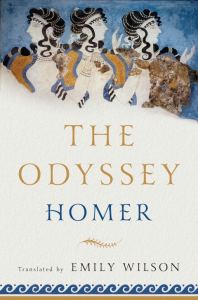
An Excess of Xenia: Some Thoughts on the Odyssey (trans. Emily Wilson)

Xenia, usually translated as “guest-friendship”  is an important part of the mores of the ancient Greeks during the Bronze Age;  a person is required to welcome travelers into his home as guests and the expectation is that the host provides a warm place to sleep, good food, a bath, wine and entertainment.  Emily Wilson, in the introduction to her translation writes, “Xenia acquired an extra importance in the era when Greek men were expanding their world.  Travelers, in an era before money, hotels, or public transportation, had to rely on the munificence of strangers to find food and lodging and aid with their onward journey.”

I view the Odyssey as a series of episodes, in rapid succession, that show men either correctly carrying out their duties of xenia or horribly violating the standards and expectations of this social code. It is a blueprint for Greeks on how to act and how not to act in terms of fulfilling one’s duties regarding xenia. Polyphemus, for example, perpetrates one of the most horrible, ugly and disgusting violations of the guest-friendship demands of xenia when, instead of feeding Odysseus and his men, he eats them for his own dinner.  This episode is oftentimes portrayed as a cute fairytale about a one-eyed monster who doesn’t know how to behave.  But in Emily Wilson’s incisive and skillfully efficient translation, the full horror of this episode is laid bare:

Leaping up high, he reached his hands towards my men, seized two, and knocked them hard against the ground like puppies, and the floor was wet with brains.  He ripped them limb by limb to make his meal, then ate them like a lion on the mountains, devouring flesh, entrails, and marrowy bones, and leaving nothing. Watching this disaster, we wept and lifted up our hands in prayer to Zeus.  We felt so helpless.

Another code of conduct that xenia covers is the mutual respect due to a host when one is a guest in another man’s home. A house guest is expected to be polite, grateful and provide a gift to the host. One of the most obvious violations of this concept of xenia in the Odyssey deals with the suitors who have placed a burden on Telemachus and Penelope by overstaying their welcome, eating all of their food and being rude to their hosts. The suitors are the ultimate bad house guests.  One of my favorite passages in the Odyssey is the Phaeacian bard’s tale of Aphrodite and Ares getting caught by Hephaestus in his own home.  The Greek, anthropomorphic gods are also capable of bad behavior, violating xenia and paying the price for it.   Ares is an awful house guest and, much like Paris himself, steals his host’s wife:

Then Ares took her hand and said to her, ‘My darling, let us go to bed. Hephaestus is out of town; he must have gone to Lemnos to see the Sintians whose speech is strange.’ She was excited to lie down with him; they went to bed together. But the chairs ingenious Hephaestus had created wrapped tight around them, so they could knot move or get up.  Then they knew that they were trapped.

And what of Odysseus himself as far as xenia is concerned?  Wilson’s translation of the Greek word polutropos as “complicated” which is used to describe Odysseus in the first line is brilliant.   He certainly relies on his trickery as well as the kindness of strangers to feed him, clothe him, and in the case of Calypso and Circe, sexually satisfy him.  Disguising himself as a beggar in his own home, he provides the ultimate moral test for his wife and son when he observes how they, and others in his household, treat a decrepit old man who is  most in need of food, clothing and shelter.  Penelope, who is the true hero of the epic in my opinion, treats the beggar with a gentle and respectful kindness.

Tricky, selfish, narcissistic, and, yes, complicated.  As a Homeric hero he certainly strives to be the good warrior, the good father, the good master, the good husband.  But even by Homeric standards his lying, cheating and elaborate falsehoods are difficult to see beyond.  Bernard Knox says of Odysseus:

For Achilles a lie is something utterly abhorrent.  But for Odysseus it is second nature, a point of pride. ‘I am Odysseus,’ he tells the Phaeacians when the time comes to reveal his identity, ‘known to the world/for every kind of craft’ (9.21-22).  The Greek word here translated ‘craft’ is dolos.  It is a word that can be used in praise as well as abuse.  Athena uses the word when, in the guise of a handsome young shepherd, she compliments Odysseus on the complicated lie he has just told her about his identity and his past, and it is with this word that Odysseus describes the wooden horse he contrived to bring Troy down in flames.  On the other hand, Athena, Menelaus and Odysseus use it of the trap Clytemnestra set for Agamemnon when he returned home, and it serves Homer as a way back from Pylos. But whether complimentary or accusing, it always imples the presence of what Achilles so vehemently rejects—the intention to deceive.

Is appealing for the privileges due under the umbrella of xenia respectful to one’s hosts when it is done under disguise and under false pretenses?  Yes, deception is oftentimes necessary for his survival.  But what about keeping his identity from his wife who is the last to know who he is?  Penelope brilliantly turns the tables on Odysseus by putting him through her own test and calling out his penchant for deception.   As a woman she has little control over what goes on with guests in her house, but she does have control over who sleeps in her bed—her secret, cleverly made bed.  Once again, Wilson’s translation of this passage is keen and trenchant:

Do not be angry at me now, Odysseus!  In every other way you are a very understanding man.  The gods have made us suffer: they refused to let us stay together and enjoy our youth until we reached the edge of age together.  Please forgive me, do no keep bearing a grudge because when I first saw you, I would not welcome you immediately.  I felt a constant dread that some bad man would fool me with his lies.  There are so many dishonest, clever men.

I have to admit that The Odyssey has not been one of my favorite ancient texts.  I’ve always greatly preferred the Iliad.   I had an intense seminar in graduate school on the Odyssey with John Peradotto and at that time, in my early twenties, translating and absorbing an entire book a week was too overwhelming for me.  But Emily Wilson’s literal and precise yet musical translation of the epic has given me a new appreciation of this text.  On a personal note, my thirteen-year-old daughter came home a few weeks ago with a copy of the Odyssey she took out of the library.  The translation was one of those that have been very popular in the past 20 years.  I quickly replaced it with Wilson’s translation.  I think it is an amazing thing that my daughter’s first impression of the Odyssey, and the standard by which she measures all subsequent renditions, will be that of Wilson’s.  She has been coming home every day and describing to me Odyssey’s latest adventures and her impressions of it.  She has asked if she can read the Iliad next.

17 Comments

Filed under Classics
