Category Archives: Classics

Review: Slow Days, Fast Company by Eve Babitz

I received a review copy of this title from New York Review Books via Edelweiss.

My Review:

babitz_Slow_Days_hi-res_largeI have to admit that I have never been to Los Angeles and the quiet, New England girl in me has always been afraid to even think about visiting the famed city on the other coast.  Images of the fast life with celebrities, drugs and name dropping via shows like The Kardashians and The Real Housewives are just too much for me.  Eve Babitz was the original glamor girl and in her book Slow Days, Fast Company she describes the Hollywood of the 1960’s and 1970’s that was just as intense, if not more so, as the Hollywood of the 21st century.

Slow Days, Fast Company is a collection of stories about Eve’s life as an artist and a writer living in the heart of Hollywood.  She meets countless celebrities that are the who’s who of L.A. in the 60’s and 70’s, from artists to rock stars and movie execs.   The impression that I got from the casual tone of the book is that she is unfazed by many of the rich and famous characters that she encounters.  In the story entitled, “Heroine” Eve is introduced to Janis Joplin twice but both times Joplin is so strung out on drugs that she is incapable of speech.  Babitz isn’t angry or disappointed that she never gets to speak with the famous rock star, but instead she is sad that drugs have consumed and destroyed another life with so much potential for greatness.  Eve herself drinks quite a bit, does cocaine, and pops a lot of Valium, but she draws the line at taking Heroine because she has seen too many people destroyed by it.

Babitz is open and brutally frank about her sex life throughout the stories.  She manages affairs with multiple men at one time and engages in the occasional ménage à trois.  Her attitude towards sex and these various relationships is also rather laid back, as if balancing several men at a time and sleeping with two men at a time is something that is totally normal and part of every day life.  There is also an undertone of humor as far as her sex life is concerned, especially when it comes to her lover named Shawn.  Shawn was a gay man living in the American south with his partner, and now finds himself in the middle of the Hollywood scene and hanging out with Eve Babitz.  She takes him on as her lover and he features prominently in several of the stories as they go on vacation together, go out to dinner, and do other things that are typical of a romantic couple.

My favorite story in the collection is the one entitled “Bad Day at Palm Springs.”  Eve is introduced to a rich socialite named Nikki Kroenberg who is married to a lawyer and has too much time on her hands.  Nikki invites Eve and Shawn to spend the weekend with her in Palm Springs and Eve jumps at the chance to spend a few quiet days away from the smog and congestion of L.A.  In this story Eve gives us a lesson about the fluidity and imprecise nature of time on the west coast.  Shawn says that he will be ready for their weekend getaway at 7 p.m. but two hours later Eve and Nikki are still sitting in Shawn’s kitchen waiting for him to finish a photo shoot.  Eve deals with the constant waiting by always keeping a paperback book with her; but the pressure of keeping Nikki busy while they wait for Shawn causes Eve to swallow a few extra Valium.  When they finally make it to Palm Springs, the slow pace of life in the sun is just too much for Eve and she is itching to get back to her life in L.A.

In Slow Days, Fast Company Babitz provides an inside look at the life of the rich and famous while at the same time not taking herself too seriously.  I never felt that Babitz was name dropping to make herself sound more important and for this reason the book was a highly entertaining read.  I still don’t have a desire to visit California anytime soon, but experiencing it through the eyes of this writer and artist is amusing.

About the Author:

Eve Babitz is the author of several books of fiction, including Sex and Rage: Advice to Young Ladies Eager for a Good Time, L.A. Woman, and Black Swans: Stories. Her nonfiction works include Fiorucci, the Book and Two by Two: Tango, Two-Step, and the L.A. Night. She has written for publications including Ms. and Esquire and in the late 1960s designed album covers for the Byrds, Buffalo Springfield, and Linda Ronstadt. Her novel Eve’s Hollywood is published by NYRB Classics.

8 Comments

Filed under Classics, New York Review of Books

Review: Zama by Antonio de Benedetto

This book was originally published in Spanish in 1956 and this English version has been translated by Esther Allen.

My Review:
ZamaDon Diego de Zama is a clerk serving the Spanish monarchy in a remote town in Paraguay at the end of the eighteenth century.  His position as an assistant for the Governor is supposed to be one of prestige and the first step as he moves up in his political career.  But if only he could find a way to get out of the backwater of Paraguay and be assigned a better position in Buenos Aires, which would also be closer to his home and his wife.  Zama is a lazy, selfish, and even at times stupid man who only seems to do things that hurt his career and his family.

There is a scene in the book in which Zama has just finished spending what little money he has at the racetrack betting on horses.  He decides to take a siesta in the shade where he encounters another man resting.  While this man is sound asleep Zama sees a poisonous spider about to jump on this man’s face and Zama decides to do absolutely nothing about it.  He doesn’t lift a finger to dispose of the spider or even warn the man of the impending danger of the venomous arachnid that is about to jump on his face.  Zama simply sits there and watches the scene unfold and seems rather detached from the fact that a poisonous spider is crawling on another man’s face.  This episode perfectly exemplifies Zama’s selfish attitude not only towards the world around him, but also towards his life, his job and his family.

The book is divided into three parts, the first of which takes place in 1790.  When we are first introduced to Zama he is waiting for a ship to come in that might contain a letter from his wife and the salary that is owed to him by the Spanish crown.  Zama misses his wife a great deal, but the lack of intimate contact with her for almost two years drives him to find a woman to fulfil his sexual desires.  In a scene that is reminiscent of the Actaeon and Artemis story from Greek mythology, he accidentally sees a local upper class woman naked while she is bathing in a river.  Once he finds out who this woman is he does everything he can to scheme his way into her home without attracting the notice of her husband or the rest of the town.  His attempts to seduce this woman are clumsy and not well planned.

The novel skips forward four years to 1794 and Zama is still stuck in this town in Paraguay. But by this time he has moved into a ramshackle farmhouse with a widow named Emilia and has a son with her.  Zama’s salary that he is owed by the Spanish crown is very seldom paid to him, so he lives in poverty and doesn’t have very much to offer his mistress and child.  He notices the child is oftentimes dirty and crying but he is never moved to console the child or find a way to provide a better life for his family.  When he has extra money in his pocket he doesn’t offer it to Emilia or his son but instead he buys his own meals at the local inn or tavern.  His own needs continue to always come first.  Zama’s wife, whom he was so eager to be near in the first part of the book, is not mentioned at all during this time.  Zama’s emotional detachment from the hardships that his families suffer is astonishing.

In the final part of the book  Zama’s selfish nature finally brings about his downfall.  The year is now 1799 and Zama is sent on an expedition with the local militia to hunt down a notorious pillager and thief.  The sole reason that he volunteers for the mission is that he thinks it will finally get him a promotion.  The final part of the book is the most exciting as Zama travels with soldiers into remote parts of South America that are dangerous because of Indian tribes.  There is also a bit of intrigue during this part of the book when the bandit’s true identity is revealed and the only one who knows this key piece of information is Zama.  His selfish and clumsy reaction to this situation is typical of his character throughout the book but this time his impetuous actions bring about his own demise.

Reading about Zama’s life is like watching a train wreck.  We know from the beginning that because of his clumsy behavior Zama is headed for a bad end, but we can’t put the book down because of our morbid curiosity to know how he finally does himself in.


About the Author:
A BenedettoAntonio di Benedetto, (born 2 November 1922 in Mendoza – died on 10 October 1986 in Buenos Aires), was an Argentine journalist and writer. Di Benedetto began writing and publishing stories in his teens, inspired by the works of Fyodor Dostoevsky and Luigi Pirandello. Mundo Animal, appearing in 1952, was his first story collection and won prestigious awards. A revised version came out in 1971, but the Xenos Books translation uses the first edition to catch the youthful flavor.  Antonio di Benedetto wrote five novels, the most famous being the existential masterpiece Zama (1956). Los suicidas (The Suicides, 1969) is noteworthy for expressing his intense abhorrence of noise. Critics have compared his works to Alain Robbe-Grillet, Julio Cortázar and Ernesto Sábato.  In mid-sixties or early seventies he caused a diplomatic faux-pas at a NATO meeting when during a ceremonial toast he raised his cup and said “cin cin” to bystanding Japanese diplomats. This caused an international pandemonium, as “chin chin” is a slang term for penis in Japanese. This later led to his prosecution. In 1976, during the military dictatorship of General Videla, di Benedetto was imprisoned and tortured. Released a year later, he went into exile in Spain, then returned home in 1984. He travelled widely and won numerous awards, but never acquired the worldwide fame of other Latin American writers, perhaps because his work was not translated to many languages.

8 Comments

Filed under Classics, Literature in Translation, New York Review of Books, Spanish Literature

Review: The Godwits Fly by Robin Hyde

My Review:
Godwits flyThis is the latest release from Persephone Press whose classic fiction I adore.  This book is unlike any other I have read from their catalog so far.  The entire time I was reading it I felt as if I were in the midst of a dream with lots of sounds and imagines, some vivid and some out-of-focus.  And the dialogue was sparse and poetic, sometimes difficult to understand.  The main character, a girl named Eliza, is an aspiring poet from a very tender age so it is no wonder that the author chose such a lyrical style for her novel.

Eliza and the other Hannays, her sisters Carly and Sandra, her brother Kitch and her parents have a somewhat nomadic life in Wellington, Australia.  Eliza’s father has a job as a office clerk on which salary he struggles to support his family of six.  They move from one cheap rental house to another and it is thanks to his wife, Augusta that their budget is stretched so far.  Augusta is an economical cook and sews clothes for her children who are always well-dressed and tidy.  The first part of the book is Eliza’s memories from the various houses and neighborhoods in which they have lived.

From the beginning we understand that the Hannay family does not get along well with one another.  Mr. and Mrs. Hannay are always fighting and one wonders how they ever got together and got married in the first place.  Mr. Hannay fancies himself a socialist and is always reading books on the subject and dragging home his seedy friends.  He appears to have little affection for or understanding of his wife and his children.  All of this behavior irritates Mrs. Hannay whose main concern is caring for her family and keeping the house clean.  She dreams of someday moving to her beloved England but as the story goes on it is evident that this is not an achievable dream for a poor woman with four children.

Much of the prose in the book is focused on capturing the details of the settings.  For example, in chapter nine, entitled “Reflections in the Water” is centered around Eliza’s birthday and the family celebrates by having a picnic and a swim at Day’s Bay.  The chapter opens with a vivid description of the people standing on the dock and boarding the boat to sail out to Day’s Bay.  Hyde writes, “Day’s Bay sand is smooth and warm, honeycombed with tiny airholes in which the blue crabs hide.”  I could feel the press of people, the heat and I could smell the water and the summer as I was reading the descriptive passages in this chapter.  The story continues to describe the beach and the picnic and although there is little in the chapter that advances the story we get another glimpse into the life of this family.

As Eliza and her sister Carly get older I was expecting that a man would catch their attention and there would be multiple weddings in the book.  But the hold that the Hannay family has on both of them doesn’t loosen its grip for anything, not even a man.  Carly is engaged for a while and she then tries her hand at becoming a nurse, but the connection with her mother pulls her right back home.  Eliza falls in love with a man named Timothy who is one of the socialists that her father brings home.  She has a lot in common with him and they like to discuss books but it seems that Timothy is a free spirit; although he loves Eliza, the pull of traveling and exploring the world is greater than his love for her.

Timothy does write letters to Eliza and even wanders back to her in Wellington from time to time but this is more of a torment to her than anything else.  She has a love affair with an older man in order to try to forget Timothy, but this episode in her life has long-term and hurtful consequences for her.  The only positive that comes out of her lost loves is that she is inspired more than ever to write poetry.

For those who love poetry, The Godwits Fly is a must-read.  Eliza reads and memorizes poems which she is fond of reciting from a young age.  She also writes a fair amount of her own poetry and she calls her gift for writing simply, “it.”  When tragedy strikes,  her gift for poetry suddenly returns: “She felt neither happy nor unhappy. merely still as the nurse moved about the room.  When she was alone, words ran in her mind, measured themselves, a steady chain of which no link was weak enough to break.  Long ago, she called the power ‘it’.”  Eliza is able to find comfort and solace in her art, but this book doesn’t have a particularly happy ending for any members of the Hannay family.  It serves as a stark reminder that growing up female in the mid-twentieth century was a struggle.

Please visit Persephone Books for more information on this title: http://www.persephonebooks.co.uk/the-godwits-fly.html

About the Author:
Robin HydeIris Wilkinson (1906-39), who wrote as Robin Hyde, is one of New Zealand’s major writers.  Brought up in Wellington (her father was English and her mother Australian), she was encouraged to write poetry. At 17 she began work as a newspaper journalist. Hospitalised after a serious knee injury, she later gave birth to two illegitimate children – the first died, but her son, Derek Challis b. 1930, was fostered (and would wrote her biography in 2004). Despite two breakdowns, she continued to work ferociously hard, notably during 1934-5 at Auckland Mental Hospital when she wrote half of her total output; here she began her autobiographical novel The Godwits Fly (1938) describing ‘Eliza’ up to the age of 21. During the 1930s Robin Hyde published a total of ten books – five novels, poetry (inc. Persephone in Winter, 1937) a travel book and journalism.  She travelled to China in 1938, made it to England, but killed herself in Notting Hill Gate a week before the outbreak of war.

9 Comments

Filed under British Literature, Classics, Persephone Books

Review: Getting it Right by Elizabeth Jane Howard

I received a review copy of this title from Open Road Media via Netgalley.

My Review:
Getting it RightGavin Lamb is a thirty-one year old virgin who still lives at home with his parents.  It’s not that he can’t afford to move out because he has a very lucrative career as a hairdresser in London.  But he doesn’t like change and moving out of his childhood home would be more change than he could possibly handle.  His doting and old-fashioned mother would also have a very hard time letting go of her son.
The strength of the book is the depiction of Gavin who is meek, shy and kind.  His job as a hairdresser has allowed him to practice talking to women but most of his customers are middle-aged and elderly women.  The thought of talking to a young woman absolutely paralyzes him.  He is also extremely self-conscious about his acne that continues to persist into his thirties.  The universe, and his friend Harry, conspire to change Gavin’s quiet, uniform world.

Gavin’s best, and really only friend is Harry, a middle-aged gay man who has a tumultuous relationship with his live-in boyfriend Winthrop.  Harry knows that Gavin must be lonely and he suggests that Gavin tag along to a party one weekend.  The thought of having to be social and talking to people he doesn’t know terrifies Gavin.  But he knows that he should try to be more social and he doesn’t want to say no to Harry.  There are two women at the party that cause Gavin to have some interesting adventures.

The woman hosting the party is named Joan and she is a rich socialite who married a man that doesn’t love her.  Joan’s husband, Dmitri, only stays with her for her money and he takes off for long periods of time to decorate the homes and yachts of the rich.  Gavin finds it remarkably easy to speak with Joan because she is so honest and straightforward with him.  It is Joan who introduces him to the finer points of physical intimacy with a woman.  But in the end Joan is too unhappy and selfish to ever be committed to someone like Gavin.

The other woman that Gavin meets at the party is a young girl named Minerva who is an absolute hot mess.  After the party she follows Gavin home and invites herself to be his house guest for the night.  Gavin is horrified at the thought of his mother waking up and finding Minerva in her house.  Mrs. Lamb is fascinated with the British upper classes, so Gavin tells her that Minerva is a Lady.  This is one of the funniest scenes of the book as Mrs. Lamb falls all over herself to impress Minerva who is just a common girl with various emotional problems.  If Mrs. Lamb knew the truth about Minerva she would be absolutely scandalized.  Gavin’s kindness and impulse to please others especially comes through when he is dealing with Minerva.  He can’t shake her off because he is too polite to tell her to get lost.  When he realizes that she has mental problems that need to be addressed he feels more responsible for her than he should.

The third woman that has an impact on Gavin at this time in his life is actually someone that he has known for three years but has never interacted with until a chance encounter during his lunch.  Jenny has been a junior assistant at his hair salon but when he accidentally meets her at the park, he talks to her with a level of comfort that he has never know with a young woman.  Jenny, he finds out, got pregnant as a teenager and her mother is helping her raise her young son Andrew while she is at work.  Jenny asks Gavin to teach her about sophisticated interests such as classical music and literature.  Gavin loves his new role as teacher and they get closer he wonders whether or not he has feelings for her.

In the end the author reveals what happens with all three of these women in Gavin’s life and whether or not he manages to get things right with any of them.  I thoroughly enjoyed the charming plot of this book as well as the endearing character of Gavin.  For those who love classics British literature then Elizabeth Jane Howard is a must-read.

About the Author:
E HowardElizabeth Jane Howard, CBE, was an English novelist. She was an actress and a model before becoming a novelist. In 1951, she won the John Llewellyn Rhys Prize for her first novel, The Beautiful Visit. Six further novels followed, before she embarked on her best known work, a four novel family saga (i.e., The Cazalet Chronicles) set in wartime Britain. The Light Years, Marking Time, Confusion, and Casting Off were serialised by Cinema Verity for BBC television as The Cazalets (The Light Years, Marking Time, Confusion and Casting Off). She has also written a book of short stories, Mr Wrong, and edited two anthologies.

Her last novel in The Cazalet Chronicles series, “ALL CHANGE”, was published in November 2013.

12 Comments

Filed under British Literature, Classics

Review: A Lady and Her Husband by Amber Reeves

My Review:
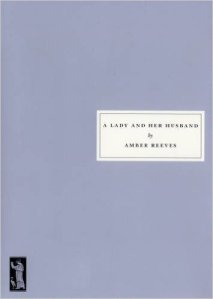
A Lady and her HusbandThis latest release from Persephone Books is a charming and entertaining look into the life of a middle-aged British couple that has been married for twenty-seven years.  When the book begins Mary is being told by her second eldest daughter, Rosemary, that she is engaged to be married.  Mary tries very hard to be stoic about this announcement even though she is upset because another one of her children is flying the coop.  Mary married John at a very young age and she has been a devoted wife and mother for her entire adult life.  The thought that of all three of her children no longer need her makes her sad and she feels lost.

Rosemary feels so guilty that she is going to be leaving her mother that she comes up with an idea of how Mary can now occupy her time.  Mary’s husband, John, owns a successful chain of tea shops and Rosemary thinks it would be a great idea for her mother to take an interest in the shop girls and find ways to improve their working conditions in the shops.  Rosemary is much more liberal and progressive than her mother so she knows that this task is way outside her mother’s comfort zone.  But Rosemary encourages her mother to have a life beyond her home.  Mary has never ventured into the realm of social causes so she is very hesitant to agree to this little project but she does so reluctantly after her husband John talks her into it.

The real conflict in the book begins when Mary starts to form her own ideas about improving the working conditions in the tea shops.  Mary wants the girls to wear more comfortable shoes, to have a proper place to eat their lunch, and she wants to increase their wages.  When Mary timidly approaches John with her suggestions, his temper explodes and he berates her for what he calls her silly little reforms.  Mary’s idea to increase wages for his employees is especially worrisome to John who believes that he pays his workers a fair wage.  John immediately rejects all of Mary’s ideas for changing the tea shops and tells her that she is naïve and that none of her ideas are practical and would work in the real world.

There is an underlying commentary in the book on the differences between men and women and how they must recognize and learn to work around those differences in a marriage.   Mary and John have had a marriage that is free of arguing and misunderstandings because she stays at home and doesn’t have anything to do with John’s business. John often comes across as condescending when he calls Mary “little mother” or “poor old thing.”  He does truly care for her but he draws the line at wanting to please her when she tries to interfere with his business.  Mary, on the other hand, after visiting John’s shops, better understands the plight of the poor and working classes and she approaches these issues from an emotional angle.  At one point in the book she recognizes that she cannot make a rational decision free from emotion with John around so she takes a flat in London to give herself time to think.

This book was written in 1914 so it brings up many political and social issues that were relevant at the turn of the last century and which continue to be discussed into the 21st Century.  Debates that have taken place during the recent elections in the U.S. have reminded us that women are still paid less than their male counterparts, the minimum wage for workers continues to be too low, and millions of Americans still do not have access to proper healthcare.  Reeves has written a charming and humorous book about the differences between men and women and the perils of navigating a successful marriage.  But there is also a serious side to the book that highlights issues that persistently affect the working classes and the poor.

I cannot recommend this book highly enough.  If you love the titles in the Persephone catalog then you must read this book.

About the Author:
Amber Reeves, the daughter of William and Maud Pember Reeves, was born in 1887 in New Zealand. When her father was appointed Agent-General in 1896 her parents moved to England. Amber went to Kensington High School. Her mother was active in the Fabian Society and in 1912 wrote Round About a Pound a Week (now Persephone Book No. 79). In 1905 Amber, ‘a clear and vigorous thinker’, went up to Newnham College, Cambridge to read philosophy. After her affair with HG Wells led to pregnancy, in 1909 she married a young lawyer, Rivers Blanco White. Two more children were born in 1912 and 1914. She published three novels including A Lady and Her Husband (1914), worked at the Admiralty, and ran the Women’s Wages Department at the Ministry of Munitions; later she was briefly a civil servant, wrote a fourth novel, stood for Parliament, taught at Morley College for 37 years and published books on ethics and economics. She died in 1981.


9 Comments

Filed under British Literature, Classics, Persephone Books