Category Archives: Classics

Hero-Shaming: Aidos and Nemesis in Logue’s War Music

Nemesis and Tyche

Nemesis and Tyche

Fat-shaming, slut-shaming, body-shaming, teen-shaming, pet-shaming.  In the blogging and book world I have even seen list-shaming recently.  There has been an explosion of attempts in the 21st century to shame one another into appropriate behavior via social media.  But what do these online exchanges really accomplish?  Have they really made us a more moral and ethical society?  Or is all of this shaming a badly veiled form of bullying and harassment?

It seems that we have come a very long way from the Homeric concept of shame, aidos, which was a quality a man or woman possessed that was a motivation for him or her to follow what was considered the correct behavior.  Aidos is the feeling of shame, humility or modesty that is specifically related to three aspects of Homeric society: situations involving sexuality, the entertainment of guests, and standing one’s ground in battle.  This last category especially pertains to the heroes in the Iliad Aidos, or shame, is what keeps a Homeric hero on the battlefield despite the horrors of warfare.  If a man flees from the battlefield due to fear or cowardice he feels great aidos, shame, in front of his fellow warriors.  James Redfield in his pivotal book “Nature and Culture in the Iliad” sums up aidos and its impact on the Homeric hero: “Combat is the crucial social act, for in combat the survival of the collectivity is at stake.  The aidos felt in battle is an experience of the collectivity; a man stands his ground because he shrinks from betraying his fellows.”

The exemplar of a hero with the most acute sense of aidos in The Iliad is Hector.  He goes into fierce battles brought on by his brother because to hide away from war would cause him great aidos. In Book VI of The Iliad, Hector returns home in the midst of fighting the Greeks in order to speak with his wife Andromache and see his infant son Astyanax.  In this beautiful yet deeply sad exchange between husband and wife, Andromache begs Hector not to go back into battle and she appeals to his sense of pity to persuade him.  She argues that when Hector dies she will be a lonely widow and their son will be a fatherless orphan.  Hector greatly pities his beloved wife as he contemplates with horror the aftermath of Troy’s destruction when she will be carried off as a slave to serve in a Greek man’s home.  But not even the thought of his wife as a captive will keep him from rejoining the battle.  What does keep him fighting and risking his life is his sense of aidos; he will die of shame, he says, if he does not return to battle and has to face the men or women of Troy who will think him a coward who shrinks from battle.  As with the concept of kleos, Homeric aidos is deeply rooted within community, something that is dependent on one’s society.

Paris is a flawed Homeric hero, the antithesis to his brother Prince Hector.  When Paris is saved from battle by the goddess Aphrodite, he feels no aidos at leaving the battlefield.  He is happy to sit in his rooms and drink in Helen’s beauty.  Paris’s sense of aidos is never fully developed and his lack of aidos makes him impervious to any nemesis he might incur.

I am disappointed that Logue did not recreate the scene in Book VI between Hector and Andromache because it is one of my favorite parts of the Iliad.  Logue does, however,  in his account of Iliad Books 3 and 4, approach the subject of Hector’s sense of aidos when the Prince volunteers himself to the Trojans who are trying to decide which man will fight Menelaus one on one.  The Trojans say about Hector’s offer:

Hector has fought and fought, has given blood and now—
Breathtaking grace,—offers his life and his armour to end
The hostilities he did not cause.

In this simply stated line, Logue alludes to one of Hector’s primary motivations for fighting a war against men who have not personally wronged him: his sense of aidos.  But the Trojans decide that it should be Paris who fights Menelaus since he started this mess in the first place.  Logue primarily deals with the Homeric idea of aidos through the character of Paris as an example of how a hero ought not to behave.  In Logue’s account, which is faithful to the Homeric plot, Aphrodite swoops in and saves Paris just before Menelaus is able to slaughter him.  When Paris reappears back in their palatial bedroom, Helen attempts to persuade Paris to go back out onto the battlefield and fight for her.  She is trying to appeal to Paris’s sense of aidos which is futile become he completely lacks this Homeric quality.  He is a defective Homeric hero:

Your death will be the best for everyone
Troy will reopen.  I shall sail for Greece.
And you will not survive your cowardice.

And later in Logue’s account of Iliad Books 7-9,  when the Greeks are beaten back to their ships and suffer horrible loses, the heroes appeal to one another’s sense of aidos to keep them on the battlefield.  The Greek men shout to one another:

Stand still and fight.
Feel shame in one another’s eyes.
I curse you, God.  You are a liar, God.
Troy will be yours by dark—immortal lies!
Home!
Home!
There’s no such place!
You can’t launch burning ships.
More men survive if no one runs.

In typical, short burst, hard hitting sentences Logue perfectly captures the Homeric ideal of aidos.  Logue’s last line of this quote in particular is reminiscent of Iliad V.531 and XV.563 when the Greeks and Trojans, in the midst of battle, are shouting to each other that when men feel aidos, more of them are likely to be saved in combat than perish.  So the Greek heroes’ need for kleos (fame) is what made them follow Agamemnon and Menelaus across the Aegean in the first place, but aidos is what keeps them from fleeing in horror every time they take their places on the battlefield.

The Greek concept of Nemesis, “righteous indignation  or “retribution” is closely related to aidos.  If a man acts improperly then he will incur the nemesis of his community;  it is aidos that keeps a man from behaving badly and attracting nemesis.  Redfield says about this Homeric concept:  “But nemesis is provoked by any act which is both improper and unexpected, ranging from failures of tact to cowardice and  betrayal.”  The outlandish behavior of the suitors, for instance, evokes nemesis in those who witness their bad manners.  Paris’s lack of aidos when he is carried off the battlefield is something that brings out nemesis in Hector who tries to persuade Paris to do the right thing.

I have found Logue’s insertion of nemesis into his poem especially interesting.  As Helen appears on the wall at Troy and looks down at the assembled armies, there is a hush over the warriors as they stare at her in awe.  And one after the other says about her:

Ou nem’me’sis…
Ou nem’me’sis…

There is some behavior that, while not ideal, is still within the acceptable social norm.  Such behavior is considered ou nemesis (ou meaning “no,” “not”).  Running from mortal danger (except on the battlefield), for instance, is ou nemesis.  I thought for a long time about Logue’s use of this phrase in relation to Helen and I believe it is his way of explaining the unfortunate circumstances under which Helen arrived in Troy.  Logue points out that it was Aphrodite that gave Helen to Paris, so Helen herself really can’t be shamed for causing this war that was not entirely her fault.  Thus, her situation is ou nemesis, even from a Greek fighter’s standpoint.  It’s also interesting to note that if it were not for her, then these heroes would not have this prime opportunity for kleos (fame).  So, another reason for ou nemesis.

In my next Logue post I will turn my attention to what, exactly, happens on the battlefield.  What makes a fighter or a man excellent?  How is honor related to a hero’s excellence?

6 Comments

Filed under British Literature, Classics

Respice Futurum: Reading Plans for 2017

books-2017

I have the privilege every day of going to work at a place that I love and that has a long and rich tradition of education.  The Woodstock Academy, founded in 1801, is one of the oldest public schools in the United States and it has a simple yet profound Latin motto which reflects and respects this tradition: Respice Futurum– “Look back at your future.” (For the philologists out there, respice is a present active imperative, a compound made up of the prefix re (back, again) and the verb spicio (to look) and futurum is the accusative, singular of the noun futurum which is formed from the future active participle of sum.)

These two simple Latin words capture the idea that one moves towards the future while also reflecting on the past.  My husband likes to say that this motto is the equivalent of moving forward on a train while sitting in a seat that is facing backward.  I thought Respice Futurum is apt for a reflection on books as well;  it seems fitting to look ahead to my reading plans for 2017 while also reflecting on the types of books I have encountered over the past year and how they will influence my reading choices moving forward.

According to my list on Goodreads I read 105 books, a total of 24, 484 pages in 2016.  A few books were left off this list such as Pascal Quignard’s Roving Shadows and The Sexual Night. The Goodreads list also doesn’t include a few volumes of poetry I’ve read and some collections of essays.  And my list does not include any of the Latin or Greek authors I’ve translated or retranslated in 2016.   This was not a bad year for me, but not my best either.   The books in translation I have read have come from the following languages:  French, German, Spanish, Estonian, Russian, Italian, Bulgarian, Korean, Malayalam, Kannada, Hungarian, Swedish, Turkish, Slovene, Icelandic, Hebrew, Norwegian, Portuguese.

In looking at this list of lit in translation, I would like to explore more books from Asia and Africa which are not well-represented on my list.  I would also love to explore more books translated from Arabic which is a huge gap in my translated fiction.  If anyone has suggestions, please leave them in the comments!

Almost all of the books I have read have been published by small presses which will continue to be my main source of reading: Seagull Books, New Vessel Press, Open Letter and Deep Vellum, Archipelago, New York Review of Books and Persephone Books. 

My first read of 2017 has been The Story Smuggler by Georgi Gospondinov.  This is #29 in the Cahier Series and the first one I’ve read from this series.  I loved it so much that I went back and bought six more titles from the series, so there will be more Cahier titles in my future.

Gospondinov’s book The Physics of Sorrow is my favorite book from the Open Letter Catalog and one of my first reads in 2017 that I just started is another title from Open Letter, Justine by Iben Mondrup. 

A book that I have already started in 2016 and will finish in 2017 is The Collected Prose of Kafka from Archipelago Press.  This is a title that I am slowly making my way through and savoring.  Archipelago has managed to collect some of Kafka’s best short pieces into one volume.

I have discovered the works of French philosopher Jean-Luc Nancy this year and reading his extensive backlist published in English should keep me busy for a very long time.  Next up on my list of books written by him is his title on Sleeping.

Speaking of French writers, I am eager to read Pascal Quignard’s Terrace in Rome and All the World’s Mornings in 2017.

I was lucky enough to get an advance review copy of  Russian author Sergei Lebedev’s The Year of the Comet which is being published in 2017 by New Vessel Press.  I am very excited that I will have an interview with Lebedev coming up in an issue of Numero Cinq, for which literary magazine I am also privileged to continue to do production editing, to scout and recruit translators and to write reviews.   I am also looking forward to two additional lit in translation titles from New Vessel:  Moving the Palace (from Lebanon) and Adua (from Italy.)

I am always eager to read whatever Seagull Books publishes and thanks to their wonderful catalog I have discovered some classics of Indian literature.  I am also looking forward to reading Goat Days by Benyamin which is already sitting on my bookshelf.  I also understand that Seagull is publishing more works from Tomas Espedal in English translation which I am very eager to get my hands on.  A long-term, very long-term goal of mine is to read the entire backlist from Seagull Books.  I will do my best to put a large dent in that list this year.

This year I discovered Ugly Duckling Presse and I am eager to explore their backlist of poetry as well as their essays.  I have a copy of To Grieve by Will Daddario on my shelf already.  I would like to read more essays this year, so please leave suggestions for essays in the comments!

Finally, I would like to read more classics in 2017, especially Tolstoy, Pushkin and other Russian masters.  I have a collection of Tolstoy’s short stories and a copy of The Complete Prose of Pushkin sitting on my shelf that I have yet to read.  I also look forward to the reissues of classics from NYRB who is publishing more books my Henry Green.  I am hoping to have read all six reissued Green books by the end of 2017.  And, as always, I look forward to whatever classics from British, (mostly) female authors that Persephone Books has in store.

And as far as posts on my blog are concerned, I have always shied away from writing about Latin and Greek and classics, but my reading of Logue’s War Music has inspired me to continue writing about The Iliad and to do some of my own translations and interpretations of various Latin authors.

classics-booksA sampling of some of my most cherished classics books; the Loebs are nestled snugly on the bottom shelf.

Well, I could go on and on about my reading plans for 2017 or I could just go and actually get to reading.  Happy new year to all of my fellow bibliophiles.  I hope you also get a chance to Respice Futurum.

chair-bookroomThe cozy spot where much of my reading takes place.  It is overlooked by a print of The Roving Shadows cover done by Sunandini Banerjee, Seagull Books artist.
 

36 Comments

Filed under British Literature, Classics, Favorites, French Literature, German Literature, Hungarian Literature, Italian Literature, Literary Fiction, Literature in Translation, New York Review of Books, Opinion Posts, Persephone Books, Seagull Books

Let us Live and Let us Love: My Translation and Interpretation of Catullus Poem 5

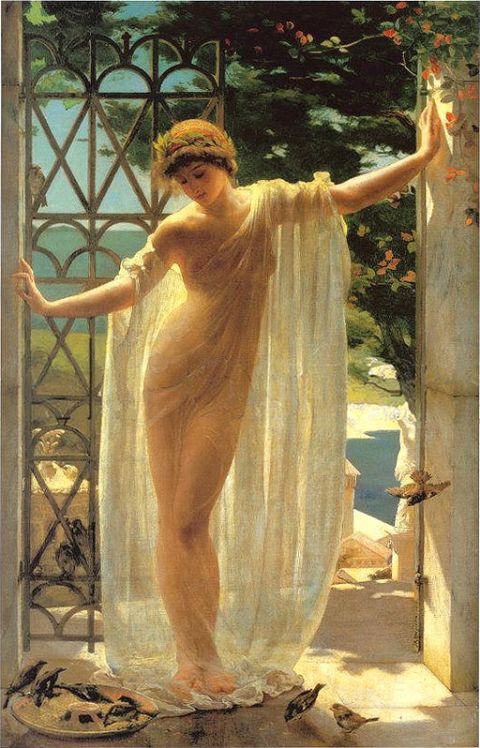
512px-john_reinhard_weguelin_lesbiaLesbia by John Reinhard Weguelin, 1878.

A dear friend who is also a classicist read my essay for the Seagull Books Catalog and pointed out that my translation of Ovid was so literal and awkward that most readers probably wouldn’t understand its meaning.  I spend my life eliciting grammatically precise, literal translations from my students so that I can assess their learning of Latin syntax.  But his message inspired me to stretch my translation skills beyond the literal and to come up with passages that readers could actually appreciate and enjoy.  Of course I also don’t want to stray so far away from the Latin that I completely abandon all rules of syntax and grammar, so it will be interesting and challenging for me to strike that balance.  I’ve decided to do a series of translations of Latin authors on my blog that will be dedicated to my friend who ever so gently gave me some suggestions for my Ovid translation.  Or, when I become frustrated with a particularly difficult Latin passage, I will blame him.

Since I am teaching a Catullus course in the spring semester, and he is my favorite Latin lyric poet, I will begin my translation series with one of his most popular poems. Gaius Valerius Catullus (c.84-54B.C.) had a passionate love affair with a woman named Clodia.  But Clodia was no ordinary woman.  Her family was of old, Patrician, noble stock and she was married to an older, prominent and powerful man, the proconsul Quintus Caecilius Metellus Celer.  As was the case with most upper class Roman marriages, Clodia’s was arranged for political and economic gains and there was no real love or affection in the marriage.  But she does find love with Catullus, who wrote several poems about her and their relationship.  I imagine him spending hours perfecting this masterpiece composed in hendecasyllabic meter and sending it off to her in secret.  And, just in case it might be intercepted by the wrong person, he disguises his love with the pseudonym “Lesbia.”

Vivamus mea Lesbia, atque amemus,
rumoresque senum severiorum
omnes unius aestimemus assis!
soles occidere et redire possunt:
nobis cum semel occidit brevis lux,
nox est perpetua una dormienda.
da mi basia mille, deinde centum,
dein mille altera, dein secunda centum,
deinde usque altera mille, deinde centum.
dein, cum milia multa fecerimus,
conturbabimus illa, ne sciamus,
aut ne quis malus inuidere possit,
cum tantum sciat esse basiorum.

Let’s live and let’s love, My Clodia,
And let’s consider worthless
The gossip of crabby old men!
Suns rise and set:
When the fleeting daylight finally sets for us,
We must spend one perpetual night together.
Give me a thousand kisses, then a hundred,
Then another thousand kisses,
Then a second hundred,
And then give me another thousand kisses
And then give me a hundred kisses.
Finally, when we have kissed many thousands of times,
Let’s mix up the number of those kisses
So that an envious man will not be able to put a curse
On us if he finds out the exact number of our kisses.

There are, of course, more salacious and explicit poems that Catullus composed about Clodia.  But I find that the subtlety and simplicity of Poem 5 makes it particularly erotic.  The standard interpretation of lines 1-6 are is the theme of carpe diem (seize the day) , with reference to our mortality but I have always viewed these lines rather differently.  The chiasmus in the first line (vivamus mea Lesbia amemus) brings to mind an image of Catullus and Clodia intertwined in bed among tangled sheets, eager for their much anticipated  sexual encounter.  He begins his poem, and his encounter with her,  slowly and languidly with the hortatory subjunctives (vivamus-“Let’s live” and amemus-“Let’s love”) and builds up to the intense immediacy of the imperative da -“give”-as he demands many kisses from her.   He is in the throws of fervent lovemaking when he uses the periphrastic (we must sleep for one perpetual night) and the anaphorae— the repetition of deinde, centum, mille—mimic the rhythm of their lovemaking.   And finally, when he has climaxed, he comes back to the more languid subjunctive forms (sciamus, possit, sciat), and suggests that the intimate details of their encounter, the exact number of their shared kisses, be mixed up so that no one will know and spoil their furtive encounters.

The hyperbole in this poem–“give me  a hundred kisses, then a thousand,” etc.–, which many have found silly, demonstrates just how much he loved her and was willing to risk to be with her.  They had to be very careful to meet secretly at the home of a trusted, mutual friend.  Catullus mentions in the first line of Poem 5 that men are gossiping about their love affair and in the last line comes back to the idea that there are those who envy the pair and wish them harm.  I imagine Catullus as a man of means, he was a wealthy Roman with high social status, who was willing to use and even risk those means to be with Clodia.  Some might accuse me of being a bad feminist, but I greatly admire Catullus, a strong man who would move heaven and earth and defy convention to spend time with the woman he loved.

I also imagine that Catullus was an infinitely patient man as weeks and even months must have gone by in between the times he was able to spend with Clodia.  When he does get to spend the night with her he doesn’t want it to end and his wish that they be suspended in one perpetual night together demonstrates how few and far between their trysts must have been. In an age of instantaneous, electronic communication and social media we seem to have lost our patience for anything and anyone who doesn’t give us immediate pleasure all the time.  I am realistic enough and old enough, some might say jaded enough, to know that an enduring love like Catullus’s is extremely rare or non-existent in an age where we so quickly swipe left, delete, unfriend, block, ignore, hide and cast aside.

Catullus’s poetry is deceptively simple and every time I translate his poems I find another layer of meaning.  Up next, I will attempt a translation of Catullus Poem 7 which is the companion piece to Poem 5 and also involves kisses.  In addition, I will explore the influence of the Greek, Alexandrian poets on Catullus’s style.   For anyone who wants to read all of Catullus’s 116 poems in translation, the Oxford World’s Classics Text by Guy Lee and the Loeb by F.W. Cornish are my favorite translations.  The Loeb translation is a bit archaic as it was published in 1913, but I find the style fitting for Catullus.

My friend who inspired these posts suggested that I translate one of  Horace’s Odes, which are nearly impossible to render into mellifluous English.  I would also like to translate some of Seneca’s Trojan Women and Ovid’s Heroides.  I would love to have more suggestions for Latin authors to translate, so please leave some requests in the comments for me!

28 Comments

Filed under Classics

The Best of Bests: Kleos In Logue’s War Music

achilles_agamemnon_pompei_mosaic_namnaples_100006Achilles and Agamemnon, Scene from Iliad Book I.  Mosaic, Pompeii

As I discussed in my first post on Christopher Logue’s War Music, it is jarring to read an interpretation of the Iliad that does not begin with the first line of Homer’s epic.  Logue instead chooses to begin his poem with a concept of kleos, an idea that is central to understanding the motives of the Bronze Age heroes who agree to follow Agamemnon across the Aegean to scale the walls of Troy.

In most English versions of the Iliad, kleos is translated as “glory” or “fame” but these definitions do not fully capture the complexity of this Ancient Greek word.  When Logue begins War Music, Achilles is having an upsetting conversation with his mother about Agamemnon’s violation of xenia and his greedy, selfish behavior which has caused fighting among the Greek warriors.  In the course of speaking to his mother, Achilles mentions to Thetis the prophecy about his fate in life: he can choose not to fight at Troy, go home and live a long life but no one will remember who he was or any deeds he accomplished.  This path will not give him any kleos.  However, if Achilles stays and fights the Trojans, he will die bravely in battle and although his life will be cut short, he will have great kleos.  When we view kleos in the context of Achilles’s conversation with his  mother, we come to understand that kleos is fame or glory that lasts well beyond a hero’s life.  Men for generations will remember Achilles and the stories of his excellence (arête) on the battlefield if that is the fate he chooses.  Kleos is derived from the Ancient Greek verb kluein, “to hear” so kleos can also be defined as what other people hear about a man, for generations after his death.

In order to better understand kleos, we have to look at the Bronze Age view of the Underworld as it is presented to us in the Odyssey.  When Odysseus recalls various shades from the after life, Achilles is one of the old friends he meets and speaks with.  Achilles tells Odysseus that he would rather be a slave or a man of humble means on earth than a king of the dead.  The Homeric view of the afterlife is a very bleak one, the heroes wander around in a type of limbo and there is no chance for reincarnation such as that presented in Vergil’s stoic version of the afterlife.

So the heroes who fight at Troy believe that they get just one life, just one chance to do something brave and heroic, something that people will remember long after a hero has died.  The opportunity for this type of fame, or kleos, presents itself in the form of valor on the battlefield.  That is why they agree to cross an ocean to help capture a city that has not done anything to personally provoke them.  Helen’s beautiful face many have launched Menelaus’s ship, but getting her back is an opportunity for the other warriors to fight on the battlefield at Troy and earn kleos.

James Redfield in his pivotal book Nature and Culture in the Iliad, argues that there is a social aspect to kleos, a man must earn his kleos from the society in which he lives.  Redfield writes:

Kleos is specially associated with the gravestone.  Society secures its memories of the dead man by creating for him a memorial to perpetuate his name, and remind men to tell his story.  He will not be utterly annihilated.  Thus the kleos of the hero is to some extent a compensation to him for his own destruction.

There is one final aspect of kleos that Achilles brings up when his shade speaks to Odysseus from the grave.  Achilles is eager to hear about the heroic exploits of his only son, Neoptolemus, and when Odysseus confirms that the young  man has proven himself to be a valiant warrior in his own right, Achilles is most pleased.  Kleos, thereforeis also carried on from father to son, it is something that is nurtured and fostered and carried on from one generation to the next.  A man’s kleos can become greater if his son carries out heroic deeds.  Part of Medea’s motivation for murdering her own children is that she will not allow Jason’s kleos to continue on through their son.  Also in the Odyssey, Telemachus eagerly awaits the homecoming of his father because it is his paternal kleos that he is eager to carry on.

Logue not only begins War Music with the theme of kleos, but he deftly weaves it throughout his interpretation of the Iliad.  Logue captures the notion of kleos on the very first page of War Music, with his fast-paced, heavy hitting poetry. Achilles says to his mother:

You had had me your child, your only child,
To save him from immortal death. In turn,
Your friend, the Lord our God, gave you His word,
Mother, His word: If I, your only child,
Chose to die young, by violence, far from home,
My standing would be first; be best;
The best of bests; here; in perpetuity

Notice that Logue uses some of his favorite poetic devices to emphasize Achilles’s kleos which will be greater than any other man’s.  Anaphora, for instance, is used to highlight the fact that Achilles is to Thetis her “only child.”  “His word” is also repeated which shows Achilles desperately clinging to the promise made by Zeus himself that he will have kleos.    Achilles’ will “be best,” “The best of bests.”  And my favorite of Logue’s literary devices, which is pervasive in War Music, is asyndeton.  Logue’s elimination of any and all connective words makes this entire speech dramatic and urgent and puts an exclamation point on the reason, the only reason, that Achilles stepped foot on the beach of Troy in the first place—to gain kleos.  And finally, attaining kleos is the one thing that keeps Achilles from carrying out his threat launched at Agamemnon to sail home and not help sack Troy.

Why don’t the Trojans just pack Helen up, open the gate and send her back to Menelaus?  Their reasons for fighting this war are not simply to let Paris keep his stolen wife or to defend their famous walls.  In Book II, Logue turns his attention to the Trojans who also desire kleos.  Hector gives a speech in which he says that he is tired of hiding behind the walls of Troy and wants nothing more than to fight the Greeks in combat:

We are your heroes.
Audacious fameseekers who relish close combat.
Mad to be first among the blades,
Now wounded 50 times, stone sane.

Hector wants kleos just as much as any Greek but he does have one additional motivation to fight Greece.  Up next, my post will be about Hector, my favorite Homeric hero, and the concept of aidos.  And in the future other aspects of War Music that I would like to explore are the role of the gods and fate and the role of women as prizes and wives.

war-music

13 Comments

Filed under British Literature, Classics

Review: A Very Russian Christmas

a-very-russian-christmasThis fascinating collection of Russian Christmas stories, many of which have been published here in English for the first time, is a glimpse into the celebration of this holiday from a simpler age which is long past.  Christmas in the twenty-first century has become the season of massive and ugly consumerism, a time when obscene amounts of money are spent on the latest and greatest toys and gadgets.  The Christmas tales in A Very Russian Christmas, penned by Tolstoy, Dostoyevsky, Teffi, Chekov, Korolenko, Zoshchenko, Lukashevich, and Gorky bring us back to the holidays of the late nineteenth and early twentieth centuries when children were thrilled to receive fruits and small trinkets that decorated the Christmas trees.   In these stories we encounter festive gatherings of different classes of people, reflections on what it meant to live a good life, and lastly, and most importantly, merry making that involves lots of vodka.  Lots and lots of vodka.  Klaudia Lukashevich describes young, Russian children who are eager with anticipation for the Christmas tree to be decorated and are so excited about celebrating Christmas with their extended family:

And now it appears—a shapely green tree, to which so many legends and recollections are tied…Hello, you sweet, beloved tree!  In the midst of winter you bring us the evergreen smell of the forests and, drenched in little lights, you delight the children’s gaze, just as according to ancient legend you brought joy to the gaze of the Holy Infant.  Our family had a custom for major holidays to make each other presents, surprises, to unexpectedly bring great happiness and joy.  Each quietly prepared his handmade gift; we memorized poems; for the New Year and for Easter we placed the handmade present under our napkins…We were engrossed in this tradition and it brought us much happiness.  The gifts were simple, inexpensive but they caused much delight.

My favorite story in the collection is, not surprisingly, from Chekhov who is the undisputed master of the short story.  In “A Woman’s Kingdom,” he gives us the character of Anna Akimovna who, despite living in a lavish mansion and being surrounded by wealth and luxury, suffers from a deep loneliness.  Anna’s parents and uncle are deceased and at the age of twenty-six she is an heiress and the reluctant owner of a large factory.  Other than an old aunt who lives in the lower part of her home, Anna has no other relatives and has not married or had any children.

When Christmas comes around Anna is surrounded by people who pay their respects to her as a member of the upper class and as a prominent owner of a successful factory.  Many people beg her for money which makes her feel uncomfortable and perplexed as to how best to help the lower classes.  Chekov vividly sets the perfect festive scene in his story as Anna dons her most beautiful dress, greets dozens of guests, and has a lavish dinner with rich food, wine and vodka.  Even though Anna is surrounded by people and engages in a variety of holiday activities that would be the envy of many, she is always the loneliest person in the room.  Throughout the course of Christmas Day as Anna is taking part in the festivities, she begins to think about one of the factory workers she has recently met and experiences feelings of hope about the prospect of getting married.

A lawyer who is an old family friend visits for Christmas dinner and Anna shares her feelings of loneliness with him.  He offers this humorous and hopeful advice to Anna:

The fin de siècle woman—I mean when she is young, and of course wealthy—must be independent, clever, elegant, intellectual, bold and a little depraved.  Depraved within limits, a little.  For excess, you know, is wearisome.  You ought not to vegetate, my dear; You ought not to live like everyone else, but to get the full savor of life, and a slight flavor of depravity is the sauce of life.  Revel among flowers of intoxicating fragrance, breathe the perfume of musk, eat hashish, and best of all, love, love, love…To begin with, in your place I would set up seven lovers—one for each day of the week…

Anna’s retort is that she is “lonely, lonely as the moon in the sky, and a waning moon too…”  The only thing in the world that will make her happy, Anna believes, is a deep and abiding love that comes with a marriage.  Chekov makes the point that all of our feelings and emotions—hope, love, kindness, compassion, loneliness— are heightened and even exasperated during the holidays.  Anna feels her loneliness more keenly as she greets her guests, but she also feels more hopeful that she will find true love.  As Christmas Day ends, however, and the clock strikes midnight, Anna loses hope for marrying a factory worker and becomes resigned to her loneliness.

I especially enjoyed the Christmas settings in these stories which described celebrations among family and friends, interesting holiday traditions, cold and snowy weather, and a spirit of hope.  New Vessel Press, one of my favorite small presses, has published their first hard cover book filled with stories from Russian masters who show us what it means to celebrate a very Russian Christmas.

I would like to wish all of my readers, followers, fellow bloggers, and bibliophiles a very Merry Christmas and a Happy New Year.


11 Comments

Filed under Classics, Literature in Translation, Novella, Russian Literature