Category Archives: Classics

Love Has Finally Arrived: My Translation of Sulpicia

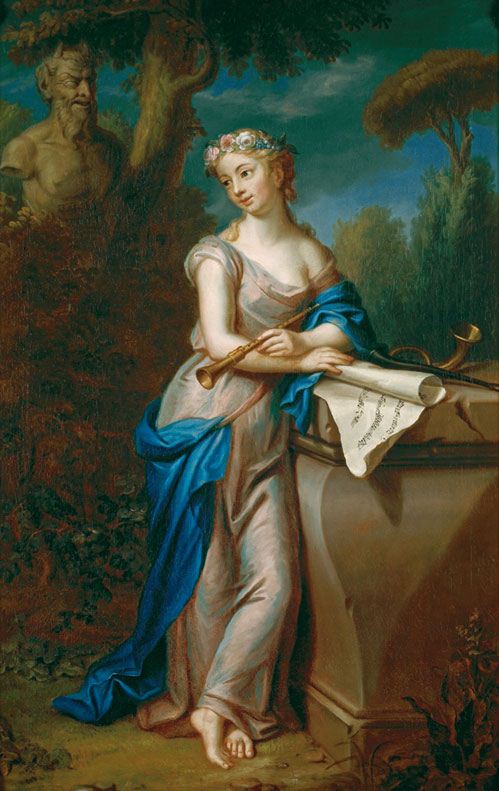
Euterpe, Muse of Music and Poetry

Since it is Women in Translation month, I thought that it would be interesting to write a little post and offer my own translation of the only female  poet from Ancient Rome whose work has survived.  Sulpicia, born during the Augustan period and a contemporary of Horace, Ovid and Vergil,  wrote six love elegies which were not published on their own, but instead appended to the volume of poetry penned by Tibullus.  Even nowadays her poems can only be found in the Loeb, for instance, as part of the Corpus Tibullianum.  For many years scholars have denied the fact that a woman could have written these poems but it is now widely accepted that it was the daughter of upper class Roman citizens, connected to Augustus’s inner circle, who composed these elegies.  Unfortunately, more recent studies have criticized Sulpicia’s poems and judged them as inferior to her contemporaries because they are missing the literary allusions that are prevalent in other elegiac poets.

After translating Sulpicia’s poems, however, it is evident that she was keenly aware of the elegiac forms of her fellow Roman poets.  Regardless of what one might think of their literary merit, Sulpicia’s six poems, addressed to her lover Cerinthus, are the only opportunity for us to sneak a glimpse into the mind and heart of a Roman female from her own perspective.

I offer my translation of Sulpicia Poem XIII in which she confirms that the rumors about her love are more than just rumors and she wishes to cast aside all veils and embrace her joys and affections:

Tandem venit amor, qualem texisse pudori
quam nudasse alicui sit mihi fama magis.
Exorata meis illum Cytherea Camenis
adtulit in nostrum deposuitque sinum.
Exsolvit promissa Venus: mea gaudia narret,
dicetur siquis non habuisse sua.
Non ego signatis quicquam mandare tabellis,
ne legat id nemo quam meus ante, velim,
sed peccasse iuvat, vultus conponere famae
taedet: cum digno digna fuisse ferar.

Love has finally arrived, and a rumor that I tried to conceal
this kind of love would bring me much more shame than
revealing it openly. I begged Venus with my poems and
she brought him right to me and placed him in my lap.
Venus has kept her promises.  If anyone is said to be lacking
in his own happiness, then let him speak about my joys.
I wouldn’t wish to entrust anything to wax tablets for fear
that someone else might read about my feelings before my
love. It pleases me to have engaged in this transgression;
I am tired of wearing a mask because of this rumor.
Let it be said that we have been together,
each of us equally worthy of the other.

I love the tone of this poem, that Sulpicia doesn’t care about rumors and she wants to free herself of societal expectations placed on her.  The digno and digna in the last line is my favorite part of the elegy—both she and her lover are “worthy of” and “fitting for” one another.

What is everyone else reading for #WITMonth?

16 Comments

Filed under Classics, Opinion Posts, Poetry

Evening Fantasy by Hölderlin (The German Library)

Volume 39 of The German Library is an anthology of poetry from 1750 to 1900 and the table of contents promises translations of poetry from Goethe, Schiller, Hölderlin, Brentano, Heine, and Nietzsche, just to name a few.  Michael Hamburger, in his Foreword to this edition, writes about the impossibility of stylistically categorizing such a vast scope of literature that encompasses “the most various and contradictory developments.”   Looking through the contents of such a book is intimidating and overwhelming, especially for someone like myself who is in no way an expert on German literature and poetry.  I decided to just dive into the poems to see which ones might capture my fancy without too much analysis and I was not disappointed with the selections.

I had originally bought the volume to get a taste of the writings of Clemens Brentano who had a close relationship with Karoline von Günderrode.  Although I enjoyed Brentano’s poetry, it was actually that of Hölderlin that I found the most pleasing.  I wouldn’t dare try to analyze this author’s poetry, even the few selections in this volume, but I will share one poem that especially resonated with me:

Evening Fantasy

Before his shaded threshold the plowman sits,
Contented; smoke ascends from the warming hearth.
A welcome rings to wanderers from
Evening bells in the peaceful village

The sailors must be coming to port now, too,
In distant cities; gaily the market’s noise
Recedes, is still; in quiet arbors
Friends take their meals in convivial splendor.

And where am I to go? Other mortals live
From pay and labor, alternate work and rest,
And all is joyful; why does only
My heart not rest, with its constant stinging?

A spring-like garden blooms in the evening sky,
The countless roses bloom, and peaceful seems
The golden world; O take me with you,
Lavender clouds, and up there then may in

The light and air my bliss and my grief dissolve!—
But as if frightened off by my foolish plea,
The spell is gone; it’s dark and lonely
Under the heavens I stand, as always.

So come to me, soft slumber; my heart has wished
Too much; but someday, youth, you will lose your glow,
You restless youth, forever dreaming.
Peaceful and cheerful are the aged.

(trans. Kenneth Negus)


6 Comments

Filed under Classics, German Literature, Poetry

The Bookshop and The Beach: My Vacation to Maine

Harding Books on Route 1 in Wells, Maine

My family and I went on our annual summer vacation this year to Kennebunk Beach in Maine. This has been our favored destination for the past few years and I thought I would say a few words about my favorite bookshop in Maine and my recent finds there. Harding’s Rare and Used Books is located one town adjacent to Kennebunk, in Wells, Maine on Route 1.  The staff is kind, friendly and very knowledgeable.  I was told by the employees that they buy books every day and their owner, a very nice gentleman named Douglas, also buys books from auctions and dealers.

One realizes this is a serious bookshop when, upon opening the front door, one encounters two gigantic piles of their newest acquisitions.  It took me a while to sift through these piles, but my patience was greatly rewarded by finding a first edition of I, Claudius by Robert Graves. I also dug out a copy of Susan Sontag’s Illness as Metaphor and William H. Gass’s Reading Rilke from these piles.


The rest of the store is like a maze with rooms of various shapes and sizes piled with books from floor to ceiling.  Harding’s has a wide variety of first editions as well as signed books and they also have  the largest selection of books about New England that I have ever encountered.  I found a first edition copy of Within the Harbor by Sara Ware Bassett, a New England author whose books are set in two Cape Cod villages that she created.  This is an interesting little find that makes visiting this store so much fun.

A view of part of the hard copy fiction books at Harding’s


I spent most of my time in the Latin and Ancient Greek, Poetry and Classic Fiction sections.  Among the classic fiction books, I found two titles to add to my ever growing collection of New York Review of Books classics and I also found five Virago Modern Classics to add to my shelves.

My haul from Harding’s

The Latin and Ancient Greek section had a nice selection of Loebs as well as ancient authors in translation.  My favorite find was a dual language edition of Oedipus by Sophocles with an introduction by Thornton Wilder.  The illustrations in this edition are also quite interesting.

I also found in the Ancient Civilization section a copy of Michael Grant’s book on Nero which is in mint condition; not only is it an excellent introduction to this enigmatic and misunderstood emperor (and my favorite), but it also contains some gorgeous color plates to go along with the text.

Among the poetry books I found a hard copy edition of the Collected Poems of W.H. Auden that was only $5.00.  I have to say that all of the books at Harding’s are very reasonably priced, including the first editions and signed books.

But I didn’t spend all of my time in the bookshop.  I also enjoyed the beach very much, worked on my tan and did a little swimming even though the water was quite chilly.  My daughter did some surfing (I only watched and took some pictures.)  My beach reads were Henry Green’s Party Going and Clarice Lispector’s Agua Viva—more thoughts on those to come.

Surfing at Kennebunk Beach

Finally, we had some truly fabulous meals in Kennebunk and Kennebunkport.  One of our favorites is David’s KPT in Dock Square whose selection of raw oysters is spectacular and decadent.  It is no surprise that the seafood dishes, in particular, are wonderful no matter the restaurant.  I will spare everyone pictures of my food as well as a picture of myself wearing one of those goofy lobster bibs.  The picture below is a view we had during Sunday Brunch.

Where have you spent your holidays this summer?  Have you found any interesting books or bookshops?

15 Comments

Filed under British Literature, Classics, History, New York Review of Books, Nonfiction, Opinion Posts, Poetry, Travel Writing

Love is War: Penthesilea by Heinrich von Kleist

As I was reading Klest’s tragic play, I kept thinking about Ovid’s imagery in Amores IX in which poem he portrays love as warfare.  The Latin poet writes:

Militat omnis amans, et habet sua castra Cupido;
Attice, crede mihi, militat onmis amans.

Every lover is a soldier, and Cupid has his own camp;
Atticus, believe me, every lover is a soldier.

Ovid proceeds, in the rest of his poem, to lay out the similarities between soldiers and lovers: both must keep up a constant vigil, pass through companies of guards and be willing to fight against challenging obstacles.  Kleist weaves this theme of soldier-as-lover throughout his tragedy, but what is unique to the German writer’s use of this motif is that he applies it to both male and female.

Odysseus and other Greek warriors are the first to appear on stage in the drama.  They describe Penthesilea, this strange Amazon warrior, as a crazed woman who can’t settle on an alliance; she fights both Greeks and Trojans alike.  As the Greeks approach her to make an attempt at an alliance with her Amazon forces, she sees Achilles and can’t take her eyes off of him.  From that moment forward, her greatest desire is to take him as her captive.  But, as the customs of her all-female society are gradually revealed in the play, we understand that her motives for overtaking the Greek hero in battle are unusual—warfare for her is a means to achieving love.

Kleist, in an attempt to build classic dramatic suspense, doesn’t give his main characters any dialogue until the fourth scene of the play during which Achilles finally makes an appearance.  We have been told by the other characters that Achilles has narrowly escaped being overcome by Penthesilea and he is very angry that a woman almost got the better of him.  At this point he has no romantic feelings for this woman, but her attack causes him to go into a rage and he refuses to go back to the Greek camp until he engages her in battle.  Kleist’s speech is a brilliant and emotional inversion of Ovid’s image of lover acting as soldier.  In Achilles speech it is the soldier whose actions resemble that of a lover:

A man I feel myself and to these women,
Though alone of all the host, I’ll stand my ground.
Whether you all here, under cooling pines
Range round them from afar,
Full of impotent lust,
Shunning the bed of battle in which they sport
All’s one to me; by heav’n you have my blessing,
If you would creep away to Troy again.
What that divine maid wants of me, I know it;
Love’s messengers she sends , wings tipp’d with steel,
That bear me all her wishes through the air
And whisper in my ear with death’s soft voice.
I never yet was coy with any girl.

Warfare is described with terms normally associated with love—the bed of battle, for instance—which not only lends emotion to Achilles’s speech, but also foreshadows what will develop between him and Penthesilea.  Later, when he meets her in battle he can’t believe that a woman who can fight with such ferocity and skill exists; it is her prowess as a warrior that causes him to fall in love immediately.  When he wounds Penthesilea in their skirmish, he puts aside his weapons and professes his feelings for her.   He sees in this fierce woman, a soul that is equally as intense and misunderstood as himself.  One of the most shocking declarations Achilles makes in the entire play is to Penthesilea: “Say to her that I love her.” Kleist’s Achilles is just as passionate and emotional as that of Homer’s; what is shocking about this version of Achilles is his declaration of the emotion of love, and for a woman who is not his captive or his prize.

The image of lover-as-soldier and soldier-as-lover also pervade Penthesilea’s speeches and actions.   The very reason she is on the battlefield in the first place is to find a man as a partner.  She explains the savage founding of her female city where men are not allowed to live or fight.  A warlike tribe of Scythians invaded their city, Penthesilea explains, killing all of the men and taking the women as their captives.  After suffering horrible abuse, the women fought off their subjugators and banned all men from the city as the women themselves became fierce warriors.  The Amazons continue the lineage of their city by conquering men in battle, bringing them back to the Temple of Diana  where they mate with the fertile Amazons in what is called the “Feast of the Flowering Virgin.”
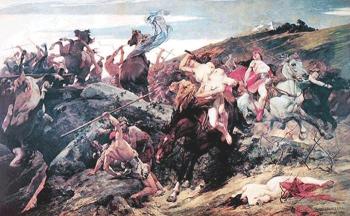
Penthesilea by Arturo Michelena, 1891.


The war at Troy with the Greeks was the Amazon’s perfect opportunity for subduing soldiers for the annual mating ritual.  Penthesilea doesn’t expect, however, to find such a spectacular hero and mate as Achilles and she is overcome with passion for him to the point of madness.  In an even stranger inversion of Ovid’s poem, the female becomes the soldier of love:

Do I not feel—ah! too accursed I—
While all around the Argive army flees,
When I look on this man, on him alone,
That I am smitten, lamed in my inmost being,
Conquered and overcome—I Only I!
Where can this passion which thus tramples me,
harbor in me, who have no breast for love?
Into the battle will I fling myself;
There with his haughty smile he waits me, there
I’ll see him at my feet or no more live!

Once Achilles and Penthesilea finally meet they confess their deeply intense love for one another.  But an issue as to where they would reside—among the Amazons or back in Greece—causes a misunderstanding that leads to tragedy.  Kleist’s ending for both of these characters varies greatly from that of Homer and the Greek tradition in epic.  I usually find it hard to read sources that alter the Greek tradition, but Kleist’s play preserves the spirit of these fierce warriors and lovers, so I was able to get beyond his changes to their story.  I will end with a line from Ovid’s Amores that sums up what happens to both of these soldiers/lovers:

quosque neges umquam posse iacere, cadunt

Those whom you would never have thought possible to be brought down, they fall.

As a side note, I read the translation by Humphrey Trevelyan that is included in the German Library’s edition of  Kleist’s plays.  I found the archaic language and verse distracting at times.  I just ordered the translation by Joel Agee and published by Harper which is a prose translation with illustrations.  I am very interested in comparing the translations.  Has anyone else read either of these?

15 Comments

Filed under Classics, German Literature

Bitter Healing: Poetry and Letters by Karoline von Günderrode

Karoline von Günderrode was born in 1780 to am impoverished, aristocratic, German family.  At the age of nineteen she went to live in a convent of sorts, the Cronstetten-Hynspergische Evangelical Sisterhood in Frankfur am Main,  which housed poor young woman and widows from upper class families who were waiting for the right man to marry.  While at the convent she was determined to educate herself and began writing poetry, drama and letters.  She spent time with many of the important intellectuals of her day including Clemens Brentano, Goethe, Karl von Savigny, Bettina von Arnim and Friedrich Creuzer  who read her works and gave her feedback.  Christoph von Nees published two volumes of her writings under the pseudonym “Tian” in 1804 and 1805.  In a letter included in the anthology Bitter Healing: German Women Writers 1700-1830, Günderrode responds to Clemens Brentano who has accused her of sounding rather masculine and “too learned” in her poetry:

How I got the idea to have my poems printed, you want to know?  I have always had a secret inclination to do so—why? and what for? I rarely ask myself.  I was very happy when someone was willing to represent me at the publishers.  Easily, an not knowing what I did, I have destroyed that barrier that separated my innermost heart from the world; and I have not regretted it as yet, for always new and alive is my desire to express my life in a permanent form, in a shape worthy of joining the  most excellent minds, greeting them and sharing their society.  Yes, I have always been drawn to that community; it is the church toward which my spirit is continuously making its earthly pilgrimage.

Her intellectual interests, influenced by German Romanticism, are evident in the poetry also translated for this collection.  Themes of nature, love, free will, metaphysics, death and gender roles pervade her verse.  The poem “Once a Dulcet Lie was Mine” begins:

Once a dulcet life was mine,
For I seemed all of a sudden
But a fragrant wisp of cloud;
Nothing to be seen above me
But a deep-blue ocean sea,
And I sailed now here, now younder
Lightly cradled by the waves.

And in “The Prime Lament” she ends with:

Who with all her heart and nature
Came to love a human creature
Ah! is not consoled
By the thought that joys departed
Usher in some newly started—
They can’t match the old.

That sweet state of living, learning
Both accepting and returning
Words and looks and airs,
Eager search and joyous ending,
Sentiment and apprehending,
Not a god repairs.

I found these lines beautiful and haunting in light of her romantic concerns and her death. Most biographies, films and works focus on her affairs with Clemens Brentano, Karl von Savigny and Friedrich Creuzer. Brentano and Savigny loved her and appreciated her intellectual talents but passed Gunderrode over to marry other women. Creuzer was unhappily married to a woman thirteen years his senior, but decided that he could not endure the scandal that would be involved if he left his wife for Günderrode. In 1806 Creuzer broke off their affair in a letter and Günderrode committed suicide by plunging a dagger into her heart which she had reportedly carried with her for many years. Her story sounds like something out of a Greek tragedy and it is not surprising that interest in her has largely been focused on her love affairs and her sad end.  Bettina von Arnim writes about her dear friend’s suicide, the full report of which is also included in the Bitter Healing anthology:

…It is quite impossible for me to write of Gunderrode on the Rhine: it is not that I am so sensitive, but I am on the spot not far enough removed from the occurrence for me perfectly to review it.  Yesterday I went down yonder where she had lain; the willows are so grown that the spot is quite covered; and when I thought how she had run here, full of despair, and so quickly plunged the violent knife into her breast, and how long this idea had burned in her mind, and I , so near a friend, now wandered in the same place, along the same shore, in sweet meditation on my happiness…

The translations included in Bitter Healing are the last few scraps of her work that I could find in English.  There are additional letters and a translation of an “Apocalyptical Fragment” in this anthology and I am hoping that more of her work will continue to be translated into English.


2 Comments

Filed under Classics, German Literature