Category Archives: British Literature

Corpus Erat: The Metamorphosis of Marcus in Brigid Brophy’s Flesh

This was my first experience with a Brophy text and I was pleasantly surprised by her writing even with a rather short novella. I viewed the book as a metamorphosis, much like those described in Ovid’s epic poem, in both a physical and emotional sense. At the beginning of the story Marcus is a timid, skinny, introvert who lingers at the edge of the parties that he forces himself to attend. He is the only boy of a wealthy Jewish family living in London and, as a result of his upbringing, he leads a rather pampered life. He has his own flat in London, for instance, but most nights he goes home for dinner and sleeps at his parent’s home. Since he has no need of a real occupation or a source of income, he spends his time reading and studying art. Being an introvert myself, Brophy’s description of Marcus’s awkwardness at a party made me cringe:

He had got himself hemmed in by other people’s backs and jammed in a corner between a bookcase and a table of food, on either of which was there room for him to set down his glass, which had been empty for half an hour. He picked out one of the books, opening up a black gap on the shelf, and mimed reading. But this solitary pleasure at a party seemed to him as much a solecism and a confession as if he had stood there wiggling a loose tooth in his mouth; and the feeling of being exposed overwhelmed any pleasure the book might have given him.

Marcus meets his future wife, Nancy, at this same party and this interesting woman is immediately drawn to Marcus because of the potential she sees in him. A potential for what, we have no idea at first. But when a very nervous and virginal Marcus is initiated into the pleasure of the flesh during his honeymoon, we are made to understand that she saw in Marcus a man that she could teach to please her in just the ways she needed: “Nancy did have a talent. It was for sexual intercourse.”

What I found most surprising in this small book is that, although much of the narrative is funny and quirky, Brophy also inserts passages with sublime, poetic descriptions of physical intimacy. After Marcus and Nancy consummate their marriage, she writes:

Where she led him was a strange world that was not new to him, since he had always known it existed, subterraneanly: a grotto, with whose confines and geographical dispositions he at once made himself quite familiar, as with the world of inside his own mouth: but a magic grotto, limitless, infinitely receding and enticing, because every sensation he experience there carried on its back an endless multiplication of overtones, with the result that the sensation, though more than complete, was never finished, and every experience conducted him to the next; a world where he pleasurable lost himself in a confusion of the senses not in the least malapropos but as appropriate and precise as poetry—a world where one really did see sounds and hear scents, where doves might well have roared and given suck, where perfectly defined, delightful local tactile sensations dissolved into apperceptions of light or darkness. of colour, of thickness, of temperature…

This marks the turning point in Marcus’s transformation to a more self-confident man. He finds a job that he is good at and really likes, he starts to gain quite a bit of weight, and he continues to delight in the physical aspect of his marriage to Nancy. As Brophy lingered on Marcus’s physical transformation in the second half of the novella, I kept thinking of a line in Ovid’s Metamorphoses when Pygmalion discovers that he statue has come to life: “Corpus erat! “ (It was a body!), he exclaims.

I have one other Brophy, The King of a Rainy Country, sitting on my bookshelf that I am now eager to read. I am about to visit some amazing bookstores on my summer travels, so please let me know in the comments of other Brophy titles I should be on the lookout for.

9 Comments

Filed under British Literature, Classics

Kudos by Rachel Cusk

The English word Kudos comes from the ancient Greek noun κῦδος which is actually a singular, nominative, neuter form, and means renown, praise or glory.  In Ancient Greek literature it is oftentimes used in relation to warfare and appears several times in Homer’s Iliad.  For the Homeric hero kudos is triumphant power or success on the battlefield which results in pretige, recognition and high rank.  Like these warriors on the battlefield, the characters in Cusk’s final installment of her trilogy,  are competing with each other for personal recognition.  Set at a literary festival and a literary conference in unnamed countries in Europe, most of the book contains stories from the lives of fellow authors and translators that Faye meets; in Kudos, Faye herself fades even further into the background of the narrative and we get fewer details about her own life than we did in Transit or Outline

When Faye first arrives at the literary festival she meets with her publisher and he gives her a glimpse into what the book industry believes is the best way for authors and everyone involved with them to gain kudos.  The “holy grail” for a publisher, he tells Faye,  “were those writers who performed well in the market while maintaining a connection to the values of literature.”  He goes on to explain his views of modern literature in such a harsh marketing climate:

Sometimes, he said, he amused himself by trawling some of the lower depths of the internet, where readers gave their opinions of their literary purchases, much as they might rate the performance of a detergent.  What he had learned, by studying these opinions, was that respect for literature was very much skin deep, and that people were never far from the capacity to abuse it.  It was entertaining, in a way, to see Dante awarded a single star out of possible five and his Divine Comedy described as ‘complete shit’, but a sensitive person might equally find it distressing, until you remembered that Dante—along with most great writers—carved his vision out of the deepest understanding of human nature and could look after himself. It was a position of weakness, he believed, to see literature as something fragile that needed defending, as so many of his colleagues and contemporaries did.

Several writers that she meets complain of their work not being properly recognized and their vying for attention among readers, reporters and other authors at these festivals gives the book a rather melancholy tone.  Written in the same style as her previous two novels—it’s been described as postmodern, indirect speech, autofiction, oral history—we occupy Faye’s world as a writer by seeing it from the perspective of those around her.  The common thread that runs through many of her colleagues’ stories is that, in this literary atmosphere of consumerism where money is the almighty ruler, there is very little kudos to go around for any of them.  A female translator and author complains that her books are a lot less well-known that those of the male authors’ works she has translated; a male author laments the fact that he is only popular and on the bestseller list now because he is writing with a partner and under a pseudonym; a harsh book critic argues that his volumes of poetry are not as widely recognized for their literary merit as they should be as a sort of pay back for all of the bad reviews he has written.

A teenager whose task it is to get writers from one venue to the next speaks about kudos, thus making it the only book of the trilogy that specifically mentions its title in the text.  Hermann had won this college’s highest award, named “Kudos”, which was given to both the top male and female students.   The boy doesn’t understand why gender needs to be a factor in an award and tells Faye his mother’s opinion about the “Kudos”:

His mother, for instance, believed that male and female were distinct but equal identities, and that having two awards was as far as it was wise to go in honouring human achievement.  But many other people felt that there should be only one award, given to the best student.  The caveat of gender, these people believed, obscured the triumph of excellence.  His mother’s response to that was interesting: if there was no caveat, she had said, then there was no way of ensuring that excellence would remain in a moral framework and not be put in the service of evil.

Just as in her previous two books, Cusk continues to examine gender roles, especially in terms of marriage and family life, throughout Kudos.  No one she meets is in a happy, stable marriage; many, if not most, are divorced and have an inimical relationship with an ex-partner that puts the children in the middle of the animosity.  Towards the end of the book, Faye is having lunch with two women, Felicia and Paola, who are in charge of her during the literary conference and she observes that the three women are sitting at a table in the restaurant under a reproduction of Artemisia Gentileschi’s Salome with the Head of Saint John the Baptist.  Felicia tells a heartrending story of how her ex-husband, through his spiteful and cruel behavior, has made her and her young daughter’s life difficult after the divorce.  Her concluding words about his treatment of them I found very chilling: “I had not, moreover, found freedom by leaving him: in fact what I had done was forfeit all my rights, which he had only extended to me in the first place, and made myself his slave.”

Salome with the Head of Saint John the Baptist. Artemisia Gentileschi. Oil on Canvas. с 1610-1615

Paola’s retort about her own ex’s abuse is equally as disturbing and also serves as a bit of a rebuke to Faye who has recently gotten remarried: “‘It used to hurt so much when he pulled my hair,’ she said, ‘so it is good to talk about these things when your head is whirling with wine instead, and with the picture of the man’s severed head on a plate before my eyes.  What I don’t understand,’ she said to me, ‘is why you have married again, when you know what you know. You have put it in writing,’ she said, ‘and that brings with it all the laws.'”

The story that stands out in my mind the most as far as gender roles, family and marriage, the one I have read several times and keep pondering over, is that told by the gentleman whom Faye sits next to on the plane on her way to the literary festival.  It is interesting to get a male perspective of family life and I found his story just as sad as the others.  This well-dressed,  middle-aged man had been the director of a global management company, he tells Faye, and he was constantly traveling and away from his family.  Now at the age of forty-six he was retired but being with his family more often had not brought him the happiness and tranquility he had expected.  His family had gotten used to him being away so much, and his constant presence in their lives now felt intrusive.  He says to Faye, “‘Since I left work I find that I’m constantly getting into arguments with people.  My family complain that now I’m at home all the time, I’m trying to control them.  They haven’t actually said,’ he added, ‘that they wish we could go back to how things were.  But I know they’re thinking it.'”  Both males and females in Cusk’s final book of her trilogy struggle to find their place in a family, in a job, in society.  It is rather fitting that the text ends with a rather gross and sinister action that is also focused on gender.

14 Comments

Filed under British Literature

I Hold You in Imagination: The Poetry of Elizabeth Jennings

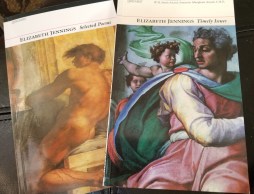
I finally received in the mail today a volume of poetry by Elizabeth Jennings (1926-2001) that I have been eagerly awaiting for weeks. The edition, entitled “Timely Issues” is published by Carcanet Press, which has also printed the other volume I own, her “Selected Poems.” Jennings was very successful with her poetry in her earlier years, publishing her work in various literary magazines and winning awards and prizes. But as her life progressed, she was mentally and physically fragile and suffered from breakdowns which caused her to be hospitalized. Her illnesses, her deep Catholic roots, and the difficult love affairs in which she engaged pervade her poems. I find her poetry simple, yet profound, quite lovely, and even soothing. I include here in my post three of my favorites from the Carcanet collections; they need no commentary or analysis as I think that would ruin my post—they stand better simply, on their own.

About These Things

About these things I always shall be dumb.
Some wear their silences as more than dress,
As more than skin deep. I bear mine like some

Scar that is hidden out of shamefulness.
I speak from depths I do not understand
Yet cannot find the words for this distress.

So much of power is put into my hand
When words come easily. I sense the way
People are charmed and pause; I seem to mend

Some hurt. Some healing seems to make them stay.
And yet within the power that I use
My wordless fears remain. Perhaps I say

In lucid Verse the terrors that confuse
In Conversation. Maybe I am dumb
Because if fears were spoken I would lose

The lovely languages I do not choose
More than the darkness from which they come.

Remembering Fireworks

Always as if for the first time we watch
The fireworks as if no one had ever
Done this before, made shapes, signs,
Cut diamonds in air, sent up stars
Nameless, imperious. And in the falling
Of fire, the spent rocket, there is a kind
Of nostalgia as normally only attaches
To things long known and lost. Such an absence,
Such emptiness of sky the fireworks leave
After their festival. We, fumbling
For words of love, remember the rockets,
The spinning wheels, the sudden diamonds,
And say with delight, ‘yes, like that, like that.’
Oh and the air is full of falling
Stars surrendered. We search for a sign.

Assurance

My love, I hold you in imagination,
Either mine or yours,
And it is stronger than remembered passion.
It uses memory with all its force.

O the clocks go silent, time departs,
Now is forever here.
How delicate yet strong are our two hearts,
Mine beats for you now almost everywhere.

Only when my world is rent with storm,
Threatened by sadness or
Overcome by black words which can come
And threaten me with the inner, hideous war

Only then, I’ve lost you. O but fast
A little flash of sun,
A hurrying memory returns you blessed
And our great love is stalwartly at one.

In a wonderfully written and compelling article entitled “Clarify Me, Please, God of the Galaxies” Dana Gioia concludes about Jennings’s poetry, ” Her poems flash like meteors illuminating what it means to be human.”

What poetry is everyone else reading lately? I would love to have some new recommendations in the comments.

8 Comments

Filed under British Literature, Classics, Poetry

Some Thoughts on The Warden by Anthony Trollope

I was emailing a friend who has read quite a bit of Trollope and he remarked that this author’s novels are rather entertaining but when one closes the last page of some of his tales, they are soon forgotten.  After reading his messages about Trollope, and also seeing a thread on literary Twitter about The Warden,  I was very eager to give Trollope a try for myself.  I have rather mixed feelings about this first novel; some parts of it were amusing but overall I was a bit underwhelmed with my first experience in Barsetshire.

No one in Trollope’s narrative, which story involves an attempt at economic reformation of the Church,  is spared his sarcasm and ridicule.  The Warden, a kind, old man who lives with his daughter Elenor, has served his position as leader of Barchester hospital that cares for poor, elderly, retired, working class men who would otherwise be homeless.  It was established in the benefactor’s will in the 15th century that, in exchange for his minimal work, the Warden receives a yearly salary of 800 pounds and the use of a comfortable, some might even say lavish, home.  Reformers, led by a local doctor named John Bold, believe that the old bedesmen living at the hospital ought to receive a larger share of the income from the hospital’s estate.  When lawyers, other reformers, and the newspaper weigh in on the matter, the Warden is, rather unfairly,  made out to be a prime example of the greed of the clergy who take money from the poor in order to live in the lap of luxury.

The archdeacon, also the son-in-law of the Warden, is satirized by Trollope as a prime example of the Church clerics who will defend this institution at any cost:

Though doubt and hesitation disturbed the rest of our poor warden, no such weakness perplexed the nobler breast of his son-in-law.  As the indomitable cock preparing for the combat sharpens his spurs, shakes his feathers, and erects his comb, so did the archdeacon arrange his weapons for the coming war, without misgiving and without fear.  That he was fully confident of the justice of his cause let no one doubt.  Many a man can fight his battle with good courage, but with a doubting conscience; such as not the case with Dr. Grantly.  He did not believe in the Gospel with more assurance than he did in the sacred justice of all ecclesiastical revenues.

The reformers are equally a target of ridicule in Trollope’s tale.  John Bold, who had good intentions when he stirred up the whole controversy and genuinely wanted to help out the poor, old bedesmen, is easily swayed to put the matter aside because of love.  Bold is courting the Warden’s daughter, Eleanor, and when Eleanor pleads with her lover to put aside the case against the hospital and her father, he is very quick to oblige:

‘I would give her my soul, if it would serve her,’ said Bold still addressing his sister; ‘everything I have is hers, if she will accept it; my house, my heart, my all; every hope of my breast is centred in her: her smiles are sweeter to me than the sun, and when I see her in sorrow as she now is, every nerve in my body suffers.  No man can love better than I love her.’

Even though Trollope makes Bold seem a bit of a fool by giving up his attempt at reform for a woman, I was glad that Bold made this decision.  The sappy, romantic in me was glad Bold chose love over a law suit.

Trollope goes on and on poking fun at various parties involved in the attempt to redistribute the Warden’s salary among the bedesmen.  But the book ends on a rather sad note when it is the Warden and the old men at the hospital who suffer the most from the fight between the clergy and the reformers.  Although they are themselves not entirely blameless in the matter, it is their lives that are most negatively affected by the arguments of more important and influential men.

Despite my mixed feelings, I will continue with the Barsetshire Chronicles.  My friend, who I mentioned above, did remark that Barchester Towers, the next book in the series, is definitely worth a “quick spin through the eyeballs.”

27 Comments

Filed under British Literature, Classics

Poised Above Pleasure or Pain: Some final thoughts on The Mill on the Floss

George Eliot’s novels usually affect me very deeply and The Mill on the Floss has been no exception. When I am in the midst of one of her books, I find myself steeling every free moment I can to read it and continually thinking about the characters and plots she so masterfully creates. The plight of Maggie Tulliver, as I mentioned in a previous post, has particularly captured my attention. Maggie is not like the other English women in St. Ogg’s; she is darker skinned, with dark eyes and dark, wild hair to match. Her personality is also quite different than other women as she experiences life with more passion and intensity than is appropriate for a proper, English young lady. She craves love, kindness and affection from her taciturn and stubborn family, especially her brother and her father.

When Maggie does finally experience an intense love that matches her own passion, it is for a self-confidant man from St. Ogg’s named Stephen Guest. But when they meet both she and the object of her love are tied to other people; Stephen is engaged to Maggie’s dear cousin, Lucy, and Maggie is bound to an old, childhood romance with Philip Wakem. The sexual tension and passion that Eliot builds into Maggie and Stephen’s encounters are the stuff of literary brilliance. The two are frequently thrown into social situations in which they take pleasure in one another’s company but try to resist the temptation of this passion. In the scene before their mutual feelings are revealed, Eliot writes about Maggie: “Even the coming pain could not seem bitter—she was ready to welcome it as a part of life, for life at this moment seemed a keen vibrating consciousness poised above pleasure or pain.”

In the culminating emotional scene between them, Stephen is trying to convince himself and Maggie that they should be together even though neither of them wants to cause what will be an inevitable pain to others in their lives. Stephen’s strongest argument, I think, is when he reminds Maggie that they will end up marrying their respective fiances under false pretenses and insincere feelings: “It is unnatural: we can only pretend to give ourselves to any one else. This is wrong in that too—there may be misery in it for them as well as for us. Maggie, you must see that—you do see that.” Maggie’s response will stand out in my mind as one of those great passages found in timeless literature:

O it is difficult—life is very difficult! It seems right to me sometimes that we should follow our strongest feeling;—but then, such feelings continually come across the ties that all our former life has made for us—the ties that have made others dependent on us—and could cut them in two. If love were quite easy and simple, as it might have been in paradise, and we could always see that one being first towards whom…I mean, if life did not make duties for us before love comes, love would be a sign that two people ought to belong to each other. But I see—I feel it is not so now: there are things we must renounce in life; some of us must resign love.”

It is so utterly tragic that when she finally feels the love she craves that Maggie must give it up. I keep thinking about that now clichéd Tennyson quote as I reread this paragraph: “Tis better to have loved and lost than never to have loved at all.” Would Maggie really agree with this? Or would she rather have spared herself the pain that comes along with such a love?

5 Comments

Filed under British Literature, Classics