Category Archives: British Literature

Beauty and Love: My Bookstore Adventure in Maine

maine-books-2
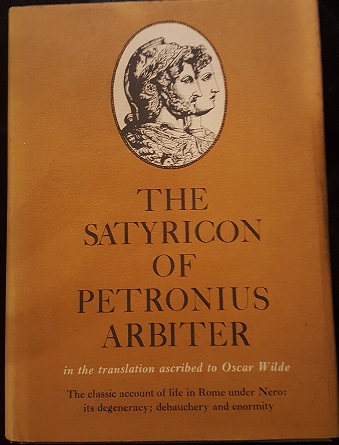
I had the chance to spend some time vacationing in Maine over the Thanksgiving Holiday.  Like any truly dedicated bibliophile, I seek out used bookstores wherever I go and Maine has some great selections.  I browed a rather large one in Wells which not only has rooms and rooms full of books but also has a rather large selection of maps.  I came home with an interesting mix of books, the first of which is a copy of Petronius’s  Satyricon.  Now why would a classicist need another translation of Petronius’s bawdy novel, you might ask.  This copy that I found was published in 1931 and is the translation attributed to Oscar Wilde.  It is attributed to Wilde but no one is quite sure if he actually did the translation himself or if he translated it from the original Latin text.  There are large parts of the translation that were borrowed from three previous translations.  In addition, the original copies of the book were published without naming the translator on the title page but instead the publisher sent out each copy with a slip indicating that the translator was Sebastian Melmoth, Wilde’s pseudonym.  For more information on this interesting literary hoax, here is a link to an excerpt of an article that was written about this translation: https://muse.jhu.edu/article/373513/pdf
wilde-satyricon

The next book I found as I wandered the many rooms of this bookstore was a copy of Thackeray’s Ballads published in 1856.  He is, of course, most famous for his longer work Vanity Fair and it was nice to discover that he had written this short volume of Ballads.  It’s interesting that this author who was known for his satirical works also wrote love poems and some short narrative poems.  The particular bookshop seems to have many editions of very old books.  This particular book of Thackeray’s Ballads is not valuable and I only paid $7.50 for it, but it is now one of the oldest books I have on my shelves.

ballads-2

ballad-inscription

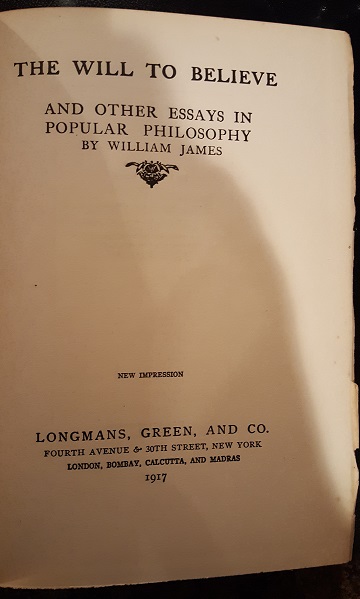
Next, I was specifically looking for a copy of anything I could find by William James, the American pragmatist philosopher.  I recently read American Philosophy by John Kaag and his discovery of a long-forgotten library with over 10,000 books, some of which beloved to James, renewed my interest in American philosophy.  I was surprised when the bookstore clerk said that books by American philosophers are very popular and I was lucky to find this copy of James’s essays published by Longmans, Green, and Co. in 1917.  This collection of essays includes some of his most famous such as “Is Life Worth Living” which was delivered at Harvard’s Holden Chapel in 1985.
james-book

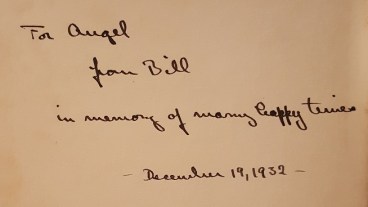
The final book that I found is my favorite of the collection.  At the entrance to the bookshop there is a huge table with stacks of books on the table and around the table that are the shop’s most recent arrivals that haven’t been categorized yet.  I walked up to these piles, which are rather daunting, and plucked a slim volume of poetry off the top.  The author of the book is William Dwight Crane and I noticed that there is a handwritten inscription inside the book that reads, “For Angel, From Bill in memory of many happy times.  December 19, 1932.”  The book is also signed by the author.  I researched the author’s name on the Internet and could find no biographical information on him or titles of other books that he wrote.  This lonely, slim volume might have been sitting on a pile in that bookshop all but forgotten for years.  I am happy to give it a new home with my other books will it will be used and read from time to time.

crane-1

crane-2

crane-3

The poems are a bit simple, but they are clearly from the heart and there is something about their simplicity that captivated me.  I will share one such poem entitled “Beauty and Love” from the collection:

Beauty is the soul of man’s desire
A blessed synthesis of pity, joy, and pain
Burned from out the centre of that fire
Of Passion which else were but a stain
Upon our shields, a funeral pyre
On which in each succeeding age have lain
The ashes of the deeds to which men’s hearts aspire,
Only to rise on phoenix-wings to urge men on again,
Beauty of form, and subtle harmony of line,
Beauty of thought and faery fantasy,
Beauty of deed, which makes the thought divine
Compose this substance born of ecstasy,
We need but fashion it with gentile hands,
And, lo! the image Love before us stands.

My daughter, who also inherited the reading gene, found some books to add to her own growing collection, including one about the ocean.  True bibliophiles know that used bookstores can be such great places of adventure and discovery.  What are your favorite bookshop finds?

14 Comments

Filed under British Literature, Classics, Opinion Posts, Poetry

Review: Country Life by Ken Edwards

My Review:
countrylifeOne of my favorite things about reading books from small presses are the literary gems that I discover from their quiet and brave authors.  Country Life, the latest novel from Ken Edwards, is one such piece of fiction released by Unthank Books.  It is not surprising that Edwards is also a poet,  has published several volumes of poetry and is also a musician.  The text of Country Life oftentimes reads more like a poem or a song than the prose of fiction.  This is very fitting for Edwards’s main characters who are musicians that like to do interesting experiments with their craft.

The main protagonist of Country Life is twenty-one-year old Dennis Chaikowsky, an unemployed musician who is house-sitting for his vacationing parents.  Dennis lives out in the country, on the coast of a peninsula, in a quiet neighborhood that is overshadowed by a nuclear power station.  The peaceful sounds of the sea and wildlife are disturbed by the lights and noises of the power station.  Dennis is recording all of the sounds of the peninsula and mixing them with his computer to compose what he calls “World Music” in 25 parts.  The landscape and the sounds emanating from it become an integral part of Edward’s deeply poetic text:

The town lay silent and all the little birds.  And from it, we may follow the railway line, venturing over rust and rubble.  And the light from the coast.  Information sent along the pathway to the superior colliculus, responsible for controlling and initiating eye movements, producing visual awareness.  Travail and trouble.  The lorries on the road.  We may suppose you call it territorial behavior.  With auditions, something seemingly miraculous occurs.  The sense of mystery, of a real danger to be faced, of an overwhelming spiritual gain to be won, were of the essential nature of the tale.

Dennis’s closest friend is a neo-Marxist named Tarquin who lives in the city and is a freelance writer for a business magazine.  Even though they appear to be close friends, their arguments about philosophy cause them to be constantly annoyed with one another. One Sunday night when Dennis and Tarquin are roaming around the peninsula and arguing about philosophy, they encounter an old woman who is lost and confused.  The men are very kind to her, especially Tarquin, and they figure out that she has dementia and they take her back to her home in a nearby housing complex.  There is a chilling argument between Dennis and Tarquin about helpless and lonely people like this old woman and what value they have to society.  Dennis has very dark thoughts about harming the woman and says that someone like her, who is making no contributions to society and is a drain on society, is expendable.  But Tarquin believes, in the Marxist tradition, that we are all collectively responsible for one another regardless of what we contribute to society.

While they are taking the old woman home they encounter a musician named Severin and his wife Alison.  There is a sinister aura that surrounds the couple and there are hints that Severin is addicted to drugs and abusive to his wife.  Severin travels for long periods of time with his band, so this allows Dennis and Alison to spend quite a bit of time together and to have a sexual encounter.  Alison seems lonely and for her the sex is an isolated incident, never to be repeated.  But Dennis becomes deeply attached to Alison and wants a long-term relationship with Alison. The best way to describe the plot of this book is a tragicomedy.  Because Dennis is naïve, young, and inexperienced he gets himself into ridiculous situations that have an underlying tone of humor.  But we know from the beginning, from his encounter with Alison, that things are not going to work out for them very happily in the end.  Edwards foreshadows with his poetic prose, “Here the hero sets out on a journey with no clear idea of the task before him.”

I received a review copy of this interesting book from Ben Winston who has started the website called Vibrant Margins.  The site is dedicated to bringing readers the best and most interesting books from small presses.   Readers can order subscriptions of books in various amounts.  I highlighted Ben’s site when I did my post about small presses and how to support them with subscription plans.  I am going to review one more book in the inaugural lineup of Vibrant Margins, so stay tuned for another post which also features a generous book giveaway from Ben.

About the Author:
Ken Edwards was born in Gibraltar in 1950, went to King’s College London in 1968, where he studied under the late Eric Mottram, and lived in London until 2004, when he moved with his wife Elaine to Hastings.

Since 1993, he has run Reality Street, which was formed through the amalgamation of his own Reality Studios imprint with Wendy Mulford’s Street Editions.

Ken has also been involved in composing and performing music since the early 1990s. Currently he plays bass guitar and sings with The Moors and Afrit Nebula, bands he co-founded with Elaine Edwards.

His publications include eight + six (Reality Street), Good Science (Roof Books, New York) Bird Migration in the 21st Century (Spectacular Diseases, Peterborough), and a first novel Futures (Reality Street). Other recent publications are: Nostalgia for Unknown Cities (Reality Street, 2007) and Bardo (Knives Forks & Spoons Press, 2011). A collection of short fictions, Down With Beauty, appeared in 2013, and, as of 2016, he was working on a new novel, The Grey Area.

5 Comments

Filed under British Literature, Literary Fiction

Review: Back by Henry Green

I received a review copy of this title from The New York Review of Books.  This title was originally published in 1946 and is the first book in a series of nine by author Henry Green that NYRB is reissuing.

My Review:
backThe premise of this Green novel is deceptively simple: Charley Summer, recently released from a POW camp in Germany during World War II, is repatriated back into England.  Although Charley suffers from a severed leg for which he must wear a prosthesis, his greatest source of pain is the love that he lost while he was in that German prison camp.  Rose, a woman with whom he was having a passionate love affair, dies from an illness before Charley is sent home.  We first meet Charley when he is trying to find Rose’s grave in an English churchyard and we immediately discover that the plot is much more complicated than we were first led to believe.

Charley is shell-shocked, grief-stricken and disoriented as he tries to settle into a job in London and reconnect with old acquaintances.  He visits Rose’s parents, Mr. and Mrs. Grant who are also having a hard time dealing with the death of their daughter amidst sirens and bombings.  Mrs. Grant is confused and displays signs of dementia; she doesn’t recognize Charley and thinks that he is her long-lost brother John who died in World War I.  Her confusion and trauma reflects Charley’s own disoriented state of mind.  As Charley is departing from this painful reunion, Mr. Grant gives him the address of a woman named Nance whom Mr. Grant requests that the young man look up while he is in London.

Charley works in the office of a manufacturing firm in London and when they send him a new secretary his emotions become further muddled.  Miss Pitter, a rather plain looking woman, attracts Charley’s attention as he likes to start at her arms.  Green relates to us bits and pieces of what a character is thinking only through dialogue,  which is oftentimes very sparse.  Charley in particular is a man of few words so it is difficult to understand what is really going on inside his head.  But he seems, at times, attracted to Miss Pitter and unsure of how to proceed with her.  Charley’s diffidence and lingering feelings for Rose appear to keep him from acting on a  possible relationship with Miss Pitter.  His short sentences, which are oftentimes canned answers like “There you have it,”  and his inability to stand up for himself whenever someone is taking advantage of him make Charley a character wholly worthy of sympathy.  Green is a master at writing tragic characters who are awash in their sad fates.

To complicate matters even further, Charley pays a visit to Nance who was recommended to him by Mr. Grant.  When Nance opens the door to greet Charley he faints dead away because Nance looks just like his Rose.  The ensuing confusion over the identity of Nance and Rose reads like a bit of a slapstick, “Who’s on First” type of a comedy.  Charley is addressing Nance as if she were Rose, but Nance is completely confused and doesn’t understand what he is talking about.  Charley comes to the conclusion that Rose never really died but instead changed her hair color and moved to London to become a tart.  He spends quite a bit of time thinking of a way to get her to confess that she really is Rose.  These scenes are humorous but also have an underlying hint of sadness because it further highlights Charley’s emotional confusion and turmoil.

One more interesting aspect of Green’s writing that must be mentioned is the story he includes in the middle of the narrative.  It is Rose’s widower, James who sends Charley a magazine story about the 18th century French  court in which a woman mistakes a royal guard for her lost lover.  This is what the Roman poet Catullus would call a libellus, a little book, embedded within the story of Charley.  I felt that the story was only tangentially related to Charley’s predicament;  there is the case of mistaken identity in both narratives but Charley doesn’t appear to learn any type of a lesson after he reads this libellus.  He is too involved in his own issues to gain any type of perspective and it is only very slowly and gradually through love, understanding and patience that Charley begins to untangle his confused mind.

This is a brief but very engrossing novel.  It took me the better part of a week to read and absorb all that was going on in order to write these few words about it.  Green uses the stress of World War II in order to highlight the madness and confusion into which a traumatized mind can so easily descend.  This isn’t a pretty love story but it is certainly one that is more true to real, human life.

About the Author:
h-greenHenry Green (1905–1973) was the pen name of Henry Vincent Yorke. Born near Tewkesbury in Gloucestershire, England, he was educated at Eton and Oxford and went on to become the managing director of his family’s engineering business, writing novels in his spare time. His first novel, Blindness (1926), was written while he was at Oxford. He married in 1929 and had one son, and during the Second World War served in the Auxiliary Fire Service. Between 1926 and 1952 he wrote nine novels, Blindness, Living, Party Going, Caught, Loving, Back, Concluding, Nothing, and Doting, and a memoir, Pack My Bag.

18 Comments

Filed under British Literature, Classics, New York Review of Books

Review: Good Morning, Midnight by Jean Rhys

Jacqui over at JacquiWine’s Journal is hosting the event “Jean Rhys Reading Week.”  Please visit Jacqui’s site for a listing of the many great reviews of Jean Rhys’s books.  I am a little late in posting my Jean Rhys review, but better late than never.

My Review:
good-morning-midnightThe title itself intrigued me when I was trying to decide which Rhys book to read for this event.  The oxymoron “Good Morning, Midnight” comes from a poem by Emily Dickinson:

Good Morning—Midnight—
I’m coming Home—
Day—got tired of Me—
How could I—of Him?

Sunshine was a sweet place—
I liked to stay—
But Morn—didn’t want me—now—
So—Goodnight—Day!

I can look—can’t I—
When the East is Red?
The Hills—have a way—then—
That puts the Heart—abroad—

You—are not so fair—Midnight—
I chose—Day—
But—please take a little Girl—
He turned away!

The tone of this poem, like the book, is one of loneliness and melancholy.  The narrator of the story, named Sasha, has come to Paris and is living in a depressing hotel and we get the feeling that she is just marking time.  She struggles to get out of bed in the morning and forces herself to fill the day with mundane tasks.  She often repeats the line, “Eat, drink, walk, sleep.”  She lives on a fixed income from a small inheritance so she has borrowed some money from a friend back in England in order to take this trip to Paris.   The narrative is a disjointed account of her time in this city as she wanders from place to place and meets various men.

But this isn’t the first time that Sasha has spent time in Paris.  She recounts another period of her time, when she was much younger, when she lived n Paris.  She was always worried about money and as a single woman who had to make her own way in life, she had a series of depressing jobs that she is unable to keep for very long.  She worked as a tour guide, a saleswoman in a shop, and even an English tutor.  As the narrative moves forward, her memories of her previous visit reach farther and farther back.  We eventually learn that it is because of a man  she met in her youth that she landed in Paris in the first place.  When he essentially abandons her, she if forced to make her own way in this foreign city.

Even though she is older during her current visit, Sasha does not seemnto have learned many lessons from her previous mistakes.  She drinks too much, is still worried about money, and has encounters with questionable men.  But the reflective nature of her narrative and her constant tendency to burst into tears leads us to believe that she recognizes her shortcomings and knows her life has not worked out the way she wanted.  She meets a Russian man who is kind to her and understands that she is lonely.  She visits a friend with him, an artist, and she buys one of his paintings for 600 francs.  The purchase made me cringe because she was trying to support this artist but was, once again, spending money unnecessarily.

This book is loosely autobiographical which fact I find lends even more sadness to the narrative.  Rhys, like Emily Dickinson, fought bravely against her depression and used her writing as an outlet for her emotional turmoil.  The one element that is distinctly missing in Rhys’s writing is self-pity; she knows what she has done to get to this point in her life and the only choice she has is to move forward.   I am so glad that Jacqui come up with the idea of a Rhys event or I might not have discovered her wonderful British classics.

About the Author:
rhysJean Rhys, originally Ella Gwendolen Rees Williams, was a Caribbean novelist who wrote in the mid 20th century. Her first four novels were published during the 1920s and 1930s, but it was not until the publication of Wide Sargasso Sea in 1966 that she emerged as a significant literary figure. A “prequel” to Charlotte Brontë’s Jane Eyre, Wide Sargasso Sea won a prestigious WH Smith Literary Award in 1967.

Rhys was born in Dominica (a formerly British island in the Caribbean) to a Welsh father and Scottish mother. She moved to England at the age of sixteen, where she worked unsuccessfully as a chorus girl. In the 1920s, she relocated to Europe, traveling as a Bohemian artist and taking up residence sporadically in Paris. During this period, Rhys lived in near poverty, while familiarising herself with modern art and literature, and acquiring the alcoholism that would persist through the rest of her life. Her experience of a patriarchal society and feelings of displacement during this period would form some of the most important themes in her work.

reading-rhys

21 Comments

Filed under British Literature, Classics

Review: Mothering Sunday by Graham Swift

Today is the first Sunday in the U.S. for 2016 American football season.  In case you haven’t read my bio., I am a life-long fan of the New York Football Giants and every Sunday in the fall I can be found glued to the scores rolling in throughout the day.  I am also in a fantasy football league with the guys at work so this gives every Sunday some added excitement.  Graham Swift, in his latest work of fiction, also uses the tradition of Sunday being a special day in England at the time when large estates employed servants.

My Review:
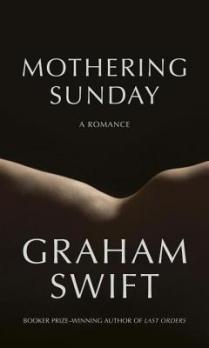
mothering-sundayThe most important decisions and in our lives can oftentimes be traced to the events of a single day.  Jane Fairchild is a writer in her nineties and decided that this would be her career on one preternaturally warm spring day in March of 1924.  Jane was a maid at the Beechwoods estate for the Niven family and she was having a secret affair with the upper class son who lived on the neighboring estate and on this day in March her lover summons her to his room for an afternoon of sensual pleasure.

The annual Lenten tradition of giving the staff a day off, called “Mothering Sunday,” was carried on in Britain during the era of large estates which employed servants.  The maids, cooks, butlers and other servants were allowed the day off on this special Sunday and many of them made it a habit to visit their mothers.  But Jane Fairchild is an orphan and, in fact, she is a foundling so she has no idea what her real name is, if she was ever given one, or what her actual date of birth is.  The orphanage named her Jane and assigned her May 1st as a birthday.  But Jane is never bitter or upset about her fate as an orphan.  She believes that if it were not for her humble and unknown beginnings then she never would have experienced that special Sunday in 1924 and might not have ever become a successful writer.

Jane came into service at Beechwoods as a young girl of sixteen and not long after that she meets and begins a passionate affair with Paul Sheringham.  Paul is the confidant and spoiled son of the neighboring Upleigh estate.  He had two brothers who were both killed in The Great War so the fact that he is still alive is a miracle and as the only surviving male heir no one ever questions his actions or choices.   When Paul and Jane begin their affair Paul pays Jane for their little trysts but as the relationship between them develops and becomes more mature they both find themselves invested in their time spent together and they carry on like this for seven years.

Paul is engaged to a woman named Emma Hobday and when the Sheringhams, Hobdays and Nivens are all meeting for lunch on a warm Sunday in March in 1924 Paul immediately summons Jane to his bedroom so that they can take advantage of her day off in the Sheringham’s empty house.  Jane and Paul usually meet in places between the two houses, like the garden path, so this Sunday is very special for Jane.  Paul even greets her at the front door, a place where a common maid would never enter the lavish home.

The first part of the book is a description of Jane’s invitation to Paul’s room and what happens once she gets there.  Swift’s writing is detailed, sensual and mesmorizing.  Jane describes what she sees in Paul’s room since she is visiting it for the first time, she describes how their encounter begins and she describes how Paul gets dressed when they are finished.  There is a focus on their nakedness and the sheer revelry of doing what they want in a place that is normally forbidden to them.  I was captivated by Swift’s writing and the suspense he creates in the story through Jane’s narrative of what happens on this special Sunday.  Jane and Paul never talk about the future or his impending marriage, but Jane assumes that this will be their last encounter and they will never find the time again for these secret and passionate trysts.

My only complaint about the book is the ending.  The last part of the narrative becomes solely about Jane and her feelings about being an author.  By this time she is a ninety-year-old woman who has had a long and successful career and she becomes philosophical about her progress as a writer.  The eroticism and mystique of the first part are lost by the end.   Overall,  this is definitely a book worth going back and starting from the beginning many times over.

About the Author:
graham-swiftGraham Colin Swift FRSL (born May 4, 1949) is a British author. He was born in London, England and educated at Dulwich College, London, Queens’ College, Cambridge, and later the University of York. He was a friend of Ted Hughes.

Some of his works have been made into films, including Last Orders, which starred Michael Caine and Bob Hoskins and Waterland which starred Jeremy Irons. Last Orders was a joint winner of the 1996 James Tait Black Memorial Prize for fiction and a mildly controversial winner of the Booker Prize in 1996, owing to the superficial similarities in plot to William Faulkner’s As I Lay Dying. Waterland was set in The Fens; it is a novel of landscape, history and family, and is often cited as one of the outstanding post-war British novels and has been a set text on the English Literature syllabus in British schools.


10 Comments

Filed under British Literature, Literary Fiction