Category Archives: American Literature

We all know how to talk, we just don’t know when: Language and Poetry

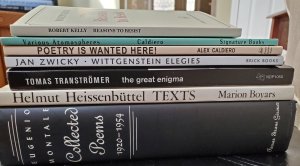
Last night I was reading Robert Kelly’s lovely new poem, Reasons to Resist, which he describes in the subtitle as “a motet.”  From the Latin word movere, “to move” a motet is a beautiful, unique style, I thought, for a longer poem which fittingly captures his ideas of music as well as language.  The one line I keep repeatedly coming back to is: We all know how to talk/ we just don’t know when.

I’ve been chasing this thread of language, words, and ways of communicating throughout the vast amounts of poetry I have been absorbing lately.

Jan Zwicky, in her incredible collection entitle Wittgenstein’s Elegies, imagines language as an ancient city, difficult to navigate, that demands effort:

Our language is an ancient city, maze of interlocking
streets and squares. To know it we must
walk it, crawl through sewers, feel our way
by night along the walls. Most answers squat
before us, humble questions. Where they tower,
not the single-minded cleavage of broad-avenued
baroque, but subtler mysteries
reach heavenward, anonymous: the master-builders.

And Alex Caldiero, whose poetry I’ve been obsessed with lately thanks to a blog post from Scott Abbott, reminds us that silence is also telling form of communication.  Silence is as powerful and extreme as shouting. From his collection Poetry is Wanted Here:

How we sound together
tells
more about who we are
than all the dialogs
of our lives
but
we settle for the uneasy
silence humans
mistakenly think
they have in common
w/ the beasts.

And from Caldiero’s collection Various Atmospheres:

We could try
to teach each other
our private wordings,
but with what words?

Or we could seek
a common denominator
in the number of our bones
or in the stances we take.

And then again
we could keep
the ancient solemn vow
of silence.

Italian poet Eugenio Montale contemplates words that betray our true feelings but agrees that silence reveals a deeper truth (tr. J. Galassi). From his collection Cuttlefish Bones:

You, my words, betray in vain the secret
sting, the gale in the heart that howls.
The deeper truth is that of a man who is silent
The song that sobs is a song of peace.

And German poet Helmut Heissenbüttel reminds us, in his poem Subjunctive about the complex grammatical structures that complicate language and communication (tr. Michael Hamburger):

up to the middle of the half
less than too little
least of all
as though as though
probably probably
took upon himself did not take upon
himself
undecided provisionally provisional

And, finally, a poem from Swedish poet Tomas Tranströmer, whose collection entitled the great enigma is extraordinary. His poem is about words on paper, written communication. Which can also turn into a form of silence. This poem, Lament, is translated by Robin Fulton:

He said aside his pen.
It rests still on the table.
It rests still in the empty room.
He laid aside his pen.

Too much that can neither be written nor keep silent!
He is paralyzed b something happening far away
although the wonderful traveling bag throbs like a heart.

Outside it is early summer.
Whistlings from the greenery—men or birds?
And cheery trees in bloom embrace the trucks that have come home.

Weeks go by.
Night comes slowly.
The moths settle on the windowpane:
small pale telegrams from the world.


4 Comments

Filed under American Literature, German Literature, Poetry

Odi et Amo: Half-Light, The collected poems of Frank Bidart

I have been voraciously reading an incredible amount of excellent poetry lately.  I’ve been sharing some of my favorite passages on Twitter, but I thought I would do a short series on the blog of my favorite collections.  Frank Bidart’s Half-Light, Collected Poems, which includes work spanning the years 1965-2016 was recommended to me by two of my favorite literary Twitter accounts.  It is one of those few collections of poetry that one can read from cover to cover in a few sittings.  I devoured it over the course of this past week.  My favorite parts of this volume are his series of poems based on Catullus 85 as well as his longer, Hour of the Night, series of poems.
It is always difficult for me to teacher Catullus Carmen 85 because, as his shortest poem—a mere two lines—the temptation is for students to translate it quickly and move on.  But there are so many layers to this deceptively simple poem (translation is my own):

I hate you and I love you.

You may be wondering why I feel this way.

I have no idea.

But that’s how I feel.

And I. am. tortured.


Odi et amo. quare id faciam, fortasse requiris?

nescio, sed fieri sentio et excrucior.

Bidart’s brilliant strategy for interpreting this poem is to compose a series of his own two line verses that each focus on a different aspect of the original.

The first version, Catullus: Odi et Amo is:

I hate and love. Ignorant fish, who even

wants the fly while writhing.

The et in italics is subtle yet striking.  And the image of a fish writhing on the fly—why would the creature still want the very thing that is killing him?

Bidart’s second version is Catullus: Excrucior which shifts focus to the end of Catullus’s Carmen-–that all powerful Latin word, excrucior,  which literally means to be crucified:

I hate and—love.  The sleepless body hammering a nail nails

itself, hanging crucified.

The entire first phrase is italicized in this iteration, and the addition of pause with the em dash adds additional emphasis to these different emotions.. Finally, the images of the nails emphasize the “crucifixion.”

Bidart’s trilogy of poems ends with Catullus: Id Faciam, which brings us back to the middle of Catullus poem.  He has no idea why he feels such conflicting emotions:

What I hate I love. Ask the crucified hand that holds

the nail that now is driven into itself, why.

The addition of the relative pronoun is unique in the final poem; the person who is causing such conflicting emotions lingers in the background.  But there is also the hint of self-inflicted torment, the hand that nails its own nail.  All three versions are slightly different, but bring to our attention various pieces of the original. At the same time they all fit perfectly into Bidart’s work as a whole through the theme of desire.

There is a bonus interview with Bidart at the end of this edition in which he describes his series of The Hours of the Night poems:

The myth behind the series of poems is the Egyptian “Book of Gates,” which is inscribed on the sarcophagus of Seti I.  Each night during the twelve hours of the night the sun must pass through twelve territories of the underworld before it can rise again at dawn. Each hour is marked by a new gate, the threshold to a new territory.

Each poem in the series is an hour we must pass through before the sun can rise again.

The collection contains four Hours of the Night stories and a fifth was published this past summer in The Paris Review.  My favorite is the Second Hour of the Night for which Bidart uses as inspiration Ovid’s story of Myrrha from the Metamorphoses.  Once again, Bidart’s focus is on desire and how much control we have or don’t have over this powerful emotion.

Ganymede; Apollo and

Hyacinthus; Pygmalion; Adonis avenged upon

Venus; the apples that Atalanta found irresistible, —

fate embedded in the lineaments of desire

(desire itself helplessly surrounded by what cannot be

eluded, what

even the gods call GIVEN,—)

In addition to italics, words and phrases in all caps are typical of Bidart’s entire collection.  As he continues the story of Myrrha, Bidart emphasizes the pity and helplessness of this young girl who falls in love with her own father.  Like Ovid, Sade and Yourcenar who also write very delicately about matters of incest, Bidart’s character is young and sheltered; she loves what she knows and what is familiar and she wants nothing else:

four steps forward then

one back, then three

back, then four forward—

…but you have lied about your

solace, for hidden, threaded

within repetition is the moment when each step

backward is a step

downward, when what you move toward moves toward

you lifting painfully his cloak to reveal his

wound, saying, “love answers need...”

The gods—well, all those except the Furies—abandon Myrrha.  She prays in the end not to be alive and not to be dead—she can’t even face others in the afterlife.  As a result she is turned into the Myrrh tree:

Aphrodisiac. Embalmers’ oil. “insistence of

sex, faint insistent sweetness of the dead undead.)

Sacred anointment oil: with wine an

anodyne. Precious earth-

fruit, gift fit for the birth and death of

prophets:—no sweet thing without

the trace of what is bitter

within its opposite:—

…MYRRH, sweet-smelling

bitter resin.

These last lines are a chilling echo of the contrasting emotions we feel from the Odi et Amo poems.

3 Comments

Filed under American Literature, Poetry

Don’t Talk So Much: Convalescent Conversations by Laura Riding

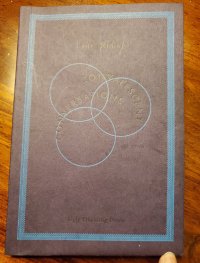
I started reading the wonderful poetry of Laura Riding after I discovered her in Michael Schimidt’s book Lives of the Poets.  And I realized that I had two of her prose books published by Ugly Duckling Presse sitting on my bookshelves.  Convalescent Conversations was first published in 1936 by Seizin Press, which she ran with Robert Graves, under her pseudonym Madeleine Vara.  It is a short novel with two central characters, Eleanor and Adam, recovering from unspecified illnesses, in the same nursing home.  They are both in their 30’s, single, and from the same social class.  When their nurse wheels them both out onto the same veranda every day for some fresh air, they find lots of things to talk about.

Riding’s  experimental piece of writing is described as having no real plot, which, I think, best showcases the brilliance of her talent.  Her characters are charming, humorous, fussy, and philosophical so there is no need for a traditional plot.  We don’t miss it.   The only real twist, if we can even call it that, is when Eleanor and Adam seem to be developing romantic feelings for one another, even though they vehemently resist this idea.  Their conversations range in topics from politics, to marriage, to sex, to religion, to language.  Eleanor seems to be the guiding force of the first eight chapters.  Riding gives her the most interesting and profound pieces of the dialogue.   When discussing the topic of beauty, for instance, Adam asks, “But have women a secret—a real secret?” to which Eleanor responds with a humorous and astute argument:

Indeed they have! And they know how to keep it. They keep it so well that men think they can master it just by sleeping with them. It’s like with some mysterious island, say the Island of the Hesperides, where the golden apples grow. The apples aren’t real golden apples, merely symbols that it’s a pretty wonderful island. But Hercules kills the dragon and steals the apples and brings them home, thinking he’s conquered the secret of the island. Every man is a sort of Hercules and sex is just a tour to foreign places. He kills the dragon, brings home the fruit, and thinks he knows it all.

The dialogue also veers into very serious topics, which read like a Platonic dialogue, in which Adam is the one who brings up conventional wisdom and Eleanor plays the role of the true philosopher like Socrates and disputes these conventional ideas.  Riding sometimes even sets up the text to look like a Socratic dialogue with characters’ names inserted into the text.  In their discussion on religion Eleanor starts with, “I don’t have ideas or pictures about God. God to me is a name—a name for all the most important things that nobody can define, and not the right name.”  Adam responds, “You mean things like truth and goodness and reality?”  Which question brings forth from Eleanor one of her longer arguments:

Yes, things like that—all the impressive ideas that people don’t believe in privately, but only in groups. Or perhaps privately they believe in them a little. Then you throw a lot of people together and they believe in such things in a big way. That’s what churches are for: you get people together and add up all the fractions of belief or interest that each one has in things which don’t bother them very much in their daily lives—and the answer is ‘God’. But no single person has more than a fraction of interest, and so the combined feeling isn’t very strong—only louder; like when a schoolmaster gets the whole class to recite a poem because no single boy recites it with much enthusiasm. He gets more volume from the class as a whole, but not more enthusiasm.

In the last few chapters, a new invalid is introduced into the mix, a Mrs. Lyley who quickly realizes that Eleanor and Adam have developed feelings for one another.  She too, has astute and philosophical observations about life and relationships that she shares with her younger friends: “But don’t you believe that when two people are thrown together and find themselves in sympathy they owe it to—well, to each other—not to draw apart again? I mean, it’s like finding something nice in the street that doesn’t seem to belong to anyone—it’d be sinful to kick it aside and pass on. Like a rose: you’d take it home and put it in water. I know I would.”

Mrs. Lyley invites Eleanor and Adam to finish their convalescence at her country home, but with the condition that they must fall in love with one another.  Eleanor is especially resistant to the whole idea and overthinks this generous proposal.  Adam finally steps in with the right arguments to convince her to take up Mrs. Lyley’s offer.  He suggests they hold hands and call one another ‘darling’ and brings up the topic of love:

Eleanor: Have I ever said I loved you?

Adam: No, but I love you. And I couldn’t possibly love you unless you loved me.

Eleanor: Well, I couldn’t possibly love you unless you loved me. So that makes just the conversational deadlock you pride yourself this isn’t.

Adam: Oh, but it isn’t a deadlock. If I say I won’t go out to-morrow unless it’s fine weather, and you say you won’t go out to-morrow unless it’s fine weather, that’s not a conversational deadlock, but an identical expression of an identical hope. And the chances are that the weather will be fine, and that we’ll go out together. Or stay indoors together if it’s not fine.

Eleanor: Don’t talk so much.

The other Riding book I have yet to read, which is also part of Ugly Duckling Presse’s Lost Literature Series, is entitled Experts are Puzzled, which, after sampling her prose, I am also very much looking forward to reading.

My friend Tony has also written a wonderful review of this book at his blog: https://messybooker.wordpress.com/2019/01/21/convalescent-conversations-madeleine-vara-laura-riding/

8 Comments

Filed under American Literature

Words form, interpretations: Love and I, Poems by Fanny Howe

Fanny Howe’s latest collection of poems, Love and I,  arrived in the mail this afternoon and I have spent some time reading and thinking about it.  Her poems have a constant sense of motion which is particularly fitting for her thoughts on love.  I’ve always felt that love—romantic, familial, platonic, etc.—is never something that can be static.  We either move forward in love by putting effort into fostering it, tending to it, even expanding it.  Conversely it also takes effort to forget it by sabotaging it, resisting it and ignoring it.  My favorite poem in the collection has a brilliant title that captures Howe’s thoughts on love, memory and motion.  Philophany is taken from two Ancient Greek words, philos, “love” and the verb phan, to “think,” “deem,” “suppose.”
Philophany

The clatter of rain has a personal meaning.
This is the time to meditate or write down your dreams.
But the lover can do neither, can only wander
From room to room trying not to spill what’s so precious.

Around the lover are myriad sounds.
Thoughts shine through like water.
Forms, shapes, colors, stations are glorified in the morning.
Indecipherable, almost transparent.

Fear of loss takes root in the blood of the lover.
Words form, interpretations.

Miracles: no one there where someone was.
Someone here where no one was.

The stars that shine are sparks and coal.
As if to show experience purifies existence.

Experience was everything to me.
(This is what the uneducated would say.)

Every word must come from my acts direct.
But I know the difficulty too.
Who will believe what I do?

I’m very interested in reading more Fanny Howe.  Her back list of poetry, essays and novels is overwhelming.  Please let me know if you have any favorites of hers as a good place to start.  I’m interested in reading all three genres.


16 Comments

Filed under American Literature, Poetry

She is the Spider, not the Fly: The Poetry of Emily Dickinson

The breadth of Michael Schmidt’s 600 page, 64 chapter book Lives of the Poets is so extensive that he had to make the biographical sketches of each poet rather succinct and brief.  But this brevity does not detract from the joyful experience of reading his work because one gets the sense that he chooses every word he writes on the page carefully and he makes every sentence, every paragraph significant. He says, for instance, about Emily Dickinson,

Life, time, nature and eternity are the big counters she moves about the rapid little quatrain squares of her verse, but each counter she makes her own through metaphor and her vivid subversions of expectation. ‘Her wit is accuracy,’ says the poet Alison Brackenbury, but ‘She is the spider, not the fly.’ Not being the fly: perhaps that was her strategy of withdrawal from a world in which she saw women snared in the strict geometries of the social web, and decided that for her the freedom of an elected solitude—not of a spinster only but of a recluse—was preferable, even necessary.

Schmidt points out that scholars over the years have come up with a myriad of reasons for her self-imposed solitude—from being rejected by a man or a woman to suffering from agoraphobia—all of which are mere speculations.  “We have the legend,” Schmidt writes, “but the crucial facts in the recorded life are absent.”  Schmidt first becomes aware of Dickinson’s poems at the age of fourteen when Robert Frost visits his school and recites one of her poems aloud; from that point forward he grapples with what, exactly, makes her poems so unique. “Dickinson’s reticence seems part of her poetic strategy: if we could assign the poems to specific emotional events, we would ground them. As it is, they are a miracle and a mystery of language.”

For eight decades editors of her poetry have stripped out Dickinson’s original punctuation; they have been especially targeted her dashes, taking all of them out of her poems.  Editors have also corrected her diction and substituted lower cases letters at the points where in her original poems she had used capitals. The Thomas H. Johnson edition in 1955 restored her original formats for all the poems and it was only then, Schmidt argues, that we finally began to understand her unique voice: “Here is her originality, unmuffled after eight decades of propriety, an irregularity that answers to the darting, tentative process of the poet’s sight and feeling, the rapid transformations that follow an unfolding argument or feeling. Dickinson’s poetry is the drama of process.”

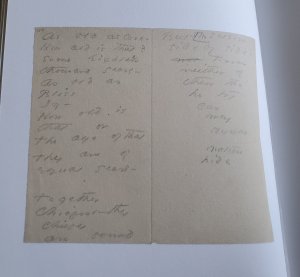
I was reading Dickinson’s collection of Envelope Poems alongside Schmidt’s chapter and even in these poetic fragments one feels her “rapid transformations.” The majority of these envelope poems were written between 1870 and 1885. I found them equally as powerful as her longer, more formal poems. It seems fitting for her that they were jotted down on corners or backs of envelopes.

A139 Begins:
As old as Woe—
How old is that?
Some Eighteen
thousand years—
As old as
Bliss
Joy—

This edition has photos of the original envelopes and transcriptions of each text.


And A317 begins:
On that
specific Pillow
Our projects
flit away-
The Nights’
Trememdous
Morrow
And whether
Sleep will stay
Or usher us—
a Stranger


I’m glad to have much more Dickinson and Schmidt to read going into my summer holidays.

5 Comments

Filed under American Literature, Poetry
