Monthly Archives: April 2017

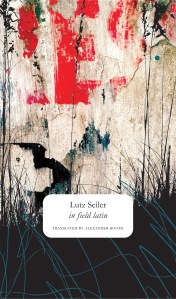
Review: in field latin by Lutz Seiler translated by Alexander Booth

Lutz Seiler was born in the former East Germany in the Langenberg district of Gera, Thuringia.  He first had a career as a skilled construction worker as both a bricklayer and carpenter.  It was during his service in the National People’s Army that he first took an interest in poetry and literature. Since 1997 he has been the literary director and custodian at the Peter Huchel Museum in Wilhelmshorst.  He has won numerous awards for his writing including the Ingeborg Bachmann Prize for his short story volume Turksib.

in field latin, published by Seagull Books in 2016, is Seiler’s debut volume of poetry translated into English.  Divided into seven sections which include between one and eleven poems, this collection gives us an interesting glimpse into life in the former East Germany via lyrics that describe landscapes, personal reflections and ghosts.

The most striking images that Seiler weaves throughout this collection are those of nature; in the first poem, entitled “Departure” he invites us into his bucolic world:

bed against window, the trip
into the wood, ever more softly
shifting gears & sleep: every

dream begins uphill, at the fence
onto the street where
someone squats like you, where

the resinous poppy with its
capsules clings to your ears, where
above already blossom edges have

gone to grey…leaf
after leave put into place
& uncompleted sent away.

The short, startling lines in this first poem are typical for the entire collection where images of reality and dreams are mingled and blurred.  His poetry is both personal reflection but also captures the universal feeling of calm while walking in the woods in autumn.  In “autumn” he writes:

is silence & custom. autumn
is rake, wood, is a mild
chill upon the eyes &

unexpected gooseflesh.  is also
the good old ready-to-fight feeling, soft, secret, skull-still
designs maturing.  the leaves all burnt, sand

still warm beneath the ashes, you
feel it now upon your hand: something
wants to flee &something never leave…

The ghosts of the past, both personal and political, also pervade his poetry.  The phrase “all the wasted time” in the following poem entitled “the stay” in particular stood out to me as an interesting commentary on the collapse of the Iron Curtain and the reunification of his country:

one evening they came
the dead of my house
back from the train-station.  one

after the other, with
balled fists, reminiscent
of tulips in their

nigh-reserve, reminiscent,
in the long being-dead, of all
the wasted time.

In a poem entitled “culmitzsch” Seiler weaves together images of landscapes, ghosts and life in the former East Germany.  The translator includes some excellent and helpful notes in the back of this edition and for this poem he explains that Culmitzch was a village in the GDR whose inhabitants were forced to move in order to make room for one of that former country’s largest uranium mines.  Seiler’s poem about this abandoned place is chilling:

in the evening the sheep go rusty
over the wasted land, birds
as if snowed therein & darkened…

only under the rubble
the farmyards are still warm.  the spoons
there by the spoons, the polish
by the boots & that little door
to the boot-room which moves you
to tears…

As always, Seagull Books has brought into English translation a fascinating collection of poetry.  I had the opportunity to interview Alexander Booth, the translator of this collection which can be read here.

3 Comments

Filed under German Literature, Poetry, Seagull Books

Molloy by Samuel Beckett: My Contribution to the #1951 Club

Karin at Kaggsy’s Bookish Ramblings and Simon at  Stuck in a Book are hosting a readlong of books that were published in 1951.  As I was looking through the list I realized that I had a nice collection of Beckett’s writing which included his novel Molloy.  At first I hesitated to write anything about Beckett.  I mean, really, what more can be said about Beckett and one of his most popular and well-known novels?  But here are the results of some feeble attempts at putting together a few words about this masterpiece.

The first part of Molloy consists of two paragraphs, the first of which is two pages long.  Molloy is living in his mother’s room and he is not sure how he got there or when she died.  The second paragraph takes up the next eighty pages of text and is written in the first person by Molloy who has embarked on the archetypal journey of a literary or mythological hero.  He sets out on his bicycle and has random encounters with a plethora of characters that include an elderly man with a stick, a police officer, a woman named Lousse whose dog he runs over and another woman named Ruth or Edith (like many other details he is unsure of her name) who shows him the meaning of love (i.e. she has sex with him.)  His thoughts and internal dialogue are as meandering as his physical journey.

In addition to the nature of his epic journey that brings him to strange places, there were two other strong parallels I noted between Molloy’s journey and that of Odysseus.   Molloy is stopped by a police officer when he is riding on his bicycle and when he is taken to the police station he can’t remember his name.  When it finally comes to him, he can’t stop saying it and shouts, “Molloy, Molloy,” which is evocative of the scene between Odysseus and the Cyclops.  In the Odyssey it is the Cyclops, Polyphemus who is representation of everything that is uncivilized, uncouth and disordered.  But through Molloy’s rambling thoughts and rambling journey, Beckett seems to be putting his narrator in the role of the outsider.  Molloy isn’t quite sure where he fits in, he is never certain of his final destination, and he has no Penelope towards whom he is drawn.  Molloy keeps bringing up his mother and is desperate to find her and find out whether or not she is dead; this is a psychologically interesting twist on the Homeric role of Penelope faithfully waiting for her husband.

An additional scene in Molloy which for me was even more evocative of the Odyssey is Molloy’s extended stay with a woman named Lousse who resembles Homer’s Circe.  Molloy runs over and kills Lousse’s dog and after he helps her bury the dog in the backyard he can’t seem to muster the strength to leave her home.  It is unclear how much time passes, but he is in a vague stupor which is imposed on him by herbs that Lousse slips him in his food and drink.  He doesn’t seem unhappy or very eager to escape.  During his stay with Lousse he also recalls visions of his mother and another woman named Ruth with whom he has sex for the first time.  Overall, Molloy seems to have a positive view of women who may, like Lousse, put a spell on him for a time, but he always manages to escape when he wants.

The second part of the book is narrated by a man named Jacques Moran who is some type of investigator hired by his boss to find Molloy.  The change in narrative structure, from the rambling story of Molloy in the first part to the more traditional method of straightforward narrative, felt rather abrupt.  At first Molloy and Moran seem to be polar opposites.  Moran is obsessed with order and structure; he eats at the same time every day, goes to church every Sunday and demands the same structure from his maid and his son.  As he prepares for his journey to find Molloy, he forces his son to pack his things so he can go along with his father.  Moran is emotionally cold, mistrustful, and condescending to his son.  At one point in the story Moran’s son complains of a stomach ache and Moran forces the boy to endure an enema which appeared to be more about control and humiliation of his son rather than trying to cure him of intestinal distress.  I suspect Beckett did not have a very favorable view of fathers or the father/son relationship, to say the least.

As Moran sets out on foot through the woods with his son he becomes more and more like Molloy.  Moran, just as Molloy in part one, becomes physically feeble and can’t walk.  The farther he goes on his journey, the more rambling and incohesive his thoughts also become.  Is Moran turning into Molloy?  Is Moran going on a figurative process of discovery and an existential crisis of identity during which he is transformed into Molloy?   Needless to say, this book is not for the faint of heart who want a light, straightforward, read.  Beckett’s trilogy which includes Molloy, Malone Dies and The Unnamable has rightfully been called one of the most important pieces of literature in the 20th century.  Be prepared to encounter thoughts on life, death, identity, and relationships while taking a trip with Molloy and Moran (or Molloy/Moran.)


23 Comments

Filed under British Literature, Classics, Literary Fiction

Nil de Nilo Fit: A Different Sea by Claudio Magris

ἀρετή τιμὴν φέρει, (excellence brings honor), are the first words spoken by Magris’s protagonist in A Different Sea.  Enrico has graduated from the Royal Imperial Staatsgymnasium of Gorizia and has decided to set sail for Patagonia in an attempt to live an authentic life, free from material items, worry,  and The Great War which is about to break out in Europe.  His mind has been shaped by the Ancient Greek texts that he and his friends Nino and Carlo are so fond of reading in Nino’s attic room:

Up in Nino’s attic in Gorizia they would read Homer, the tragedians, the Pre-Socratics, Plato, and the New Testament in the original Greek, and Schopenhauer—also, of course, in the original; the Vedas, the Upanishads, the Sermon of Benares and the other teachings of Buddha; Ibsen, Leopardi, and Tolstoy.  They used to exchange their thoughts and describe the day’s events, like that story of Carlo and the dog, in ancient Greek, and then translate them into Latin for fun.

Enrico has an existential crisis in his youth as he is trying to decide what, for him, constitutes excellence in his life.  To the Homeric heroes he is so fond of studying, excellence comes in the form of success on the battlefield which, in turn, brings them honor.  Enrico’s search for purpose in life seems to have more elements of Epicurean philosophy than Homeric values.  He feels the most content when he is with his friends, in the attic, discussing life and Greek philosophy.  Epicurus himself achieved ἀταραξία (a lack of disturbance) sitting in his garden and contemplating human existence with his friends.

The Epicurean elements of Magris’s text continue as Enrico traverses the ocean in order to reach South America.  Enrico craves simplicity, has no interest in politics, avoids pain and has no fear of death.  On board the ship, when he is told the story of a famous captain who dies at sea Enrico remarks: “Nil de nilo fit et nil in nilum abit” (nothing happens from nothing and nothing will go into nothing).  Once he reaches Argentina he spends weeks and months alone herding his flocks and living in a modest hut with only a bed and a few Greek books.

When Enrico finally returns home he settles in Salvore and also lives a modest life in a small house and rents his land out to tenants.  But he still remains unhappy and unfulfilled since his friends have all died and he fails to make connections with anyone else in his life.  Every time he has the chance to get close to someone, especially a woman, he ends up driving them away.  His poor relationship with women begins early in his life with his mother whom he feels favors his younger brother.  He finds comfort in having a woman with him who can also fulfill his sexual needs but he treats each woman he lives with very badly.  Even his niece, for whom he at first develops a fondness, is treated poorly and verbally abused by Enrico.  In the end Enrico’s loneliness and his failure to achieve ἀταραξία are due to his inability to make emotional connections with other people in his life.  He never finds his excellence, his reason for living, something that can bring him honor and self-satisfaction.

I found Magris’s writing in A Different Sea as enjoyable as his longer novel Blameless which I recently reviewed.  He is fond of weaving images of the sea into his stories, imbedding stories within stories in his texts, and portraying flawed characters who are searching for meaning in this random, crazy life.

Here is a link to a recent interview with Claudio Magris whose English translation of Blameless has just been published by Yale University Press: http://blog.yupnet.org/2017/04/13/writing-as-witness-a-conversation-with-claudio-magris/

For a more detailed discussion of excellence and honor in Homer see my thoughts on Logue’s War Music: https://thebookbindersdaughter.com/2017/03/23/excellence-and-honor-in-logues-war-music/

3 Comments

Filed under Historical Fiction, Italian Literature, Literary Fiction, Literature in Translation, Novella, World War I

A Soviet Titanomachy: My Interview with Russian Author Sergei Lebedev

Sergey Lebedev

Sergei Lebedev was born in Moscow in 1981. Before he became an author he had a career as a geologist working in northern Russia. His debut novel, Oblivion, translated by Antonina W. Bouis and published by New Vessel Press in 2016, is one of the first novels in the 21st century to describe the horrors of the Russian Gulag system. Obliviion is loosely autobiographical as the unnamed narrator in this book travels to Siberia as a geologist and during his expeditions he sees the old, abandoned camps where millions of Russians were forced to do backbreaking labor. The narrator of the book is especially interested in learning more about the Gulag that was run by a family friend, whom he only knows as Grandfather II. Lebedev’s mellifluous and poetic prose as he describes the landscape in Siberia and the desolate camps is striking. Oblivion is a haunting, intense, descriptive literary odyssey; the detailed stories he tells about this once-hidden piece of Russian history ensures that the experiences of life under Soviet rule will indeed not fade into oblivion.

Sergei Lebedev’s follow-up to Oblivion, which is also loosely autobiographical, is set in Russia just as The Soviet Union is nearing its collapse. The Year of the Comet is translated by Antonia W. Bouis and was published by New Vessel Press in February 2017. The unnamed narrator in The Year of the Comet describes his boyhood in the mid 1980’s and his two grandmothers that have the most influence over his life. Although they are very different women—one grandmother is of peasant stock and the other is from a long line of nobility—their strong wills have allowed them to survive many hardships during World War II and Stalinist Russia. The boy suspects that the grandmothers have something to hide so he takes to snooping about their apartments for clues. At the same time as he is becoming more aware of his family’s secret past, the Soviet Union is showing its first signs of collapse. There are everyday things in life that start to disappear: there are plenty of shoes but no shoelaces, binding materials such as glue, wire and pins become scare. Lebedev’s second novel is equally as poetic and insightful as Oblivion as he describes the history of Russia and the Collapse of the USSR through the eyes of a child.

I conducted this interview with Sergei Lebedev via email over the course of a few weeks in December 2016 and January 2017.  I want to give a very special thanks to Sergei for his thoughtful and fascinating answers, for being so open and kind and for his time.  Of all the posts I’ve written and worked on for my blog this interview is one of my most favorite and cherished pieces.

Melissa Beck (MB): Your first career, before you were an author, was working on geological expeditions in northern Russia. In your first book Oblivion the narrator is a geologist doing this very job and in your current book, The Year of the Comet, the narrator talks about his early love of geology. Can you trace the progression of your career from geologist to journalist to author and poet?

Sergei Lebedev (SL): Geology was my cradle. My mother and father were geologists. I was growing up among the books about minerals and ores, among the beautiful crystals, black and white photos from North and East, expedition equipment… Nobody pressed me as parents sometimes do, but with this intriguing environment, I was doomed to be a geologist. When the USSR collapsed, geology as a science and as an industry was fast to deteriorate. At the same time, the geological spaces were opened for Jack London style expeditions, searches of old abandoned mines, and deposits.

This was my geology. We were collecting specimens and selling them to museums and private connoisseurs. There was no USSR anymore and the new states were like newborn babies. No borders, no authorities, money was calculated in millions. It was something like the period of Civil War that my grandmother witnessed as a young girl and described to me.

It was during this time that I first encountered the remains of the Gulag: ruins of barracks and bridges, old glades and roads, cyclopic heaps of exhausted rock – like the sum of prisoners’ eliminated lives. It was shocking. I thought the former camps existed only in memoirs. They were in fact present on earth, but nobody had seen them.

Later I found that the language of geology was very helpful to me in dealing with the past. “Geology is working with time and pressure” (that is my favorite quote from the Shawshank Redemption). Geology is working with substances transformed by time and pressure, transformed not only once – three, four, five times. This is a perfect parallel with Soviet history, because the USSR was constantly rewriting its history, denying the past and declaring a new future.

In addition, the search for minerals is like an exciting hunt. You cannot simply rely on professional skills. Intuition, luck, a sixth sense also matters. You are like a detective looking for what happened hundreds or thousands of millions of years ago, tracing the marks of mineral veins in the landscape, in the river sand and pebbles, reading the Book of Creation. It is a perfect school for a writer and an investigator!
My own transformation from geologist to journalist and writer occurred when I made an astonishing and eerie discovery in my grandmother`s archive. I found that her second husband was a state security officer of a high rank, a former chief of the Gulag camp. This discovery was my initial impulse to dive into my family`s history. I assumed that this history was quiet, simple and guileless, but it happened to be elusive, dark and unwilling to reveal its secrets.

MB: In The Year of the Comet Grandmother Tanya is an editor for Politizdat and she is also secretly writing a memoir. Did your own grandmother or anyone else in your family encourage you to write and to inspire you to want to become an author?

SL: As I remember from my Soviet childhood, writing was always something a little bit suspicious. I was writing in school where we had ideologically assigned topics like partisans, official holidays like Women`s day, the Day of Victory etc. But this was not writing, it was only repeating ideological formulas. But to write on your own? To write whatever you wanted to write? This was something unbelievable.

I think my grandmother Natasha, who wrote the memoirs about the family`s history, had a different goal. She was writing her memoirs in the late years of the Soviet Union, but had no idea that the USSR would soon collapse. So hers was a text with two contradictory intentions. On the one hand, it gave a wide overview of the past, it reestablished links with the past. On the other hand, it shaped the Soviet approved version of the past, and it excluded some dark pages which could have been an unnecessary burden for future generations.

Her book of memoirs was like the final book, the final piece of knowledge, because she was the family`s only survivor and, just as the Soviet state, she had the monopoly over writing about the past. The memoirs were her precious gift, her testament in a way. However, I don`t think she wanted anybody to go further.

MB: Two strong-willed yet very different Grandmothers have the most influence over the narrator in The Year of the Comet and the narrative is centered around stories about them. What made you choose to make Grandmother Tanya and Grandmother Mara such important characters in your book? Is there a particular memory that you have of your own grandmothers that stands out in your mind?

SL: My own two grandmothers were the most impressive figures of my childhood. Others, like my mother, father, and various relatives, were just regular people like I am. My grandmothers were like pillars of the Soviet Universe. One was from a noble aristocratic family, and one was from a poor peasant’s family. Only the revolution of 1917 made it possible for them to meet, to become relatives.

They embodied struggling times, Red power and White, defeated power (there were no Reds without Whites). All the hidden contradictions of history and society were personalized by their presence. I was feeling two different gravitations, like two different wizards, two magicians were competitively whispering in my ears strong spells shaping my fate, my future, my conscience. Therefore, The Year of the Comet at its core is a Soviet Titanomachy.

MB: The Year of the Comet is full of personal and Soviet history, stories and anecdotes. How did you prepare to write this book? Were there particular family members you went back and Interviewed, old photos you perused or other family documents you read to refresh your memories so that you could include personal details in the book?

SL: The novel was written without any assistance or surveys. I had the idea to write the book of a generation, the book about the last children of the Soviet Union, about those who inherited the full extent of the Soviet mythology produced in Stalin`s era, Khrushchev’s era, Brezhnev`s era, in different USSR`s, as I worded it in the book. I was trying to understand why this mythology survived the crash of communist ideology and twenty years later has once again become vivid and effective. I did spent time in my preparations for writing the novel with Robert Graves’s book about ancient Greek mythology and dozens of memoirs, sociological and historical research, and with newspapers and magazines of that period.

MB: I am actually a classicist myself, I teach Latin and Ancient Greek at a high school here in the US, so your reading about Greek myth in preparation for writing the novel is especially interesting to me. I also noticed your reference to Theseus in The Year of the Comet. Was there a particular story or ancient author that attracted you to reading about Greek myth?

SL: It is a funny story of how I was attracted to read about the ancient Greeks. All the soviet kids were fans of D`Artagnan and the Three Musketeers film. It was shown on TV during every school vacation. I was a fan too. Once my father told me that when he was a teenager he was friends with the actor Veniamin Smekhov, who played Atos in the film. I didn`t believe him because actors were like celestial beings and I asked him to prove it. He showed me a book which he received as a gift from Smekhov with the actor’s signature in it. It was a rare book, the complete editions of Homer’s Iliad and Odyssey. For me it was a book recommended by my beloved film hero, by the musketeer Atos himself. And I started to read it while fighting with the hexameter.

I kept returning to Homer repeatedly, especially the Odyssey. I was deeply, unconsciously obsessed with the theme of escape; escape as a category of human actions that I never witnessed because Soviet values taught us to endure, to wait, to reconcile with circumstances. I felt these values and was astonished with Odysseus who never stopped escaping from all kind of traps, temptations, encumbrances, dangers. He was my hidden hero in a way.

Theseus was my second love. The story with the sandals and sword left under the stone, the symbol of his heroic origin… I imagined something like this about myself, imagined I was a Soviet Theseus. My sword and sandals were the orders and medals kept by my grandmother. I thought these orders and medals belonged to her first husband, my grandfather whom I never met, the officer who fought in the battle of Stalingrad and was wounded while crossing the Dnieper River. When nobody was looking, I put the Red Star order on my shirt and dreamed about carrying out feats and attaining glories equal to my grandfather’s. In these moments, I wanted to be his grandson more than to be the son of my parents, to be the successor of his deeds, of his heroic epoch.

Only later, when my grandmother died, did I learn that this orders and medals belonged to her second husband, the chief of the concentration camp, the mass murderer. I wrote the novel Oblivion about this discovery – about a Theseus who finds not the sword and sandals under the stone, but something else that he never expected to find.

MB: In The Year of the Comet, the dacha that the narrator spent the summers in as a child was a happy place full of interesting memories. Helping Grandma Mara in the garden, playing with the other boys in the neighborhood and even solving the mystery of the serial killer were all a part the narrator’s childhood summer at the dacha. Do you have a dacha in your family and do you still visit it as an adult?

SL: Our dacha was an axis of family life since the early fifties. We lived in different flats, but we always had the same dacha. Flats were Soviet-built, anonymous houses, faceless and indistinguishable from each other. Our dacha was built by my grandfather with some trash timber, but it was ours.

At the same time, however, the dacha was a kind of a trap. We possessed our dacha – it represented not only a certain style of living, it was also a safe retreat from ideology and stress and it imperceptibly became a cellar. All our desires and perspectives were connected with the dacha. But, by the very fact of its existence, it diminished our horizons, it diminished our willingness to develop, to discover. Our dacha is the place I was writing about in The Year of the Comet but I am glad to be free of it now.

MB: Some authors who have written autobiographical fiction have angered family and friends for revealing too many private, family stories. Karl Ove Knausgaard and his family’s negative reactions to his books come to mind. What was your family’s reaction to your books? Did they think you revealed too many private family memories or did they enjoy revisiting old stories through your books?

SL: As I said previously, writing was always treated as something potentially dangerous in my family. I didn`t expect my books to be accepted easily by family members. I didn`t want to shock them or to punish them, so I tried to write with patience and tenderness. I think it was tough reading, we had some discussions, but in general my parents’ always supported me and I am grateful for this.

MB: One of the prominent themes in both Oblivion and The Year of the Comet is secrets and the process of discovering them. Do you still have that investigative spirit of the child narrator who is always snooping around his grandmothers’ apartments in search of family secrets? Are there still family secrets or other secrets about The Soviet Union that you want to unravel?

SL: Soviet life is still full of secrets. The archives of state security are still closed and guarded. Secrets, or secrecy itself, is still a main feature of Russian life. Secrecy is the aura of the authoritarian (now quickly becoming totalitarian) Russian state, the mythological evidence of its sacred power and supernatural historical mission. Or, in a more pragmatic way, secrecy serves as a repressive measure against civil freedoms. Because of this secrecy, opening up these secrets, penetrating the curtains is still something important to me.

Later I want to write a book about famine in the USSR. The state-organized famine of the thirties that was used as a repressive measure against peasants brought about the deaths of millions of people and caused wide-spread cannibalism. Famine is not considered a “modern’ mechanism of repression which instead uses arrests, prisons, concentration camps. Famine is a return to prehistory, to Neanderthal times, the bottom of the bottoms, the Ninth circle of Dante`s Hell. Bolsheviks and their successors today are eager to justify Stalin`s rule because, as they insist, he brought modern civilization to Russia. But this is the type of “civilization” he brought: the return to prehistory.

Even repressions carried out during the Great Terror are reluctantly and partially recognized by the Russian state as a crime. Famine, however, is not and it is instead viewed as a “natural disaster.” I want this so-called “natural disaster” to be exposed. This is also part of my personal story since my grandmother`s sister survived the famine in the Ukraine and wrote a few letters about her experience.

MB: In The Year of the Comet you chose to have the narrator tell his story from the point of view of his childhood. You not only capture the spirit and innocence of childhood through your narrator, but you also deal with some very sophisticated topics through his perspective. It seems very difficult to write such a complex book from the mindset of a child. What were the challenges you faced when writing from this point of view?

SL: It is a common thing for elders to have some kind of conspiracy in a family, to keep away from children facts they are too young to know – like a biography of an uncle who was the shame of the family or an old quarrel between twin sisters. Children are very sensitive to such things, they don`t know the rules of silence and obeyance.

In the USSR the family conspiracy was keeping secret the system of life itself. I do remember getting an exciting or chilling feeling sometimes, the feeling that I was a spy or detective in my own family, the feeling that everybody had two faces, that everybody was hiding something. Of course, these were not feelings I had daily, but when they came it was like a sudden breakthrough. For example, I was used to seeing my great-grandfather`s photo in his Red Army uniform. The photo was taken in the early twenties and this was the only image of him given to me. And I remember a feeling of great astonishment when I understood that I didn`t know who he was before this photo was taken, because “before” didn’t exist for me; the revolution in 1917 was like a border between light and dark. In reality before the revolution he was an officer of the Russian Imperial Army –a Tsarist officer was a compromising and unwelcomed job to have in a Soviet citizen’s dossier.

I gave my hero in The Year of the Comet this same type of disturbing feeling as his guiding line, as an Ariadne`s thread.

MB: You write such beautiful and lyrical prose and I wasn’t surprised to find out that you also write poetry. Do you have any favorite poets that have influenced your writing?

SL: Of course, it is Josef Brodsky. We are living and writing within a Russian language that was transformed by Brodsky, we are writing inside his literary universe.

MB: What aspects of Brodsky’s writing in particular have influenced your poetry? Can you elaborate on that?

SL: Brodsky`s poems deeply affected not only my poetry, but my use of language itself. When I first read one of his poems, I don`t even remember which one, I was amazed. I felt the rhythm, the intonation – as behavior, as pace. I understood that I had never met people who behaved like this, people who are not using Aesopic speech.

The Soviet-Russian language was full of crippled words, perverted words, corrupted words, words with forgotten meanings, ruined words, decayed, descended words, turncoat words, dead words, eliminated words, twisted words, poisonous words… People spoke this language. He didn’t. He appeared to me as a linguistic Luther in a way because he clarified and reestablished the language. He was for me like a personalized rebellion against linguistic oppression and depravity. He made it possible for us to stand on the field he prepared, to speak words he transmitted through his magic poetry machine that made them connected with The Word as it was in the beginning.

MB: What are your writing plans for additional books? Your last two books were about your family and growing up in Russia and experiencing the fall of The Soviet Union. Will you write another book about your experiences growing up there or are you exploring other topics? Do you have any plans to publish a book of poetry in English translation?

SL: I have just finished the fourth novel, the last novel of the tetralogy about my family`s history. The fourth book is about the German roots of the family, about two centuries of Russian – German relationships, about two totalitarian machines producing fake identities.

I will be glad if my poetry is translated. But if not, you can find it in the novels. Poetry is my sketchbook that preserves the most inconstant, ephemeral impressions or shapes that later become parts of my novels.

MB: You mention a fourth novel, but what is the status of the third novel, the follow-up to The Year of the Comet that you also wrote about your family?

SL: The third novel is called The People of August and it will soon be translated into English. It was published in Russia and Germany and the French translation of it is currently in process. So there will be a total of four novels based on my family history.

3 Comments

Filed under Author Interviews, Russian Literature

Why Are You Mute, Field?: My Review of The Year of the Comet by Sergei Lebedev

The stunned knight came upon a field

Where nothing lived, just scattered skills and bones.

What battle had been fought, what did it yield?

No one remembered why the screams and groans.


Why are you mute, field?

Why overgrown with grasses of oblivion?

—Alexander Pushkin, Ruslan and Ludmilla


I received a review copy of this title from New Vessel Press.  The original title was written in Russian and this English edition has been translated by Antonina W. Bouis.  This review is a bit longer than most of my posts, but Sergei Lebedev’s books are captivating and worthy of a longer analysis.  The Year of the Comet will be on my favorite books list of 2017, as well as my list of all-time favorite books of literature in translation.

The unnamed narrator of The Year of the Comet was born in a Moscow hospital in the late 1970’s in the midst of an earthquake which natural phenomena prematurely hastened his birth. This seismic event is a harbinger of the feelings of turmoil and unease that will pervade the narrator’s childhood. “The earthquake was my first impression of being,” he writes, “the world was revealed to me as instability, shakiness, and wobbliness of foundations.” In this coming-of-age tale, the protagonist feels a constant sense of danger and shifting throughout his boyhood; he grows up trying to understand vague bits and pieces of family stories he hears about hardships suffered during Stalinist Russia and World War II. At the same time as he is becoming more aware of his family’s hidden past, the Soviet Government is beginning to show signs of its impending collapse.

The Year of the Comet is the follow-up to Sergei Lebedev’s stunning and lyrical debut novel, Oblivion which focuses on one man’s quest to uncover the horrors of the gulag in Soviet Russia when he travels to the Siberia as a geologist in the late 1990’s. Both Oblivion and The Year of the Comet, although fictional accounts of life in Soviet and Post-Soviet Russia, have elements of Lebedev’s own experiences. Both novels are written from the point-of-view of an unnamed narrator who is attempting to understand the dark secrets of his country’s history while perestroika pushes the Soviet Union to its end. What is markedly different about Lebedev’s second novel, The Year of the Comet, is that it center on the narrator’s memories of his childhood spent in Moscow in the mid 1980’s during which time the first cracks in the façade of the Soviet Regime are beginning to appear.

It was a literary risk for Lebedev to create a narrator who takes on the mindset, the point-of-view of his childhood; writing a story that deals with the complexities of family history and the collapse of The Iron Curtain while at the same time employing a child’s view that is not jejune is a literary feat that Levedev successfully achieves. The narrator never explicitly states the age at which he experienced the events depicted in the book, but based on clues within the text, he appears to be describing the 9th and 10th years of his life. The similarity in narrative style with Karl Ove Knausgaard’s third installment of his fictional autobiography, subtitled Boyhood, came to mind as I was reading The Year of the Comet. Similar to Knausgaard’s narrative, Lebedev combines the first person point-of-view with the past tense so that we get a child’s view of the story without the author having to use a child narrator. Where Lebedev differs from Knausgaaard is that the Russian author never gives a name to his narrator, thereby reinforcing the fact that although this story might have pieces or hints of autobiography, it is a work of fiction. As he tells his story, Lebedev’s protagonist maintains the innocence, mystery and mindset of his adolescence yet he is still free to make observations about complex themes such as loss, deficiency, pain and concealment. From a very young age the unnamed narrator of Lebedev’s novel has a sense that there are ominous family and national secrets he does not know and he turns the uncovering of these secrets into his own personal and interesting scavenger hunt.

Two Grandmothers, Two USSRs:

The Year of the Comet is divided into four parts all of which are focused on the narrator’s rearing by his grandmothers. His mother works for the Ministry of Geology which studies the causes and consequences of natural disasters and his father is a scholar who specializes in catastrophe theory. Since his parents are busy with their careers he is oftentimes entrusted to the care of his grandmothers:

My grandmothers, who had suffered so much, lost brothers, sisters, and husbands, but had survived all the events of the age, were to give me refuge in the peaceful flow of their lives, bring me up on the margins, far from real time, as if deep in the woods or on a lost farmstead. But—and I will tell you about this later—the nearness of my grandmothers merely intensified the sensation it was supposed to heal.

Most of Part One—the longest of the book—portrays with a compelling mixture of humor and sadness the lives of these women who are wartime widows. They have suffered numerous loses throughout their lives but their strong wills have given them the fortitude to live on despite those loses. Grandmother Mara and Grandmother Tanya are very different characters, but one thing they have in common is their devotion to their young grandson. He is the only grandchild of both of these women so that all of their love, attention, affection, adoration and hopes for the future are focused on the boy. More than his parents, more than his teachers, and even more than his friends, the grandmothers are the central figures in the book who have the most influence on his adolescence.

Grandma Tanya, the narrator’s maternal grandmother, is from a long line of Russian nobility, is well educated and worked as an editor at Politizdat. She is also nearly deaf and since she refuses to wear a hearing aid, the narrator has to put his arm around her and speak directly into her ear when he wants to have a conversation with her. “The skill of dealing with time and darkness was given to me by my Grandmother Tanya,” is the narrator’s introduction to this gentle woman with whom he spends most of his time when not at school. By contrast, Grandma Mara, his paternal grandmother, is of peasant stock, a zealot of communism and Stalin, enjoys cooking large family meals, loves lipstick, perfume and sweets, and is a rather loud presence in the narrator’s life. He says about Grandmother Mara, “Even in insignificant situations she spoke aggressively, pushing, harsh, trying to tear the words apart, use them all up so that the final silence could come.”

Both grandmother’s refuse to talk about their family histories but the narrator, through astute observations of his surroundings, knows that there are family members whom he has not met that died or disappeared under tragic circumstances. Grandmother Tanya has a wall of photos hanging in her apartment of people that the narrator has never met and about whom she refuses to answer any questions. Furthermore, the narrator finds it unsettling that Grandmother Tanya oftentimes recites the lines from Pushkin, “Why are you mute, field.”  Grandma Mara, whenever there is a family gathering, sets the table for more people than is necessary. The empty place settings at family dinners are an eerie reminder of relatives that are gone and whom she refuses to name or mention. He decides that the best way to put an end to this “conspiracy of silence” is to excavate Grandmother Tayna’s and Grandmother Mara’s apartments to undercover clues about these lost relatives.

Lebedev’s subtle humor shines through in this part of his story as the narrator describes his boyhood days snooping around his grandmothers’ apartments as if he is some sort of secret agent on a mission. Whenever he finds himself alone in Grandma Tanya’s Moscow apartment, he performs a thorough and comical search that could only be undertaken by a precocious and inquisitive child. He sets up an alarm clock in the middle of the apartment so he doesn’t lose track of time before she returns and then he fingers the linings of clothes, looks between spaces in the radiator, studies the inside of the washing machine, and opens forbidden drawers in her desk. He is frustrated to the point of despair when he finally finds an untitled book, which he thinks is a secret diary, hidden in plain sight on the bookshelf. Grandma’s book, however, which is written in some kind of an invisible ink, is unintelligible to him so whenever he is alone in Grandmother’s apartment he keeps searching.

The narrator concentrates his search of Grandma Mara’s apartment on a room that was strictly off limits to him: “There was a storeroom near the toilet that served as a kind of Siberian exile.”   Items that were old and broken were relegated to this storeroom and he was forbidden to go in there without any explanation. He is nervous as he attempts to break into the locked room, so he finds one of his deceased grandfather’s war medals and pins it on his shirt to give him courage. With the Red Star serving as his apotropaic protector he finds, much to his wonder and excitement, a set of volumes of the Great Soviet Encyclopedia (GSE) from the 1920’s and 1930’s.

I had stepped on the Atlantis of books, the continent of the past that had floated up from the ocean depths.   Gradually there appeared a world about which I knew nothing. Those names, events, and phenomena did not exist in my time, or if they did, I intuitively sensed that they were presented in a completely different way.

By doing more snooping, more research and comparing the GSE to the Small Soviet Encyclopedia, the narrator figures out that Grandma’s encyclopedia contains names that had vanished, had been erased in later editions of the books. He also comes to the chilling realization that not only does his family have a secret past to hide, but so does his country: “I began to understand that the USSR I knew and inhabited was just a copy, a piece of the other, earlier one.” There are, in effect, two USSRs.

Throughout Part One, the narrator also depicts his boyhood as one in which he has a constant, prescient suspicion that something big and significant is about to happen. He senses it and he can feel it from his observations and bits of conversations he gleans from the adults around him. Some of his anticipation is due to childhood bravado, but some of it is also the innate sense that children have when a big change is about to occur. As he is searching his Grandmothers’ apartments for family secrets he intuits a faint hint, a faint shaking of the foundation that will bring about the collapse of the Soviet Union. The narrator, however, doesn’t describe what we would expect when a government starts to collapse—there are no scenes of riots, political turmoil or military occupation. He never mentions words like “perestroika”, “revolution”, or “Gorbachev.” Instead he notes “a brink-of-war disorder in daily life.” There are plenty of shoes available in stores but no shoelaces. There is a plethora of pots available to buy at the local hardware store but not a single frying pan. The most obvious items he notices that are missing from hardware stores are materials used to bind and fasten: nails, screws, wires, cement and glue all become scarce. As an American who also grew up in the 1970’s and 1980’s and having only a vague understanding of everyday life behind the Iron Curtain, I found his descriptions of these insignificant items that go missing absolutely fascinating. I think many of us have in mind an image of protests and rioting in the streets, but the collapse of the Soviet Union, as seen through the eyes of a child, was much more subtle than that. The Soviet Union is literally coming apart at the seams and there are no materials left with which to bind it back together.

The Celestial Guest and the Nuclear Disaster

Part Two of the book focuses on the year during which two major scientific events, one natural and one man-made, threaten to cause more upheaval in the narrator’s young life.   Grandma Tanya and Grandma Mara take a keen interest in Haley’s Comet, which “celestial guest” was predicted to make an appearance over the skies of Moscow. Both Grandmothers are nervous and on edge about the comet and eagerly read any piece of news about it in the papers.

They were preparing for the comet’s arrival, and while preparations were not manifest in action, they were palpable. Grandmother Mara softened, and contrary to her personality she let go of her old feuds and worried that she would not be able to forgive everything in time. Grandmother Tanya, an incredible tranquil person, became calmer still, more tactful, as if apologizing even to the dust she wiped away or the salt she tossed into the soup.

Lebedev’s clever humor comes through, once again, as he describes the Grandmother’s waiting for The Comet as if it will somehow usher in an apocalypse. The behavior of the Grannies makes the narrator so anxious that he works up the nerve to ask Grandma Tanya about this heavenly phenomena. Her answer unsettles him even more: the last time the Comet visited was in 1910, she tells him, four years before The Great War, which she vividly remembers; to her, the reappearance of the comet was a sign of great misfortune to come.

The other event that absorbs the narrative of Part Two is the nuclear disaster at Chernobyl. Since the narrator’s father specializes in catastrophe theory, he is one of the first scientists to get a phone call about the meltdown of the nuclear reactor. The theme of secrecy, which encompasses both his family and his country, also pervades part two. School is canceled and no one knows what is going on: “My parents did not sleep at home, I did not go to school, and it was only on the third day that the word Chernobyl appeared” is how the narrator describes the early days of the disaster.

When the narrator witnesses the aftermath of this disaster, he, too, notes that the Soviet government was keeping a veil of secrecy around this catastrophe, not sharing the details of the fallout with its own citizens. The narrator shares various rumors about war breaking out, planes crashing and nuclear explosions of all sorts being circulated around Moscow. He recalls what he learned as a boy from his Book for a Young Commander about nuclear war: “If the capitalists provoke us into a third world war, our goal will be noble and beautiful—to make that war the last in the history of humanity.” This startling declaration from his childhood book is a reminder that we are viewing this scene through a young boy’s perspective; he cannot fully comprehend or describe the implications of a nuclear war.   There is a gap left in the text that we must fill in for ourselves with all of the eerie and horrible thoughts that the boy’s statement evokes.

The Dacha and the Serial Killer

In addition to writing fiction, Lebedev is also a talented poet. The author’s lyrical and mellifluous prose and personal, sometimes philosophical, writings are evident throughout the narrative. But his talent in poetics especially comes through in part three with his descriptions of the hot summer the narrator spends in the dacha, the family summer home in the country:

It was June, close to the solstice; the summer was dry, hot, and scorchingly sunny; It made the heavy fir forest beyond the dacha fence seem even blacker. Late evening and nighttime, when children are usually afraid, did not seem scary that summer; scary and horrible were the afternoons, when the streets were empty, hot haze shimmering above the asphalt, distorting and hiding perspective and the horizon; in the boiling jelly of that haze, the figures of passersby could suddenly appear very close, shimmering, inaccurate, flowing and worrying; blessed was the cool of the evening, cleaning the air and chasing away the ghosts of the day.

This paragraph is a typical example of Lebedev’s style, in both Oblivion and The Year of the Comet, of ubiquitously using semicolons to give multiple layers to the poetic descriptions of his scenes. We slowly absorb Lebedev’s writing one small piece at a time, from semicolon to semicolon. The semicolon makes us pause, reflect a bit and then grasp another piece of the setting; if he used a series of sentences instead of these independent clauses, his lengthy and vivid scenes would not have the same cohesion or fluidity. Lebedev’s description of the haze being like “boiling jelly” drops us right into the midst of the oppressively hot summer, the most dangerous time of day, when a serial killer is on the prowl in the dacha neighborhood.

Much of Part Three is taken up with relating of the story of a serial killer targeting children, a man whom the police call “Mister.”  The boy decides that the killer is probably a spy and he will look for him, have him arrested, and be the hero of the dacha. His hope is that he will only be seriously wounded and not killed in his brave, selfless act of heroism. One day as he is wandering the deserted, sweltering summer roads and looking for Mister in the dacha’s hiding places, he nearly gets kidnapped by a non-descript man who at first appears harmless. The description of his near-abduction was horrifying because the boy doesn’t fully understand that catching a serial killer is not a game and he just barely escapes being harmed. It is in this scene that we experience the brilliance of Lebedev’s use of a child’s view, one that we would normally not consider as adults when reading about a dangerous situation. We are put into the mindset, the very existence of the narrator’s harrowing escape from abduction but we still sense that element of innocence because he doesn’t fully grasp the danger he has put himself in. After this shocking event, the boy simply goes home and collapses on his bed until his Grandmother wakes him up. He never tells a living soul about what happened and now it is the narrator who carries around his very own secret.

The Earthquake Subsides:

Part Four is the shortest and final piece of the story and by this point the protagonist is a few years older, in his early teenage years. The Grandmothers, who served as the tectonic plates, the solid foundation of his upbringing, have weakened, have become rather elderly and feeble and require a lot of attention and medical care. Despite their declining health they maintain their affection and devotion to their only grandchild and their only grandchild still retains a certain uneasiness in their presence:

I was uncomfortable and embarrassed, I noticed signs of their frailty that should not be noticed, I was clumsy, self-conscious, pathetic, and unable to respond to their love. Grandmother Mara kept talking about my future, my wonderful wife, and my good apartment—she meant hers, and this kindly rejection of her own future grated on me. Grandmother Tanya was much quieter, but she started holding my hand much more frequently, as if trying to slip something into it or seeking support.

Because he is no longer dependent on them for care, a poignant shift occurs in his life as he grows closer to his parents and is more distant from his Grandmothers. Even though at this point the collapse of the Soviet Union is playing out in the streets of Moscow, there is an unexpected and strange sense of calmness and serenity that suffuses this final part of the book. After an earthquake, when the foundations have finally stopped moving, a sense of calm descends on the victims as they crawl out of their hiding places and survey the effects of the shifting earth. The final part of Lebedev’s book feels as if the narrator comes to the realization that his foundations have stopped quaking and he is attempting to survey the aftermath of those childhood tremors. As he wanders the streets of Moscow and sees masses of people saying farewell to communism, as barricades and bonfires fill up city squares, he finally comes to an understanding of what the turmoil he experienced throughout his boyhood meant.

In the last scene of the book he once again finds Grandma Tanya’s secret book he had discovered a few years ago in her apartment. She had been writing a memoir, directly addressed to the narrator, chronicling the entire history of their family. “The history of our family goes back to the XIV century,” Grandmother Mara writes to him. And she proceeds to lay out all the minute details of their family history and ancestry. He experiences a final moment of calm because at last there are no more secrets, about his family or about his country, for him to unravel.


2 Comments

Filed under Russian Literature