
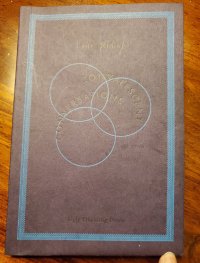
 I started reading the wonderful poetry of Laura Riding after I discovered her in Michael Schimidt’s book Lives of the Poets. And I realized that I had two of her prose books published by Ugly Duckling Presse sitting on my bookshelves. Convalescent Conversations was first published in 1936 by Seizin Press, which she ran with Robert Graves, under her pseudonym Madeleine Vara. It is a short novel with two central characters, Eleanor and Adam, recovering from unspecified illnesses, in the same nursing home. They are both in their 30’s, single, and from the same social class. When their nurse wheels them both out onto the same veranda every day for some fresh air, they find lots of things to talk about.
Riding’s experimental piece of writing is described as having no real plot, which, I think, best showcases the brilliance of her talent. Her characters are charming, humorous, fussy, and philosophical so there is no need for a traditional plot. We don’t miss it. The only real twist, if we can even call it that, is when Eleanor and Adam seem to be developing romantic feelings for one another, even though they vehemently resist this idea. Their conversations range in topics from politics, to marriage, to sex, to religion, to language. Eleanor seems to be the guiding force of the first eight chapters. Riding gives her the most interesting and profound pieces of the dialogue. When discussing the topic of beauty, for instance, Adam asks, “But have women a secret—a real secret?” to which Eleanor responds with a humorous and astute argument:
Indeed they have! And they know how to keep it. They keep it so well that men think they can master it just by sleeping with them. It’s like with some mysterious island, say the Island of the Hesperides, where the golden apples grow. The apples aren’t real golden apples, merely symbols that it’s a pretty wonderful island. But Hercules kills the dragon and steals the apples and brings them home, thinking he’s conquered the secret of the island. Every man is a sort of Hercules and sex is just a tour to foreign places. He kills the dragon, brings home the fruit, and thinks he knows it all.
The dialogue also veers into very serious topics, which read like a Platonic dialogue, in which Adam is the one who brings up conventional wisdom and Eleanor plays the role of the true philosopher like Socrates and disputes these conventional ideas. Riding sometimes even sets up the text to look like a Socratic dialogue with characters’ names inserted into the text. In their discussion on religion Eleanor starts with, “I don’t have ideas or pictures about God. God to me is a name—a name for all the most important things that nobody can define, and not the right name.” Adam responds, “You mean things like truth and goodness and reality?” Which question brings forth from Eleanor one of her longer arguments:
Yes, things like that—all the impressive ideas that people don’t believe in privately, but only in groups. Or perhaps privately they believe in them a little. Then you throw a lot of people together and they believe in such things in a big way. That’s what churches are for: you get people together and add up all the fractions of belief or interest that each one has in things which don’t bother them very much in their daily lives—and the answer is ‘God’. But no single person has more than a fraction of interest, and so the combined feeling isn’t very strong—only louder; like when a schoolmaster gets the whole class to recite a poem because no single boy recites it with much enthusiasm. He gets more volume from the class as a whole, but not more enthusiasm.
In the last few chapters, a new invalid is introduced into the mix, a Mrs. Lyley who quickly realizes that Eleanor and Adam have developed feelings for one another. She too, has astute and philosophical observations about life and relationships that she shares with her younger friends: “But don’t you believe that when two people are thrown together and find themselves in sympathy they owe it to—well, to each other—not to draw apart again? I mean, it’s like finding something nice in the street that doesn’t seem to belong to anyone—it’d be sinful to kick it aside and pass on. Like a rose: you’d take it home and put it in water. I know I would.”
Mrs. Lyley invites Eleanor and Adam to finish their convalescence at her country home, but with the condition that they must fall in love with one another. Eleanor is especially resistant to the whole idea and overthinks this generous proposal. Adam finally steps in with the right arguments to convince her to take up Mrs. Lyley’s offer. He suggests they hold hands and call one another ‘darling’ and brings up the topic of love:
Eleanor: Have I ever said I loved you?
Adam: No, but I love you. And I couldn’t possibly love you unless you loved me.
Eleanor: Well, I couldn’t possibly love you unless you loved me. So that makes just the conversational deadlock you pride yourself this isn’t.
Adam: Oh, but it isn’t a deadlock. If I say I won’t go out to-morrow unless it’s fine weather, and you say you won’t go out to-morrow unless it’s fine weather, that’s not a conversational deadlock, but an identical expression of an identical hope. And the chances are that the weather will be fine, and that we’ll go out together. Or stay indoors together if it’s not fine.
Eleanor: Don’t talk so much.
The other Riding book I have yet to read, which is also part of Ugly Duckling Presse’s Lost Literature Series, is entitled Experts are Puzzled, which, after sampling her prose, I am also very much looking forward to reading.
My friend Tony has also written a wonderful review of this book at his blog: https://messybooker.wordpress.com/2019/01/21/convalescent-conversations-madeleine-vara-laura-riding/
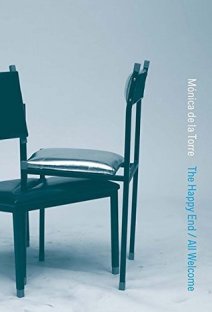 As much as companies like Google have attempted to rearrange office space into non-traditional configurations and break free of the rat maze of traditional cubicles, we still show up to work every day and have to function within a corporate structure. Monica de la Torre’s collection of poems in The Happy End/All Welcome satirize the futile attempts of office dwellers to break free of the constraints imposed on them by bosses, human resources, and even the chairs they sit in. De la Torre cleverly highlights the absurdity that we face in our every day work lives by using a scene from the unfinished Kafka novel, Amerika, as her backdrop.
 Mónica de la Torre is co-author of the book Appendices, Illustrations & Notes (Smart Art Press) with artist Terence Gower, and co-editor, with Michael Wiegers, of Reversible Monuments: Contemporary Mexican Poetry (Copper Canyon Press). She edited and translated the volume Poems by Gerardo Deniz, published by Lost Roads and Taller Ditoria, and has translated numerous other Spanish-language poets. Born and raised in Mexico City, she moved to New York in 1993. She has been the poetry editor of The Brooklyn Rail since 2001 and is pursuing a PhD in Spanish Literature at Columbia University. Her work has appeared in journals including Art on Paper, BOMB, Bombay Gin, Boston Review, Chain, Circumference, Fence, Mandorla, Review: Latin American Literature and Arts, and Twentysix. Talk Shows was her first book of original poetry in English.
 In 2013, Will Daddario experienced the loss of his father, grandmother, friend, and cat all within a span of five months. In early 2014, he and his wife were expecting their first child, a baby boy whom they were going to name Finlay, but their precious gift died during delivery. Daddario writes this short, philosophical, moving chapbook to serve as a chronicle of his grieving process and as a tribute to those he loved and lost. He introduces his writing: “While grieving, I have turned to multiple sources to guidance. What follows here is my own attempt to act as guide for others who encounter such loss, though, truthfully, the primary audience is myself.”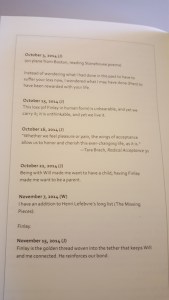



 The Book Binder's Daughter