Tag Archives: Seagull Books

Soul as the Prison of the Body: The 2016-2017 Seagull Books Catalog

seagull-catalog-2016

Seagull Catalog 2016-2017

The diverse offerings of thought-provoking and interesting literature in translation from around the world has made Seagull Books one of my favorite publishers.  Naveen Kishore, Sunandini Banerjee and their staff at Seagull publish a catalog each year that not only tempts us with descriptions and photos of their books, but they also include pieces of writing from authors and translators around the world.  This edition is very special to me because Naveen invited me and a few of my favorite bloggers to be contributors.

Naveen begins by sending out a provocation and asks each person to write a response or a reaction to his provocation.  As you can see from this year’s provocation Naveen is a master of creating poetic prose that is beautiful and thought-provoking:

Soul he said. Soul as the prison of the body. Soul I asked? What about the ones who don’t believe? In soul. Or God. Or religion. The ones that understand the body for what it is. Accept its one-way journey towards the inevitable. The body as decay. Gradual ruin. Eventual crumbling. We all know this. Or those that think the ‘inner core’, or what I presume is a ‘substitute’ for the notion of ‘soul’, is actually just an ever changing, evolving, fermenting mass of literature that grows. And grows. And knows freedom. And fear. And emotion. And love. And death. And every kind of existential angst that any soul worth its weight in gold would know! What about me? I asked. Or you for that matter. We who write and read and write and continue to both read and write while our bodies grow old and tired. But the mind. The mind remains in a state of excitement. Constantly radiant. Its brilliance grows with every new thought. What if we substitute ‘literature’ for ‘soul’ in your proud statement so that it now reads ‘Literature as the prison of the body’. Thing is that this doesn’t hold. Literature cannot be a space that restricts movement. Or freedom. At least it shouldn’t be. It is meant to be a liberating presence. Like its close companion. The dark. For me the dark is important. The dark as a substitute for soul? Maybe. Darkness is essential for literature of meaning to grow and take root.

For my own response, I wrote what I know and what I experience every day—Ovid, teaching and my daughter:
 x

Ovid, in Book XV of his epic poem the Metamorphoses, lays out the stoic vision of the transmigration of the soul. Ovid challenges the human race not to fear death because the underworld is merely a transition, a brief holding place until the spirit takes on another form. Animae semperque priore/relicta sede novis domibus vivunt habitantque receptae: And our spirits, with an old place always being left behind, and having been received by new homes, live and dwell in them.

In my Latin 2 course when I teach the passive voice I give my students this passage from Ovid’s Metamorphoses with which to practice their translations. This is always one of the most animated and lively classes of the year for my students as they decipher the Latin as well as the Stoic argument that the soul is never destroyed but that it is the part of us that always lives on. As a contrast, I also give the class an explanation of the Epicurean view of the soul, which is quite the opposite; the Epicureans believed that this life is all there is for us and once we are gone there is nothing left, neither a physical body nor a spirit.

Every year, without fail, my students unanimously reject the Epicurean idea of the afterlife and embrace the Stoic notion that our souls, the very essence of who we are, survive in some form. Out of the dozens of lines of Latin prose and poetry I translate with my students over the course of their five years of study in my program, this is the one passage that they always remember; this is the passage that they quote back to me long after they have graduated and this is the passage that a few of them have even had tattooed onto their bodies. Morte carent animae: Our spirits lack death. Omnia mutantur, nihil interit: All things are in flux, nothing is lost. Ipsa quoque adsiduo labuntur tempora motu, non secus ac flumen: Time itself glides in continual motion, not differently than a river.

the-empty-space

We were recently translating another passage of the Metamorphoses in an upper level Latin course, the suicide death of Pyramus. The students were horrified by Pyrmaus’ impulsive decision to take his own life because his soul will be stuck in limbo for eternity. The Romans believed strongly that the punishment for taking one’s own life hastily because of what Vergil calls a durus Amor (a harsh love) or unrequited love was that the soul would forever wander in the Underworld. Even though Ovid tries to take away the fear of an afterlife, it is the fear of the unknown that still lingers. Will we come back into a body as something better than before, will we come back as human or beast, or will we come back as anything at all?

Ovid’s writings about the soul are the very things that keep his work relevant and immortal even in the twenty-first century. It is his discussion of the human soul that saves the literary soul of the Metamorphoses for generations to come. Ovid’s own words can be applied to each new class, each new year, each new generation of students’ interaction with his writings. Nova sunt semper. There are always new things. Momenta cuncta novant: All moments are renewed.

The optimism of believing in an undying soul reaches even farther back into the spirits of children. When my daughter was three or four years old she started asking questions about death and dying. We are not raising her under any particular religious doctrine, so my husband explained to her what various religions believe about the soul and what might happen to us when we pass from this world. Her favorite explanation was the idea that we are reincarnated and that the soul lives on and takes on new forms. Even today, as a fourth grader, she is still a Stoic in her belief that some part of our spirit remains even when we pass from this life. It is my hope that she will learn Latin so I can translate Ovid with her and witness her reaction to Ovid’s writings about the soul.

My interactions with my students and my daughter have led me to believe that there is a youthful optimism and hope that the soul, the spirit, the very core of who we are, lives on and on. Do we retain this same optimism as we grow older? Is this an extension of the idea that young people think they will live forever? Or is this even a faint hint of a memory from some life in the past?

chemmeen

Anthony, one of my favorite bloggers, whose site is aptly entitled Times Flow Stemmed, takes a deeply philosophical approach and reaches all the way back to Aristotle for his inspiration. He responds:

My sense of soul is rooted in Aristotle who also used the term psyche in a time before we rooted psychology in the brain, rather as a form or a forming of the whole body. Was and imprint, like Ovid’s Pygmalion, are one, but this begs the question of how we become one. Identity is a precondition for unity of self, awareness of our selves. The eye is for sight, the ear for hearing but there is no organ of memory, no place in the body where identity can be seen to reside.

Joe, who blogs at his site Rough Ghosts , provides a response that is, like his book reviews and essays,  poetic and contemplative:

Literature as liberator, you suggest.

     I am, I want to reply, inclined to agree.

     But I would caution you that words can confine us, as readily as they set us free.  We can become entangled in meanings, lose ourselves in definitions, search in  circles for explanations when all we know is that the words we hear don’t seem to touch the heart of what or whom we seem to be.

And Tony Malone, who blogs at Tony’s Reading List concludes the collection with a meditation on existential angst:

So, what to do with all this, the soul of literature, the literature of the soul, existential angst and the compost of the day?

I think I’ll just delete it and go to bed.  Sleep’s supposed to be very good for your soul.

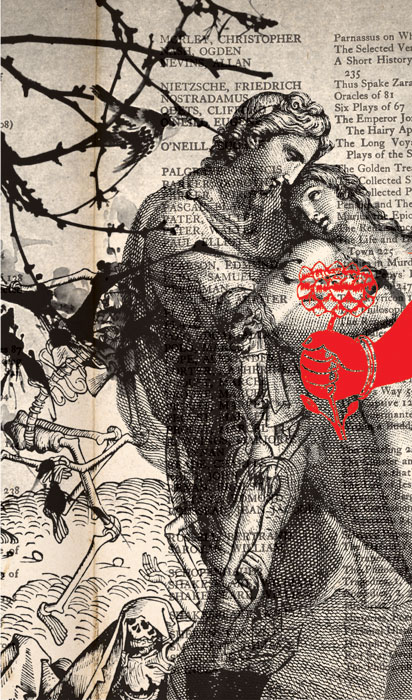
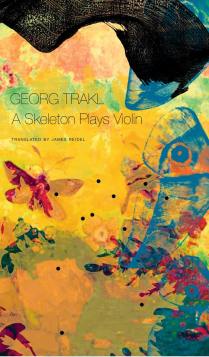
Finally, a word must be said about the beautiful and stunning art work in the catalog that is done by Sunandini Banerjee.  She is the graphic artist for Seagull Books and does the art work for their catalog and their book covers.  I did a post about her art and the piece that has been featured on my blog.  The poetry, essays, photography and book descriptions are always amazing, but it is Sunandini’s art that puts that truly unique finishing touch on this spectacular literary catalog.
a-skeleton-plays-violin

11 Comments

Filed under Literature in Translation, Seagull Books

Thieving Magpie: The Artwork of Sunandini Banerjee

Regular followers of my website may have noticed a bit of a remodel in the last few day.  I am so thrilled to feature the artwork of Sunandini Banerjee who is the multi-talented editor, translator and graphic designer at Seagull Books.  She designs all of those stunning covers that we are used to seeing from Seagull Books.  I purchased three of Sunandini’s pieces and she has graciously agreed to let me also use one of the prints as the background to my website.

I put a lot of time and effort into making my site visibly pleasing and inviting.  I had been using stock images that I bought from a stock photo website  but I am so pleased to now feature artwork that is unique and has great meaning for me.  Suandini’s artwork can be viewed on the Seagull website: Seagullindia.

The image that currently occupies the background of The Book Binder’s Daughter is from a piece entitled “Come Back In Winter” and is part of Suandini’s Thieving Magpie collection.  This is a digital print on archival paper, 11.8″ x 14.5″, Edition of 7, 2010.

come-back-in-the-winterCome Back In Winter by Sunandini Bangerjee

I also purchased this print which will be most fitting to decorate the walls of my office.  This is a digital print on archival paper 17.7″ x 14.5″, Edition of 7, 2010:

cartography-02Cartography 02 by Sunandini Banerjee

The final piece that I purchased will be displayed on the walls of my newly decorated and reorganized book room.  This is a digital print on archival paper 11.8″ x 14.5″, Edition of 7, 2010:

love-and-deathLove and Death by Sunandini Banerjee

10 Comments

Filed under Art

Review: Goethe Dies by Thomas Bernhard

I received a review copy of this title from Seagull Books.  This book was published in 2010 in the original German and this English version has been translated by James Reidel.

My Review:
Layout 1This slim volume of four short stories by Bernhard is difficult to describe in a brief review.  I experienced them and reacted to them as I would poetry and as a result my instinct is to analyze just about every line in these stories; but then my review would be the same length as this edition of stories.  One must really read Bernhard for oneself in order to fully grasp what is the Bernhard literary experience.  The stories are dripping with dark satire and are laden with a rebellion against his native home of Austria.  No topic related to his homeland is off limits as he pokes fun at the Austrian government, Catholicism, Austrian literature and even his relationship with his Austrian parents.
The rhetorical devices that Bernhard uses in his prose give a lyrical feeling to the text.  The persistent repetition of words or phrases, for instance, enhances the level of biting satire in the stories.  The incredibly long sentences give the stories a meandering and aimless feel to them;  we are never sure when or if Bernhard is getting to the point of his story.  In the title story, “Goethe Dies”, Goethe is nearing the end of his life and he insists to his aids and secretaries that he must meet Wittgenstein before he slips away.    The idea of this anachronistic meeting is funny in and of itself but the silliness of the meeting is enhanced by the characterization of Goethe who is a cantankerous old man that will not take no for an answer.  Why his secretaries and assistants object to Goethe’s meeting with Wittgenstein is never clearly articulated by any of them.  Bernhard’s use of indirect speech increases the ridicule of this famous German philosopher and his inner circle.

With time Goethe allegedly worked himself up over notion, as Krauter confirmed, of summoning Wittgenstein from England to Weimar under any circumstance and as soon as possible and Krauter would in effect be bringing Wittgenstein to see Goethe oddly enough on this, the twenty-second; the idea of inviting Wittgenstein to Weimar occurred to Goethe at the end of February, thus said Riemer presently, and not at the beginning of March, as Krauter maintained, and it was Krauter who learnt from Eckermann that Eckermann would prevent Wittgenstein from travelling to Weimar to see Goethe at all costs.

The next two stories, “Montaigne: A Story in Twenty-Two Installments” and “Reunion” ruthlessly mock the parent-child relationship.  Bernhard highlights the codependent nature of the family dynamic which oftentimes serves very little purpose other than to make the parents and child miserable.  In Montaigne, the narrator, similar to the philosopher Montaigne, is trying to lock himself up in his tower so that he can finally have peace from his family.  His family is more interested in business and the narrator wants to be left alone to read good books.  What bibliophile would not be able relate to this?  Bernhard begins the tale of “Montaigne” with:

From my family and thus from my tormentors, I found refuge in a corner of the tower and had, without light and thus without the mosquitoes driving me insane, brought with me a book from the library after I had read a few sentences in it, by Montaigne as it turned out, to whom I am related in such a close and truly enlightening way as I am to no one else.

“Reunion” extends this dysfunctional family dynamic by describing the young narrator as he desperately struggles to free himself from his annoying, hateful parents.  The hyperbole that Bernhard employs in this story made it, for me, the funniest narrative in the collection.  The narrator believes that his parents mission in life is to make him miserable and blame him for all of their problems.  He writes:

Essentially everything about our parents was rough, they were rough and ruthless to our whole lives, I said, whenever they should have always been circumspect with us, caring.  Mother slammed the doors behind her all the time, Father trampled through the house in his old climbing boots.

The parents are in constant search of “peace and quiet” and to him, the narrator, his parents are the antithesis of peace and quiet.  Wherever they go, they disrupt and destroy any chance of peace and quiet.  While on vacation in the Alps, the family hikes to a quiet alcove in the mountains and when they reach the quiet peak the parents rupture the “peace and quiet” by playing instruments.  Anyone who has gone on a family vacation in search of rest and relaxation, but instead has come home more aggravated and anxious,  will most certainly laugh uncomfortably at this story.

These four stories were an excellent introduction to the literary style and talent of Bernhard.  I ordered three more of his longer novels after I finished this volume.  I am very eager to experience his unique writing techniques in a full length book.


About the Author:
T BernhardThomas Bernhard was an Austrian author, who ranges among the most distinguished German speaking writers of the second half of the 20th century.

Although internationally he’s most acclaimed because of his novels, he was also a prolific playwright. His characters were oftenly working in a lifetime and never-ending major work while they deal with themes such as suicide, madness and obsession and, as Bernhard did, they use to have a love-hate relation with Austria. His prose was tumultuous but sober at the same time, philosophic in the background, with a musical cadency and plenty of black humor.

He started publishing in the year 1963, with the title “Frost”. His last published work, appeared in the year 1986, was “Extinction”. Some of his most well known works include “The loser” (where he ficitionalizes about Glenn Gould), “Correction” and “Woodcutters”.  To read more about his works visit: http://www.thomasbernhard.org/.


14 Comments

Filed under German Literature, Humor, Literature in Translation, Seagull Books

Review: The Inventors and Other Poems by René Char

This is my second review for National Poetry Month and is, once again, another unique volume published by Seagull Books.  The translator of this volume is Mark Hutchinson.

My Review:
The InventorsAs I first read the introduction to this volume, the piece of information that stuck out to me immediately was that Char was influenced by Heraclitus, the pre-Socratic philosopher.  Char imitates Heraclitus’ style of short and puzzling works as well as his theme of strife.  The pre-Socratic course I took in graduate school was one of the most challenging yet rewarding courses in my career as a student.  The Ancient Greek, which is fragmentary, is difficult to put together and even more difficult to analyze when one has come up with an English version. Heraclitus acquired the nickname “The Obscure” for good reason.  I had the same feelings, both of obscurity and difficulty, as I was reading Char.

The poems are in various lengths and some of the are not poems at all, but actually prose that still read like poems.  “Pontoneers” is an excellent example of a shorter work in the Heracletian style:

Two riverbanks are needed for truth: one for our outward

journey, the other for truth’s return. Paths that soak up their

mist.  That preserve our merry laughter intact.  That, even when

broken, are a haven for our juniors, swimming in icy waters.

I could spend a lifetime trying to unpack these few short lines and each time I look at them I find something different.  They are reminiscent to me of Heraclitus’ famous line about never being able to step into the same river twice.  But here Char reminds us of the ever-changing nature of our existence by posing two rivers and suggesting that what we experience, our own personal truth, may be different depending on which path we take.

Char struggles with the idea of existence and whether or not something of us serves in an afterlife.  Sometimes he comes across as a Stoic, such as in these few lines from “Loins.”

In taking leave of the world, we return to what was out there

before the earth and stars were formed; to space, that is.  We

are that space, in all its prodigality.  We return to aerial day and

its black rejoicing.

The Stoic idea that something of us, of our spirit, survives seems to be lurking in these lines.  But there are also times when I thought that Char leaned toward the Epicurean.  A line in “How Did I Ever Get this Late?” stood out to me as particularly Epicurean.  He imagines a deity that sets the human experience in motion but then steps back and has nothing else to do with its own creations.  The “Master Mechanic” watches his own chaos for his amusement:

In the immense community of the heavely clock

face, the Master Mechanic, it would seem, has greased the

motors and slipped away, chuckling, to amuse himself elsewhere.

This volume of poetry is nearly impossible to write a coherent review for.  The selections that are chosen for this edition are a sampling of the poet’s wide range of styles and topics.  Char’s enigmatic messages and obscure writing style are as difficult to unpack as Heraclitus.  But this is absolutely a volume that any lover of poetry will want to have on his or her shelf.  I find that the most challenging volumes of poetry are the most rewarding.

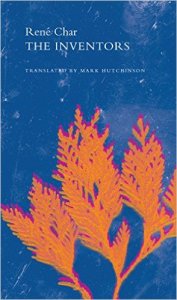
Finally, I have to say something about beautiful book jackets that are all designed by Sunandini Banerjee of Seagull Books.  Each volume is wonderfully colorful and captures the spirit of the poems contained within.

About the Author:
CharHe spent his childhood in Névons, the substantial family home completed at his birth, then studied as a boarder at the school of Avignon and subsequently, in 1925, a student at L’École de Commerce de Marseille, where he read Plutarch, François Villon, Racine, the German Romantics, Alfred de Vigny, Gérard de Nerval and Charles Baudelaire.

Char was a friend and close associate of Albert Camus, Georges Bataille and Maurice Blanchot among writers, Pablo Picasso, Joan Miró and Victor Brauner among painters.


5 Comments

Filed under France, Poetry, Seagull Books

Review: The Anchor’s Long Chain by Yves Bonnefoy

In order to celebrate National Poetry Month, I decided to review some of the poetry collections from Seagull Books.  Thanks so much to Naveen for sending me some beautiful offerings from their catalogue.  First up is an edition of Bonnefoy’s poetry translated by Beverley Bie Brahic.

My Review:
Layout 1This collection of poems begins with a series of short pieces that have some common themes, the most striking of which is a reflection on memory.  The poems appear to the reader as snippets of the poet’s memory as he is trying to reflect on pieces of his life that have passed.   Sometimes the images are very clear and precise.  For example, the end of one poem reads:
 

Do you remember

Our first bedroom?  Do you remember the ad

Flowered wallpaper?  We wanted to strip it off

Only there was other paper underneath,

Layers of it,

And the last, on the grey plaster, newsprint,

With words from the other century

That we rolled under our wet fingers. At last

We craped the wall clean with pen knives.

You were laughing, so was I, night was falling.

But the images that flit across the poet’s memory are not always this transparent.  He oftentimes struggles to grasp at a fleeting memory and it is at these times where the poetry also becomes more blurred for the reader.  One of the most poignant images that he evokes to demonstrate his frustration at the ephemeral nature of memory is that of the Greek god Erebus:

Oh, memories: our Erebus,

A great shapeless sob is at the bottom of us.

Erebus is the perfect symbol for Bonnefoy’s struggle with memory as he is grasping around the dark recesses of his mind to find his past.  As I noted above, the passages in which his memory is not clear come across as muddled and harder for the reader to understand.  One such passage, which I read over and over, is:

She dreams

She is up on the ladder, she knocks at the

closed door.

The engines roar.

Fro the plane’s belly no one responds

And the world takes off.

She hangs there adrift between birth and death

In the calm sky,

The sky where just a few puffs of cloud

Melt into the blue, that is, God–no, the eternal.

One more aspect of these poems that I have to mention is the recurring images of the ocean, the sand and the waves.  They are prominently feature in these short pieces and these images seem to have made an especially lasting impression on the poet’s memory.  He remembers a relationship with a woman as they are walking on the beach; he remembers a summer’s eve when he is crumbling up newspapers to make a fire by the sea.

The next part of the collection actually features short pieces of prose.  Each of these short stories, which I would argue can be considered flash fiction, revolve around the innocence of childhood.  The most striking story is the one entitled “The Long Name.”  The story begins with a boy wandering in the woods and he hears what he thinks is singing.  He stumbles upon a little girl who is setting out things for her tea.  The boy learns that the little girl is a princess and the song isn’t a song at all but her servant calling out her extremely long name.  The girl, who is a princess, explains why the king gave her such a long name.  These stories all have a fairytale quality to them and the poet seems to  envy the innocence and simplicity of childhood.  A little girl who wants to play with her toys and have tea should not be burdened by the adults in her life with such a long and cumbersome name.

The final part of the collection features a series of nineteen sonnets.  I so much enjoyed reading these and I have read a few of them over and over again.  This is the type of poetry collection that will sit on my coffee table and I will pick up and will reread and find something different and interesting every time.  Many of the sonnets are tributes, a tombeau in the French as the note in the text tells us, to artists and writers of the past.  The collection starts with a tribute to Leon Battista Alberti and also includes sonnets about Maupassant, Descartes and Poussin.

My favorite sonnet, which should be no surprise to anyone who knows about my classics background, is the one entitled “Ulysses Sails Past Ithaca.”  In this poem we are given an image of Ulysses as he sail past a place he once knew as his home of Ithaca.  “Remember, with the bees and olive tree,/ The faithful wife and the old dog.”  But this is all gone now, just a fading memory.  The poem ends with the wish that Ulysses might be able to go back to the child he once was that played in the surf.   This sonnet ties together the entire collection perfectly; in its subtle nod to the poetry of Homer the poet uses the images of the fleeting nature of memory and the innocence of childhood.

This is a difficult collection of poetry to review because it is impossible to capture its brilliance in a few short paragraphs.  Thanks to Seagull Books for translating and bringing to English readers this beautiful and thought-provoking collection.

About the Author:
Y BonnefoyYves Bonnefoy (born June 24, 1923) is a French poet and essayist. Bonnefoy was born in Tours, Indre-et-Loire, the son of a railroad worker and a teacher.

His works have been of great importance in post-war French literature, at the same time poetic and theoretical, examining the meaning of the spoken and written word. He has also published a number of translations, most notably Shakespeare and published several works on art and art history, including Miró and Giacometti


7 Comments

Filed under France, Literature in Translation, Poetry, Seagull Books