Tag Archives: Literature in Translation

Review: The 6:41 to Paris by Jean-Philippe Blondel

Today I welcome France Book Tours back to the blog with an intriguing literary novel from New Vessel Press.  This novel was originally written and published in French and this English translation has been done by Alison Anderson. Scroll down to the end of the review to enter to win your own copy and to look at all of the stops on the book tour.

My Review:
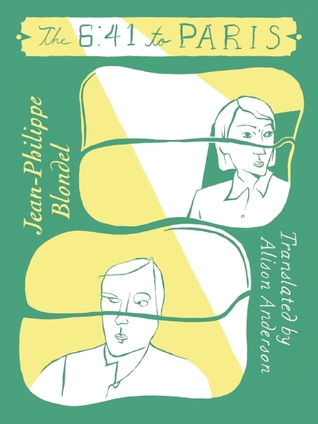
641 to ParisCécile is a stylish and confident forty-seven year old entrepreneur who owns a successful cosmetics company, has been married for twenty years and has a teenage daughter.  When the book opens, she has just visited her elderly parents for the weekend and is about to take the 6:41 a.m. train back to her home in Paris.  As her parents age, her weekend visits to their home are becoming harder for her and more depressing.  The only thing that Cécile wants to do on the train is to relax and have a few hours of peace and quiet.  But when she realizes who sits down next to her on the train, her commute back home is anything but restful.

Philippe Leduc is also forty-seven but time has not been as kind to his physique as it has to Cécile.  Philippe is divorced and his teenage children pretty much want nothing to do with him and he has a monotonous job selling televisions in a big box chain store.  He is also on the 6:41 a.m. train to Paris but for a very different reason than Cécile.  Philippe’s childhood friend is dying of cancer and Philippe is on his way to the hospital in Paris to say his final goodbyes.  Philippe also assumes that his train ride will be quiet, until he realize that the only seat left on the train is the one next to his ex-girlfriend, Cécile.

Philippe and Cécile had a four month relationship when they were in their early twenties.  They were both very different people at the time: Philippe was the most popular boy in school, handsome, and very popular; Cécile was plain looking, shy and did not have many friends.  They immediately recognize one another on the train, but neither one of them has the courage to speak up and acknowledge one other’s presence.  They each sit in silence and contemplate the disaster that was their short-lived romantic relationship that ended more than twenty years ago.

While they were dating, the relationship, for the most part, seemed fine but Cécile always had the feeling that Philippe was better than her and that he would inevitably dump her for someone better.  They go on a trip to London together which ends up being an awful memory for both of them because it is on this very trip that Philippe decides to end the relationship in the worst possible way.  What is interesting about the end of their affair is the effect it has on each of them.  Cécile decides she will never again be made to feel inferior and will not be treated so badly by anyone.  Philippe, on the other hand, knows that he has behaved in a very mean and churlish way towards Cécile and this eats away as his pride and confidence.  He is never able to recover from the guilt of this bad breakup and never has a successful relationship after his time with Cécile.

The ending to this book is very interesting as the author builds up to the conclusion.  We are left wondering if Cécile and Philippe will ever speak with each other; and if they do have a conversation will it be amicable?  New Vessel Press has provided us with another entertaining translation of a charming French book.

About The Author/Translator:

Jean-Philippe Blondel was born in 1964 in Troyes, France where he lives as an author and English teacher.  His novel The 6:41 to Paris has been a bestseller in both France and Germany.

Alison Anderson is a novelist and translator of literature from French. Among the authors she has translated are JMG Le Clézio, Christian Bobin, Muriel Barbery and Amélie Nothomb. She has lived in Northern California and currently lives in a village in Switzerland.

Follow New Vessel Press on Twitter | on Facebook Sign up to receive their latest news and deals.

Giveaway:

You can enter the global giveaway here or on any other book blogs participating in this tour. Be sure to follow each participant on Twitter/Facebook, they are listed in the entry form below. This giveaway is open to US residents only. Five participants will each win an ARC print copy of this book.

Enter here

CLICK ON THE BANNER TO READ OTHER REVIEWS AND AN EXCERPT

641 to Paris_Banner


11 Comments

Filed under France, Literature in Translation

Review: Rock, Paper, Scissors by Naja Marie Aidt

I received an advanced review copy of this title from Open Letter Press through Edelweiss.  This book was originally published in Danish and this English translation is done by K.E. Semmel

My Review:
Rock Paper ScissorsAt the core of the book is the complex character of Thomas who has never really dealt with or gotten over his terrible childhood.  Thomas’ mother walked out on their family when he was a young boy and left Thomas and his sister, Jenny, to be raised by a physically and emotionally abuse father.  When Thomas’ father, with whom he has not had contact in years, dies in prison, all of his unpleasant childhood feelings and memories come crashing in on his life.

Thomas owns and runs a successful stationery store with his best friend and partner, Maloney.  A lot of the book describes Thomas everyday life while he works, goes out for lunch and drinks and spends time with his live-in girlfriend, Patricia.  It seems that Thomas has a good life, a steady income, and is surrounded by stable friends and family.  Thomas is close to his sister, Jenny, and even though she is emotionally needy and dramatic he still feels the need to always protect her.  But when Thomas has to deal with his father’s funeral, he slowly begins to unravel and come apart at the seams.

The sentences and language of the book are oftentimes short, even choppy or staccato, which style fits well with the ever-changing moods of Thomas.  One minute he is enraged and punching a heap of boxes and the next he is calm and happy. There is a long stretch of time in the book, after his father’s funeral, during which Thomas wants to do nothing but sleep.   He becomes distant from Patricia and he won’t even consider having a family with her.  His rage also has sexual manifestations and this is what ultimately drives his girlfriend Patricia away.

A large section of the book is dedicated to a family trip that Thomas takes with Patricia as they go and visit Thomas’ aunt, cousins, sister and niece.  The setting in the rustic countryside and the meals shared together seem to put Thomas at ease and the reader is lured into thinking that Thomas’ rough patch is finally over.  But there is one guest at the party, a young man named Luke, who was an old acquaintance of his father’s.  Thomas doesn’t quite trust Luke or Luke’s supposed relationship with Thomas’ father.  Even when Thomas has some peace like on the weekend vacation, there is always a discomfort or an uneasiness lurking in the background.

One final aspect of the story worth mentioning is Thomas’ encounter with his father’s old business partners.  Thomas accidentally finds a large sum of money at his father’s abandoned apartment and he tries to ask his partners about his father’s criminal past.  But the partners are reluctant to speak about their business at all and it is never even revealed why his father was in prison.  Thomas’ stationery business is vandalized, his home is broken into and his girlfriend is attacked at one point.  Thomas assumes that all of these incidents are related to his father’s illegal business but, despite his theories, Thomas never really gets to the bottom of this mystery.

ROCK, PAPER, SCISSORS is a dark, complex look into the psyche of a man who has had a traumatic childhood; it is also a look into what can happen to that man’s life if these issues are never dealt with.   I will warn you that the book ends on a bit of a cliff hanger.  We can only wonder and hope that Aidt has another episode of Thomas’ story in the works for us.

About The Author:
N AidtNaja Marie Aidt is a Danish poet and writer. She was born in Greenland, and spent some of her childhood there. She published her first book of poetry in 1991, and in 2008 she was awarded the Nordic Council’s Literature Prize.

4 Comments

Filed under Literary Fiction, Literature in Translation

Review: Henri Duchemin and His Shadows by Emmauel Bove

I received an advanced review copy of this collection of short stories from The New York Review of Books.  The stories were written in 1928 in French and this English version has been translated into English by Alyson Waters

My Review:
Henri DucheminThis collection of short stories all feature men who are unhappy and looking for someone or something with which to identify.  In the first story entitled “Night Crime,”  Henri Duchemin, a forty-year-old man,  is alone on Christmas Eve in a pub lamenting over his poverty and loneliness and the last thing he wants to do is to go back to his cold, empty flat.  He wanders around the streets in the rain until he really has no choice but to go home.  But before he goes home, a woman whome he meets on the streets notices his sadness and abrasively suggests that he kill himself.  As he drifts off to sleep, thoughts of suicide and murder haunt his restless dreams.

My favorite story in the collection is written in the epistolary style.  “What I saw” is a letter written by Jean to an unnamed friend; Jean desperately wants his friend’s opinion about something that he saw involving his girlfriend that disturbed him greatly.  Jean’s letter begins with a description of his girlfriend, Henrietta, and her devotion to Jean.  One thinks she is the model woman until, one day, Jean sees her sitting in a taxi and kissing another man.

When Jean confronts Henrietta about the liaison, Henrietta adamantly denies ever being with another man.  Henrietta and Jean’s other friends try to convince Jean that he must have been mistaken and only saw someone who resembled Henrietta.  Jean wants so much to continue his relationship with Henrietta and as he finishes his tale he begs the recipient of the letter to tell Jean his true opinion about Henrietta’s alleged indiscretion.  Jean, like the other characters in the story, has a tenuous grasp on an important relationship in his life and he is eager and even desperate not to lose it.

Another story worth mentioning is “The Story of a Madman.”  Fernand, the narrator, makes it a point at the beginning of his tale to address the reader and inform him or her that he is not, in fact, crazy or out of his mind.  He goes on for a few pages giving us some background about his activities and frame of  mind so that when he carries out his plan, the reader will think he is perfectly sane in doing so.

Fernand then proceeds to have a meeting with his father and tells his parent that he never wants to see him again.  Fernand then makes his way to his girlfriend, Monique’s apartment;  He assures us that he is deeply in love with Monique and they have a fantastic relationship, but he informs her that he never wants to see her again either.  The next stop on Fernand’s list is his best friend, with whom he also breaks off all contact.

Fernand’s final stop on his break-up tour is with his sister and brother-in-law.  After a friendly conversation, he also informs them that he never wants to see them again.  So, we are left wondering why Fernand would alienate all of the people in his life that he loves.  There are hints throughout the story that Fernand is exercising his willpower and that he is attempting to make a plan and adhere to it no matter what others may think.  But the last few sentences of the story leave us with a haunting suggestion that maybe his motives for leaving are a bit more depressing and sinister.

This is a small yet powerful collection of stories that will leave you thinking about these men and their feelings of alienation and unhappiness.  Bove’s language is sometimes curt and sometimes poetic.  He weaves these small tales in such a way that we are never sure where they will end.  I highly recommend this brilliant collection of writing brought to us by The New York Review of Books classics collection.
About The Author:
E BoveEmmanuel Bove, born in Paris as Emmanuel Bobovnikoff, died in his native city on Friday 13 July 1945, the night on which all of France prepared for the large-scale celebration of the first ‘quatorze juillet’ since World War II. He would probably have taken no part in the festivities. Bove was known as a man of few words, a shy and discreet observer. His novels and novellas were populated by awkward figures, ‘losers’ who were always penniless. In their banal environments, they were resigned to their hopeless fate. Bove’s airy style and the humorous observations made sure that his distressing tales were modernist besides being depressing: not the style, but the themes matched the post-war atmosphere precisely.

9 Comments

Filed under France, Literature in Translation, New York Review of Books, Short Stories

Review: Killing Auntie by Andrzej Bursa

I received an advanced review copy of this title from New Vessel Press.  This book was originally written in Polish in 1959 and this English version is translated by Wiesiek Powaga.

My Review:
Killing AuntieJurek is a twenty-year-old college student who lives with his aunt. She is very doting on him and works hard to provide well for him.  So it is rather puzzling when one day she asks him to hang a mirror in their apartment and he turns the hammer he was using for this task on her head.  In two quick and hard whacks to the head auntie is now a corpse.

Jurek’s life, leading up with to this point, is rather mundane and dreary.  He goes to lectures at the university, hangs out with friends, and eats dinners cooked by auntie; there is no real challenge in his life until he is faced with the disposal of auntie’s corpse which is now decomposing in his bathtub.  The humor of the book is very dark, but done brilliant, especially as Jurek tries and fails many times to chop up and hide body parts.

He first takes off a thumb and starts small.  When he tries to flush the finger down the toilet it keeps floating to the surface so he has to fish it out of the commode and try another plan.  He then hacks off a foot and shoves it into the coal stove in his apartment.  All of a sudden there is a massive amount of smoke in his kitchen and an awful stench that draws the attention of his neighbors.  He finally decides to wrap up different body parts and mail them to random people around the city.

Jurek is intent on not getting caught and the anticipation of whether or not his crime will be found out makes this an intriguing read.  Jurek gets very drunk with a group of friends and is picked up by the police on the way home.  He thinks they have found out about his crime and he is ready to confess everything only to learn that they put him in jail for public intoxication.  Jurek also falls in love with a woman he meets on the train and when the relationship with her becomes intimate he confesses everything to her.  For a minute we think that she will tell the police but she suddenly decides to help him dispose of the corpse.  Finally, when another aunt and his grandmother visit they discover the corpse and mistake it for animal meat and bite a chunk out of it.

KILLING AUNTIE is humorous, intense, and in the end, surreal and nightmarish.  The ending is somewhat bizarre but a fantastic and unexpected surprise.  New Vessel Press has given us another brilliant novella in translation that I highly recommend.


About The Author:
A BorsaAndrzej Bursa (March 21, 1932 – November 15, 1957) was a Polish poet and writer. Born in Kraków, he studied journalism, then Bulgarian at Jagiellonian University in Kraków.

Bursa published his first poem in 1954. A prolific writer, he published 37 poems and a short story in different magazines during his lifetime. He died of a heart attack in 1957. Shortly thereafter, his first poetry collection was published, an important event in Polish poetry. Presently, there is a poetry prize named after Bursa which many living Polish poets have won (e.g. Ewa Lipska and Stanisław Barańczak).

5 Comments

Filed under Humor, Literature in Translation

Review: Two Novellas from Flaubert and Dostoevsky

I recently stumbled across a sale that Melville House Publishers was having on their novella series.  They have released 56 novellas from famous authors across the world.  I chose two titles, A Simple Heart by Gustave Flaubert and The Eternal Husband by Fodor Dostoevsky to review here.  Please check out all of the great titles in their selection.  You can even buy a subscription to the novella series and have novellas show up on your doorstep every month: http://www.mhpbooks.com/series/the-art-of-the-novella/

A Simple Heart by Gustave Flaubert:
A simple heartThis novella introduces us to a simple servant woman who is cast out of her own home as an orphan at an early age and searches for intimacy and love for the rest of her life.  Felicite falls in love with a young man who ends up rejecting her so that he can marry a rich, old widow and avoid conscription.  After this disappointing heartache, Felicite never finds another man that she can trust her heart to.  When she comes into the service of Madame Aubain, a young widow with two small children, she is the most faithful and loyal servant anyone could ask for.  Felicite bestows love on the two children who eventually leave home for school and meet a sorrowful end due to illness.  Felicite is also given a parrot which she lavishes with love and attention.  But, like everyone else in her life that she has loved, he dies and leaves her.  This is not a tale with a happy ending but gives us a realistic view of life, love and loss.


The Eternal Husband by Fodor Dostoevsky:
The eternal husbandThe story opens with Velchaninov living in St. Petersburg in an apartment flat by himself trying to iron out the details of a lawsuit.  He has become increasingly depressed and melancholy and has eventually cut himself off from all of his friends and acquaintances.  One day an old friend, whom he has not seen for nine years, shows up on Velchaninov’s doorstep.  He is stunned to see his friend after so many years and further shocked when Trusotsky announces that his wife has died of consumption.  Velchaninov had an affair with Trusotsky’s wife and that is the main reason he hadn’t visited the couple for nine years.  When Trusotsky’s wife broke the affair off, Velchaninov vowed never to see either of the again.

Velchaninov describes Trusotsky as “an eternal husband,” which to him means a man that is subservient to a domineering wife.  Nowadays we might call Trusotsky “henpecked” or “whipped.”  Trusotsky descends into a depression that is fueled by excessive drinking; he turns out to be a man who cannot live without a wife, who cannot operate in the world without the confines of a marriage.  In typical Dostoevsky fashion, we get a glimpse into the male psyche and an interesting and ironic storyline.  I thoroughly enjoyed this story as much as his longer works.

According to the Melville House website, novellas are oftentimes ignored by academics and publishers.  I would love to hear about other readers’ favorite choices as far as this overlooked style of writing.  Do you like novellas and, if so, what are some of your favorites?


18 Comments

Filed under Classics, France, Literature in Translation, Novella, Russian Literature