Tag Archives: Historical Fiction

Review: The Exchange of Princesses by Chantal Thomas

I received an advanced review copy of this title from the publisher, Other Press.  This was originally written and published in French and this English translation is by John Cullen

My Review:
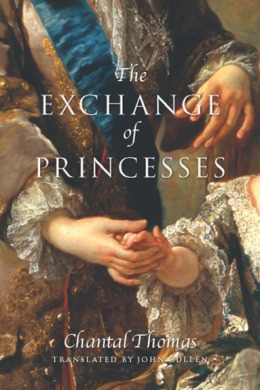
Exchange of PrincessesIn 1721, the regent of France, Philip D’Orleans, decides that the best alliance that the eleven-year-old King Louis XV can make with Spain is through marriage.  The regent proposes that Louis XV marry the princess of Spain, who is only four-years-old at the time of their betrothal.  The regent will also give his own daughter, Louise Elizabeth, a moody 11- year-old girl, to the Prince of Spain, also just a boy of 12,  as a show of good faith.  If you are already confused about names and ages then please don’t let that discourage from reading the book; I was confused in the beginning as well but the author does a good job of repeating the names and making the characters clear and distinct.  In 1722, both princesses set out on a long and arduous trek on the unpaved and rough roads between France and Spain.  The princesses are exchanged on the middle of the journey and each one proceeds to her new home and position.

My favorite part of the book is reading about the four-year-old Spanish princess;  like any little girl she loves her dolls, playing games, and being lavished with attention.  She is talkative and precocious and all of France and the French court becomes smitten with this charming little girl.  The author describes the very adult tasks that she must endure such as receiving ambassadors from foreign countries and attending balls in her honor.  At one such ceremony the little infanta is described as sucking on her thumb and clutching her favorite doll while a group of academics from the University of Paris pay their respects to her.  The only one who is not taken in by the charms of the princess is her own husband, King Louis XV.

Things do not go quite as smoothly as Philip D’Orleans had expected as far as these arranged marriages are concerned.  But, what did the regent expect when he decided to base political alliances on the lives of children?  Even though the little princess, Marianna Victoria, is a delightful four-year-old, her future husband, the king, is a jealous and petty eleven-year-old boy who is very upset that his nanny is now taking care of his future bride.  As he grows up he has no interest, whatsoever in spending any time with her or getting to know her.  The infanta, on the other hand, worships the king and is so thrilled whenever he is around her.

Meanwhile, in Spain the roles are reversed as Louise Elizabeth, the future Queen of Spain, wants nothing to do with her husband Don Luis.  The future King of Spain is so thrilled to have a pretty wife and he wants nothing more than to consummate their marriage.  But Louise Elizabeth does everything she can to keep the Prince away from her.  I don’t want to give too much away, but nothing works out in the end as the regent had intended.

The Exchange of Princesses actually reads more like a non-fiction history book than an historical fiction.  The author uses real letters from the characters involved as well as newspaper articles from the time period.  There are great details about ceremonies, details of palaces and descriptions of costumes.  If you are looking for a fast-paced, exciting historical fiction novel then this is not the book to read.  However, if you want to learn something about the political situation between France and Spain during the 18th century and the players involved then this well-researched novel is the perfect choice.


About The Author:
Chantal Thomas (born 1945 in Lyon) is a French writer and historian. Her 2002 book, Farewell, My Queen, won the Prix Femina and was adapted into a 2012 film starring Diane Kruger and Léa Seydoux.

Thomas was born in Lyon in 1945, and was raised in Arcachon, Bordeaux, and Paris. Her life has included teaching jobs at American and French universities (such as Yale and Princeton) as well as a publishing career. She has published nineteen works, including essays on the Marquis de Sade, Casanova, and Marie Antoinette.

In 2002, Thomas published Les adieux à la reine (Farewell, My Queen). The novel gave a fictional account of the final days of Marie Antoinette in power through the perspective of one of her servants. It won the Prix Femina in 2002, and was later adapted into the 2012 film Farewell, My Queen. The film stars Diane Kruger as the titular queen and Léa Seydoux as her servant Sidonie Laborde. Thomas co-wrote the screenplay,and it opened the 62nd Berlin International Film Festival. Helen Falconer of The Guardian called the work “a well written slice of history” with “evocative, observant prose,” but criticized it for creating a narrator who “merely provides us with a pair of eyes to see through rather than capturing our interest in her own right.” While disagreeing in its classification as a novel, Falconer did however add that Farewell, My Queen “generates in the reader a real sense of being a fly on the wall, eavesdropping on the affairs of the great and the not so good.”

Thomas is currently the director of research at the French National Centre for Scientific Research.

 

3 Comments

Filed under France, Historical Fiction, Literature in Translation, Spain

Review: Newport by Jill Morrow

I received an advanced review copy of this title from the publisher, William Morrow.

My Review:
Newport-428x648-198x300What drew me to this book was the time period in which it is set, between the Great Wars in the Roaring Twenties when Prohibition is firmly entrenched and wealthy families vacation at their summer “cottages” in Newport.  Most of the drama takes place at the Chapman family’s sprawling estate in Newport and at the very core of this drama is a contested will.  Bennett Chapman is in his eighties but he is about to remarry a woman forty years his junior and change his will to make her the primary heir of his textile fortune.

Bennett’s two children, Nick and Chloe, stand to be mostly cut out of their father’s will if he manages to draft a new one.  Nick and Chloe think that their father is completely out of his mind and try to convince Bennett’s lawyers, Adrian and Jim, that Bennett is not mentally capable of making such a decision.  Nick and Chloe’s main evidence for their father’s mental instability is the fact that he has been having séances in which his first wife, dead for over thirty years, is the one who is telling him to remarry and change his will.  Are these séances a farce and an attempt to cheat Bennett out of his inheritance or are they legitimate messages from his wife from beyond?

The plot twist at the end was interesting and the descriptions of Newport in the twenties are the strongest aspects of this book.  The part of the story I had trouble with are the séances and the talking to dead people beyond the grave.  The author used this supernatural aspect to advance the plot which made the whole thing seem silly to me.  But that is just my particular preference for stories that do not involve the supernatural.  The historical setting, the bad behavior of spoiled, rich families and the contested will, in my opinion, could have all stood on their own to make an interesting story without inserting the ghost of a dead wife.

I would love to hear other reader’s opinion about this if you have read the book.  Are there certain additions or twists added to a novel that either distract you or cause you to give it a lower rating?

About The Author:
Jill-Morrow-200x300Jill Morrow has enjoyed a wide spectrum of careers, from practicing law to singing with local bands. She holds a bachelor’s degree in history from Towson University and a JD from the University of Baltimore School of Law. She lives in Baltimore.

6 Comments

Filed under Historical Fiction

Review: White Hunger by Aki Ollikainen

I received an advanced review copy of this title from Peirene Press. White Hunger has been translated from the Finnish by Emily Jeremiah and Fleur Jeremiah

Peirene Press is an independent publisher based in England.  They specialize in translating and publishing the best European novellas. Please visit their site for more fantastic books in translation: Peirenepress.com.

My Review:
White HungerWhat is the color of hunger, poverty and death?  For the Finnish people living during the famine of 1867 it is white because of the prolonged winter and constant blizzards.  It is wretched enough that scores of people are dying from hunger, but when they set out from their homes begging for scraps of food the snow swallows them up before they can find any relief.

Marja and her family are victims of this horrible famine and when her husband becomes gravely ill she must leave him behind to set out in search of food.  Marja bundles up her young daughter and infant son and all three of them embark on a cold, tiresome and relentless journey.  The vivid language of this book made me shutter with sympathetic chills as time and again Marja and her family are denied succor and turned out into the cold.

Ollikainen explores the animalistic nature which extreme circumstances tend to bring out in human beings.  Marja and her young children are treated not just as beggars but something less than human.  They are abused and denied even the most basic needs like food and a warm place to sleep.  I was stunned by the lack of sympathy shown to Marja and her children all along their journey.

The story also depicts Teo and Lars, brothers who, because of their upper class status, fare a little better during the famine.  Teo is a doctor traveling the countryside to bury a friend who has been overcome by disease and hunger.  Teo is a morally ambivalent character in the book and when he encounters Marja we wonder whether or not he will make the humane choice to help her.

WHITE HUNGER is a beautiful yet haunting account of the effects of famine not just on one family but on the conscience of an entire population.  I am so thrilled to have discovered this gem from Peirene Press and I am eager to read more of their titles.

About The Author:
A OllikainenAki Ollikainen was born in 1973, has taken the Finnish literary scene by storm with his extraordinarily accomplished debut novel White Hunger, which has won the most prestigous literary prizes in Finland. A professional photographer and reporter for a local newspaper, the author lives in Kolari in northern Finland. His second novel will be published in spring 2015.


3 Comments

Filed under Literature in Translation, Novella

Review: The Sound of the Sundial by Hana Andronikova

I received a review copy of this title from the publisher. The Sound of the Sundial won the Czech Republic’s prestigious Magnesia Litera Award in the category of Best New Discovery, just a few years before its author died of cancer at the age of 44. It is making its world premiere appearance in English here from Plamen Press.

My Review:
Sound of the SundialThis is the beautiful yet devastating story of a Czech family that is torn apart by the tragedies and atrocities of World War II.  Rachael and Thomas are deeply in love and are the type of couple who perfectly compliment each other:  Rachael has a fiery temper and is very passionate and impulsive while Thomas is calm, thoughtful and contemplative.  Their relationship is traced in the book from its very beginning where they meet in Zlin when Rachael’s devoutly Jewish parents forbid her to have a relationship with Thomas who is not Jewish.

Rachael, of course, defines her parents and marries Thomas despite their objections.  Thomas is a builder for a prominent shoe manufacturer in Czechoslovakia and they send him to India in order to plan a new factory that will be set up in Calcutta.  Quite a bit of the story involves flashbacks to Thomas and Rachel’s time in India where they are also raising their young son Daniel.  The language of the book perfectly captures the sensual, beautiful and almost savage landscape of Calcutta.

Rachael and Thomas return to Czechoslovakia when Rachael’s mother is dying.  Unfortunately, this corresponds with the German invasion of Eastern Europe and the persecution of Jews.  Thomas desperately tries to get his family out of the country before his wife is sent to the Ghetto but he doesn’t manage to do this before his wife is torn from their family.  The scenes of Rachael’s removal and separation from her husband and son are heartbreaking.  Eventually Rachael is sent to Auschwitz where her emotional endurance among deplorable circumstances is beyond description.  Thomas and Daniel long to hear word about her and fight their own madness as they wonder whether or not they will ever see her again.

This is truly a beautiful story about a family and their hardships that echo through the generations.  Even though Daniel is an old man with his own grandchild the stories about his mother and father still bring him to tears.  I highly recommend THE SOUND OF THE SUNDIAL for those who enjoy historical fiction set during World War II as well as an engrossing story.

About The Author:
H. AndronkinovaHana Andronikova was a widely-published Czech writer. She received the Magnesia Litera Award in 2002 for her first novel, Zvuk slunecnich hodin [The Sound of the Sundial] (2001) and went on to author the short story collection Srdce na udici [Heart on a Hook] (2002). Her fiction has appeared in numerous journals and anthologies in Europe and the U.S., including World Literature Today


Leave a comment

Filed under Historical Fiction

Review: The Mapmaker’s Children by Sarah McCoy

I received an advanced review copy of this title from the publisher through TLC Book Tours.

My Review:
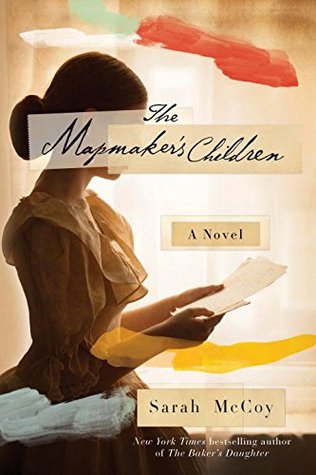
Mapmaker's ChildrenThis story is a dual narrative that traces the lives of two women: Sarah Brown is living in the 1860’s and her father is fighting to free slaves, and Eden Anderson is living in the 21st century and lays around wallowing in self-pity and thinking about her fertility issues.  The contrast between the characters of these two women and how they deal with hardships is extreme.  Sarah learns very early on that she cannot have children because of a high fever from dysentery, but she dedicates her life to her father’s cause of helping free slaves through the Underground Railroad.  Sarah draws maps so that these men and women who are desperate to escape their enslavement can make it to safety.  Even when Sarah’s father is hanged for his part in the Harper’s Ferry uprising, she bravely carries on the abolitionist cause at great personal risk.

Eden, on the other hand, is absorbed by anger and depression because she cannot have a child and she sadly takes her frustrations out on her husband.  When the story opens Eden is ready to give up on her marriage and move out.  The juxtaposition between the strength of Sarah and the weakness of Eden makes Eden an even more unlikeable character.  The eleven-year-old girl named Cleo who lives next door to Eden is a much more interesting and feisty character and both she and a dog named Cricket finally challenge Eden to stop feeling sorry for herself.

The two narratives gradually intersect as a secret door in the pantry of Eden’s house reveals the head of a doll.  With Cleo’s help Eden gets to the bottom of this mystery and she, predictably, learns some valuable lessons for her own life.

The strongest part of this novel is the story of Sarah Brown and her family as they fight for the abolition of slavery.  For me the story of Eden and her infertility were distracting and tiresome.  The events of the Harper’s Ferry Rebellion and the fight for freedom is such a powerful and interesting period of history and these events could stood on their own as the focus of an historical fiction novel.

I am interested to hear what other readers think: do you enjoy historical fiction novels with dual narratives in different time frames?

See what other bloggers are saying about the MAPMAKER’S CHILDREN book tour.  Click on the TLC banner below for a listing of all the stops on the tour.

About The Author:
McCoySARAH McCOY is the New York Times, USA Today, and international bestselling author of The Baker’s Daughter, a 2012 Goodreads Choice Award Best Historical Fiction nominee; the novella “The Branch of Hazel” in Grand Central; The Time It Snowed in Puerto Rico; and The Mapmaker’s Children (Crown, May 5, 2015).

Her work has been featured in Real Simple, The Millions, Your Health Monthly, Huffington Post and other publications. She has taught English writing at Old Dominion University and at the University of Texas at El Paso. She calls Virginia home but presently lives with her husband, an Army physician, and their dog, Gilly, in El Paso, Texas. Sarah enjoys connecting with her readers on Twitter at @SarahMMcCoy, on her Facebook Fan Page or via her website, http://www.sarahmccoy.com.

tlc-logo-resized

9 Comments

Filed under Historical Fiction