
I received a review copy of this title from Farrar, Straus & Giroux via Netgalley. The book was published in the original German in 2014 and this English version has been translated by Charlotte Collins.
My Review:
 We are first introduced to Andres Egger in 1933 when he has had an unexplained instinct to pay a visit to his elderly neighbor, Horned Hannes. Hannes is a reclusive goatherd who lives in the same Austrian mountain village as Egger and when Egger finds the old man he is barely alive. Egger attempts to carry the goatherd on his back down the mountain but in a fit of madness due to his fever the goatherd runs off into the snow never to be seen again. Between the time that Egger loses the goatherd while carrying him down the mountain and the goatherd’s petrified body is found forty years later on a mountain ledge, we are told the story of Egger’s whole life.
From the beginning of the book there is a sense of foreboding and ill omen. As Egger is struggling down the mountain side with the goatherd strapped to his back they engage in an eerie conversation about death. Horned Hannes tells Egger: “People say death brings forth new life, but people are stupider than the stupidest nanny goat. I say death brings forth nothing at all! Death is the Cold Lady.” This discussion of death hangs over the entire story like a dark storm cloud. Egger’s tragic beginnings as an orphaned child further serve to set the tone as one of tragedy and misfortune.
Egger is orphaned as a small boy of four when his mother dies of consumption and he is sent to live with a distant relative. The relative, a farmer named Hubert Kranzstocker, took pleasure in beating the small boy with a hazel rod for the slightest indiscretions like spilling his dinner. Kranzstocker is so brutal in his beatings that he breaks the boy’s leg and causes Egger to have a limp for the rest of his life. The author builds sympathy for this boy throughout the first part of the narrative: “To all intents and purposes he was not seen as a child. He was a creature whose function was to work, pray, and bare his bottom for the hazel rod.” To an outsider looking in, this wretched boy who is given no love and no warm place to call his own is deserving of the utmost pity; but Egger himself would never think to waste a single moment on self-pity. He stoically accepts what fate has to offer him and he does the best he can given his awful fate.
When Egger finally breaks free of his abusive relative at the age of eighteen he supports himself by taking on odd jobs and he saves up to buy himself a small piece of land on the mountain. His earthly possessions are meager but they are his pride and joy because he bought them with his own earnings and he can make what he wants out of them. The most sentimental thing that he owns is the gate that leads onto his property; one day he hopes to open the gate to a real visitor so he can show someone what he has made of the place. This is a subtle hint that although Egger doesn’t complain about his isolation from the rest of the village, he still experiences loneliness and longs for some human contact and intimacy. His visitor finally does come, in the form of a woman as gentle and brave as Egger himself. But once again, cruel fate has other circumstances in store for Egger.
Egger eventually gets a regular job helping to build cable cars that will ferry tourists up to the top of the mountain. He has conflicting emotions about his job because although it does provide him with a steady and respectable income, he doesn’t like cutting down trees and disturbing the natural landscape of his beloved mountain. Egger recognizes the tension that his mountain must feel as each piece of rock is blasted from her façade and each precious tree is felled from her forest. There is a hint in the text that the destruction caused by avalanches that occasionally happen on the mountain are mother nature’s way of exacting her revenge.
Through the years Egger continues to work hard and survive the best way that he knows how. He has an adventure during World War II when, after fighting for only a couple of months, he is captured by the Russians and lives for years in a prison camp. Even while he is in the camp Egger never complains about his fate. As long as there is enough work in the camp to keep him busy then his mind is able to endure much more hardship than most. And looking back on his life, perhaps it is the misery of Egger’s early years that have helped him to become strong and to even survive the hunger, disease and cold of a Russian prison camp.
The author’s simple prose is fitting for the life of this simple man; Egger’s story is emotionally jarring yet uplifting at the same time. When the book comes to its end Egger has lived to be almost eighty years old and he has no regrets in his whole life: “He had never felt compelled to believe in God, and he wasn’t afraid of death. He couldn’t remember where he had come from, and ultimately he didn’t know where he would go. But he could look back without regret on the time in between, his life, with a full-throated laugh and utter amazement.”
About the Author and Translator:
 Robert Seethaler was born in Vienna in 1966 and is the author of four previous novels. He also works as an actor, most recently in Paolo Sorrentino’s Youth. He lives in Berlin.
Charlotte Collins studied English at Cambridge University. She worked as an actor and radio journalist in both Germany and the U.K. before becoming a literary translator. She previously translated Robert Seethaler’s novel The Tobacconist.
 This collections defies classification as far as genre is concerned. The introduction to the book calls the writings a collection of eighty-one “brief texts” that were written throughout the course of Walser’s life. Some of the writings appear to be fictional short stories but others have a distinctly autobiographical feel to them. Walser even writes a few short dialogues and a book review. In addition, he has a wide range of topics and themes and writes about anything from nature, to fashion, to death and dying. This is a collection best absorbed a few pieces at a time so one can savor his pithy and didactic collection.
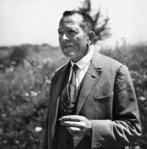 Robert Walser (1878–1956) was born into a German-speaking family in Biel, Switzerland. He left school at fourteen and led a wandering, precarious existence while writing his poems, novels, and vast numbers of the “prose pieces” that became his hallmark. In 1933 he was confined to a sanatorium, which marked the end of his writing career. Among Walser’s works available in English are Jakob von Gunten and Berlin Stories (available as NYRB Classics), The Tanners, Microscripts, The Assistant, The Robber, Masquerade and Other Stories, and Speaking to the Rose: Writings, 1912–1932.
 This story is told in the first person by a forty-five year old man named Germain who describes himself as being “soft in the head.” Germain tells us about his current circumstances and his life as well as his childhood and early years. He vividly describes his experiences in primary school with his teacher, “The strong get off on walking all over other people, and wiping their feet while they’re at it, like you would on a doormat. This is what I learned from my years at school. It was a hell of a lesson. All that because of some bastard who didn’t like kids. Or at least he didn’t like me. Maybe my life would have been different if I’d had a different teacher. Who knows? I’m not saying it’s his fault I’m a moron, I’m pretty sure I was one even before that. But he made my life a misery.” I don’t include very many quotes in my reviews, but when I read this part of the book I had tears in my eyes and I felt like someone punched me in the stomach.
 Born in Bordeaux in 1957, Marie-Sabine Roger has been writing books for both adults and children since 1989. Soft in the Head was made into a 2010 film, My Afternoons with Margueritte, directed by Jean Becker, starring Gerard Depardieu. Get Well Soon won the Prix des lecteurs de l’Express in 2012 and will be published by Pushkin Press in 2017.
 This book is a very slim volume and can be read in an hour or so. It attempts to answer the question that has been nagging historians and artists for centuries: Who, exactly, was the woman Mona Lisa that Da Vinci made so famous in his painting? In this plot it is a French aristocrat that becomes obsessed with the mysterious woman in Da Vinci’s painting.
 Alexander Lernet-Holenia was an Austrian poet, novelist, dramaturgist and writer of screenplays and historical studies who produced a heterogeneous literary opus that included poesy, psychological novels describing the intrusion of otherworldly or unreal experiences into reality, and recreational films.
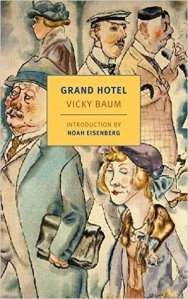 The Grand Hotel is the place to stay for anyone who wishes to be surrounded by luxury and high society in 1920’s Berlin. The guests that have all checked into the hotel in March of 1929 are an interesting mix of misfits whose stories all collide in a cleverly intertwined plot.



 The Book Binder's Daughter