Tag Archives: Classics

Corpus Erat: The Metamorphosis of Marcus in Brigid Brophy’s Flesh

This was my first experience with a Brophy text and I was pleasantly surprised by her writing even with a rather short novella. I viewed the book as a metamorphosis, much like those described in Ovid’s epic poem, in both a physical and emotional sense. At the beginning of the story Marcus is a timid, skinny, introvert who lingers at the edge of the parties that he forces himself to attend. He is the only boy of a wealthy Jewish family living in London and, as a result of his upbringing, he leads a rather pampered life. He has his own flat in London, for instance, but most nights he goes home for dinner and sleeps at his parent’s home. Since he has no need of a real occupation or a source of income, he spends his time reading and studying art. Being an introvert myself, Brophy’s description of Marcus’s awkwardness at a party made me cringe:

He had got himself hemmed in by other people’s backs and jammed in a corner between a bookcase and a table of food, on either of which was there room for him to set down his glass, which had been empty for half an hour. He picked out one of the books, opening up a black gap on the shelf, and mimed reading. But this solitary pleasure at a party seemed to him as much a solecism and a confession as if he had stood there wiggling a loose tooth in his mouth; and the feeling of being exposed overwhelmed any pleasure the book might have given him.

Marcus meets his future wife, Nancy, at this same party and this interesting woman is immediately drawn to Marcus because of the potential she sees in him. A potential for what, we have no idea at first. But when a very nervous and virginal Marcus is initiated into the pleasure of the flesh during his honeymoon, we are made to understand that she saw in Marcus a man that she could teach to please her in just the ways she needed: “Nancy did have a talent. It was for sexual intercourse.”

What I found most surprising in this small book is that, although much of the narrative is funny and quirky, Brophy also inserts passages with sublime, poetic descriptions of physical intimacy. After Marcus and Nancy consummate their marriage, she writes:

Where she led him was a strange world that was not new to him, since he had always known it existed, subterraneanly: a grotto, with whose confines and geographical dispositions he at once made himself quite familiar, as with the world of inside his own mouth: but a magic grotto, limitless, infinitely receding and enticing, because every sensation he experience there carried on its back an endless multiplication of overtones, with the result that the sensation, though more than complete, was never finished, and every experience conducted him to the next; a world where he pleasurable lost himself in a confusion of the senses not in the least malapropos but as appropriate and precise as poetry—a world where one really did see sounds and hear scents, where doves might well have roared and given suck, where perfectly defined, delightful local tactile sensations dissolved into apperceptions of light or darkness. of colour, of thickness, of temperature…

This marks the turning point in Marcus’s transformation to a more self-confident man. He finds a job that he is good at and really likes, he starts to gain quite a bit of weight, and he continues to delight in the physical aspect of his marriage to Nancy. As Brophy lingered on Marcus’s physical transformation in the second half of the novella, I kept thinking of a line in Ovid’s Metamorphoses when Pygmalion discovers that he statue has come to life: “Corpus erat! “ (It was a body!), he exclaims.

I have one other Brophy, The King of a Rainy Country, sitting on my bookshelf that I am now eager to read. I am about to visit some amazing bookstores on my summer travels, so please let me know in the comments of other Brophy titles I should be on the lookout for.
9 Comments

Filed under British Literature, Classics

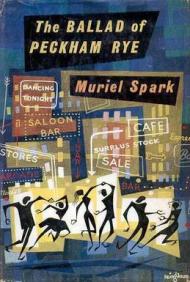
The Ballad of Peckham Rye: My First Experience with Muriel Spark

This is my first Muriel Spark book (thanks to Grant at 1st Reading for giving me the nudge to try her) and I knew from these opening sentences that I would enjoy her writing very much:

‘Get away from here, you dirty swine,’ she said.

‘There’s a dirty swine in every man,’ he said.

‘Showing your face round here again,’ she said.

The “he” is Humphrey, who has recently jilted his bride-to-be, Dixie, at the altar and the “she” is Dixie’s mother.  Spark’s narrative is full of surprises, the first, and most obvious of which, is that the author begins her story at the end.  My impression after reading the first page was poor Dixie, what an awful thing to happen to her.  But over the course of the next 140 pages Spark convinces me that Humphrey probably made the right decision.  Men might have something of the dirty swine in them, but the ladies don’t fair much better in this humorous and strange book.

Dougal Douglas, the new guy in town, is blamed not only for the failed wedding, but also for the other mayhem that has recently broken out in town—fighting, absenteeism at the local textile factory, and even murder.  He keeps showing everyone that he used to have two horns on his head that were surgically removed and so many people believe that he is, physically and mentally, a devil.  Although Dougal is shrewd and quirky, his intentions are not really evil.  And, unlike everyone else in Peckham, he is rather forthcoming about his greatest weakness—he can’t stand any type of sickness.  At the first sign of a disease he will flee as fast as he possibly can.

The two subplots in the text that entertained and intrigued me the most were those that involved Mr. Druce, a manager at the local factory and Dixie’s thirteen year-old brother, Leslie.  Mr. Druce is in a rather unhappy marriage of twenty years and is having a an affair with the head of the typing pool.  When Dougal questions Druce about his reasons for staying in the marriage, it seems that the wife has some sort of secret that she is holding over her husband.  And what is even more interesting is that the pair having spoken in a few years, only communicating through notes.  Mr. Druce and his odd behavior keep the tension building in this bizarre narrative right up to the final page.

Leslie, at first, seems like a typical, sulky teenager who is withdrawn from his family.  But as the story goes on we learn that this boy has a much more sinister side and is involved with gangs, blackmail and roughing up old ladies.  His parents argue over his upbringing, or lack thereof; his father thinks that since he works all day that the responsibility of childrearing falls on the maternal parent and his mother thinks that his father ought to take more of an interest in his son’s life.  So the result of this parental stalemate is a wild boy who tortures his sister and his neighbors and never suffers any consequences for his bad behavior.

This was just the perfect book to enjoy poolside on a hot Sunday afternoon.  I look forward to reading more of Spark over my summer holidays.  I have Open to the Public, The Mandelbaum Gate and Memento Mori sitting on my TBR piles.  Please let me know what other books of hers you would also recommend.

18 Comments

Filed under Classics

How Always Alone: Nothing but the Night by John Williams

Published in 1948, Nothing but the Night is John Williams’s, little known about, first novel.  It takes place over the course of a single day in the life of twenty-three year old Arthur Maxley who has suffered a very traumatic experience in his childhood.  When we first meet Arthur, he is alone in his apartment—he is most often alone—and after a night of solitary drinking and reading is just waking up from a dream.  The story is intense and suspenseful from the very beginning as Williams slowly reveals the tragedy Arthur has suffered in his early life.  By slowing down time in his narrative, we are given a realistic glimpse into Arthur’s fractured and damaged mind.  For instance, Arthur forces himself to get out of bed and take a walk in the park, but never actually makes it to the park because he goes into at a seedy diner.  The vivid and startling description of his breakfast is a clue that Arthur is truly suffering:

From the chipped blue plate, the egg stared up at him like a knowing, evil eye.  At first, he was amused by the fancy; but as he stared longer and as the yellow eye glared back at him, he became acutely uncomfortable.  He blinked rapidly.

And still the yellow pupil stared senselessly at him from its greasy white orb.  He reached for the bottle of Tabasco sauce and poured a bit of the fiery red liquid on the eye.  As if it were suddenly irritated beyond all endurance, the white surrounding matter became alarmingly bloodshot and developed a network of liquidly shifting veins, changing the vacant expression into something almost frightening.  It looked up at him reproachfully, as if in great agony.

With an effort, he tore his gaze away and forced his lids down to cover his own eyes and he shook his head vigorously from side to side.  He tried to laugh at himself.  These fancies…Why did he allow them to take hold of him?  It was only and egg, a simple thing, and for a moment his imagination (it was only his imagination) had made him think that…

Throughout the course of his ordinary day, Arthur is on edge and easily startled by what appear to be the simplest things.  Two events in particular, though, trigger flashbacks to that fateful day in Arthur’s childhood—a letter and a visit from his father.  Williams slowly builds up to revealing Arthur’s tragic memory at the very end of the book which, I thought, was rather unexpected.  The dramatic suspense and Williams’s depiction of the loneliness of mental illness are the strengths of this book.  No one can truly understand Arthur’s suffering, even if he were able to put it into words.  A brief distraction with a lovely woman at a nightclub only highlights Arthur’s abiding sense of being alone.  He thinks he is happy for a fleeting moment, but then his intrusive thoughts come flooding back to him:

And again the desire to convey to her his utter contentment overwhelmed him.  But there was the barrier, always the barrier of words; and that which he now felt was beyond words, deeper and more meaningful.  He opened his mouth to speak, then closed it again, and said nothing.

For at the moment he realized that this understanding which he so desired was a thing that must come from between them, inviolate and alone, unasked and unacknowledged.  And he thought for a moment that he had discovered the secret.

This was the thing that drew men and women together: not the meeting of minds nor of spirits, not the conjunction of bodies in the dark insanity of copulation—none of these.  It was the tenuous need to create a bond, a tie more fragile than the laciest ribbon.  It was for this that they strived together, ceaselessly and always really alone; it was for this that they loved and hated, gathered and threw away. For only the little thread which they could never test for the fear of its destruction, for only the delicate thread which they could never secure for fear of breaking it in two.

How alone we are, he thought. How always alone.

The three books of Williams’s that I have read—Stoner, Augustus, and Nothing but the Night—are all very different stories.  I would advise not to go into this short novel expecting any of the narrative elements that are in his other two books.  What is similar, however, in all three novels is the author’s brilliant and mesmerizing way he uses language; there is something about Williams’s style of writing that completely absorbs me and draws me into these different worlds he creates.

(I read the Vintage edition published in the U.K., but NYRB Classics is also reissuing this book later this year.)


15 Comments

Filed under Classics, Literary Fiction, New York Review of Books

A Certain Amount of Daring: Two Serious Ladies by Jane Bowles

When I mentioned on Twitter that I was going to read my first Jane Bowles story, there was a rather strong, positive reaction to her writing.  But the comments I received about Two Serious Ladies still did not prepare me for reading this story.  This short novel, in fact her only one, is enigmatic, humorous, surprising, even shocking and sad all at the same time.  Truman Capote’s description of the story, I think, sums it up best:

Voyaging for the first time into Two Serious Ladies, I was immediately disoriented.  I did not know what to make of this object at all.  There was no discernible narrative strategy.  There was no way of explaining or analyzing the processes at work.  Interpretation was useless.  The vistas were dispiriting, the food foul, the wind always howling.  Her people were mournful, impulsive, and as erratic in their peculiar journeys’ flights as bats.  They were often drunk.  They thought continuously, obsessively, but had no thoughts exactly, no helpful method of perceiving the world or their positions in it.

Miss Goering and Mrs. Copperfield, the two serious ladies, spend very little time together as they are casual acquaintances.  Each has her own distinct story, but what fascinated me about both of them is their attempt to live on their own terms and find their own versions of happiness.  I found them a bit crazy but also rather brave.  Mrs. Copperfield is dragged to Central America by her adventurous husband; we get the feeling that she stays with him out of a sense of duty, even fondness or nostalgia, but she would much prefer to be off on her own.  And that’s exactly what she does.  In Colon she stays at a seedy hotel, makes friends with a prostitute, and drinks way more gin than she ought to.  At the end of the story she tells Miss Goering, “I have gone to pieces, which is a thing I’ve wanted to do for years.  I know I’m as guilty as I can be, but I have my happiness, which I guard like a wolf and I have authority now and a certain amount of daring, which, if you remember correctly, I never had before.”

Miss Goering is horrified by Mrs. Copperfield’s new outlook on life, but perhaps she is frightened by those qualities which she recognizes in herself.  When the story begins she is a spinster living alone on her family’s home in upstate New York but she slowly gathers a rather strange entourage of people around her.  I found Miss Goering’s narrative to be the most surprising.  What oftentimes begins as a humorous description of her adventures quickly turns melancholy; twice she is invited by men back to their apartments and on both occasions nothing turns out as one would expect.  She is different from Mrs. Copperfield in that she seems to be on a mission to save herself and the strange men she meets from some sort of sin.  Her last words in the novel are mysterious and disconcerting: “‘Certainly I am nearer to becoming a saint,’ reflected Miss Goering, ‘but it is possible that a part of me hidden from my sight is piling sin upon sin as fast as Mrs. Copperfield?’ This latter possibility Miss Goering thought to be of considerable interest but of no great importance.”

I am very eager to read Bowles’s letters which I am impatiently awaiting to arrive in the mail.  I suspect, from what little I know about her life and from reading this book, that I will find among them humor, sadness, loneliness and a lot of drinking.

16 Comments

Filed under Classics, Literary Fiction

Some Thoughts on The Warden by Anthony Trollope

I was emailing a friend who has read quite a bit of Trollope and he remarked that this author’s novels are rather entertaining but when one closes the last page of some of his tales, they are soon forgotten.  After reading his messages about Trollope, and also seeing a thread on literary Twitter about The Warden,  I was very eager to give Trollope a try for myself.  I have rather mixed feelings about this first novel; some parts of it were amusing but overall I was a bit underwhelmed with my first experience in Barsetshire.

No one in Trollope’s narrative, which story involves an attempt at economic reformation of the Church,  is spared his sarcasm and ridicule.  The Warden, a kind, old man who lives with his daughter Elenor, has served his position as leader of Barchester hospital that cares for poor, elderly, retired, working class men who would otherwise be homeless.  It was established in the benefactor’s will in the 15th century that, in exchange for his minimal work, the Warden receives a yearly salary of 800 pounds and the use of a comfortable, some might even say lavish, home.  Reformers, led by a local doctor named John Bold, believe that the old bedesmen living at the hospital ought to receive a larger share of the income from the hospital’s estate.  When lawyers, other reformers, and the newspaper weigh in on the matter, the Warden is, rather unfairly,  made out to be a prime example of the greed of the clergy who take money from the poor in order to live in the lap of luxury.

The archdeacon, also the son-in-law of the Warden, is satirized by Trollope as a prime example of the Church clerics who will defend this institution at any cost:

Though doubt and hesitation disturbed the rest of our poor warden, no such weakness perplexed the nobler breast of his son-in-law.  As the indomitable cock preparing for the combat sharpens his spurs, shakes his feathers, and erects his comb, so did the archdeacon arrange his weapons for the coming war, without misgiving and without fear.  That he was fully confident of the justice of his cause let no one doubt.  Many a man can fight his battle with good courage, but with a doubting conscience; such as not the case with Dr. Grantly.  He did not believe in the Gospel with more assurance than he did in the sacred justice of all ecclesiastical revenues.

The reformers are equally a target of ridicule in Trollope’s tale.  John Bold, who had good intentions when he stirred up the whole controversy and genuinely wanted to help out the poor, old bedesmen, is easily swayed to put the matter aside because of love.  Bold is courting the Warden’s daughter, Eleanor, and when Eleanor pleads with her lover to put aside the case against the hospital and her father, he is very quick to oblige:

‘I would give her my soul, if it would serve her,’ said Bold still addressing his sister; ‘everything I have is hers, if she will accept it; my house, my heart, my all; every hope of my breast is centred in her: her smiles are sweeter to me than the sun, and when I see her in sorrow as she now is, every nerve in my body suffers.  No man can love better than I love her.’

Even though Trollope makes Bold seem a bit of a fool by giving up his attempt at reform for a woman, I was glad that Bold made this decision.  The sappy, romantic in me was glad Bold chose love over a law suit.

Trollope goes on and on poking fun at various parties involved in the attempt to redistribute the Warden’s salary among the bedesmen.  But the book ends on a rather sad note when it is the Warden and the old men at the hospital who suffer the most from the fight between the clergy and the reformers.  Although they are themselves not entirely blameless in the matter, it is their lives that are most negatively affected by the arguments of more important and influential men.

Despite my mixed feelings, I will continue with the Barsetshire Chronicles.  My friend, who I mentioned above, did remark that Barchester Towers, the next book in the series, is definitely worth a “quick spin through the eyeballs.”

27 Comments

Filed under British Literature, Classics