Tag Archives: British Literature

Moderating and Checking The Emotions: Of Human Bondage by W. Somerset Maugham

One of my closest friends is always telling me not to take off hand remarks or things that people say personally. It’s a good piece of advice but one that is much easier said than done. I think he is gently trying to teach me what Spinoza says in his Ethics about emotions being a type of human bondage:

Human infirmity in moderating and checking the emotions I name bondage: for, when a man is a prey to his emotions, he is not his own master, but lies at the mercy of fortune: so much so, that he is often compelled, while seeing that which is better for him, to follow that which is worse. Why this is so, and what is good or evil in the emotions, I propose to show in this part of my treatise. But, before I begin, it would be well to make a few prefatory observations on perfection and imperfection, good and evil.

W. Somerset Maugham uses this phrase from Spinoza, “Of Human Bondage” as the title of his novel about a young man who is born at the turn of the 20th century with a club foot and is orphaned at the age of nine. Philip Carey, when both his parents die within a year of each other, is sent to live with his aunt and uncle who live in the vicarage of a small fishing village. Although his aunt, who is childless herself, nurtures and cares for Philip, his uncle, the pastor, is a stern and rigid man who quickly sends the boy off to boarding school at the age of ten.

Philip’s club foot is a constant source of humiliation since he can’t participate in most of the other boys’ games. He spends a great deal of time by himself reading books. His ostracism, loneliness, and the indignity he suffers from his disability often drive him to fits of anger which he directs at the people who are closest to him—his aunt, his school friend, his love interest. But this is not a “feel good” story about the life of a person who is heroic, humble or brave because of his deformity. But instead, Maugham adroitly develops the character of a flawed man who is self-reflective enough to work through his negative emotions—his “bondage.” Much like the ancient Greek tragedies—Oedipus especially comes to mind—his anger leads him to pain and heartache and he must learn to tame these negative emotions.

Philip’s other emotional bondage is revealed when he is smitten with a waitress in a coffee shop he frequents in London. Mildred is uncouth and cold to him, but she uses his feelings to her advantage. He starts out by buying her gifts, nice dinners and tickets to music halls. But his obsession with her drives him to the extreme of supporting her and a child she has with another man. Maugham hints several times in the text that Philip is mostly drawn to Mildred by pure, animal attraction. The crueler she is to him and the worse she treats him, the more he wants to possess her and relieve his physical desires: “It seemed to him that he was swayed by every light emotion, as though he were a leaf in the wind, and when passion seized him he was powerless. He had no self-control.”

Philip’s character is further tested and developed as he tries to decide what he should do with his life. He hates boarding school and leaves before he graduates to spend a year in Germany. He learns languages and reads voraciously there but when he returns to England he is a miserable failure when he tries to be an accountant in an office in London. He then enrolls in art school in Paris where he thinks about a career as a painter. It’s in Paris where he encounters authors and artists who are miserable, drunks who have wasted away their lives in the unrealistic pursuit of a famous career. His time in Partis is the turning point in the book, when Philip becomes especially contemplative as he reflects on the meaning of life and what his purpose in it might be. Philip returns to London after two years and he decides to attend medical school and become a doctor like his father that he barely knew.

Philip doesn’t get his medical degree until he is nearly thirty and persists in this career despite suffering multiple setbacks. Because of the things he has learned through his experiences he becomes master of his emotions and can appreciate all that he has been through. He is no longer quick to anger and he becomes known among his patients for his kind and gentle bedside manner. His awful experiences with Mildred do not make him bitter, but instead when he finds a remarkable woman who loves and adores him he is able to return that love with equal affection.

He accepted the deformity which had made life so hard for him; he knew that it had warped his character, but now he saw also that by reason of it he had acquired that power of introspection which had given him so much delight. Without it he would never have had his keen appreciation of beauty, his passion for art and literature, and his interest in the varied spectacle of life. The ridicule and the contempt which had so often been heaped upon him had turned his mind inward and called forth those flowers which felt would never lose their fragrance. Then he saw that the normal was the rarest thing in the world. Everyone had some defect, of body or of mind.

Maugham’s novel is a remarkable piece of literature not only for its development of a complex character but his writing is that of excellent literature at its finest. It may sound a little silly, or cliche, to say this but the best books always make me look at the world a little differently; Of Human Bondage has certainly made me appreciate my friend’s advice against getting pulled down by negative emotions.
22 Comments

Filed under British Literature, Classics

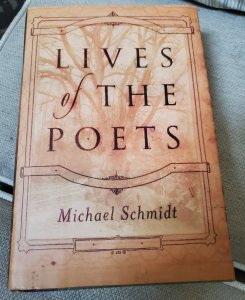
Lives of the Poets by Michael Schmidt: Some Concluding Thoughts

My life, like everyone else’s in the world, has been completely upended this week. I’ve had to learn how to move all of my classes online and I’ve pretty much stayed in my house for the past week. The worst part about this has been my inability to focus on reading. But on the bright side my husband, daughter and I are safe at home and enjoying each other’s company and we are both still very lucky to have jobs. I have found my friends on Twitter, especially those in the literary community, to be particularly soothing at this time. Naveen from Seagull Books has reminded us many times that it’s the books that will save us. Just today he wrote, “Yes. We need compassion. And that old fashioned love for everyone around us. So yes. Books.” I decided to ease my anxiety by forcing myself to concentrate on what has been one of my favorite books since last spring, Michael Schmidt’s Lives of the Poets which I finally finished last night.

Lives of the Poets, at nearly 1,000 pages, is an impressive survey of more than 300 English language poets spanning the last 700 years. Each of the 64 chapters, which proceed in chronological order, have brief biological sketches of poets including their places of birth and their educational backgrounds. What is astonishing about the book is the cumulative nature of poetry and how Schmidt connects poets and generations of poets together. Schmidt lays out his intentions for his survey of these poets in the second chapter:

Poems swim free of their age, but it’s hard to think of a single poem that swims entirely free of its medium, not just language but language used in the particular ways that are poetry. Even the most parthenogenetic-seeming poem has a pedigree. The poet may not know precisely a line’s or a stanza’s parents; indeed, may not be interested in finding out. Yet as readers of poetry we can come to know more about a poem than the poet does and know it more fully. To know more does not imply that we read Freud into an innocent cucumber, or Marx into a poem about daffodils, bu that we read with our ears and hear Chaucer transmuted through Spense, Sidney through Herbert, Milton through Wordsworth, Skelton through Graves, Housman through Larkin, Sappho through H.D. or Adrienne Rich.

This book has had two very personal effects on me which I will focus on in my post. First, Michael Schmidt has made me feel more grateful than I have ever been to have studied classics and have degrees in Latin and Ancient Greek. One of the most obvious threads that emerged for me in the course of reading this book is how much the English language poets have drawn on the materials, language, themes, etc. of the ancient poets. From the earliest instances we have of English language poetry through the 20th century there is a robust tradition of poets using ancient sources. Some of the ones I’ve discovered have been profound and have further enriched my study and teaching of classics.

One of my favorite discoveries in Schmidt’s book is Chapman’s poem “Ovid’s Banquet of Sense.” I have long been familiar with Chapman’s translations of Homer, but he is a brilliant poet when he is composing his own verses. “Ovid’s Banquet of Sense” is a description of the Roman poet’s feast of senses that is triggered when he see Corinna bathing naked in her garden. Chapman explains that Corinna is a pseudonym for Julia, the Emperor Augustus’s daughter, who has walked into the courtyard where she proceeds to bath, play the lute and sing, all of which Ovid observes hidden by an arbor. His first sense that is stimulated by her is his sight:

Then cast she off her robe and stood upright,
As lightning breaks out of a labouring cloud;
Or as the morning heaven casts off the night,
Or as that heaven cast off itself, and show’d
Heaven’s upper light, to which the brightest day
Is but a black and melancholy shroud;
Or as when Venus strived for sovereign sway
Of charmful beauty in young Troy’s desire,
So stood Corinna, vanishing her ‘tire.

Oftentimes poets don’t necessarily dedicate an entire poem to writing about a classical theme, but instead weave allusions to ancient myths into their poems. Another favorite discovery from Schmidt’s book is the poet The Earl of Surrey and his poem “When Raging Love” is an excellent example of this type of classical allusion:

When raging love with extreme pain
Most cruelly distrains my heart;
When that my tears, as floods of rain,
Bear witness of my woeful smart;
When sighs have wasted so my breath
That I lie at the point of death:

I call to mind the navy great
That the Greeks brought to Troy town,
And how the boysteous winds did beat
Their ships and rent their sails adown,
Till Agamemnon’s daughter’s blood
Appeased the gods that them withstood.

And how that in those ten years’ war
Full many a bloody deed was done,
And many a lord, that came full far,
There caught his bane, alas, too soon,
And many a good knight overrun,
Before the Greeks had Helen now.

Then think I thus: since such repair,
So long time war of valiant men,
Was all to win a lady fair,
Shall I not learn to suffer then,
And think my life well spent to be
Serving a worthier wight than she?

Therefore I never will repent,
but pains contented still endure:
For like as when, rough winter spent,
The pleasant spring straight draws in ure,
So after raging storms of care
Joyful at length may be my fare.

And one more example of poets using classics, and another favorite discovery from Schmidt, is the Australian poet A.D. Hope. This is an example of a poet using a myth as a springboard in order to expand the voice of a character that we don’t hear from in the original, ancient sources. In his poem “The Return of Persephone” Hope gives us this myth from Persephone’s point-of-view:

Gliding through the still air, he made no sound;
Wing-shod and deft, dropped almost at her feet,
And searched the ghostly regiments and found
The living eyes, the tremor of breath, the beat
Of blood in all that bodiless underground.

She left her majesty; she loosed the zone
Of darkness and put by the rod of dread.
Standing, she turned her back upon the throne
Where, well she knew, the Ruler of the Dead,
Lord of her body and being, sat like stone;

Stared with his ravenous eyes to see her shake
The midnight drifting from her loosened hair,
The girl once more in all her actions wake,
The blush of colour in her cheeks appear
Lost with her flowers that day beside the lake.

The summer flowers scattering, the shout,
The black manes plunging down to the black pit —
Memory or dream? She stood awhile in doubt,
Then touched the Traveller God’s brown arm and met
His cool, bright glance and heard his words ring out:

“Queen of the Dead and Mistress of the Year!”
— His voice was the ripe ripple of the corn;
The touch of dew, the rush of morning air —
“Remember now the world where you were born;
The month of your return at last is here.”

And still she did not speak, but turned again
Looking for answer, for anger, for command:
The eyes of Dis were shut upon their pain;
Calm as his marble brow, the marble hand
Slept on his knee. Insuperable disdain

Foreknowing all bounds of passion, of power, of art,
Mastered but could not mask his deep despair.
Even as she turned with Hermes to depart,
Looking her last on her grim ravisher
For the first time she loved him from her heart.

The second side effect of reading Schmidt’s book—something that I honestly didn’t think would ever happen—is that I’ve actually begin to appreciate and enjoy American poetry. The only American poetry I had read at any length are those assigned to me in my classes at school and university. But I’ve been reading Walt Whitman, Ezra Pound, e.e. Cummings, Laura Riding, John Berryman, Louise Gluck, Jorie Graham, and Frank O’Hara, just to name a few. Schmidt has single-handedly managed to give me a new understanding of the poets of my own country while putting them in the larger context of the history of English language poetry.

Finally, it has taken me months to read Lives of the Poets, not because it is a difficult text. In fact, as one can tell from the quote I shared at the beginning of the post, Schmidt’s writing is engaging and his sense of humor comes through quite often. But I kept pausing to read more of the poems he mentions and I have ordered an obscene amount of poetry in the last several months. So a bit of a warning if you read this book—you will be tempted to buy loads of poetry books. But can one ever really have too much poetry, especially in these trying times?

12 Comments

Filed under American Literature, British Literature, Poetry

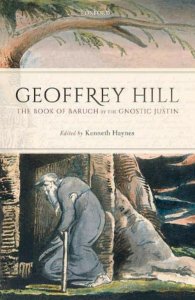
Poem as…:The Book of Baruch by the Gnostic Justin by Geoffrey Hill

Geoffrey Hill intended the Book of Baruch to be published posthumously and he worked on this collection of poems right up until his death in 2016.  The book contains a sequence of 270 numbered poems with no titles.  It is the most erudite, difficult and engrossing volume of poetry I have ever read, which statement I do not make lightly.  Even though it is a fairly slim volume it has taken me about two weeks to read and absorb Hill’s thoughts, reflections, aphorisms and cultural references.   I have spent hours chasing down references to various politicians, poets, artists, and even rappers that Hill writes about.  These were all of the things occupying his mind as he nears the end of his life.

In the poem numbered 190 he describes this collection which evolves and grows every day as his own time gets shorter: “This, it is becoming clear, is more a daybook than ever The Daybooks were: il mestiere di vivere that secures its own private consistory and guards the door, admitting neither rich nor poor to the designs and details of poetry which are the very devil to portray without favour or fear.”  This short verse is typical of Hill’s reference to other poets or works of art.  The Job or Work of Living is the title of Italian author Cesare Pavese’s Diary in which the author recorded notes about his thoughts and feelings on a variety of subject between 1935-1950. Hill forces his reader to think deeply about the various connections he is making between different forms of poetry.

Hill composes poems involving a dizzying number of poets from Milton to Hopkins to Celan to Desnos and many others he admires: “Some deep poets are like divers with the bends.”  He also has no patience for false poets, those he calls poetasters: “Those who poetaste are not like novices at the piste, learning how to coordinate brain, knee, writs.  To me, they present themselves as a despised caste, breeding on, off, their own waste; ignorant as to why wreaths of myrlte and laurel invest Milton’s bust.”

Many of Hill’s best verses, especially toward the end of the collection, are his “Poem as…” thoughts.  Some are short yet so profound it feels like a punch in the gut (or the knee):

The poem begins as a small tight maelstrom somewhat at knee-height, not quite touching your shins.

Poem as posthumous running sore.

Poem as equity release—whatever that is.

Poem as no less an authority on history than whom.

Poem as Samson dozing post coitus with coiffure of unshorn hair.

Poem as neuro-linguistic programme with close attachments to the absurd.

And one of my favorites:

Poem to restart pumping system for self-esteem sewage and rage of heart.

And Hill’s expertise and talent with metaphor especially come through on his longer verses about poetry.  Once gain he forces the reader to look at objects and concepts and poems in a completely novel way:

Poem as scimitar-curve, shear along sheer, a ‘Tribal’ class destroyer, veteran of the North Cape run, bearing down on a submarine that has struck and already gone from the scene, leaving sea-rubble wretchedly a-swim, thickslicked in oil.

And:

In poetry, ignorance can sometimes work things to the good, as a form of muse-inducing narcolepsy in which, entranced, you retain evidence of the tombs among which you have danced: mots, etes-vous des mythes et pareils aux myrtes des morts?

Finally, I have to say a word about Hill’s sense of humor which, as far as I can tell, has not been discussed very much.  He is especially adept at turning his biting sarcasm at current affairs:

Foghorn Leghorn and Roadrunner are a particular kind of winner. While their winning is not gaining anything, neither can happy idiocy every fail. All is back on track ready for the next reel, for you ‘bit of a laugh’ philosophe.

Rid us—somebody—God—of callous ignorant administrators, lords of public want, sinecurists of their own failures, bearers of no brunt, inimical to dissent.

And poets, and poetasters, are not above his ridicule either:

Most poets are less capable than those who at airports x-ray our tits and our boots and happily leave us to scrabble.

A dear, kind friend has sent me Hill’s Broken Hierarchies as well as some of his essays and other writings.  I will be occupied (or obsessed) will Hill for a long time to come.


5 Comments

Filed under British Literature, Poetry

We Live by Hope: A Month in the Country by J.L. Carr

Hope is a thing with feathers, according to Emily Dickinson.

And Max Porter.

Hope floats, according to the film title.

Pope writes in his “An Essay on Man” that “Hope springs eternal.”

In Aeschylus’s play, Prometheus says he gave to humans the gift of blind hope.

Pink, in her new collaboration with Khalid “Hurts 2B Human,” sings that “hope flows away.”

And hope is the one thing, quite ambiguously, left in Pandora’s box of evils. Is hope also considered an evil? And, if so, should we be glad that it was held in the box? Or is hope a good thing, left behind in the box and now separated from evil?

Tom Birkin, the narrator of J.L. Carr’s novella A Month in the Country, spends the summer of 1920 in the small English town of Oxgodby when he is hired to restore a medieval mural in the town’s church. It is Tom’s hope that by spending a summer in this quiet town that the horrible memories and shell shock he suffered during World War I and the failed marriage with his wife Vinny will begin to fade away:

The marvelous thing was coming into this haven of calm water and, for a season, not having to worry my head with anything but uncovering their wall-painting for them. And, afterwards, perhaps I could make a new start, forget what the war and the rows with Vinny had done to me and begin where I’d left off. This is what I need, I thought—a new start and, afterwards, maybe I won’t be a casualty anymore.

Well, we live by hope.

It is the connections that Tom makes with the other people in Oxgodby during this idyllic summer that help him to lose his stammer and his facial twitches.  The Ellerbeck family feeds him and welcomes them into their home; Charles Moon, who is also doing work for the church, is a fellow veteran who understands his wounds; and Alice Keach is the pastor’s wife with whom he spends many hours talking.  The bucolic setting also goes a long way to healing Tom who came from the noise and bustle of London.  Carr’s version of hope is the positive kind, the one that leads us to take action, like Birkin did, towards something new and joyful.

This was the perfect summer read for an afternoon sitting in my garden oasis with the birds singing in the trees, the frogs croaking in the pond and my neighbor’s horse neighing in the distance.  Listening, contemplating, hoping…

22 Comments

Filed under British Literature

Trust in the Future as Little as Possible: The Voyage Out by Virginia Woolf

I usually devour a 350-page book in a couple of days, but Woolf’s writing, both her fiction and non-fiction, demands careful attention and a slow read. It took me a week to read The Voyage Out, Woolf’s first novel that was published in 1915. She is just beginning to experiment with what will become her signature, stream-of-consciousness style. She pokes fun at the uptight, British upper class who, even while on holiday in a tropical South American climate, insist on wearing furs and formal coats and having tea every afternoon promptly at 5:00. Even though on the surface they engage in polite conversation about politics, suffrage, and social gossip, Woolf gives us a glimpse of what they are really thinking. She introduces us to Rachael, her heroine, by her own thoughts as she sits in her drawing room in solitude on her father’s ship:

To feel anything strongly was to create an abyss between oneself and others who feel strongly perhaps but differently. It was far better to play the piano and forget all the rest. The conclusion was very welcome. Let these odd men and women—her aunts, the Hunts, Ridley, Helen, Mr. Pepper, and the rest—be symbols,—featureless but dignified symbols of age, of youth, of motherhood, of learning, and beautiful often as people upon the stage are beautiful. It appeared that nobody ever said a thing they meant, or ever talked of a feeling they felt, but that was what music was for.

Rachael is a very naïve twenty-four-year old who was raised by her spinster aunts and her widowed father. Her Aunt Helen, who is also on the voyage to South American, invites Rachael to stay at her villa for the winter in the hopes of better educating her about life and bringing her out of her sheltered existence. When they land in South American, Rachael and her aunt socialize with the British upper class men and women who are staying at the local hotel. Among these guests is Terence Hewett, an financially independent twenty-seven-year-old man who likes to travel and dabbles in writing novels. Both Rachael and Terence have never been in love; even though they are mentally and physically attracted to one another they spend a lot of time drawing close and then pulling back from one another because their feelings terrify them.

Once they finally confess their feelings and allow themselves to be happy, Rachael and Terence start planning their wedding and have a few weeks of bliss. But The Voyage Out ends in tragedy. It’s a shame that the lovers wasted so much time before they decided to embrace what would make them both happy. Horace’s Ode 1.11, the famous Carpe Diem poem kept coming to mind as I read Woolf’s novel (translation is my own):

May you not ask to know what end
—for it is not right—the gods might
have in store either for you or for me
Leuconoe, and may you also not consult
Babylonian Astrology. How much better
it is to endure whatever will be, whether
Jupiter has allotted us more winters, or
if this is the last, the winter which weakens
the Tyrrhenian Sea with opposing rocks. May
you be wise, may you strain your wine, and
because life is brief, may you give up any
long-term hopes. As we are speaking, envious
time slips by. Seize the day, trust in
the future as little as possible.

10 Comments

Filed under British Literature, Classics, Poetry
