Review: The Death of the Perfect Sentence by Rein Raud

“If we always knew in advance what was going to happen, we would behave like machines.  So in a sense it is the unexpected things in life that make us who we are.” —Rein Raud

My Review:
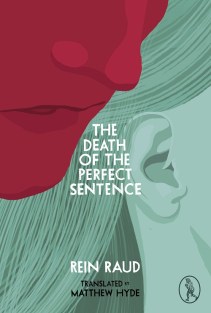
In Rein Raud’s latest novel he cleverly inserts his own voice into his narrative by including text boxes with personal stories, observations, anecdotes and proverbs.  For example, one such text box in the novel states:

When the big boss walks past
the wise peasant bows low
and quietly farts.

(Ethiopian proverb)

This is, admittedly, an odd way of starting a review about a book that deals with spying and subterfuge during the waning years of Soviet Occupation in Estonia. But Raud’s inclusion of these observations into his text is the perfect demonstration of the author’s ability to mix serious topics with his subtle and wry humor.

The novel begins with descriptions, in alternating chapters, of a group of Estonian youths who have formed an alliance to collect and smuggle secret KGB files out of Estonia.  Each person is given a background story so that we better understand their motivations for undertaking such a potentially dangerous operation.  These Estonians , like the Ethiopian proverb says, bow low to their masters, the Soviet occupiers, but they find subtle and subversive ways to fight back against their oppressors.  Among the group is Indrek who, when he reaches eighteen, moves out of his parents’ home and has no desire to do what is expected of him and work at a construction brigade.  Erwin seems to be the most restless of the bunch and no matter what happens with the rest of the group he is determined to find his way to freedom.  And the most interesting is Anton who is caught between two worlds because of his Estonian father and Russian mother.

As the story progresses the role of each of these Estonians in their alliance becomes clearer.  By alternating between different points of view, the story maintains its suspense until very end when all of the characters’ roles in the operation are revealed.  The varying points of view also provide a rich and multifaceted peek into the lives of everyday Estonians during this time period.  I found it especially fascinating that the book allows us to see how different people and different generations dealt with life under Soviet rule.  A young man named Raim, for instance, lives with his conservative parents who spend quite a bit of time watching Finnish television.  The USSR was not able to block the Finnish TV signals, so Estonians got a wider view of what was going on beyond the Iron Curtain than their counterparts in Russia.  Although Raim has joined his friends to combat the Soviet regime, his parents seem more resigned to their fate.  Raim’s father isn’t necessarily interested in seeing the blue, white and black Estonian flag fly over the capital once again, but he would like to be able to travel to Finland without having to go through a labyrinth of officials and paperwork.

Another interesting way in which Raud demonstrates the tension and conflict between oppressor and oppressed is through the insertion of a romance into the narrative.  An Estonian young woman named Maarja who becomes involved in the mission to smuggle KGB files to the west develops feelings for Alex, a Russian economist from Leningrad whom she meets at a café.  Neither of them knows that the other is involved in the smuggling of files so their romance, at first, progresses as a separate plot within the novel.  The author makes an intriguing choice in their relationship to use a woman as the Estonian character to represent the smaller, weaker and oppressed and to use a male as the Russian to represent the larger, stronger oppressor.  But their romantic involvement and their characters are much more complicated than a simple case of conqueror and conquered.  Alex is a kind young man who treats Maarja with respect and their romance is simple, romantic, tender and naïve; when Maarja’s friends begin to question her choice of a Russian boyfriend she, too, buys into their paranoia and mistrust of Alex.  In the end it doesn’t matter if Alex is kind, genuine, romantic and able to whisper the perfect sentence into Maarja’s ear because the deep seated mistrust in anything Russian will destroy their hopes.

The best writing and most enlightening parts of the book are the ones in which the author inserts his own voice and commentary into the fictional story.  Raud describes his life as an Estonian living during and after the occupation, his first trip to Finland, and his motivations for writing this book.  There is one particularly poignant text box in which he discusses an old Chinese curse and how it relates to his experiences living through a communist regime:

“May you live in interesting times”

In 1936, shortly before Sir Hughe Montgomery Knatchbull-Hugessen departed on a diplomatic mission to China, one of his friends told him about a Chines curse he had once heard: ‘May youlive in interesting times!’ Or at least that is what Knatchbull-Hugessen claims in his memories.  There are some other British authors who appear to have know of such an expression too.  The Chinese, however, do not.  The closest thing in meaning which they have is the following: ‘It is better to live as a dog in peaceful times than as a human in a world of confusion.’

And what about it?

Just like anyone else, I have done things in my life which I am not proud of, and even one or two things which I regret.  But I have no reason to be anything other than happy that I have lived in a  period when I have, and that I have been able to experience one world changing into another.  So what if this has stirred hungers in me which have damaged me?  I am willing to pay that price, if only for the perspective it gave me, which is something I do not encounter in people who have lived under only one political order.

As someone who has only lived under one political order, I wholeheartedly agree with Raud’s assessment.  When I read books like his or Sergei Lebedev’s novels about life under Soviet rule they feel more like movies or dreams to me than reality.  The Death of the Perfect Sentence and politically charged literature that is similar to it are important so that we can have some iota of perspective, especially in these turbulent political times.  A lack of perspective, I think,  is one of the reasons for many Americans apathy at the mess our current president has made of the American system of government.  It is alarming to me how many people I encounter that don’t understand or care about the news; those who are not adequately alarmed by the machinations of our current president seem to have the attitude that our system has always worked for us and allowed us to be free so why wouldn’t it continue to do so?  Raud’s book is timely and important for those of us who, whether we like to acknowledge it or not, are living in “interesting times.”

One final aside that the author includes in the narrative is a very personal account of his attitude towards this book.  He writes, “Even after I put the final full stop in the draft of this story, it took me a long time to shake the moods which it evoked in me.  It was hard to think of anything else…And I still feel that I am somehow trapped inside it.”  I found The Death of the Perfect Sentence thought-provoking, relevant and chilling and it will linger with me for a long time to come.  We had better learn from countries like Estonia or we might find ourselves bowing low to a big boss…

Coming soon on the blog, I have an interview with Rein Raud in which we discuss the themes of family and relationships in his books, his interesting use of narrative voice and his thoughts on the current state of literature in Estonia.

About the Author:

Rein Raud was born in Estonia in 1961. Since 1974, he has published numerous poetry collections, short stories, novels, and plays. For his works he has received both the Estonian Cultural Endowment Annual Prize and the Vilde Prize. Having earned his PhD in Literary Theory from the University of Helsinki in 1994, Raud is also a widely published scholar of cultural theory as well as the literature and philosophy of both modern and pre-modern Japan. For more information on purchasing The Death of the Perfect Sentence visit https://www.vagabondvoices.co.uk/bookshop-changelings/the-death-of-the-perfect-sentence or the author’s website: http://reinraud.com/


8 Comments

Filed under Literary Fiction, Literature in Translation

If Only Sleep Would Come: One Night by Umberto Saba

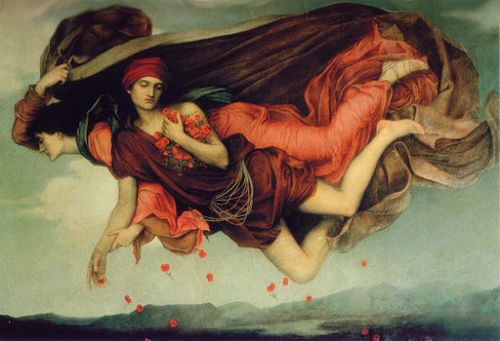
Night and Sleep by Evelyn De Morgan, 1878

One of my favorite literary bloggers, Tom from Wuthering Expectations, did a post on Modern European Poetry with a focus on the Greek poetry contained within this wonderful volume.  If you haven’t had a chance to read Tom’s posts then please do yourself a favor and peruse his blog.  His analysis of literature is full of what the Roman poet Catullus would call facetiae (wit) and lepida (charms).

As I was reading through this collection of modern poetry, I was happy to find poems by Ingeborg Bachmann whose name I have seen many times on bloggers’ personal canons.  A few poems by the Italian author Umberto Saba also captivated me.  I thought I would share one particularly short yet moving piece (Catullus would definitely approve!)

One Night

If only sleep would come, as it has come
on other nights: already slipping through
my thoughts.

Instead now,

like an old washerwoman wringing clothes,
anguish wrings another pain from my heart.
I would cry out but cannot. As for torment—
suffered once—I suffer on in silence.

And that which I have lost, only I know

Translated by Felix Stefanile

2 Comments

Filed under Classics, Italian Literature, Poetry

Review: Moving the Palace by Charif Majdalani

I received an advanced review copy of this title from New Vessel Press.  The novel was published in the original French in 2007 and this English version has been translated by Edward Gauvin.

My Review:
The story of Samuel Ayyad, a Lebanese man who, in 1908 at the age of eighteen leaves his home in Beirut to become a civilian officer for the British army in the Sudan, is told many decades later by his grandson.  The narrator states at the beginning of his tale that the stories of his adventurous grandfather’s life have been passed down through his family by word of mouth making some of this story read more like legend than biography.  He begins his tale with a rhetorical question:

How to bring together and breath life into all those outlandish, nonsensical particulars uncertain traditions have passed down, or vague stories my mother told me that he himself, her own father, told her, but which she never sought to have him clarify or fasten to anything tangible, such that they reached me in pieces, susceptible to wild reverie and endless novelistic embroidering, like a story which only chapter headings remain, but which I have waited to tell for decades.

Majdalani’s rendition of the unreliable narrator that he uses for his story seems fitting for a plot that involves the dismantled contents of a palace being carried through the desert via camel and donkey caravan.  Samuel’s story begins believably enough when he takes a job in the Sudan as a translator for a British officer named Colonel Moore. The Colonel is tasked with trying to unify the Sudan which had been retaken from Khalifa Abdallahi by the Anglo-Egyptian armies.  After decades of despotic oppression the country is still in a state of chaos as the capital city of Khartoum is slowly being rebuilt.   When Samuel arrives in Khartoum his duties are to act as liaison and interpreter between the British army and the local populace.  Samuel’s stay in Khartoum is short-lived as he becomes involved in Colonel Moore’s expedition to the desert to speak with local tribes in an attempt to prevent an uprising lead by one of the tribal chieftains.  From this point forward, Samuel’s life becomes the archetype of a flawless hero, one in which he feels the urge to carry other men’s burdens, both figuratively and literally, through the desert.

When Samuel ventures out into different parts of the Sudan as a member of Colonel Moore’s entourage, he quickly becomes indispensable not only as the commander’s translator but also as his advisor for negotiating the customs of the local tribes.  When the Colonel decides to return to Khartoum, Samuel is left in charge of a small contingent of forces as well as a small fortune of gold in order to negotiate with the local tribes.  Thus, Samuel takes up the Colonel’s burden of quelling a rebellion and uniting the tribes of western Sudan under the British flag.  Samuel spends his nights in the desert, eating rich dinners of roasted gazelle and exchanging stories with local sultans.  Majdalani’s strength as a writer is found in his beautiful and detailed descriptions of the topography of this region.  At times the narrative is so detailed that I felt a map would have been appropriate to include within the text.  But, then again, because our narrator is not entirely reliable, a map might break the spell of this story that is not meant to be entirely plausible.

The next burden that Samuel takes upon himself is a palace that has been dismantled into a thousand pieces and is being carried through the desert by an antique dealer named Shafik Abyad.  Abyad, in his hunt for ancient treasure, buys a this small Arabian palace in Tripoli.  Instead of selling off the pieces of the palace bit by bit, he loads the stones, frescoes, gilded mirrors, staircase and even the pool adorned in Moorish style onto the backs of camels and heads south with his caravan.  When Samuel encounters Abyad in the desert, the antiquities dealer has been carrying these pieces in his caravan for years and has failed to find a buyer for his palace.  Samuel, whether out of pity or a sense of adventure, or plans for his future—once again the narrator isn’t entirely sure of this information—buys the entire palace which he, himself now bears across parts of Africa and The Middle East.

Throughout his travels in the desert Samuel continues to help others by taking on their burdens and he becomes famous for his adventures.  As he attempts to make his way back to Lebanon, World War I has broken out and naval blockades prevent him from sailing to his homeland with his palace.  The author includes a hefty amount of history about this tumultuous region in the early 20th century that at times felt overwhelming .  The juxtaposition of volatile historical events with the heroic character of Samuel makes for an odd mix of realism and romanticism in the novel.   As war and uncertainty surround him, Samuel remains a constant pillar of strength, bravery and tenacity.  He becomes a larger than life hero who has no flaws or faults of any kind; Samuel is always polite, always chooses to do the right thing, and always saves others from their own, crushing burdens by taking them on as his own.  It becomes evident that the narrator’s uncertainty about these events allows him to idealize his grandfather who drags his palace all the way back to Beirut where he eventually lives in it with his “princess”—the narrator’s grandmother.  Although this was a lovely story with a happy ending,  I have to admit that I much prefer my heroes to be of the Ancient Greek sort— in other words, rather flawed.

About the Author:
Charif Majdalani, born in Lebanon in 1960, is often likened to a Lebanese Proust. Majdalani lived in France from 1980 to 1993 and now teaches French literature at the Université Saint-Joseph in Beirut. The original French version of his novel Moving the Palace won the 2008 François Mauriac Prize from the Académie Française as well as the Prix Tropiques.

1 Comment

Filed under French Literature

Fato Profugus: Teffi’s Memories—From Moscow to The Black Sea

As I was reading Teffi’s memoir about her katabasis from Russia to Constantinople during the Bolshevik Revolution in Russia, two words from Vergil’s Aeneid kept coming to mind: fato and profugus .   After barely escaping from the burning and destruction of Troy, Aeneas is profugus–“exiled”, “driven forward”, he is essentially a fugitive or a refugee.  The fate of his sea voyage and his various landings are the result of fatum, “fate” driving him along from one place to the next; he rarely, if ever, chooses his next destination.  Like Aeneas, Teffi is a refugee and much of her flight from her motherland is a result of fate and circumstance.  At one particularly dramatic part of her journey in Odessa she reflects, “And then there I was, rolling down the map.  Fate had pushed me on, forcing me wherever it chose, right to the very edge of the sea.  Now, if it so wished, it could force me right into the sea—or it could push me along the coast.  In the end, wasn’t it all the same?”

Teffi’s journey begins in Moscow when an impresario named Gooskin approaches her and convinces her to do a series of readings in Odessa: “My Petersburg life has been liquidated.  The Russian Word has been closed down.  There is, it seems, no possibility of anything.  Or rather, there is one possibility; it appears, day after day, in the shape of a squint-eyed Odessa impresario by the name of Goodskin, who is trying to persuade me to go with him to Kiev and Odessa and give public readings there.”   There are many scenes throughout the narrative, similar to this opening paragraph, in which Teffi allows herself to be swept up and carried along the waves of fate and hordes of people and luggage from one city to the next.

The tone of Teffi’s narrative reminded me of Lenora Carrington’s memoir Down Below;  in both memoirs there is strange calm, almost an indifference that pervades the texts.  But I would argue that each woman, writing her memoir in hindsight, is attempting to relate the most harrowing and traumatic experiences they have ever experienced and the only way to revisit such horror is to do it with as little emotion as possible. Both of these narratives also seem to be cathartic farewells for these women: Carrington bids goodbye to her mental illness and her relationship with Max Ernst while Teffi is paying a final adieu to her beloved Russia.

Teffi’s Memories were originally written and published as serials in the Russian language newspaper Vozrozhdenie  between 1928 and 1930.  At that point Teffi had been in exile for ten years and was able to tell her story of chaos, violence and destruction caused by the Bolsheviks as they take over one city after another with a certain amount of detached calm.  The human spirit can only take so much suffering and Teffi gives us a glimpse into her mindset as she escapes one dangerous situation after another.  When she is left almost alone in a desolate hotel in Odessa, unsure of how she will escape that city she writes:

My future was a matter of complete indifference to me.  I felt neither anxiety nor fear.  In any case there was nothing I could do.  In my mind I retraced my strange journey from Moscow, always south, always further south, and always without any deliberate choice.  In the form of Gooskin, the hand of fate had appeared.  It had pushed me on my way.

As  Teffi  narrowly escapes invading forces while making her way south from Kiev to Odessa to Novorossiisk,  she describes her experiences with cramped train journeys, cold and uncomfortable living quarters, food shortages and outbreaks of  Spanish influenza and typhus.  Teffi’s humor and strong spirit, however, prevent the tone of this memoir from becoming horrendously bleak.  As she leaves Odessa she runs into a beauty salon full of women who don’t want to go into exile without getting their hair done; in Novorossiisk she meets a woman who is so proud of her newly made dress that is fashioned completely out of medical gauze.

In addition to her humor and her resilent spirit, there are certain objects that Teffi carries along with her that give her comfort as a refugee.  Her guitar, her religious artifacts and her sealskin coat are dragged along with her from city to city.  One of the most poignant stories in the book was about her sealskin coat that she wraps around her for warmth while traveling by train and she makes us understand that those coats represented the entire, prolonged journey of Russian refugees:

Were there any of us who did not have a sealskin coat?  We put these coats on as we first set out, even if this was in summer, because we couldn’t bear to leave them behind—such a coat was both warm and valuable and none of us knew how long our wanderings would last.  I saw sealskin coats in Kiev and in Odessa, still looking new, their fur all smooth and glossy.  Then in Novorossiisk, worn thin around the edges and with bald patches down the sides and on the elbows.  In Constantinople—with grubby collars and cuffs folded back in shame.  And, last of all, in Paris, from 1920 until 1922.  By 1920 the fur had worn away completely, right down to the shiny black leather.  The coat had been shortened to the knee and the collar and cuffs were now made from some new kind of fur, something blacker and oilier—a foreign substitute.  In 1924 these coats disappeared.  All that remained was odds and ends, torn scraps of memories, bits of trimming sewn onto the cuffs, collars, and hems of ordinary woolen coats.  Nothing more.  And now, in 1925, the timid, gentle seal was obliterated by invading hordes of dyed cats.  But even now when I see a sealskin coat, I remember this epoch in our lives as refugees.

Teffi’s memoir is timely because it reminds us that the many refugees we see on a daily basis in the media are suffering hardships that we couldn’t begin to otherwise imagine.  What objects do these refugees, who are also exiled by fate, carry along with them?  As these refugees are forced to live in camps and not welcomed by other nations we should ask ourselves what would have happened if Teffi didn’t have a place like Paris to welcome her and give her a new home?

15 Comments

Filed under Classics, Literature in Translation, New York Review of Books, Russian Literature

Everyone Forgets that Icarus also Flew: Poetry by Jack Gilbert

One of the things I like best about being part of such a great lit blogging community is the daily book recommendations I receive from like-minded readers.  Many have lamented the death of literary Twitter, but even on this crazy social media site I have managed to block out most of the nonsense and glean book suggestions from and engage in interesting literary conversations with other bloggers.  The other day as I was scrolling through my feed and reading the posts from my interesting literary friends (you know who you are) when I saw a Tweet that included a poem by Jack Gilbert entitled “Failing and Flying” that begins, “Everyone forgets that Icarus also flew.”  I immediately ran to my bookshelves and pulled out the volume of Jack Gilbert that I had bought a while back based on a recommendation from another reader.  What a pleasant experience it is to be involved and included in a community of people who love books and literature and talking about such things.  I was never the “cool” kid in school but being part of lit blogging makes me feel that I am a part of the “in” crowd.

Jack Gilbert often uses references and allusions to Greek and Roman myths and literature in his poems which makes reading his pieces a richer experience for me.  I thought I would share just a few of the poems that made the greatest impression, but I highly recommend reading his entire volume of Collected Poems.

Orpheus in Greenwich Village:

What if Orpheus,
confident in the hard-
found mastery,
should go down into Hell?
Out of the clean light down?
And then, surrounded
by the closing beasts
and readying his lyre,
should notice, suddenly
they had no ears?

Some days, especially at this time of the year, it feels as though I am Orpheus signing to the “beasts” who have no ears.

Many of the poems in this collection contemplate the different types of love we experience throughout the course of our lives. Gilbert talks about young love, passionate love, mature love and married love. The next poem I chose describes the enigmatic nature of love’s genesis and evolution. I thought, as I read this poem, that “we cobble love together” like a mosaic and every time we fall in love the experience is like composing a different work of art:

Painting on Plato’s Wall:

The shadows behind people walking
in the bright piazza are not merely
gaps in the sunlight. Just as goodness
is not the absence of badness.
Goodness is a triumph. And so it is
with love. Love is not the part
we are born with that flowers
a little and then wanes as we
grow up. We cobble love together
from this and those of our machinery
until there is suddenly an apparition
that never existed before. There it is,
unaccountable. The woman and our
desire are somehow turned into
brandy by Athena’s tiny owl filling
the darkness around an old villa
on the mountain with its plaintive
mewing. As a man might be
turned into someone else while
living kind of happy up there
with the lady’s gentle dying.

And one final poem worth pointing out is entitled “Trouble,” the first three lines of which I found rather striking:

That is what the Odyssey means.
Love can leave you nowhere in New Mexico
raising peacocks for the rest of your life.
The seriously happy heart is a problem.
No the easy excitement, but summer
in the Mediterranean mixed with
the rain and bitter cold of February
on the Riviera, everything on fire
in the violent winds. The pregnant heart
is drive to hopes that are the wrong
size for this world. Love is always
disturbing in the heavenly kingdom.
Eden cannot manage so much ambition.
The kids ran from all over the piazza
yelling and pointing and jeering
at the young Saint Chrysostom
standing dazed in the church doorway
with the shining around his mouth
where the Madonna had kissed him.

Who among us with “pregnant heart” hasn’t traveled a long distance, endured discomfort, various tribulations and the agony of hope all in the name of love?

Have you read this collection or any other pieces by Jack Gilbert? Or, better yet, what other poetry or literature recommendations have you gleaned from the lit blogging community recently?

4 Comments

Filed under Poetry
