
 George Steiner, in his book Tolstoy or Dostoevsky, writes: “Great works of art pass through us like storm-winds, flinging open the doors of perception, pressing upon the architecture of our beliefs with their transforming powers.” Having read the first few hundred pages of War and Peace, I can already tell that this epic will reshape how I view other authors and works of literature. There will be a marked difference in my reading life before Tolstoy and after Tolstoy. I have to admit that I was apprehensive because my experience reading Anna Karenina several years ago was not as pleasant as I had hoped. In retrospect it was a matter of choosing to read a book at the wrong time. But my foray into War and Peace could not be more pleasurable.
Prince Andrei, the first born son of a stern, wealthy, bellicose old man, has especially captured my attention. In the opening scene of the book he is attending a party with his pregnant, young wife, referred to in the test as the “little princess” and it is evident that he has no real affection or patience for her. The Prince is dignified, taciturn and eager for a military career and his wife’s incessant and trivial babbling about social gossip irritates him. When the Prince’s friend, Pierre, visits their home this young husband has some shocking advice for his single friend about marriage:
‘Never, never marry, my dear friend! That’s my advice: never marry till you can say to yourself that you have done all you are capable of, and until you have ceased to love the woman of your choice and have seen her plainly as she is, or else you will make a cruel and irrevocable mistake. Marry when you are old and good for nothing—or all that is good and noble in you will be lost. It will be wasted on trifles. Yes! Yes! Yes! Don’t look at me with such surprise. If you marry expecting anything from yourself in the future you will feel at every step that for you all is ended, all is closed except the drawing room where you will be ranged side by side with a court lackey and an idiot!…But what’s the good!’ and he waved his arm.
It seems that both Prince Andrei and his wife feel stuck in this marriage and have realized too late, already with their first child on the way, that they are ill-suited for one another. The little Princess would rather be in Moscow or Petersburg, going to parties and balls, and visiting with her friends, but instead she is forced to live in the country with her crotchety, old father-in-law and her pious sister-in-law, while her husband goes off to war. Although the little Princess is depicted as being shallow and insipid , I still sympathized with her as well as Prince Andrei; both are stuck in this marriage for the sake of family and propriety and neither one of them are getting their needs met. It’s interesting that Tolstoy wrote these words when his own marriage—one that would prove to be rather tumultuous—was only in its first few years.
In the first few hundred pages alone we get thoughts about marriage, love, life, war and death. I have not been this captivated by a work of fiction in a very long time. It is difficult to capture the brilliance of the entire books with these posts, but I am hoping to update my blog every few hundred pages with a focus on particular passages, like the one above, that catch my attention. I also feel so lucky to have come upon George Steiner’s book length essay on Tolstoy which I will read eagerly alongside War and Peace.
 Polymath George Steiner in his text entitled The Poetry of Thought: From Hellenism to Celan, ambitiously seeks to explore the tension between philosophy and language that has occupied western thinkers for millennia. The author begins his essay with his thoughts on Heraclitus, the Presocratic philosopher whose fragmentary writing is notoriously enigmatic. The Presocratics, and Heraclitus in particular, fascinated me so much as a graduate student that I chose them as the topic for one of my specialized exams for my Master’s degree. After reading Steiner’s first chapter I immediately, and enthusiastically, dug up my old Heraclitus texts which I am chagrined to say I have not looked at for many years. I offer a translation here of a few of my favorite fragments:
 There are some intriguing and surprising personal stories and anecdotes that George Steiner weaves into the essays in My Unwritten Books. In his essay on his political and religious beliefs, for instance, he admits that he has never once in his life voted in any election, local or national. He is an avid dog lover and the emotion he shows towards his pets, he admits in the essay “On Man and Beasts,” sometimes runs deeper than that which he feels for his family. And, perhaps the most intriguing statement in the book, comes in his writing about Eros: “I have been privileged to speak and make love in four languages. Also in the interstices, sometimes inhibiting, sometimes playful, between them.”
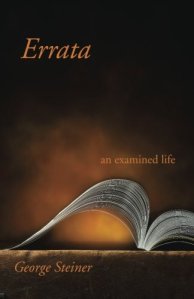 Errata is a Latin perfect passive participle, neuter, nominative plural that means “these things having been done in error” or “these things having been done by mistake.” Errata are oftentimes issued as corrections to a published text and are not a usual part of a book. George Steiner’s Errata, an usual book itself being part memoir and part essay, is a reflection of and commentary on those accidents of fate that launched him on the path of being a teacher, polyglot, critic and scholar. There is an underlying tone of gratitude for the fortuitous errata that have made up what he humbly considers to be happy accidents in his life.


 The Book Binder's Daughter