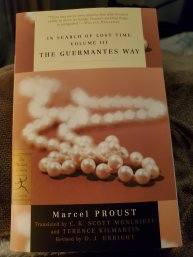
The Assembly of the Gods: Expectation in Proust’s Guermantes Way

My reading of the first part of The Guermantes Way has me thinking about expectations and how we are constantly needing to adjust expectations that are set too high or too low.  From the Latin verb expecto, meaning “to await” or “to wait for”, expectation implies looking to the future and a sense of anticipation.  The narrator in Proust’s novel has been invited to the opera where he will see Berma, who once was his favorite actress, in a production of Racine’s Phedre. As a child he couldn’t wait to see Berma—his expectations were full of that sense of anticipation which the word implies—but he is bitterly disappointed by her performance.  But this time he is a bit older and he has no expectations for his second experience with her.

As a young adult, the narrator now sits in the opera house and, as the play unfolds, he realizes that his earlier expectations as a child, were unrealistic and even silly.  Now that he is older he understands that her craft, which includes subtleties of the inflection of her voice and gestures, clearly set Berma apart from other actors. He reflects:

I realized that my original desire had been more exacting than the intentions of the poet, the actress, the great decorative artist who directed the production, and that the charm which floated over a line as it was spoken, the shifting poses perpetually transformed into others, the successive tableaux, were the fleeting result, the momentary object, the mobile masterpiece with the art of the theatre intended and which the attentiveness of a  too-enraptured audience would destroy by trying to arrest.

This more mature and thoughtful version of the narrator also realizes that he similarly had unrealistic expectations that he placed on Gilberte, Swann’s daughter with whom he was in love in the previous book.  While watching Berma perform, he thinks about the myriad of factors that influence the foundation of one’s expectations:

It had just occurred to me that if I had not derived any pleasure from my first encounter with Berma, it was because, as earlier still when I used to meet Gilberte in the Champs-Elysees, I had come to her with too strong a desire.  Between my two disappointments there was perhaps not only this resemblance, but another, deeper one.  The impression given us by a person or a work (or an interpretation of a work) of marked individuality is peculiar to that person or work.  We have brought with us the ideas of ‘beauty,’ ‘breadth of style,’ ‘pathos’ and so forth which we might at a pinch have the illusion of recognizing in the banality of a conventional face or talent, but our critical spirit has before it the insistent challenge of a form of which it possesses no intellectual, in which it must must disengage the unknown element.

But just as Berma walks off stage, the focus of the narrator’s attention is diverted to other, important, and captivating audience members,  the Princesse de Guermantes who is seated with her aunt, and, incidentally, Proust’s new neighbor, the Duchesse de Guermantes.  It is this encounter that causes him to become smitten with the Duchesse for a good part of this book.  Germaine Bree argues in his essay “Proust’s Dormant Gods” (Yale French Studies No. 38, 1967) that Proust likes to apply Greek myths when discussing the metamorphosis of nature and persons.  I think Proust also has a penchant for comparing the women who become the object of his love to Greek myth and ancient goddesses (in the previous volume he compares Albertine and her friends to nymphs), thereby setting his expectations for his interactions and relationships with these women rather high.  He observes and thinks about the Duchesse and the Princesse as they sit in their theater box:

The costumes of these two ladies seem to me like the materialisation, snow-white or patterned with colour, of their inner activity, and, like the gestures which I had seen the Princesse de Guermantes make and which, I had no doubt, corresponded to some latent idea, the plumes which swept spangled bodice seemed to have a special meaning, to be to each of these women an attribute which was hers, and hers alone, the significance of which I should have liked to know: the bird of paradise seemed inseparable from the wearer as her peacock is from Juno, and I did not believe that any other woman could usurp that spangled bodice, any more than the fringed and flashing shield of Minerva. And when I turned my eyes to their box, far more than on the ceiling of the theatre, painted with lifeless allegories, it was as though I had seen, thanks to a miraculous break in the customary clouds, the assembly of the Gods in the act of contemplating the spectacle of mankind, beneath a crimson canopy, in a clear lighted space, between two pillars of Heaven.

When one sets one’s expectations as high as Mount Olympus, one is bound to be disappointed. But, as the narrator reminds himself while watching Berma, sometimes we just can’t stop ourselves from setting lofty and, perhaps,  unrealistic expectations. Proust is reminding us, I think, in this theater scene that life is a series of expectations, ones we must constantly adjust and readjust.



8 Comments

Filed under French Literature, Proust, Uncategorized

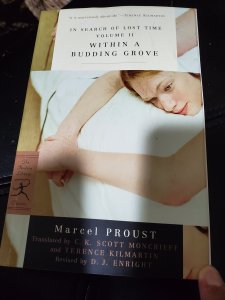
Our Cocoon of Habit: More thoughts on Proust’s In a Budding Grove

As I’m just about to finish Within a Budding Grove, I keep thinking about Proust’s use and exploration of the word Habit, Habitude in French, in different contexts. Both the French and English words are derived from the Latin noun habitus (fourth declension, masculine) which itself is taken from the perfect passive participle of the verb habeo, habere. It is an important and fundamental Latin verb and is taught as one of the first words in beginning Latin. Its most basic meaning is to own or possess (as in I have a book), but it is also commonly used to mean that one possess certain physical or mental attributes (as in I have a powerful intellect). It is this latter meaning that I keep contemplating in relation to Proust and how habit is intertwined with ideas of memory and time.

Habit is first, and most famously, used in Swann’s Way when the narrator, as a child, is trying to sleep and is comforted by his familiar surroundings: “Habit! that skilful but slow-moving arranger who begins by letting our minds suffer for weeks on end in temporary quarters, but whom our minds are none the less only too happy to discover at last, for without it, reduced to their own devices, they would be powerless to make an room seem habitable.”

Within a Budding Grove, the narrator, now a teenager, is going to Balbec with his grandmother for a summer holiday, but upon arrival he is miserable because the room he occupies in the hotel and his new surroundings are not part of his habits which, in Paris, make him happy and comfortable. But as a young man he is quickly realizing that Habit is maybe not always a good thing. As he has new experiences, and especially as he meets new people in Balbec he comes to understand that it is this same Habit that, although it comforted him as a child, as an adult it keeps one from having new experiences and therefore happiness and enjoyment in life:

As a rule it is with our being reduced to a minimum that we live; most of our faculties like dormant because they can rely upon Habit, which knows what there is to be done and has no need of their services. But on this morning of travel, the interruption of the routine of my existence, the unfamiliar place and time, had made their presence indispensable. My habits, which were sedentary and not matutinal, for once were missing, and all my faculties came hurrying to take their place, vying with one another in their zeal, rising, each of them, like waves, to the same unaccustomed level, from the basest to the most exalted, from breath, appetite, the circulation of my blood to receptivity and imagination.

It is this second example of Habit which Proust also applies to a discussion of art. When he meets the painter Elstir in Balbec, he knows right away that the artist’s work is something different. It is the Habit of looking at similar works of art, of reading similar books that dulls our minds and keeps us from new, aesthetic experiences:

Since Elstir began to paint, we have grown familiar with what are called “wonderful” photographs of scenery and towns. If we press for a definition of what their admirers mean by the epithet, we shall find that it is generally applied to some unusual image of a familiar object, an image different from those that we are accustomed to see, unusual and yet true to nature, and for that reason doubly striking because it surprises us, takes us out of our cocoon of habit, and at the same time brings us back to ourselves by recalling to us an earlier impression.

And finally, in Within A Budding Grove the narrator applies the ideas of Habit to his own understanding of love. He becomes smitten with Swann’s daughter, Gilberte and it becomes his habit to visit her and her family on a daily basis. When he realizes that Gilberte is not going to love him the way he loves her, he is mature enough to understand that the only way to rid him of his unhappiness is to change his habits. He understands, even at a young age, that sometimes it is not love that keeps us in a relationship but instead we stay because another person has become part of our everyday life and has essentially evolved into another habit. The sooner he can let go of this habit, the sooner he can find happiness elsewhere: “In Paris I had grown more and more indifferent to Gilberte, thanks to Habit. The change of Habit, that is to say the temporary cessation of Habit, completed Habit’s work when I set our for Balbec. It weakens, but it stabilises; it leads to disintegration but it makes the scattered elements last indefinitely.”

I am eager to see how Proust further develops and explores the concept of habit as the narrator ages and encounters different surroundings, novel artwork and new love.

22 Comments

Filed under French Literature, Proust

In a Budding Grove: Proust Teaches Us How to Read Proust

As a young boy and adolescent, the narrator of Proust’s masterpiece is an avid reader and is a particular devotee of the books of an author called Bergotte.  As a consequence Proust gives us some insight into what he thinks about writing,  literature and other creative endeavors that require talent and genious.  When the narrator meets his hero, he remarks about the author’s style of writing:
The true variety is in this abundance of real and unexpected elements, in the branch loaded with blue flowers which shoots up, against all reason, from the spring hedgerow that seemed already overcharged with blossoms, whereas the purely formal imitation of variety (and one might advance the same argument for all the other qualities of style) is but a barren uniformity, that is to say the very antithesis of variety, and cannot, in the work of imitators, give the illusion or recall the memory of it save to a reader who has not acquired the sense of it from the masters themselves.

Proust has an interesting mix of real and fictional authors throughout his story.  For readers and critics who try to understand why Proust invents this fictional author, Bergotte, and, in vain, attempt to guess on whom he is based, Proust provides the answer in his narrative.

And for those who fret over genre, and how to categorize his lengthy, meandering, difficult, masterpiece—to which a countless number of adjectives have been applied in the attempt to label it—Proust offers this:

The reason why a work of genius is not easily admired from the first is that the man who has created it is extraordinary, that few other men resemble him.  It is his work itself that, by fertilising the rare minds capable of understanding it, will make them increase and multiply.  It was Beethoven’s quartets themselves (the Twelfth, Thirteenth, Fourteen and Fifteenth) that devoted half a century to forming, fashioning and enlarging the audience for Beethoven’s quartets, thus marking, like every great work of art, an advance if not in the quality of artists at least in the community of minds, largely composed today of what was not to be found when the work first appeared, that is to say of persons capable of appreciating it.  What is called posterity is the posterity of the work of art.  It is essential that the work (leaving out of account, for simplicity’s sake, the contingency that several men of genius may at the same time be working along parallel lines to create a more instructed public in the future, from which other men of genius will benefit) should create its own posterity.

I enjoyed Swann’s Way more than I can appropriately express in a post.   The way in which he gives us Swann’s account of his painful relationship with the courtesan, Odette, by taking on Swann’s point-of-view was riveting, to say the least.  As I began Volume II, In a Budding Grove, I had expected that in the chapter entitled “Madame Swann at Home” that I would, in turn, get Odette’s point-of-view and learn more about how their marriage came about.  But Proust only gives us Mme. Swann’s story through his narrator’s eyes.  That’s not to say that he isn’t successful at writing female characters—quite the opposite, in fact.  I’ve enjoyed Mme. Swann’s story just as much, if not more, than Swann’s himself.  Proust doesn’t, however, dare to step in her place and write from her perspective.  Even after 800 pages of text I am still learning from Proust how to read Proust, that is, to throw all expectations I’ve gained from my previous reading out the window.

12 Comments

Filed under Uncategorized

My First Encounter with Proust

Charles Swann, the eponymous character of Proust’s first Volume of In Search of Lost Time,  is an old acquaintance of the narrator’s family and, although he has connections to the upper classes and the royals in France and Britian, he never forgets to visit with his middle class friends.  Swann is also very quiet about these other, important social circles to which he has access, and a knowledge of this would have shocked the narrator’s great-aunt:

But if anyone had suggested to my great-aunt that this Swann, who, in his capacity as the son of old M. Swann, was “fully qualified” to be received by any of the “best people,” by the most respected barristers and solicitors of Paris (though he was perhaps a trifle inclined to let this hereditary privilege go by default), had another almost secret existence of a wholly different kind; that when he left our house in Paris, saying that he must go home to bed, he would have no sooner turned the corner than he would stop, retrace is steps, and be off to some salon on whose like no stockbroker or associate of stockbrokers had ever set eyes—that would have seemed to my aunt as extraordinary as, to a woman of wider reading,  the thought of being herself on terms of intimacy with Aristaeus and of learning that after having a chat with her he would plunge deep into the realms of Thetis, into an empire veiled from mortal eyes, in which Virgil depicts him as being received with open arms.

This short passage in Proust brought to mind my very early days as an undergraduate, when taking a Vergil course and being handed these lines from the Georgics and asked to produce a polished translation and commentary.  I carefully and lovingly labored over this Latin text for weeks.  Aristaeus chases Eurydice through a field where she is bitten and killed by a serpent.  Orpheus, in his intense grief, asks the ruler of the Underworld to allow him to bring his wife back, but, by not following the only rule—not to look back at his wife—he is unsuccessful.  As a punishment for his indiscretion Aristaeus’s bees are destroyed and he is allowed to visit his mother and the other nymphs in their underwater lair to get advice on how to resurrect his bees.  I remember the part in which Arisaeus enters this watery realm because there were certain Latin words I keep thinking about and adjusting in my translation.  My mother would call me every week and ask, “How are the bees coming along?”  Although I had studied Latin in high school, I viewed translation as just another acquired skill, but it was due to this Vergil class that I decided to be a classicist.

So many memories.

I have spent the last weekend sitting in my garden, soaking up summer and completely immersed in Proust.  I have no doubt that this experience of summer will be forever linked with my first encounter with Proust’s extraordinary masterpiece.  I had expected something special, but nothing quite like this.  Walter Benjamin, in his essay “The Image of Proust” states it perfectly, “The thirteen volumes of marcel Proust’s À la Recherche du temps perdu are the result of an unconstruable synthesis in which the absorption of a mystic, the art of a prose writer, the verve of a satirist, the erudition of a scholar, and the self-consciousness of a monomaniac have combined in an autobiographical work. It has rightly been said that all great works of literature found a genre or dissolve one—that they are, in other words, special cases.  Among these cases this is one of the most unfathomable.”

One of the most astute and erudite readers I know remarked to me that Proust was a turning point in his reading life—-there is a distinct difference in reading and literature before Proust and after Proust he said.   Even after finishing only the first volume of In Search of Lost Time I think he is absolutely right.


11 Comments

Filed under Classics, French Literature, Vergil

What Has to be Said is Unutterable: Contre-Jour by Gabriel Josipovici

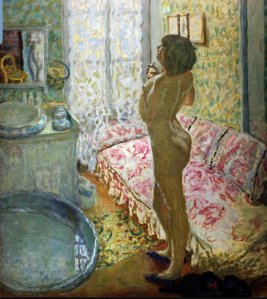
Nu a Contre-Jour. Pierre Bonnard. 1908. Oil on Canvas

The artist in Josipovici’s short novel tries to explain the difficult of creating art and painting, “It’s that what has to be said is unutterable. Or else: How can we tell what is the right language?  The proper tongue? That which is licit?”  Art demands a certain silence, when creating it and viewing it.  Josipovici captures the essence of this silence in both the art and the artist himself in this deceptively complex narrative which he subtitles, “A Triptych after Pierre Bonnard.”

The painter, his wife and their daughter each have a section of the book in which they describe their life together, a life that is dominated and overpowered by the artist’s desire to paint.  The first section portrays a grown daughter who is bitter and angry at her parents because she feels rejected by them.  There is no place for her, she feels, in their family and the pets received more attention than she did.  Like Bonnard’s “Nu a Contre-Jour” painting, the most important figure in the book is the artist’s model, his wife.  She meets the artist when she is working as a model and for the next 45 years she becomes his only model.  He draws and paints her incessantly, especially in the bath.  Also similar to Bonnard’s paintings, the bath is a common scene in the book as the wife soothes a severe skin rash by bathing four times a day and the artists sketches her during these baths.

But as the wife’s narrative progresses it becomes apparent that she is suffering from a mental illness and the baths become a compulsion that sooth her physically and mentally.  It’s as if she is trapped in her marriage and in her husband’s paintings.  Her entire life has been reduced to being his model and she gets no respite from the art or from his compulsion to create.  In addition, the wife’s description of their life and her confusion call into question the entire interpretation of the story, especially the first part which involves the daughter.  Like any piece of art, our perception changes the more we interact with it.

Silence is used in many forms throughout the book.  Unanswered letters, telegrams, and telephones.  Passing notes instead of talking.  The wife silently pretends to sleep to avoid interacting with guests.  In the terse and succinct writing, questions are answered by repeating the questions.  And, of course, there are long periods of silence needed by the artist to work.  We realize at the very end, when the painter himself finally speaks, just how much silence has permeated their lives.  On the death of his wife the artist writes a one page letter to a friend expressing in raw, stark language how devastating his wife’s death is for him.  He is filled with grief, loneliness and anxiety.  But why did he keep silent about his true feelings for her when she was alive?

This was my first Josipovici book and its strange and unexpected story has intrigued me and made me eager to explore his writings further, especially his non-fiction.

22 Comments

Filed under Uncategorized