
I received an advanced review copy of this title from Atria books via NetGalley. The book was published in the original Spanish in 2010 and this English version has been translated by Nick Caistor and Lorena Garcia.
My Review:
 Max Costa is a scoundrel and a thief but you wouldn’t know it from his refined manner and elegant clothes. We first meet him in 1928 on board the Cap Polonio, a transatlantic luxury liner bound for Buenos Aires. Max is a professional ballroom dancer on the ship and he entertains the unaccompanied young women with his tangos and fox trots. But his work as a ballroom dancer is just a cover for his real profession which his stealing from his rich dance partners. The narrative takes place between 1928 and 1966 and alternates between three distinct periods of time during which Max meets a woman whom he cannot forget.
On board the ship Max meets an intriguing Spanish couple; the husband is a world-famous composer, Armando de Troeye and his younger, gorgeous, and elegant wife Mecha Inzunza de Troeye. What draws Max to the couple at first is a very expensive pair of pearls that the wife wears which Max believes he can easily steal and make a large profit for little effort. Mecha is an excellent dancer and she is particularly skillful at the Tango, for which dance her husband has in mind to compose a new piece. Armando likes to watch while Mecha dances often with Max and this builds up the sexual tension between the dance partners.
Once they land in Buenos Aires Max, who lived in that city until he was fourteen, serves as their tour guides to all of the local dance pubs. Armando wants to know the origins of the Tango, which is not the same Tango that is performed among the European gentry. Their time in Buenos Aires is fraught with danger and tension as they go to some of the seediest places in the city. Max and Mecha also begin a passionate love affair, but their relationship, if one can call it that, is not at all what I expected. This is not a clandestine affair that is hidden from Mecha’s husband but, on the contrary, he encourages her to seduce Max and he even watches them while they make love.
Max gets his hands on Mecha’s pearls and disappears. When he next meets up with Mecha it is almost ten years later in Nice, where he has lived comfortably as a gentleman off of his ill-gotten earnings. This is one of the most exciting parts of the book because Max is asked by spies for both the Italian and Spanish governments to steal some sensitive documents from the home of a rich, society woman. Max fits in perfectly with the European gentry so he has the perfect cover to case the house and come up with a plan that involves breaking into a house and safe cracking.
During his stint as a secret agent he, once again, runs into Mecha who is living in Nice alone because her husband has been arrested among the chaos of the Spanish Civil War. The theft of the pearl necklace is all but forgotten as Mecha and Max rekindle their sexual relationship. They are drawn to each other and their physical relationship is intense, passionate and sometimes even boarders on the violent.
After Max completes his mission he must flee Nice for fear of being arrested and his farewell to Mecha this time is emotionally difficult for both of them. It is evident that the have deep feelings for each other and saying goodbye is difficult not something that they want to do. When Max meets Mecha, almost thirty years later in Sorrento, he can’t stay away from her this time either. Max is now sixty-four years old and has retired from his dangerous career as a thief. He lives a quiet life as a chauffeur for a Swiss doctor. Mecha is in town because her son, Jorge Keller, is competing in a national chess competition and Max decides to check into her hotel so he can reminisce about his younger, more exciting days.
The last part of the book also has a bit of a mystery which involves Jorge’s Russian chess opponent. There is cheating and spying going on and Mecha asks Max to help her son plot against the Russians. Max is very reluctant to get involved in international affairs, even if it is just chess, because he doesn’t want to jeopardize his now stable and quiet life. But Mecha has a secret weapon that convinces Max to come out of retirement and use his thieving skills against the Russians.
This book is full of mystery and suspense with multiple plot lines woven throughout. My problem with the book is that some scenes were so suspenseful and interesting and then others were boring and superfluous to the plot. A few scenes could have been edited to make the plot even stronger. Also, the relationship of Max and Mecha isn’t fully developed until about two-thirds of the way into the story. At first their relationship is purely physical and I would have been more interested to see the emotional side of these two characters laid out much earlier on in the plot.
Overall this was an interesting read full of mystery, passion, tango and chess. If you enjoy a good historical fiction set in the 20th century then I recommend giving this book a chance.
About the Author:

Although his debut was not quite successful, in 1988, with ‘The fencer master’, he put his name as a serious writer of historic novels. That was confirmed in 1996, when was published the first book of his Captain Alatriste saga, which has been his trademark. After this book, he could leave definitely journalism for focusing on his career as a fiction writer. This saga, that happens in the years of the Spanish golden age, has seen, for now, seven volumes, where Pérez-Reverte shows, from his particular point of view, historical events from Spanish history in the 16th century.
Apart from these, he also penned another successful works like Dumas Club and Flandes Panel, titles that, among others, made Pérez-Reverte one of the most famous and bestseller authors of Spanish fiction of our era.
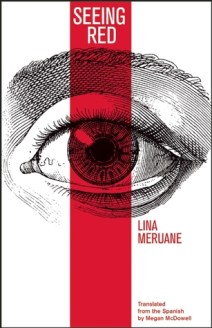 Our senses are our most precious natural gifts because it is through them that we are able to experience the world. At one point we have all probably wondered what it would be like to lose our hearing or our sight or our sense of smell. In Seeing Red, we are given a vivid understanding, through the character of Lina, of what it is like to lose one’s sight. Lina, a young woman attending graduate school in Manhattan and living with her boyfriend Ignacio, suddenly loses her vision. She has been a diabetic all of her life and from what we are told about her medical history in the book, the blood vessels in her eyes have burst and have caused her blindness. She knows that this is coming and the opening of the book is the moment at which her nightmare comes true.
 Lina Meruane is one of the most prominent and influential female voices in Chilean contemporary literature. A novelist, essayist, and cultural journalist, she is the author of a host of short stories that have appeared in various anthologies and magazines in Spanish, English, German and French. She has also published a collection of short stories, Las Infantas (Chile 1998, Argentina 2010), as well as three novels: Póstuma (2000), Cercada (2000), and Fruta Podrida (2007). The latter won the Best Unpublished Novel Prize awarded by Chile’s National Council of the Culture and the Arts in 2006. She won the Anna Seghers Prize, awarded to her by the Akademie der Künste, in Berlin, Germany in 2011 for her entire body of written work. Meruane received the prestigious Mexican Sor Juana Inés de la Cruz Prize in 2012 for Seeing Red. Meruane has received writing grants from the Arts Development Fund of Chile (1997), the Guggenheim Foundation (2004), and National Endowment for the Arts (2010). She received her PhD in Latin American Literature from New York University, where she currently serves as professor of World and Latin American Literature and Creative Writing. She also serves as editor of Brutas Editoras, an independent publishing house located in New York City, where she lives between trips back to Chile.
 This is a difficult title to review because it is impossible to describe the beautiful and philosophical language which permeates the book. When the narrative begins Felipe Díaz Carrión is returning to his home in a small village in Spain, but returning from where we do not yet know. When he reaches his native village he takes great comfort in the familiar surroundings in which he grew up; the trees, the road, the nest of Egyptian vultures, the bronze doorknocker on his house and a cross which is the grave marker for his own father are all soothing to him. As a person who likes her routine and is comforted by old, familiar things, I was mezmorised by the first few pages of this story as Felipe slips back into his peaceful and calm surroundings.
 Adrià Guinart lives in Barcelona with his mother and adopted younger sister. But at the first chance he gets he leaves his home and joins an unnamed war that is ravaging the countryside. He is only fifteen-years-old and what he sees while the war is raging forms the bulk of this bizarre and surreal narrative. The book almost reads like a series of shorts stories, each of which is based on a different character that Adria meets while he is away from home at war.





 The Book Binder's Daughter