
I received an advanced review copy of this title from Farrar, Straus and Giroux via Netgalley. The original novella was published in Icelandic in 2013 and this English version has been translated by Victoria Cribb.
My Review:
 Máni Steinn lives on the fringes of society in 1918 in the city of Reykjavik; he has no family except for a great aunt who has taken him in, he has no friends and he is homosexual. It is very dangerous for him to be gay and if he is caught in any type of sexual act with another man he could be arrested and severely punished.
It is mentioned in passing in the story that the fighting in Europe has recently ended and Iceland has been largely spared the destruction that ravaged Europe. The Spanish Influenza, however, quickly spreads through and devastates this small island nation. One of the ways that Máni passes his time is by seeing films that are shown in the two movie theaters in the city. When the flu hits Iceland it is speculated that public places like this were responsible for its rapid spread and the theaters are shut down for months.
Máni himself is also struck down by the flu and in the state of mental delirium caused by his fever he has vivid and gruesome nightmares. Through these scenes Sjon showcases his diverse talents as a writer. He also copies at poignant moments throughout the text newspaper articles that were published in Reykjavik at the time. In sum, Sjon perfectly captures s a realistic snapshot of this short timespan in Icelandic history when people are not only suffering from this horrible pandemic, but are also watching the local volcano erupt, reading the papers for news of war in Europe and dealing with their own shortages of necessities like coal.
I was captivated by the character of Máni who doesn’t seem bitter or resentful that at the age of sixteen his only living relative is a great aunt whom he calls “the old lady.” She is just as surprised as he is when Máni is dropped off at her front door. She is kind to him and provides him food and shelter, but she does not offer the kind of guidance and discipline that a sixteen-year-old boy ought to have. Máni has regular men around the city with whom he engages in sex for money. He doesn’t seem to have a particular fondness for any of these men but he does get a certain amount of enjoyment out of these furtive and illicit sexual encounters. The person that Máni shows an interest in is, rather surprisingly, a teenage girl named Sola. Sola drives around on her Indian motorcycle, makes her own clothing, and lives in a nice home with her family. Mani’s fascination with her is never fully explained and the author leaves us to speculate whether or not Mani’s attraction is sexual or just an innocent curiosity.
The only complaint that I have about this book is that it left me wanting to know more about the rest of Máni’s life. At a very slim 160 pages I read the book in a couple of hours and was disappointed when Mani’s story came to an end. I don’t want to give away the plot but it is Máni’s “aberrant” behavior as a homosexual that ironically is the catalyst for his escape out of the city and away from his lonely life. I wanted to know more about Mani’s thoughts in retrospect as an adult and how his time in Iceland helped to shape the rest of his life.
About the Author:

 All of us deal with grief in different ways and in this short book Max Porter presents us with grief in the form of a crow. It is not a mystery why the crow is the perfect symbol of grief. Crows are oftentimes associated with bad luck or evil omens, which is appropriate this book in which the Mum dies from a strange accident. Crows are also birds of carrion which swoop down and eat the remains of decaying animals. But crows are also know for their intelligence and resilience, so what better animal to use than this bird to personify grief.
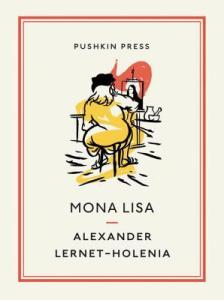 This book is a very slim volume and can be read in an hour or so. It attempts to answer the question that has been nagging historians and artists for centuries: Who, exactly, was the woman Mona Lisa that Da Vinci made so famous in his painting? In this plot it is a French aristocrat that becomes obsessed with the mysterious woman in Da Vinci’s painting.
 Alexander Lernet-Holenia was an Austrian poet, novelist, dramaturgist and writer of screenplays and historical studies who produced a heterogeneous literary opus that included poesy, psychological novels describing the intrusion of otherworldly or unreal experiences into reality, and recreational films.
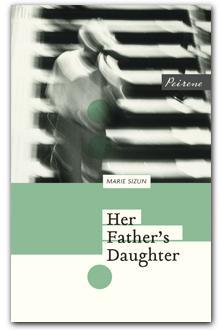 France is a four and a half year old little girl, growing up in war time France with her mother. Her father left to fight in World War II when she was an infant, so she only knows him through photographs. In fact, the very concept of a father is alien to her because there are no other examples of fathers to which she is exposed. I was immediately captivated by this short book and drawn into this small child’s recollections about the war and its lasting effects on her family.
 Marie Sizun is a prize-winning French author. She was born in 1940 and has taught literature in Paris, Germany and Belgium. She now lives in Paris. She has published seven novels and a memoir. Marie Sizun wrote her first novel, Her Father’s Daughter, at the age of 65. The book was long-listed for the Prix Femina
 The narrative of this book takes places during the 1980’s and 1990’s as the communism regime in Bulgaria collapses and the government goes through a transition to democracy. The narrator jumps from one time period to another in an erratic and almost frantic method. The book opens when his father-in-law, a man named K-Shev who is the cruel dictator of Bulgaria, has fled to Germany. The narrator is visiting the now sick and dying old man in the hospital and delivering a giant suitcase of money that K-Shev stashed away before his hasty retreat.
 Georgi Tenev, before penning the Vick Prize-winning novel Party Headquarters, had already published four books, founded the Triumviratus Art Group, hosted The Library television program about books, and written plays that have been performed in Germany, France, and Russia. He is also a screenwriter for film and TV.


 The Book Binder's Daughter