Category Archives: Nonfiction

The Tongues of Eros: More Thoughts on George Steiner

There are some intriguing and surprising personal stories and anecdotes that George Steiner weaves into the essays in My Unwritten Books.  In his essay on his political and religious beliefs, for instance, he admits that he has never once in his life voted in any election, local or national.  He is an avid dog lover and the emotion he shows towards his pets, he admits in the essay “On Man and Beasts,”  sometimes runs deeper than that which he feels for his family.  And, perhaps the most intriguing statement in the book, comes in his writing about Eros: “I have been privileged to speak and make love in four languages.  Also in the interstices, sometimes inhibiting, sometimes playful, between them.”

Steiner begins with a general discussion of his thoughts on language and moves on to describe how Eros is a unique language in and of itself that has not been studied in any methodical way.

We have no systematic poetic or rhetoric of eros, of how the making of love is a making of words and syntax.  No Aristotle, no Saussure has taken up this pivotal challenge.  More specifically, we have, so far as I am aware, no study, even summary, of how sex is experienced, of how love is made in different languages and different language-sets (ethnic, economic, social, local).  Per se, the polyglot condition at varying levels of immediacy and proficiency is not all that rare.  It features in numerous communities, such as Sweden, Switzerland, Malaysia.  A multitude of men and women dispose of more than one “native” tongue, from very earliest childhood.  Yet we seem to have no valid account, no introspective or socialized record of what must be their metamorphic erotic lives.  How does lovemaking in Basque or Russian differ from that in Flemish or Korean?  What privileges or inhibitions arise between lovers with different first languages? Is coitus also, perhaps fundamentally, translation?

Steiner describes his sexual experiences with a German, Italian and French woman and gives specific details about how making love in each of these three languages was a unique experience.  Sex with a German woman he calls Ch. is described as an encounter in which the interplay of sex and sadism is prominent.  He concludes, “To make love in German can be taxing.”  It was an Italian woman, named A.M., he says that “instructed me in the litany of seduction.”  And he debunks the myth that the French culture is more amorous than any other.  He learns by having sex with a French woman that French erotic exchanges happen with formal language: “Gloriously astride me, my first teacher in the arts of orgasm, praise God, an older woman burnished by irony and compassion, bade me ‘come, come now and deep.’ But did so using the formal vous.”

I have to admit that I was disappointed that Steiner did not give equal time to describing his sexual experiences in English.  He argues that his own observations would not be able to capture any universal experiences because of the global pervasiveness of the English language: “How can any one person register more than an insignificant fraction of a sexual lexicon and grammar which stretch from the syncopations of Afro-Carribean pidgeons to the delicate love lyrics of Anglo-Bengalis, which comprise the creole of English hybrids in Southeast Asia and the worn passwords of the multinational dealer summoning his escort service to an anonymous hotel room in Istanbul or Valparaiso?” I think that at least some general statements about his lovemaking in English versus his experiences with other languages would have made the essay seem more complete.

Steiner’s concluding remarks in the essay, I suspect, are a better explanation for his omission of English sexual encounters: “Perhaps shared orgasm is an act of simultaneous translation.  I sense that I could have made a contribution, even pioneering.  But the hurt is would have done to that which is most precious and indispensable in my private life (this chapter comports risk) made this impossible.  Indiscretion much have its limits.”  Steiner’s wife, Zara, is the American-born, British historian…
2 Comments

Filed under British Literature, Essay, Nonfiction

Chinoiserie and Invidia: My Unwritten Books by George Steiner

Each of the seven chapters in this book is an essay about a book that George Steiner did not write.  The first two chapters, “Chinoiserie” and “Invidia” are dedicated to Joseph Needham and Cecco d’Ascoli, authors whose works were just too large of a scope for Steiner to tackle.  But, in usual Steiner fashion, he uses the writings of Needham and d’Ascoli as a starting point to explore other ideas.  At times the level of erudition in his essays is astounding.

Joseph Needham (1900-1995) was a British scientist, historian and sinologist whose body of writing, even to someone as erudite as George Steiner, is overwhelming:

So far as I am aware, there is no definitive bibliography of Needham’s opera omnia.  The catalogue of lectures, articles, monographs and books extends well beyond three hundred.  Their range is awesome.  It comprises technical publications in biochemistry, in biology and comparative morphology, in crystallography by one of the ranking members of the Royal Society.  There are voluminous studies, both monographic and summarizing, on the history of the natural sciences, theoretical and applied, on instrumentation and technology, from antiquity to present.

In addition, Needham published historical novels that dealt with the Cromwellian period.  And Needham’s largest work, begun in 1937 and carried on until his death in 1995,  is Science and Civilization in China.  Steiner discusses and tries to grapple with Needham’s difficult-to-categorize, massive work on Chinese science and culture:

By 1948, Needham had outlined seven volumes.  These were to range from Chinese contributions to physics and mechanical engineering all the way to Chinese medical botany, navigation and physiological alchemy.  Before long, the proposals for SCC, as it became known internationally, ran to ten monumental parts (some in double volumes).  Soon even this manifold blueprint was overtaken by the plethora of new materials and queries.  The eighteen volumes which Needham intended to write himself—several installments being simultaneously in the pipeline—would require an estimated sixty years of unbroken labor plus the immense task of preliminary research and bibliography.  Literally hundreds of sources, many recondite and difficult to locate, would have to be combed.

Needham would have had to live to the age of one-hundred and seven to finish SCC according to this schedule.  It is said that he worked on it up until two days before his death at the ripe, old age of ninety-four.  Steiner compares the literary style and scope of the SCC to a number of authors whose work is equally as erudite, comprehensive and voluminous as Needham’s magnum opus.  Pieces of A.E. Housman’s body of work, Nabokov’s four volume translation and commentary of Eugene Onegin, Proust’s Recherché and Burton’s The Anatomy of Melancholy  are all discussed in relation to the SCC.  But none of these other narratives in their entirety, however, is exactly like the SCC.  Steiner concludes, “SCC, however, belongs to a more special genre.  One that has not, so far as I can tell, been properly identified, let alone elucidated.”  It is no wonder why this project defeated Steiner.

The other author whose writing that Steiner felt was too daunting a task to analyze is Francesco degli Stabili (Cecco d’Ascoli) (1257-1327).  The only pieces of d’Ascoli’s writing that has survived is an incomplete epic entitled l’Acerba, two astrological treaties, and a handful of sonnets.  Steiner says of d’Ascoli’s literary reputation: “During the sixteenth century, the theme which surfaces is that of Cecco’s intellectual boldness, of an unyielding proto-scientific integrity which makes of him a true predecessor to Giordano Bruno and Galileo.” In later centuries De Sanctis, Carducci, Petrarch and Goethe all praise Cecco’s intellectual and literary merits.  So why, then, was Cecco burned at the stake along with all of his writings in 1327 and why has he not obtained the same level of fame as Dante, his literary contemporary?

Steiner speculates that invidia (envy) was at the core of Cecco’s failures and he uses Cecco’s life as a starting point for a fascinating discussion of invidia as it has been portrayed in mythology and literature.  Steiner argues that Cecco’s fate, when matched up against Dante’s, was doomed from the start:

What is it like to be an epic poet with philosophic aspirations when Dante, as it were, in the neighborhood?  To be a contemporary playwright when Shakespeare is out to lunch?  ‘How can I be if another is’ asks Goethe.  Outside my door at the Institute for Advanced study in Princeton I heard J. Robert Oppenheimer fling at a junior physicist the demand, ‘You are so young and already have done so little.’ After which, the logical option is suicide.  Themes of rivalry, of jealousy, of envy have been perennially cited and dramatized.  They are as ancient as Saul’s rage of David’s meteoric ascent and the venomous derisions spat out by Homer’s Thersites.

Steiner ends his essay on Cecco’s life and the theme of invidia on a personal note and gives us the reason for not writing this book: “I did not write the study of Cecco d’Ascoli.  It might have been of some interest.  But it came too near the bone.”

I’ve only highlighted the first two essays in this collection; Steiner’s level of knowledge and scholarship is astounding.  My favorite passages are those in which he inserts personal anecdotes.  His chapter on sex, eros, and language are intriguing, to say the least.  I have to gather my thoughts first and process his writing if I am going to write about that chapter…


Leave a comment

Filed under British Literature, Essay, Nonfiction

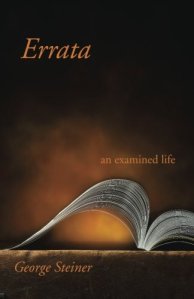
Errata by George Steiner

Errata is a Latin perfect passive participle, neuter, nominative plural that means “these things having been done in error” or “these things having been done by mistake.”  Errata are oftentimes issued as corrections to a published text and are not a usual part of a book.  George Steiner’s Errata, an usual book itself being part memoir and part essay,  is a reflection of and commentary on those accidents of fate that launched him on the path of being a teacher, polyglot, critic and scholar.  There is an underlying tone of gratitude for the fortuitous errata that have made up what he humbly considers to be happy accidents in his life.


Steiner was born in Paris in 1929 to Jewish Viennese parents who escaped Austria just as Nazism was taking hold.  His words about his father’s perceptions of Austria in the early twentieth century are chilling:  “With gram clairvoyance, my father perceived the nearing disaster.  A systematic, doctrinal Jew-hatred seethed and stank below the glittering liberalities of Viennese culture.”  Steiner’s father, whom he fondly calls “Papa” in his narrative,  moved the family once again to America in 1940, one month before the Germans invaded Paris.  Of the many Jewish children in Steiner’s Lycee in Paris, there were only two that survived.  Steiner’s parents not only had the foresight to save his life, but they also had a profound effect on his education and his passions.

There is a beautiful passage in Errata that I’ve already written about which describes Steiner being introduced to Ancient Greek and the Iliad by his father.  An enthusiasm for learning that goes even deeper is instilled in Steiner by his father from a young age:

I accepted, with unquestioning zest, the idea that study and a hunger for understanding were the most natural, the determinant ideals.  Consciously or not, the skeptical ironist had set out for his son a secular Talmud.  I was to learn how to read, how to internalize word and commentary in the hope, however chancy, that I might one day add to that commentary, to the survival of the text, a further hint of light.  My childhood was made a demanding festival.

Steiner’s mother was also a great influence on him as he was brought up in a truly trilingual household: “My radiant Mama would habitually begin a sentence in one tongue and end it in another.”  He uses this as a background for a beautiful discussion on language.  These are some of my favorite passages about Steiner’s observations on the errata of language:

It is my conviction that these liberations from the constraints of the physical, from the blank wall of our own death and a seeming eternity of personal and collective disappointment, are in crucial measure linguistic.  Bio-socially we are indeed a short-lived mammal made for extinction, as are all other kinds.  But we are a language-animal, and it is this one endowment which, more than any other, makes bearable and fruitful our ephemeral state.  The evolution in human speech—it may have come late—of subjunctives, optatives, counter-factual conditionals and of the futurities of the verb (not all languages have tenses) has defined and safeguarded our humanity.  It is  because we tell stories, fictive or mathematical-cosmological, about a universe a billion years hence; it is because we can, as I mentioned, discuss, conceptualize the Monday morning after our cremation; it is because “if”-sentences (“If I won the lottery,”  “If Shubert had lived to a ripe age,” “If a vaccine is developed against AIDS”) can, spoken at will, deny, reconstruct, alter past, present, and future, mapping otherwise the determinants of pragmatic reality, that existence continues to be worth expecting.  Hope is grammar.

One final thought I had about Errata is that the Latin verb Erro also means to wander or to roam  Steiner’s life also involves a lot of wandering, not just between languages but between countries.  He has a wonderful chapter that describes his favorite places in France, England and The United States.  He also discusses the many teachers and memorable students he has met in the various places he has taught and held academic chairs.  When Steiner says, “I have scattered and, thus, wasted my strength” he is, in my opinion, being humble to the extreme.

4 Comments

Filed under British Literature, Nonfiction

The Rush of Wonder: George Steiner on The Iliad

I was emotionally stirred when reading George Steiner’s beautiful second chapter in his book Errata in which he describes his initial experience with reading and translating Homer as a six-year-old boy: “My father, in broad strokes, had told me the story of the Iliad.  He had kept the book itself out of my impatient reach.  Now he opened it before us in the translation by Johann-Heinrich Voss of 1793.  Papa turned to Book XXI.”  Steiner’s father goes on to read Homer’s account of Achilles’s murderous fury and his killing of the Trojan youth Lycaon who begs for his life in vain.

Steiner’s father then opens the passage in Ancient Greek and as a very young boy he gets his first taste of the language:

My father read the Greek several times over.  He made me mouth the syllables after him.  Dictionary and grammar flew open.  Like the lineaments of a brightly colored mosaic lying under sand, when you pour water on it, the words, the formulaic phrases, took on form and meaning for me.  Word by sung word, verse by verse.  I recall graphically the rush of wonder, of a child’s consciousness troubled and uncertainly ripened, by the word “friend” in the  midst of the death-sentence: “Come friend, you too must die.”  And by the enormity, so far as I could gauge it, of the question: “Why  moan about it so?”  Very slowly, allowing me his treasured Waterman pen, my father let me trace some of the Greek letters and accents.

…Papa made a further proposal, as in passing: “Shall we learn some lines from this episode by heart?”  So that the serene inhumanity of Achilles’  message, its soft terror, would never leave us.  Who could tell, moreover, what I might find on my night-table when going back to my room?  I raced.  And found my first Homer.  Perhaps the rest has been a footnote to that hour.

Steiner further discusses what effect classic works like those of Homer, Tolstoy and Dante have on us.  He ends the chapter with this personal reflection: “Exposure, from early childhood, to these ordinances of excellence, the desire to share with others the answerability and transmission in time without which the classic falls silent, made of me exactly what my father intended: a teacher.”

4 Comments

Filed under British Literature, Classics, Nonfiction

Respice Futurum: Some Reading Plans for 2018

Henricus Respicit Futurum.

As I have mentioned in a previous post, The Woodstock Academy where I have had the privilege of teaching Latin and Classics for many years now, is one of the oldest public schools in the United States and has a simple yet profound Latin motto which reflects and respects this tradition: Respice Futurum–-translated literally as “Look back at your future.” These two simple Latin words capture the idea that one moves towards the future while also reflecting on the past— it is the equivalent of moving forward on a train while sitting in a seat that is facing backward.   Respice Futurum is an fitting description for thinking about my reading plans for 2018

Respicio in Latin means more than “looking back.” One of my favorite translations of this word is “to have regard for another person’s welfare.” The Stoic philosopher Seneca, for example, applies respicio to the idea of self-improvement in his work De Clementia: sapiens omnibus dignis proderit et deorum more calamitosos propitius respiciet. (A wise man will offer help to those who are worthy and, in the manner of the gods, he especially will have regard for those in need.”) A good person, Seneca argues, always looks towards his future but uses experiences from the past to inform his decisions.  So as I look forward to books I intend to read in 2018, I can’t help but consider which literary selections in 2017 have influenced my choices.  Which books, based on previous choices, will give me a chance for deep reflection and even self-improvement?

Based on my past experiences, there are a few of my favorite publishers that put out spectacular books year after year.  A few of these titles I am looking forward to are:

Seagull Books:

Villa Amalia, Pascal Quignard
Eulogy for the Living, Christa Wolf (trans. Katy Derbyshire)
The Great Fall, Peter Handke (trans. Krishna Winston)
Monk’s Eye, Cees Nooteboom (trans. David Colmer)
Lions, Hans Blumberg (trans. Kári Driscoll)
Requiem for Ernst Jandl,  Friederike Mayröcker (trans. Rosalyn Theobald)

NYRB Classics:

The Juniper Tree, Barbara Comyns
Berlin Alexanderplatz, Alfred Döblin (trans. Michael Hofmann)
Kolyma Stories, Varlam Shalamov (trans. Donald Rayfield)
The Seventh Cross, Anna Seghers (trans. Margot Bettauer Dembo)
Anniversaries, Uwe Johnson (trans. Damion Searls)

Yale University Press:

Packing my Library, Alberto Manguel
A Little History of Archaeology, Brian Fagan
Journeying, Claudio Magris (trans. Anne Milano Appel)

I am also looking forward to more publications from Fitzcarraldo Editions, New Directions, Archipelago Press, Ugly Duckling Presse, Persephone Books (whose bookshop I hope to visit in the spring) and the Cahier Series. I’ve also heard that new books by Kate Zambreno and Rachel Cusk will be coming out later in 2018 and I am eager to read new titles by both of these women.

While I am waiting for the books listed above to be published, I will dip into German and British classics which I have loved reading over the last year. Here is what I have sitting on my shelf awaiting my attention in 2018:

German Literature:

Hyperion, Holderlin (trans. Ross Benjamin)
The Bachelors, Adalbert Stifter (trans. David Bryer)
The Lighted Windows, Heimito von Doderer (trans. John S. Barrett)
brütt, or The Sighing Gardens, Friederike Mayröcker (trans. Roslyn Theobald)
On Tangled Paths, Theodor Fontane (trans. Peter James Bowman)

British Literature:

Marriage, Susan Ferrier
The Voyage Out, Virginia Woolf (I’d also like to continue reading her volumes of essays and diaries)
To the Wedding and G., John Berger
Pilgrimage, Vols. 3 and 4, Dorothy Richardson

Russian Literature:

I was disappointed this year not to get around to this stack of Russian literature in translation books as well as Russian history books I have sitting on my shelves—

Gulag Letters, Arsenii Formakov (ed. Elizabeth D. Johnson)
Found Life, Lina Goralik
City Folk and Country Folk, Sofia Khvoshchinskaya (trans. Nora Seligman Favorov)
Sentimental Tales, Mikhail Zoshchenko (trans. Boris Dralyuk)
October, China Mieville

(I’ve toyed with the idea of starting War and Peace as well, but who knows where my literary moods will take me)

And for some Non-fiction:

I am very eager to read more George Steiner: Errata, The Poetry of Thought and Grammars of Creation are all on my TBR piles.
I am teaching a Vergil/Caesar class and an Ovid (Metamorphoses) class in the spring and in preparation for these authors I would like to read some of Gian Biaggio Conte’s books, especially Latin Literature: A History and Stealing the Club from Hercules: On Imitation in Latin Poetry.

I know, this list seems impossible, ridiculous, all over the place. But who knows what rabbit holes I will fall down, or where my journey will take me. All I can say for sure is that 2018, much like 2017, will be filled with great books and interactions with other wonderful readers. Happy New Year!

47 Comments

Filed under British Literature, Cahier Series, German Literature, Literature in Translation, New York Review of Books, Nonfiction, Seagull Books, Virginia Woolf