Category Archives: Literature in Translation

Review: Little Jewel by Patrick Modiano

I received a review copy of this title from Yale University Press  via NetGalley.  This book was published in 2001 in the original French and this English version has been translated by Penny Hueston.

My Review:
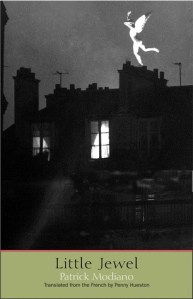
Little JewelThérèse  thought she had put her horrible childhood behind her until one day when she is on the metro in Paris she sees a woman with a faded yellow coat whom she thinks might be her long lost mother.  The brief narrative which is written from the point-of-view of this nineteen-year-old woman has multiple layers of imagery and themes which showcase Modiano’s great talent as a writer.

As we gradually get to know Thérèse through her own thoughts and words, we learn that she is alone in the world and is trying to figure out what she wants to do with her life.  She takes on temporary jobs such as babysitting and she lives in a tiny room in an apartment building that used to be a hotel.  When she sees the woman on the metro who resembles her mother she wanders around the streets of Paris looking for this woman again.  As she wanders through the city she replays her unhappy childhood memories in her mind and she is overwhelmed by emotions that she thought she had left in the past.

Thérèse’s mother had the intention of coming to Paris and being a prima ballerina but an injury to her ankle ended her career very early on.  Thérèse’s birth seems to have been a mistake or a surprise for her mother who never showed any affection, kindness or maternal love for her daughter.  Even the nickname she gives her daughter, “Little Jewel,” is meant as a stage name for the television appearance she forces upon her daughter.

Thérèse has no idea who her father is and the only family member she meets is a man who watches her once a week and is told that he is her uncle.  At the age of five Thérèse is left alone for days on end as her mother suffers episodes of depression and locks herself away in her bedroom.  Her mother abandons the poor child for good by putting her on a train bound for the suburbs where Thérèse comes to live with one of her mother’s friends.   After a few years pass Thérèse is told that her mother died in Morocco but she is not given any details as to how she died or why she was in Morocco.

This sense of abandonment never leaves Thérèse as she continues to have very few emotional connections into her young adulthood.  The past weighs on her so heavily that she cannot move forward and make a fulfilling life for herself that is distinct from her early years.  She does manage three important connections with other people throughout the course of the story and it is this tenuous and fragile contact with other humans that saves her in the end.

Modiano is a master of imagery and he does not disappoint even in this short narrative.  Images of light keep appearing to  Thérèse and Modiano hints in the text that his character will see the proverbial light at the end of the tunnel after the events of this story have concluded.  The little girl whom she babysits for always keeps a light on in her bedroom so she won’t be afraid in the dark.  One night when Thérèse is wandering around Paris in the dark and is at her wits end, she sees a solitary light from a pharmacy and the pharmacist provides physical and emotional support.  Finally, the most brilliant and subtle imagery of light in the story is connected with a man whom Thérèse also meets by chance on the streets of Paris.  This man is a translator of radio programs from around the world; he brings Thérèse back to his apartment and when his radio is on a green light appears which makes Thérèse feel calm and connected to a world of voices that she can hear but cannot see.

Readers seem to have a love or hate reaction to Modiano’s writing and I would most definitely put myself in the former category.  I also reviewed his collection of short stories entitled  Suspended Sentences which was also published by Yale University Press.  I would love to hear what other Modiano books that others have enjoyed.

Review: Suspended Sentences by Patrick Modiano

About the Author:
Patrick Modiano is the winner of the 2014 Nobel Prize for literature and an internationally beloved novelist. He has been honored with an array of prizes, including the 2010 Prix mondial Cino Del Duca by the Institut de France for lifetime achievement and the 2012 Austrian State Prize for European Literature. He lives in Paris.

15 Comments

Filed under France, Literature in Translation

Review: Zama by Antonio de Benedetto

This book was originally published in Spanish in 1956 and this English version has been translated by Esther Allen.

My Review:
ZamaDon Diego de Zama is a clerk serving the Spanish monarchy in a remote town in Paraguay at the end of the eighteenth century.  His position as an assistant for the Governor is supposed to be one of prestige and the first step as he moves up in his political career.  But if only he could find a way to get out of the backwater of Paraguay and be assigned a better position in Buenos Aires, which would also be closer to his home and his wife.  Zama is a lazy, selfish, and even at times stupid man who only seems to do things that hurt his career and his family.

There is a scene in the book in which Zama has just finished spending what little money he has at the racetrack betting on horses.  He decides to take a siesta in the shade where he encounters another man resting.  While this man is sound asleep Zama sees a poisonous spider about to jump on this man’s face and Zama decides to do absolutely nothing about it.  He doesn’t lift a finger to dispose of the spider or even warn the man of the impending danger of the venomous arachnid that is about to jump on his face.  Zama simply sits there and watches the scene unfold and seems rather detached from the fact that a poisonous spider is crawling on another man’s face.  This episode perfectly exemplifies Zama’s selfish attitude not only towards the world around him, but also towards his life, his job and his family.

The book is divided into three parts, the first of which takes place in 1790.  When we are first introduced to Zama he is waiting for a ship to come in that might contain a letter from his wife and the salary that is owed to him by the Spanish crown.  Zama misses his wife a great deal, but the lack of intimate contact with her for almost two years drives him to find a woman to fulfil his sexual desires.  In a scene that is reminiscent of the Actaeon and Artemis story from Greek mythology, he accidentally sees a local upper class woman naked while she is bathing in a river.  Once he finds out who this woman is he does everything he can to scheme his way into her home without attracting the notice of her husband or the rest of the town.  His attempts to seduce this woman are clumsy and not well planned.

The novel skips forward four years to 1794 and Zama is still stuck in this town in Paraguay. But by this time he has moved into a ramshackle farmhouse with a widow named Emilia and has a son with her.  Zama’s salary that he is owed by the Spanish crown is very seldom paid to him, so he lives in poverty and doesn’t have very much to offer his mistress and child.  He notices the child is oftentimes dirty and crying but he is never moved to console the child or find a way to provide a better life for his family.  When he has extra money in his pocket he doesn’t offer it to Emilia or his son but instead he buys his own meals at the local inn or tavern.  His own needs continue to always come first.  Zama’s wife, whom he was so eager to be near in the first part of the book, is not mentioned at all during this time.  Zama’s emotional detachment from the hardships that his families suffer is astonishing.

In the final part of the book  Zama’s selfish nature finally brings about his downfall.  The year is now 1799 and Zama is sent on an expedition with the local militia to hunt down a notorious pillager and thief.  The sole reason that he volunteers for the mission is that he thinks it will finally get him a promotion.  The final part of the book is the most exciting as Zama travels with soldiers into remote parts of South America that are dangerous because of Indian tribes.  There is also a bit of intrigue during this part of the book when the bandit’s true identity is revealed and the only one who knows this key piece of information is Zama.  His selfish and clumsy reaction to this situation is typical of his character throughout the book but this time his impetuous actions bring about his own demise.

Reading about Zama’s life is like watching a train wreck.  We know from the beginning that because of his clumsy behavior Zama is headed for a bad end, but we can’t put the book down because of our morbid curiosity to know how he finally does himself in.


About the Author:
A BenedettoAntonio di Benedetto, (born 2 November 1922 in Mendoza – died on 10 October 1986 in Buenos Aires), was an Argentine journalist and writer. Di Benedetto began writing and publishing stories in his teens, inspired by the works of Fyodor Dostoevsky and Luigi Pirandello. Mundo Animal, appearing in 1952, was his first story collection and won prestigious awards. A revised version came out in 1971, but the Xenos Books translation uses the first edition to catch the youthful flavor.  Antonio di Benedetto wrote five novels, the most famous being the existential masterpiece Zama (1956). Los suicidas (The Suicides, 1969) is noteworthy for expressing his intense abhorrence of noise. Critics have compared his works to Alain Robbe-Grillet, Julio Cortázar and Ernesto Sábato.  In mid-sixties or early seventies he caused a diplomatic faux-pas at a NATO meeting when during a ceremonial toast he raised his cup and said “cin cin” to bystanding Japanese diplomats. This caused an international pandemonium, as “chin chin” is a slang term for penis in Japanese. This later led to his prosecution. In 1976, during the military dictatorship of General Videla, di Benedetto was imprisoned and tortured. Released a year later, he went into exile in Spain, then returned home in 1984. He travelled widely and won numerous awards, but never acquired the worldwide fame of other Latin American writers, perhaps because his work was not translated to many languages.

8 Comments

Filed under Classics, Literature in Translation, New York Review of Books, Spanish Literature

Review-The First Wife: A Tale of Polygamy by Paulina Chiziane

I received an advanced review copy of this title from Archipelago Books via Netgalley.  This is my second contribution to Women In Translation month.  Please see the hasttag #WITMonth on Twitter for all of the great reviews that have been shared.

My Review:
The First WifeThis is a challenging book to read for several reasons.  It is a sad fact that women in Mozambique, even in the twenty first century, have extraordinarily tough lives and the author does not hold back from describing the hardships that women face on a daily basis in this country.  The story is told from the point of view of a woman named Rami who is in her forties and is tired from trying to raise her five children alone.  She is not divorced and but her husband of twenty years is the chief of police and doesn’t come home very often.  Rami reaches her breaking point when one of her sons breaks the window of a car while playing ball and she has to take care of the situation by herself.


Rami suspects that her husband, Tony, is not only kept away from home by his career but she also thinks he has another woman stashed away somewhere in the city.  Through local gossips she learns the name of this woman and goes to her home and confronts her.  Rami is shocked to find out that Tony is not only seeing another woman, but he has another family and home with this woman that includes four children and one on the way.  Rami gets into a physical altercation with this woman but once they both calm down and get to know each other they realize that Tony doesn’t visit either of his families very often because he has a total of fives wives and five different families.

Once the knowledge of Tony’s polygamist lifestyle is out in the open and the shock wears off,  Rami becomes empowered to improve her life and the lives of the other wives.   The only family that Tony sees on a regular basis is his fifth, most recent and youngest wife.  The other women and children suffer from the lack of a partner and male figure in their homes and they are dependent on Tony for whatever money he happens to throw their way every month on his sporadic visits.  There is an underlying tone of humor as a battle of wills ensues between Tony and his five wives who have now joined together to force him to become a proper husband.  Rami makes Tony accept the bride price from each family and recognize each woman as a proper wife.  Even though Rami is his only wife by law, the acceptance of the bride price is an acknowledgement of marriage in Mozambique culture.  The wives draw up a conjugal rota in which Tony spends one week at each house and the women have a meeting to discuss his health and his mood before they pass him off to the next wife.

There is a lot of repetition in the text as Rami constantly laments her loneliness and inadequacies.  The emphasis on cultures in the north of Mozambique versus those in the south are oftentimes reiterated.  The style of writing reminded me of epics like the Iliad and Odyssey which are prone to repetition because of their origins as oral literature.  In addition, each wife is assigned a sort of epithet that is repeated throughout the text: Rami-the first wife, Julieta-the abandoned one, Saly the feisty wife, Maua the youngest.  These titles for the women were very helpful in remembering each wife and her role in the polygamist family.

Chiziane, the first published female author in Mozambique, brings out into the open the harsh reality of life for women in her native country.  But Rami, her main character, becomes a role model for all women to take charge of their lives instead of passively accepting the dominance and suppression forced on them by the old customs in their culture.  As Rami and the other wives ban together they realize that they are stronger as a unit and eventually they come to realize that Tony is no longer so important to them and he loses his power over this family.

About the Author:
P ChiazinePaulina “Poulli” Chiziane (born 4 June 1955, Manjacaze, southern province of Gaza, Mozambique) is an author of novels and short stories in the Portuguese language. She studied at Eduardo Mondlane University, Maputo. She was born to a Protestant family that moved from Gaza to the capital Maputo (then Lourenço Marques) during the writer’s early childhood. At home she spoke Chopi and Ronga.  Chiziane was the first woman in Mozambique to publish a novel. Her writing has generated some polemical discussions about social issues, such as the practice of polygamy in the country. For example, her first novel, Balada do Amor ao Vento (1990), discusses polygamy in southern Mozambique during the colonial period. Related to her active involvement in the politics of Frelimo (Liberation Front of Mozambique), her narrative often reflects the social uneasiness of a country ravaged and divided by the war of liberation and the civil conflicts that followed independence. Her novel “Niketche: Uma História de Poligamia” won the José Craveirinha Prize in 2003

2 Comments

Filed under Literature in Translation

Review: Compartment No. 6 by Rosa Liksom

I received an advance review copy of this title from Graywolf Press.  This title was published in the original Finnish in 2011 and this English version has been translated by Lola Rogers.  This is my first contribution to Women in Translation Month which is taking place all during the month of August.

My Review:
Compartment No. 6As I first started reading this book I kept wondering why a young Finnish girl would choose to attend university in the Soviet Union during the decade of the 1980’s.  But as the plot progresses it is revealed that the girl, who is never given a name, falls in love with Moscow on a trip with her family.  But the Moscow she sees on her trip as a young high school student is the pristine and official one, created and controlled by the government, and is very different than the one the girl encounters as a university student on her trip across the Soviet Union via the Trans-Siberian railway.  When the girl boards the train she chooses compartment No. 6 because it is quiet and empty but her solitude is soon disrupted by a gruff and garrulous ex-soldier named Vadim.

When the girl boards the train on her way to Mongolia she seems emotionally numb and the sexually explicit and crass stories of her traveling companion don’t appear to penetrate her malaise.  The author cleverly emphasizes the girl’s mental aloofness by blurring certain details that we would expect from a main character.  As I have already mentioned, she is never given a name and is simply referred to as “the girl” and her speech is never directly quoted anywhere in the text.  When Vadim and other characters are speaking, traditional quotations and direct speech are used, but the girl’s thoughts and words are always summed up in the third person.  Vadim tells one tale after another of his sexual conquests, fights and outrageous behavior but the girl is too lost in her own world to have the strong reaction to him that one would expect.

As the bleak landscape of the taiga passes her by, the girl reflects back on her time in Moscow as a student where she lived with her boyfriend, Mitka.  Her memories are scattered and disjointed and it felt as though I was looking through an old photograph album with her and getting the barest details about her relationship.  As she describes her life in Moscow, it appears that she is remembering Mitka with a feeling of bitter sweetness and there is something that has happened with Mitka and his mother that has made her flee Moscow and get as far away from them as possible.  There are vague descriptions of Mitka having a severe breakdown and being in a mental institution and the girl’s subsequent relationship with Mitka’s mother.  There is also an intriguing story of a violent encounter that the girl and Mitka suffer one night in Moscow.  This is another example of the details of the text being blurred and leaving the reader to speculate about the girl’s life in Moscow.

As the girl and Vadim get farther along on their journey, they form an unusual bond of what I would loosely call friendship.  Vadim is a man who likes to be the center of attention and tell outrageous stories and the girl listens to him.  She does flee their compartment when he suggests that they have sex, but she always comes back.  Vadim performs small tasks for the girl like brewing her tea and sharing his meals and arranging for places to stay when the train stops overnight.  Even though Vadim has had a rough life and has a proclivity towards violence, even with his own wife, he is patient and protective of this strange Finnish girl.  The culminating moment in their relationship is when they reach Mongolia and she is having a hard time dealing with her government appointed tour guide.  She seeks out Vadim, cries on his shoulder and he sets about making everything right for her.

The two most interesting aspects of this book are the relationship that develops between the girl and Vadim and the amazingly detailed descriptions of the Soviet landscape from one end of that country to another during the late 1980’s.  Even though it is spring, the forests and landscapes which the train passes are empty, untouched,  snow-covered and bleak.  By contrast, the Soviet towns at which the train makes stops are industrial, dirty, and crowded and in shambles.  The people of these towns are trying to squeeze out an existence in whatever ways they are able.  The shelves of department stores are bare and the people are forced to bargain for their vodka on the black market.  One of the most peculiar descriptions are those of the restaurants they visit which have “closed” signs on the doors but are crowded with people and the girl enters anyway.  This brings us back to the conclusion that nothing is as it seems in this brutal, cold and bizarre place that is the Soviet Union.  The author must have visited this place at some point in order to capture such vivid details in her writing.

For those interested in post-Soviet literature then Liksom’s book is a must-read.  Looking at this strange place through the eyes of a foreigner provides a unique lens for us to get another glimpse at the last days of the Soviet Union before it dissolves into oblivion.

About the Author:
R LiksomRosa Liksom was born in a village of eight houses in Lapland, Finland, where her parents were reindeer breeders and farmers. She spent her youth traveling Europe, living as a squatter and in communes. She paints, makes films, and writes in Helsinki.

15 Comments

Filed under Literature in Translation, Scandanavian Literature, Travel Writing

Review: Blitz by David Trueba

I received an advanced review copy of this title from Other Press.  The book was published in the original Spanish in 2014 and this English version has been translated by Mara Faye Lethem.  This is yet another contribution to Spanish Lit Month hosted by Stu and Richard.  A special thanks to the both of them for hosting this literary event.

My Review:
BlitzBeto is a landscape architect who, like many others, has been hit hard by the economic recession in Europe.  Building and maintaining elaborate gardens and parks is a luxury that businesses and municipalities can no longer afford.  In order to make some money to pay the bills, Beto enters a landscape architecture contest in Munich, where the first prize would be enough to keep him afloat for a while.  Beto and his girlfriend, Marta who is also his assistant and partner in his landscape business, both travel to Munich to attend the landscape conference where the prize winners will be announced.

Beto is having a good time in Munich speaking with other architects and listening to their ideas and proposals.  But one night at dinner Beto receives a text message from Marta that clearly wasn’t meant for him.  He says, “Life changes when the love messages aren’t for you. That love message arrived like a lightning bolt, unespected and electric, and changed my life.”  When he confronts Marta about the message, she admits it was meant for her ex-boyfriend with whom she has reconnected and she announces that she leaving Beto to go back to her ex.

Beto’s reaction to this awful news is one of denial and inertia;  he doesn’t want to face his life again in Barcelona where he lives and works with Marta.  He impulsively decides to stay behind in Munich even though he has no money and is about to be thrown out of his hotel room.  Helga, who was serving as a translator for Beto at the landscape conference, steps in and saves Beto in more ways than one.  Helga, at age sixty-two, is about thirty years older than Beto and her offer of help appears to be a natural,  maternal gesture.  Helga takes Beto back to her apartment in Munich and over a bottle of vodka Beto learns that Helga has been divorced for fifteen years and has lived alone ever since.  Throughout the course of their conversation Beto is surprised to discover that he has become very attracted to Helga and he wants to kiss her.

Beto and Helga spend the night together and do much more than kiss.  Trueba offers a brutally honest and at times graphic commentary on the realities of aging.  Helga has sagging skin and wrinkles and Beto is ashamed that he is attracted to this woman who is so different physically and emotionally from Marta.  As they spend time together after their night of passion, Beto feels that he should be embarrassed to be seen with an older woman in a romantic situation and he realizes that this reaction is hurtful to Helga.

Beto has to face reality and say goodbye to Helga and return to the shattered remains of his life in Barcelona.  Their farewell at the airport is awkward because they don’t expect to see each other again despite two nights of emotional and physical intimacy that they shared.  The last part of the book when Beto is back in Spain is narrated like a diary in months.  Beto moves to Madrid and takes a job in a  landscape firm where his career finally takes a positive turn.  But Beto is not successful in finding another woman with whom he wants to be in  a long-term relationship.  The memory and pull of Helga and their unexpected connection always lingers in the back of his mind.

This book is a brutally honest commentary on age and love.  I especially enjoyed the ending which was a bit of a surprise.  Another unique aspect of the book are the pictures that the author includes to illustrate different pieces of the text.  Beto’s idea for his garden that is entered in the Munich competition is illustrated as well as other important scenes from the story.  Trueba’s character-driven story line with it’s straightforward prose is a great read to bring to the beach when it is released this August.

About the Author and Translator:
David TruebaDavid Trueba was born in Madrid in 1969 and has been successful both as a novelist and as a scriptwriter. La buena vida was his widely acclaimed debut as a film director and was followed by Obra Maestra (2001), Soldados de Salamina (2003), Bienvenido a casa (2006), and La silla de Fernando (2007). He is also the author of two previous novels; his debut, Four Friends, sold over 100,000 copies with twenty reprints.  Learning to Lose won the Critics Award in 2009.

Mara Faye Lethem is the translator of Spanish and Catalan authors such as Albert Sánchez Piñol, Juan Marsé, Javier Calvo, Jorge Semprún, and Pablo DeSantis. Born and raised in Brooklyn, New York, she has lived in Barcelona since 2003.

6 Comments

Filed under Literature in Translation, Spanish Literature, Summer Reading