
 As I was reading Anna Soror, the third and final novella in Yourcenar’s Two Lives and a Dream, I kept thinking about the images of love that Ovid creates in Amores. The beginning poems in Amores Book I, in particular, depict Love (Amor)—personified as Cupid replete with arrows— as something to be feared because of its (or his) unpredictable nature. The poet himself has fallen victim to this volatile and unruly emotion and he is tortured because it is something over which he has no control. He begins Amores 1.2 (the translation is my own):
Esse quid hoc dicam, quod tam mihi dura videntur
strata, neque in lecto pallia nostra sedent,
et vacuus somno noctem, quam longa, peregi,
lassaque versati corporis ossa dolent?
nam, puto, sentirem, siquo temptarer amore.
an subit et tecta callidus arte nocet?
sic erit; haeserunt tenues in corde sagittae,
et possessa ferus pecora versat Amor.
What should I call this, that my bedsheets seem
so hard to me, and my coverlets do not stay in their
place on my bed, and without sleep I have passed
the night, oh for so long, and the weary bones
of my tormented body are suffering? For I think
that I would feel it if I were tempted by love.
Or could it be that cunning Love has crept up
on me with its hidden arts? It will be thus;
Love’s subtle arrows have pierced my heart and
savage Love disturbs my breast which he
already occupies.
The image of Ovid’s tumultuous night recalls the character of Don Miguel who suffers from fevers, insomnia and exhaustion because he is in love with his sister, Anna. Their story takes place in Naples in the late-16th century when their father, Don Alvaro, is serving as the Spanish Governor of that city. They live in an elaborate, well-guarded castle and they are raised together by their mother, Donna Valentina, a pious women who cares deeply for both of her children. Mother, daughter and son form a close bond that largely isolates them from the rest of the world. When the three of them travel to southern Italy to oversee the grape harvest on one of the family estates, Donna Valentina is taken to her bed with fever and her ensuing death devastates both of her children. When their mother dies, the brother and sister oftentimes find themselves alone and this causes a strange tension between them.
Yourcenar, through an extreme example with incest, is attempting to make the same point about love as Ovid did with his poetry; love is unpredictable, it cannot be controlled, and no matter how hard we try to resist it or fight it or reason it away, it is an emotion to which we are all susceptible. Yourcenar treats her characters with compassion and understanding. Her story is not shocking, lewd or salacious, but instead she highlights the torment that Miguel and Anna feel in their deep and innocent love for one another. Their feelings are very subtle at first and neither one of them understands why they are suffering from constant anxiety, haunting dreams and extreme fatigue. Yourcenar is a master at slowly and steadily building tension in her stories. She describes Don Miguel on one of his sleepless nights:
He no longer repressed his nightly fantasies. He awaited with impatience the half consciousness of the mind falling asleep; with his face buried in his pillows, he gave himself over to his dreams. He would awake from them with his hands burning, his mouth stale as if from a fever, and more obsessed than the day before.
And later, when brother and sister consummate their love during a brief period of joy and passion, Yourcenar’s text is subtle and sensitive. She only composes a few lines about their sexual encounter: “In the darkness, she discerned his anguished face , which seemed eroded by tears. The words she had prepared died on her lips. She fell upon them with an anguished compassion. They embraced.” Don Miguel and Anna do not apologize or regret their relationship, but they fear eternal damnation so each chooses a penance in the hopes of mollifying their sin. Don Miguel volunteers for a dangerous mission to rid the Mediterranean of pirates and dies in battle. Anna, despite marrying and having two children, never feels the same joy that she experienced in her five days spent with Don Miguel. Throughout her life she wears hair shirts and prays constantly in the hopes of being released from her sin.
Yourcenar does not shy away from exploring different kinds of forbidden love in her other writings. In An Obscure Man, for instance, Nathanaël has an intimate, physical relationship with another man that he enjoys and for which he feels no remorse. He knows the world would judge him for engaging in what are considered unnatural acts, but he refuses to believe that his genuine affection for another man should be considered wrong. Yourcenar makes it clear in Anna, Soror that Don Miguel and Anna, likewise, are unapologetic for their sincere, kind and passionate love. It is the church and its laws which they are taught to obey that condemns their connection and it is because of the church that each chooses a penance.
As Ovid’s poem progresses, he realizes that there is no fighting against Love (Amor) so he willfully surrenders to passion and embraces his fate. The torment of the first scene of the poem in which he is tossing and turning in his bed fades away. In the Postface to this collection of novellas, Yourcenar’s description of her characters feels very similar to the force of Love that Ovid experiences: “Their passion is too powerful not to be acted upon, yet, despite the long inner conflict which precedes their fall, is immediately felt to be an ineffable happiness, so that no remorse penetrates them.”
I would also like to share this great article in the New Yorker about Marguerite Yourcenar that Anthony at Times Flow Stemmed recommended to me. Yourcenar is a fascinating writer and I am looking forward to reading her memoirs as well as her historical fiction novel about the emperor Hadrian: http://www.newyorker.com/magazine/2005/02/14/becoming-the-emperor
 Two Lives and a Dream, which includes three of Yourcenar’s novellas, was originally published in 1934 as La Mort conduit l’attelage (Death drives the cart). The English version I read was translated by Walter Kaiser and published in 1987 by Farrar, Straus & Giroux. The first two stories in the collection An Obscure Man and A Lovely Morning take place in mid 17th century Amsterdam and England and describe the rough and turbulent lives of a man named Nathanaël and his illegitimate son named Lazarus. My first impression of Yourcenar’s writing is that she was a master storyteller, especially in the genre of historical fiction.
 The nine stories in this collection are Stendhal’s translations and retellings of historical records from Italy in the 16th century which depict the upper classes behaving very badly: forbidden love, murder, adultery, torture, poisoning are all found within the pages of Stendhal’s translations. Written between 1829 and 1840, most of the stories in this volume were not published until Stendhal’s death. He tells us himself, in the beginning of “The Duchess of Palliano”, why the stories from this time period and in this part of Europe so fascinated him. Stendhal believes that “Italian passion” is something that no longer exists in the literature and culture of his own era. Love, in particular, he observes, has given rise to so many tragic events among the Italians and Stendhal is fascinated with visiting Italy and searching through the archives of Rome, Florence and Siena to find stories of these “Italian passions”:
 The story of Samuel Ayyad, a Lebanese man who, in 1908 at the age of eighteen leaves his home in Beirut to become a civilian officer for the British army in the Sudan, is told many decades later by his grandson. The narrator states at the beginning of his tale that the stories of his adventurous grandfather’s life have been passed down through his family by word of mouth making some of this story read more like legend than biography. He begins his tale with a rhetorical question:
 Charif Majdalani, born in Lebanon in 1960, is often likened to a Lebanese Proust. Majdalani lived in France from 1980 to 1993 and now teaches French literature at the Université Saint-Joseph in Beirut. The original French version of his novel Moving the Palace won the 2008 François Mauriac Prize from the Académie Française as well as the Prix Tropiques.
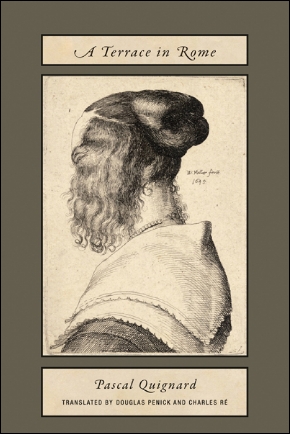 To read any work by Pascal Quignard whether fiction or non-fiction, is to experience philosophical and literary reflections on sex, love, shadows, art and death. A Terrace in Rome, his novella which won the Grand Prix du Roman de l’Académie Française prize in 2000, explores all of his most favored themes and images via the fictional story of Geoffroy Meaume, a 17th century engraving artist whose illicit love for a woman causes him horrible disfiguration, pain and suffering. The year is 1639 when twenty-one-year-old Meaume, serving an apprenticeship as an engraver, first lays his eyes on Nanni, the eighteen year-old blond beauty who is betrothed by her father to another man. For a while Meaume is happily absorbed in this secret affair and playing in umbra voluptatis (in the shadow of desire.)


 The Book Binder's Daughter