Category Archives: Classics

Review: The Happy Tree by Rosalind Murray

My new favorite literary obsession is the wonderful novels from Persephone Books.  Please visit their website to learn more about this small press and the fabulous books they publish: http://www.persephonebooks.co.uk

My Review:
The Happy TreeFirst, I would like to mention that each Persephone book comes with beautiful endpapers and a matching bookmark.  Each endpaper and bookmark pattern that are chosen have a history of their own.  The picture here is the endpaper from The Happy Tree and is a replica of a 1926 printed woolen plush by TF Firth & Sons.

This novel shows us the devastating effects that World War I has on ordinary people who are trying to carry on in their daily lives while chaos and death have broken out around them.  The story is told from the point of view of Helen Woodruffe, who spends her childhood with her Cousin Delia and her two sons, Guy and Hugo.  Helen’s own father has died and Helen’s mother wants nothing to do with raising a child.  So Helen’s paternal relations step in and raise her.  She spends many happy days running around the family estate at Yearsly with Guy and Hugo.  Helen is particularly close to Hugo who is about her same age; they seem to have a special understanding of one another’s sensitive personalities and they share the same interests.

As Helen and Hugo develop into teenagers, it is evident that there is a strong attraction between them.  Everyone who is close to them assumes that they will eventually marry.  But when Hugo takes interest in another girl, Helen agrees to marry a man named Walter because she thinks Hugo is lost to her forever.  Walter is a good husband and loves Helen and it is sad that she comes to the conclusion that she has married the wrong person.  Helen has three children with Walter and she does seem happy for most of her married life with Walter.

The most interesting part of the book is reading about people’s reaction to the war; Helen and her family are at a dinner party when Franz Ferdinand is assassinated and no one believes that there will be a war and any fighting that does break out they believe it will be minor.  When Great Britain is pulled into the war and all of Helen’s young friends, including Guy and Hugo, join the fighting no one believes that the war will last for very long.  As the war drags on, Helen gets notice of one friend after another who has been wounded or killed in the fighting.  In the meantime, she has to deal with food rations, long lines and fuel shortages.  This begins to wear her down and she becomes very depressed, especially when her second child is born.

One of my favorite quotes from the book is one in which Helen describes the struggle of everyday existence during the war years:

This was not life, this daily drudgery, this struggle to keep going, to get through, to exist. I was marking time, we were all marking time, waiting and waiting for the strain to relax, for the war to end; and meantime our youth was going.

THE HAPPY TREE is a realistic view of World War I as see through the eyes of Helen and the everyday British citizens whose lives were worn down by this horrible conflict.  Persephone Books has given us another great classic that should go on the “must read” list for all those interested in World War I historical fiction.

About The Author:
rosalind-murray-copy_1Rosalind Murray (1890-1967) was the daughter of the well-known classical scholar Gilbert Murray and Lady Mary Howard. Brought up in Glasgow and Oxford, she was educated by governesses and at the progressive Priors Field School. She published her first novel, The Leading Note, in 1910 when she was 20, her second, Moonseed, in 1911 and her third, Unstable Ways, in 1914; this was the year after her marriage to the historian Arnold Toynbee, with whom she had three sons between 1914 and 1922. The Happy Tree came out in 1926; it was followed by another novel, Hard Liberty, and by a children’s history book.  During the 1930s Rosalind Murray’s interests turned to theology; although brought up agnostic, she was received into the Roman Catholic Church in 1933, and published several books about faith and religion. She parted from her husband in 1942 and spent the rest of her life farming in Cumberland.
 

3 Comments

Filed under British Literature, Classics, Historical Fiction, Persephone Books, World War I

Review: The Making of a Marchioness Parts l and ll by Frances Hodgson Burnett

My Review:
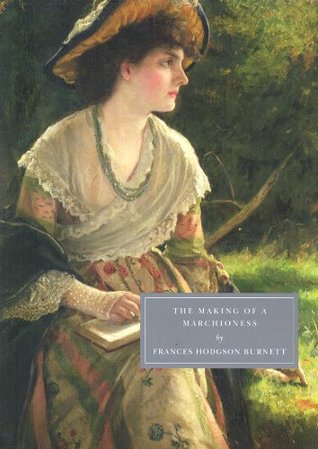
MarchionessThis is a simple yet sweet story of one woman who is saved from her dreary life by a British Lord.  Emily Fox-Seton was brought up in an aristocrat family in late 19th century England, but when both of her parents die and she is left penniless she is forced to make her own way in the world.  But Emily never, even for a minute, laments her fortune, or lack thereof, in life.  She rents a room from two kind ladies in a boarding house and she makes her living by running errands and doing odd jobs for British aristocrats.  It is an invitation from one such aristocrat, Lady Maria Bayne, that changes the course of her entire life.

At Lady Maria Bayne’s country estate, to which she is invited for a summer vacation, Emily is put to work by this selfish upper class woman.  Among Lady Maria’s guests are a plethora of silly young ladies who are each in need of a rich husband.  The most eligible bachelor present is Lord Walderhurst, a widower in his fifties whose aloof attitude leads us to believe that the last thing he wants or needs is a wife.  But the ingenuous nature of Emily catches his eye and he sweeps her off of her feet by asking her to be Lady Walderhurst.

The second part of the story deals with Emily’s adoration of her new husband and Lord Walderhurst’s growing appreciation and affection for his wife.  The marriage really seems to work for both of them and it is disappointing when Lord Walderhurst takes his leave of her for and extended business trip to India.  This part of the story is a bit ridiculous and melodramatic as the Lord’s heir, Alec Osbourn, tries to kill Emily and make it look like an accident.  Alec is a lazy drunk who, up until Lord Walderhurst’s marriage, assumes he will take over the Walderhurst title and money very soon.  He sees Emily as the only obstacle in his way of gaining an easy fortune.  Emily deals with the Osbourns in the same calm, stoic and intelligent way that she has handled all obstacles in her life.

THE MAKING OF A MARCIONESS is another delightful read from Persephone Books that I highly recommend.


About The Author:
F Hodgson BurnettFrances Eliza Hodgson was the daughter of ironmonger Edwin Hodgson, who died three years after her birth, and his wife Eliza Boond. She was educated at The Select Seminary for Young Ladies and Gentleman until the age of fifteen, at which point the family ironmongery, then being run by her mother, failed, and the family emigrated to Knoxville, Tennessee. Here Hodgson began to write, in order to supplement the family income, assuming full responsibility for the family upon the death of her mother, in 1870. In 1872 she married Dr. Swan Burnett, with whom she had two sons, Lionel and Vivian. The marriage was dissolved in 1898, and Burnett was briefly remarried, to actor Stephen Townsend. That marriage too, ended in divorce. Following her great success as a novelist, playwright, and children’s author, Burnett maintained homes in both England and America, traveling back and forth quite frequently. She died in her Long Island, New York home, in 1924.

Primarily remembered today for her trio of classic children’s novels – Little Lord Fauntleroy (1886), A Little Princess (1905), and The Secret Garden (1911) – Burnett was also a popular adult novelist, in her own day, publishing romantic stories such as The Making of a Marchioness (1901) for older readers.

4 Comments

Filed under British Literature, Classics, Persephone Books

Review: Wilfred and Eileen by Jonathan Smith

I am just in love with all of the books that I have read from Persephone Press.  This is another great classic based on a true story and deals with World War I and its affects on a loving and devoted couple.

My Review:
Wilfred and EileenThe first part of this novel deals with Wilfred Willet who is about to graduate from Trinity College, Cambridge and meets a beautiful woman named Eileen Stenhouse at a ball.  Even though they are from different social classes, they seem to hit it off right away and have lots of things to talk about.  Soon after he graduates,  Wilfred goes off to medical school and works as a resident in a hospital while Eileen sits at home with her aristocratic parents and does, well, not much of anything but wait for Wilfred to call.  In the first part of the book we are left wondering if Wilfred is as devoted to Eileen as she is to him; will Wilfred’s work at the hospital take precedence over having an engagement or eventually a marriage with Eileen?

As time goes on, Wilfred decides to defy the wishes of his parents, especially his mother, and marries Eileen in secret.  It is ironic that, although Wilfred’s family is of a lower social class, the Willets are the ones who strenuously object to the marriage.  Wilfred’s mother seems to be overly protective of her only child and I suspect that, in her eyes,  no woman would ever be good enough for him.

When World War I breaks out and Wilfred volunteers to go to the front, he decides that his secret marriage must be revealed to both families.  The author includes letters that Wilfred and Eileen write back and forth on almost a daily basis until he gets wounded.  The details he describes about the deplorable and inhumane conditions in the trenches are vivid and must have been heart-wrenching for Eileen to read.  She does manage to stay strong and put on a brave face for her husband and family and her sentiments of love and devotion in the letters are beautiful.

The real hero in the book is Eileen who travels to France in order to extract Wilfred from a makeshift army hospital and bring him back to Britain so he can receive the best medical care for his head wound.  Eileen eventually brings Wilfred back to the very hospital in which he served as an intern and his old mentor saves Wilfred’s life.  Eileen never waivers for a moment in her devotion to Wilfred despite the handicap he suffers for the rest of his life.  They make a home together in the countryside and even have two children.

If you love historical fiction set during World War I then I highly recommend giving WILFRED AND EILEEN a try.  I am completely smitten with these wonderful novels from Persephone Books.

About The Author:
Jonathan Smith was born in Wales in 1942 and went to Christ College, Brecon. He read English at Cambridge, taught at Loretto School, Edinburgh and in Melbourne, and from the late 1960s onwards at Tonbridge School, where he was head of English for 17 years. He is married and lives in Kent.


4 Comments

Filed under British Literature, Classics, Historical Fiction, Persephone Books, World War I

Review: Precious Bane by Mary Webb

This excellent, classic title was also recommended to me by a like-minded reader.  I downloaded it onto my Kindle but I will definitely buy a hard copy because it is one of those classic novels that I will reach for again and again.

My Review:
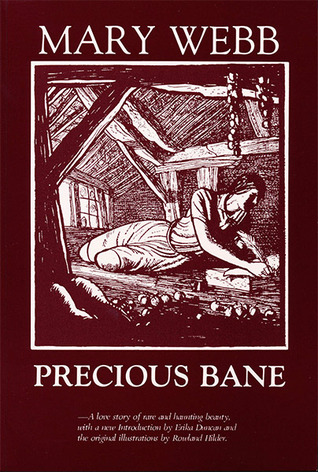
Precious BaneA the core of this story is a lesson about being kind and accepting of others who are physically different than what is considered to be society’s norm.  Prue Sarn is born with a hare lip and for the first third of the book the reader is not even made aware of her difference except for a few hints from her mother.  We are made painfully aware of Prue’s physical difference when she encounters other people from the village and they make cruel and mean comments about her lip.

In the 19th century, not only was a person with a physical deformity treated cruelly but they were viewed as cursed.  Prue is accused of witchcraft and having something wicked in her soul that caused her lip to be “hare-shodden.”  But Prue is the kindest, wisest and most patient soul in the novel.  Even when her friends and family members make offhand and hurtful comments about her lip she immediately forgives them.

The most maddening figure in the book is Gideon, Prue’s brother.  When Gideon and Prue’s father dies, Gideon inherits the family farm and he has visions of working the land night and day and making enough money for them to buy a fancy house and live in the lap of luxury.  He makes his sister Prue swear that she will work herself to the point of exhaustion in order to help him achieve his goal.  Prue doesn’t care for money or wealth or status but she agrees to help Gideon because she wants to do what will make him happy.

Gideon’s focus on producing extra crops and becoming a wealthy man is so strong that it becomes a detriment to others around him.  He will not marry Jancis, his long-time sweetheart and she is pawned off by her father as a dairy maid instead.  He even harms his ailing mother because he sees her as a drain on his income when she needs the doctor more and more.  Prue aptly begins to call Gideon’s goal and his crop his “precious bane” which foreshadows his eventual downfall.

In the end we are left wondering whether or not any man has enough honor in his spirit to look beyond Prue’s face and into the depths of her soul and see her for the good and kind person she truly is.  You will have to read PRECIOUS BANE for yourself to find out if it has a fairy tale ending.


About The Author:
Mary WebbMary Webb (1881-1927) was an English romantic novelist of the early 20th century, whose novels were set chiefly in the Shropshire countryside and among Shropshire characters and people which she knew and loved well. Although she was acclaimed by John Buchan and by Rebecca West, who hailed her as a genius, and won the Prix Femina of La Vie Heureuse for Precious Bane (1924), she won little respect from the general public. It was only after her death that the Prime Minister, Stanley Baldwin, earned her posthumous success through his approbation, referring to her as a neglected genius at a Literary Fund dinner in 1928. Her writing is notable for its descriptions of nature, and of the human heart. She had a deep sympathy for all her characters and was able to see good and truth in all of them. Among her most famous works are: The Golden Arrow (1916), Gone to Earth (1917), and Seven for a Secret (1922).


5 Comments

Filed under British Literature, Classics, Literary Fiction

Review: Greenery Street by Denis Mackail

The purpose of my blog has been to connect with like-minded readers and share great books.  This title was recommended to me by one such like-minded reader whose recommendations of books for me always seem to be spot on.  For a full list of wonderful titles from Persephone Books please visit their website: http://www.persephonebooks.co.uk/

My Review:
Original-Greenery-Street-cover-422x600Greenery Street is the perfect place in London for the blissfully happy newlyweds with its “thirty-six narrow little houses.”  The street is so charming that every couple moves in with the intention of staying there forever, but as soon as the first baby arrives each couple realizes that Greenery Street is too small to contain a growing family.  This book treats us to the first several months in the life of the charming and adorable newlywed couple, Ian and Felicity Foster.

Ian and Felicity’s courtship and engagement is not an easy road for them especially since Felicity’s father, “Old Humphrey” objects to his daughter’s marriage.  It’s not that he doesn’t like Ian, but it just seems to him that Felicity would never have to do something as complicated as getting married and leaving home.  Old Humphrey is famous for dodging touch decisions and he does this by getting a fever and having to lie in bed for several days whenever a pivotal moment in life arises.

Some readers might this this book mundane since it is the chronicle of a happy marriage.  Mackail’s sense of humor and witty dialogue make ordinary matters like shopping, having lunch, dealing with the servants and paying bills funny and entertaining.  Ian and Felicity are so nice and polite of a couple that when their servants are taking advantage of them and drinking on the job, they can’t even bring themselves to fire them.  The house-parlor maid, who is particularly cranky and awful at her job, is affectionately and secretly called “The Murderess” by the newlyweds.

I was truly delighted by the happiness of this couple and the little ways in which they found to show their love and devotion to each other.  Felicity waits eagerly on their little balcony everyday to greet Ian when he gets home; Ian apologizes and soothes Felicity even when he is not sure what he has done wrong; Felicity secretly sells her grandmother’s pearls when she wants to pay the builder’s bill and not worry Ian over money.

I highly recommend GREENERY STREET as a charming, witty and well-written book.  I could not put this book and read it in only a few sittings.  I am eager to read other titles from Persephone Books.

About The Author:
Denis MackailDenis Mackail was born in Kensington, London to the writer John William Mackail and Margaret Burne-Jones, daughter of the painter Edward Burne-Jones. Educated at St Paul’s School, Hammersmith, he went to Balliol College, Oxford, but failed to complete his degree through ill-health after two years.

His first work was as a set designer, notably for J. M. Barrie’s The adored one and George Bernard Shaw’s Pygmalion (1914). The outbreak of World War I interrupted this promising start, however, and Denis, not fit enough for active service, worked in the War Office and the Board of Trade.

In 1917 he married Diana Granet, only child of the railway manager Sir Guy Granet, who was a director-general for railways in the War Office. The couple had two children, Mary (born 28 March 1919) and Anne (born 12 January 1922) and lived in Chelsea, London. It was the necessity of supporting his young family that led Denis to write a novel when office jobs became insecure after the end of the war.

With his novel published, his first short-story accepted by the prestigious Strand Magazine and the services of a literary agent, A. P. Watt, Denis was soon earning enough from his writing to give up office work. He published a novel every year from 1920 to 1938 and among his literary friends were P. G. Wodehouse and A. A. Milne.

During the 1930s Mackail lived at Bishopstone House, Bishopstone near Seaford, Sussex

As therapy from a nervous breakdown, Denis agreed to write the official biography of J. M. Barrie, which appeared in 1941. He went on to produce seven more novels and some books of reminiscences, but after the early death of his wife in 1949, he published no more and lived quietly in London until his death.


3 Comments

Filed under Classics, History, Literary Fiction, Persephone Books