
My Review:
 Justine is another example of the cutting-edge, fascinating, and experimental writing that Open Letter seeks out and publishes from authors around the world. Originally written and published in 2012 in Danish, it has taken a few years for Mondrup’s work to become available in English. It is just the type of creative, sensual, interesting book that was screaming out for Open Letter to translate and publish.
When the book opens, Justine’s house has just burned down and along with the house all of her artwork for an upcoming exhibition has gone up in flames. Justine inherited the house and her artist sensibilities from her grandfather. We are given some vague hints about what started the fire and whether or not Justine herself is to blame. Most of the book is taken up with Justine’s jumbled thoughts about her life past and present, about her experimentations with her art, about the sexist world of the Dutch art school, about her varied sexual relationships and about her disintegrating state of mind.
Sex is available to Justine no matter whom she encounters in art school; professors, graduates and students alike, male or female, will sleep with her. I can’t help but think that the author chose the name for her title and main character, Justine, as a literary nod to de Sade who also penned a book with this title. Justine is officially dating a woman named Vita, whom she appears to have genuine affection for: “I love her,” she writes, “I already loved her that New Year’s Eve when the light had long since departed, everyone had gone home, it was only us tough dogs left.” Notice the interesting mix of past and present tense—the polyptoton love and loved is especially fitting— even in this one short sentence spoken by Justine.
But despite her feelings for Vita, Justine keeps cheating on Vita with an interesting variety of men. It turns out that Vita has also been seeing another woman behind Justine’s back and Justine becomes extremely jealous when she finds out. Like the writing and some of the plot in the book, Justine’s sexual orientation is ambiguous. Her sexual encounters with men and women are, like her state of mind, frenzied, intense, dark and highly erotic. She describes a drunken escapade with a man named Bo she regularly meets for sex:
I can perch atop him and ride. In my hand he’s an animal I’m bringing down. I’ll ride him like he’s never been ridden, until he spurts until he dies. I unzip his pants. There’s softness in the warmth between the hairs. I ride him with my hand. I transform him to a fountain that shoots high in the air.
When her Grandfather and Ane, a good friend from art school, are described the narrative is more straightforward, more traditional. But when she tells us about her various erotic interludes the text becomes poetic, scattered, broken. Grandfather, who was himself a painter, discusses art, life and family history with Justine. Grandfather himself has not had an easy existence because his wife, Justine’s grandmother, suffered from a nervous breakdown after she gave birth to Justine’s mother. Justine’s mother is also mentally unstable and a drunk who accidentally burns herself to death. Mondrup subtly weaves patterns of images throughout Justine’s scattered narrative: fire, burning, passion and madness.
Another significant stylist detail to note about the book is that several of the pages of the text are very short, a paragraph or even a sentence in length. Since Justine jumps back and forth between past and present sometimes we are thrust into the midst of one of these short meditations and we aren’t sure if she is talking about past or present. Many of her thoughts are eerily foreboding:
Is it even possible to find a cut-off? An exact moment when it all went wrong? A point around which all events are distributed? Before and after? A crime scene? A weapon cast in a backyard? The road to murder is a slippery slope of things that are said and done. An eye that saw amiss. Something that should’ve remained hidden. Or something that didn’t happen. After the murder there’s the clean-up. The cover up. Someone must pay the penalty. Others must receive it.
Justine finally manages to pull enough of her art work together to have a successful showing at a local gallery. But the ending of the book can only be described as ambiguous. Normally I would find this frustrating, but it is a fitting end for Justine whose own ambiguities abound throughout the novel.
About the Author:
 Iben Mondrup is a trained visual artist from The Royal Danish Academy of Fine Arts who is also the author of four novels, including Justine, its sequel, and Godhavn.
Read an conversation with Mondrup from The Rumpus: http://therumpus.net/2016/12/the-rumpus-book-club-chat-with-iben-mondrup-and-kerri-pierce/
 December comes from the Latin word decem, meaning ten because in the original Roman calendar December was the tenth month of the year. When two new months were added to the beginning of the Julian calendar, thus pushing back December to become the twelfth month, no one bothered to change the name. As the month which concludes the Julian and Gregorian calendar years it is naturally a month of reflection, of looking back, of becoming more aware of the passage of time. Kluge and Richter use this last month of the year for the inspiration behind their collection of stories and photographs; there is one entry for each day of the month in December and together the writings and art work serve as a philosophical and poetic commentary about time, fate, choice and even love.
 The doctor estimates that he has about four or five hours to live when suddenly he sees a faint, flickering light in the distance. He isn’t sure if this light is a figment of his bewildered mind but he chooses to follow it anyway. The light, which is indeed the very thing that saves him, was the lamp of the cathedral verger who at that precise moment was climbing the stairs of the cathedral to ring the nightly bells.
 Come Back In Winter by Sunandini Bangerjee
 Cartography 02 by Sunandini Banerjee
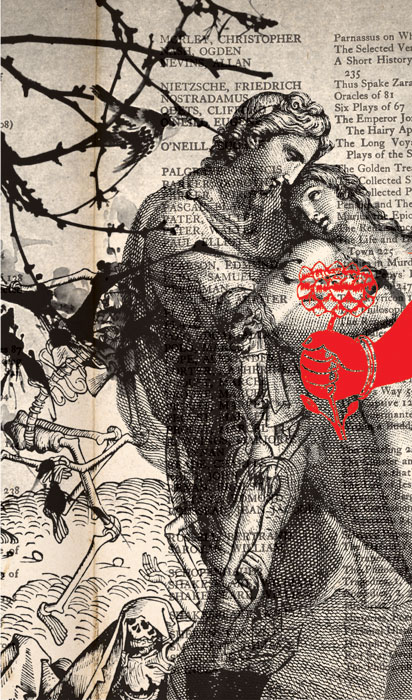 Love and Death by Sunandini Banerjee
 One of my favorite poems from the Roman elegiac poet Catullus is his shortest, which contains two very powerful and vivid lines:
 I know what my readers are thinking: You are reviewing a catalogue, how boring can that be? But please bear with me for a moment because the Seagull Catalogue of books is so much more than a listing and description of their forthcoming titles. It is a work of art, of literature and literature in translation in its own right.
 and blindness and hindsight. His letter begins, “Man will pluck their eyes. This is known. Out of shame. And horror. Over a deed committed. Often more imagined than the truth. Sometimes as a gesture made drama.” The first two responses to his letter, from Reinhard Jirgl and Benedict Anderson, pick up on the idea of blindness as a punishment by referring to the Ancient Greek story of Oedipus.
 The artwork that corresponds to the series of letters is equally as stunning. In one image a boy looks out the window of what appears to be a train;
 in another a sculpture is being painted with the finishing touches and emphasis being put on the eyes;
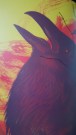 and in yet another a raven is painted in black with its eye highlighted in a striking shade of red.


 The Book Binder's Daughter