

I received a review copy of this book from the translator, Helen Wallimann. The book was published in the original German in 1990 in Switzerland and this English version was released in 2015. I invite you to read my review and scroll down to the end of the post to win your own copy of Epitaph for a Working Man.
My Review:
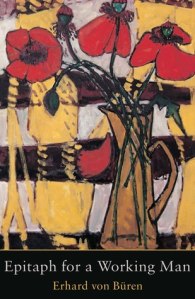 Haller resides in a nursing home in Switzerland where he still participates in a very full and active life. He visits the local pub, he continues doing some work as a stone mason and he entertains his roommates with his quick, sarcastic wit. This book is the story of the last year of his life as told by his only child, his son.
When the story begins, Haller’s son, who is never given a name, is picking up his father’s belongings from the nursing home at which he had resided for the last twelve years of his life. His father’s only earthly possessions are contained in two small boxes. His son slowly begins to recount his father’s illness which began as an odd mole on his back that at first only caused him some minor discomfort. We guess from the description of this growth that Haller has melanoma and as the story progresses this diagnosis is confirmed.
Haller has to make three trips a week to the hospital in order to undergo radiotherapy treatments for his back. At first the prognosis seems quite good and the doctor is optimistic that the treatments will take care of the growth on the old man’s back. Haller’s son meets him at the hospital for all of his father’s appointments and waits for him while he receives his treatments. Haller and his wife divorced when their child was very young so Haller and his son have never been very close. It is Haller’s illness and his time at the hospital that bring the father and son together into a closer relationship and connection.
Haller’s son has lost his job as a typesetter and has been living on unemployment for many months now. He has lost his sense of purpose and his only task during that day is that of “house husband.” He makes meals for his wife, picks up around the house and does laundry while his wife is at work all day. He takes the news that his wife is having an affair with her boss in a rather emotionally detached way. He wonders where they meet to have their trysts and he also wonders if he should leave her. He doesn’t seem to be all that upset about this development in their marriage so we are left to speculate if he wasn’t all that emotionally attached to the relationship in the first place, or if he is just numb with shock and depression.
The last few days of his life, which are very painful for Haller, are related to us in some detail. Haller’s son never shares with his father when the cancer reaches his organs. He struggles with his decision not to be honest with his father about his diagnosis. He also struggles with how to make his father the most comfortable in his final days. The strength of this story lies in its subtle commentary on how we struggle as human beings to deal with our final days. Helen’s translation beautifully renders the heartwarming relationship between father and son into English for us.
About the Author and Translator:
Erhard von Büren was born near Solothurn, Switzerland, in 1940. After a PhD in Psychology and German philology from Zurich University (Zur Bedeutung der Psychologie im Werk Robert Musils. Atlantis, Zürich) and study stays in France he worked as a teacher in advanced teacher training. He lives in Solothurn, Switzerland. He has had three novels published in Switzerland: Abdankung. Ein Bericht (Zytglogge Verlag, Bern 1989), Wespenzeit (Rotpunktverlag, Zürich 2000), Ein langer blauer Montag (verlag die brotsuppe, Biel/Bienne 2013). Erhard von Büren has won various literary awards including the Canton of Solothurn Prize for Literature in 2007. Homepage: http://www.erhard-von-bueren.ch
Helen Wallimann was born in 1941 and grew up in Cheltenham. She received her MA from Edinburgh University in 1963.She has worked in publishing in Munich, Paris and London. From 1973 to 2001 she was a teacher of French and English at the Kantonsschule Solothurn. Her literary translations in book form include Legends from the Swiss Alps. MCCM Creations, Hong Kong 2009 (translated from German); Leung Ping-kwan, The Visible and the Invisible. Poems. MCCM Creations, Hong Kong 2012 (translated from Chinese).
Giveaway:
The translator put together a fun little multiple choice quiz about Switzerland for my readers. Whoever gets the most answers correct will win a paperback copy of the book. If there is a tie I will randomly choose a winner. The quiz will be open until Friday, Feb. 19th. This giveaway is open internationally. Good luck!
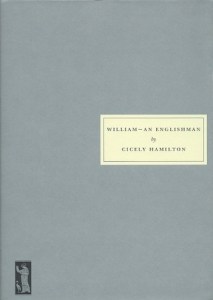 I was not surprised to find out the author composed this novel in a tent on the front lines of World War I. The novel is a gruesome, starkly honest portrayal of the horrors of war. The author, however, draws the readers in at first with a light and satirical description of its gentle, naïve and optimistic main characters, William and Griselda.
 This edition of Mandelstam’s Voronezh Notebooks, recently published by the New York Review of Books, is a collection eighty nine verses the Russian poet wrote while he was exiled to the city of Voronezh. During the early 1930’s Mandelstam wrote and published poetry that mocked and criticized Stalin and so it is no surprise that he was arrested and sent into exile. During part of his exile he was allowed to live in Voronezh which was a bit more civilized as far as Russian exiles were concerned. He was lucky that his wife Nadezhda was allowed to go with him and if it were not for her then much of his poetry would have been lost to us.
 Osip Mandelstam was a Russian poet and essayist who lived in Russia during and after its revolution and the rise of the Soviet Union. He was one of the foremost members of the Acmeist school of poets. He was arrested by Joseph Stalin’s government during the repression of the 1930s and sent into internal exile with his wife Nadezhda. Given a reprieve of sorts, they moved to Voronezh in southwestern Russia. In 1938 Mandelstam was arrested again and sentenced to a camp in Siberia. He died that year at a transit camp.
 One of my favorite poems from the Roman elegiac poet Catullus is his shortest, which contains two very powerful and vivid lines:
 I always thought it was sad that the Roman Stoic philosopher Cicero, in his moral treatise De Senectute (On Old Age), argues that not only do old men not engage in the pleasures of a lover any longer, but they are actually relieved to be free from such sensations. Seneca, in one of his Stoic epistles, agrees with Cicero’s sentiment by telling Lucilius that it is a relief to have tired out one’s appetites and be done with such things.



 The Book Binder's Daughter