Monthly Archives: February 2016

Review: The Voronezh Notebooks by Osip Mandelstam

My Review:
MandelstamThis edition of Mandelstam’s Voronezh Notebooks, recently published by the New York Review of Books, is a collection eighty nine verses the Russian poet wrote while he was exiled to the city of Voronezh.  During the early 1930’s Mandelstam wrote and published poetry that mocked and criticized Stalin and so it is no surprise that he was arrested and sent into exile.  During part of his exile he was allowed to live in Voronezh which was a bit more civilized as far as Russian exiles were concerned.  He was lucky that his wife Nadezhda was allowed to go with him and if it were not for her then much of his poetry would have been lost to us.

The first notebook contains poetry written between April and July of 1935.  All of the poems are numbered as well as dated.  In this first series of poems we understand that Mandelstam is relieved to be in Voronezh although he by no means feels at home in this city.  He lives is a crowded boarding house that he describes as a “coffin” in the first poem.  He and his wife have no privacy and they hear every movement and sound of their neighbors.  In the third poem he begs Voronezh to have mercy on him and “restore” him but throughout these poems we get the sense that he feels hemmed in, claustrophobic and hopeless.

The second Notebook beings in December of 1936 and goes through February of 1937.  The imagery of winter that one encounters in these poems are particularly striking.  He describes this season as a “postponed present” because the length of its extent is always uncertain.  Poem #37 is one of my favorites from this collection; he admires the goldfinch who “curses the sticks and perches of his prison.”  He admires this  bird who makes so much noise and is “disobedient.”

The final notebook is written between March and May of 1937.  As I have already hinted at through his writing of winter and the goldfinch, Mandelstam’s lines abound with images of nature and the forest.  In the introduction to this volume, Andrew Davis, the translator, tells us that Mandelstam composed these verses in his head while he was walking.  He seems to have done a great deal of exploring his natural surroundings and appreciated, even for a few hours, the illusion of freedom which they provided.  But Mandelstam realizes that his stay in Voronezh is not his own choice and he is still a captive of a fascist regime.  In Poem #72, for example, he writes of the night sky and the stars which he is fighting against as they hem him in and suffocate him; although the sky appears limitless, he is stuck under the sky that only encompasses this city.    In Poems #76 he declares, “I am ready to roam where the sky is greater.”

Finally, in his introduction to the collection Davis points out that the Notebooks were saved through the extraordinary efforts of his wife who, even after his death, saved pieces of them in teapots and other small places hidden around her apartment.  Each day she would practice memorizing them and Davis explains that “she made it her life’s work to preserve her husband’s poetry.”  Because of her act of devotion and bravery this seemed to me like a fitting collection to review as we celebrate and acknowledge those we love on this upcoming Valentine’s Day.


About the Author:
OsipOsip Mandelstam was a Russian poet and essayist who lived in Russia during and after its revolution and the rise of the Soviet Union. He was one of the foremost members of the Acmeist school of poets. He was arrested by Joseph Stalin’s government during the repression of the 1930s and sent into internal exile with his wife Nadezhda. Given a reprieve of sorts, they moved to Voronezh in southwestern Russia. In 1938 Mandelstam was arrested again and sentenced to a camp in Siberia. He died that year at a transit camp.

The translator has written a wonderful article about the difficulties of translating Mandelstam’s poems from Russian to English that I encourage everyone to read: https://psa.fcny.org/psa/poetry/crossroads/own_words/Osip_Mandelstam/
 

14 Comments

Filed under Literature in Translation, New York Review of Books, Osip Mandelstam, Poetry, Russian Literature

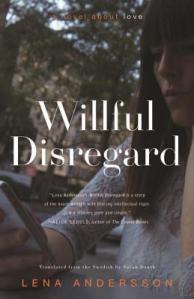
Review: Willful Disregard by Lena Andersson

I received an Advanced Review Copy of this title from Other Press.  The original book was published in Swedish in 2013 and this English version has been translated by Sarah Death.

My Review:
Willful DisregardOne of my favorite poems from the Roman elegiac poet Catullus is his shortest, which contains two very powerful and vivid lines:

Odi et amo. quare id faciam, fortasse requiris? nescio, sed fieri sentio et excrucior.

(I hate and I love.  Perhaps you may ask why I do this?  I don’t know,  but I feel that it is so and I am tortured)  -Catullus, poem 85

At the time of composing this poem Catullus had been in the throws of an illicit affair with a woman twenty years his senior.  In the beginning the affair is intense and all-consuming; but the woman slowly grows tired of poor Catullus and the agony he experiences as a result of what turns out to be a one-sided love affair is aptly expressed in this poem.  When love is not reciprocal, and expectations are higher for one person and not the other, feelings of torment and torture are the result.

Lena Andersson, in her latest novel, also employs a brevity of powerful words to express a woman’s disappointment and torment when an affair becomes one-sided.  When the book opens, the  main character, Ester, is a strong, independent, hardworking, artistic woman who has a successful career writing articles for art magazines and journals.  She is hired to give a lecture about one of Sweden’s most prominent modern artists, Hugo Rask; what ensues is a year’s worth of frustration, torment and false hope for this woman who was once strong and independent.  Even as she researches Hugo to give her lecture he becomes a larger than life, heroic artist and her interest in him borders on obsession.  When she meets Hugo in person she is immediately attracted to him and wants to be around him all of the time.  She breaks up with her live-in boyfriend, a kind man named Per, because she wants nothing more than to have a relationship with Hugo.

Ester begins her tentative interactions with Hugo through dinners and long conversations.  There is an interesting subtext that is cleverly at work in the novel as well since many of Ester and Hugo’s conversations deal with fascism, totalitarianism, freedom and independence.  The exact details of the conversations are not always given since the book mainly deals with Ester’s inner dialogue.  Ester tells us that the conversations with Hugo are erotic and emotionally charged and she fully expects that they will become lovers.  She appears desperate to be in the full throws of a relationship with this artist whom she idolizes and she becomes very impatient when the relationship does not advance as quickly as she expects.

The author’s foreshadowing in this book is brilliant.  At the beginning, when Ester begins to talk about Hugo and her interactions with him she oftentimes describes them as causing her torment and pain, much like the torture that Catullus feels in the above mentioned poem.  There are quite a few things that neither we, the readers, nor Ester know about Hugo.  He mysteriously disappears every other weekend to another city in Sweden.  Ester assumes that he might have a relationship with another woman with whom he is spending so much time on the weekends, but she doesn’t really know.  And she never asks him directly!  Hugo also puts her off from showing her his apartment and only ever meets her at his work studio.  Ester chalks all of this up to Hugo’s mysterious nature as an artist, but the astute reader understands that this secretive nature of his doesn’t bode well for their relationship or any chance of them having a future together.

When Ester and Hugo finally end up in bed her feelings intensify and she becomes even more obsessed with the progression of their relationship.  She analyses and over analyzes every text message and e-mail from him.  She waits impatiently for him to return her phone calls.  She can’t stand it when days go by without seeing him.  I found myself wanting to scream at her while reading, “He’s not worth it.”  “Run the other way and never look back before this ridiculous farce of a relationship destroys you!”  Her friends, which she describes as the “girlfriend chorus” do give her this wise advice but she cannot tear herself away from the emotional attachment she feels towards Hugo.  We are left wondering page after page when poor Ester will finally come to her senses and regain her independence and free herself from these destructive feelings.

This author truly has a gift for philosophical writing; the description of hope and the negative effects in has on the lover at the very end of the book are nothing short of brilliant.  Andersson compares hope to a parasite that” has to be starved to death if it is not to beguile and dazzle its host.  Hope can only be killed by the brutality of clarity.  Hope is cruel because it binds and entraps.”

I always tell my students that it is no wonder that hope was in Pandora’s box of evils.  If you have ever been in the throws of love and have been tortured by hope because of a futile love then you should read this book.

About the Author:
L AnderssonLena Andersson (born 18 April 1970 in Stockholm) is a Swedish author and journalist. She won the August Prize in 2013 for the novel Wilful Disregard . In the same year, the same book, won her the Literature Prize given by the Swedish newspaper Svenska Dagbladet.

8 Comments

Filed under Art, Literature in Translation

Review: Winter by Christopher Nicholson

I received an advanced review copy of this book from the publisher, Europa Editions.

My Review:
WinterI always thought it was sad that the Roman Stoic philosopher Cicero, in his moral treatise De Senectute (On Old Age), argues that not only do old men not engage in the pleasures of a lover any longer, but they are actually relieved to be free from such sensations.  Seneca, in one of his Stoic epistles, agrees with Cicero’s sentiment by telling Lucilius that it is a relief to have tired out one’s appetites and be done with such things.

Christopher Nicholson, in his fictional autobiography about the last few years of Thomas Hardy’s life, greatly disagrees with Cicero and Seneca’s views on old age.  Nicholson gives us an example, through the life of this famous author, of an old man enjoying love and fantasizing about pleasure even though such enjoyments are not necessarily attainable.  The focus of the book is the winter of Hardy’s eighty-fourth year when he decides to become involved in an amateur production of Tess.  He has resisted turning what is his most famous novel into a staged production, but when he meets Gertrude Bulger, a local townswoman, he believes she is the only one that can do his heroine justice.

Hardy lives a very quiet life in the small town of Wessex where he was born.  He doesn’t go out and socialize very much, so it is truly remarkable when he agrees to become involved with the local theater company to stage this production of Tess.  He develops a heart-warming relationship with the lead actress, whom he affectionately refers to as “Gertie.”  He enjoys having her over for tea and talking to her about books, philosophy and life in general.  He realizes that, even though he is in the winter of his life, he still has strong feelings of love and desire for this twenty-eight year-old woman.  She inspires him to write love poems again and he produces over twenty such poems in the course of a few months.

The imagery and backdrop of winter is appropriate for Hardy’s reflections on what he feels could be the last few months, weeks or days of his life.  The cold and ice and bleak landscape reflect what he feels is going on in the natural progression of his life.  He, however, is not sad or bitter about this .  And when he has the opportunity to interact with Gertie he embraces the opportunity and does not deny himself feelings of love, pleasure and desire just become of his advanced age.  One of the sweetest moments of the book is when he finds one a piece of her hair and tucks it into one of the books in his library as a keepsake.

The other forceful character in the book is Hardy’s wife who is about forty years his junior.  Although Florence is much younger than her husband she acts like she is the octogenarian in the relationship.  She is obsessed with her health, paranoid, whiny and jealous.  When she sees that Thomas has developed feelings for Gertie she is relentless in her nagging at him and does everything she can to make sure that they do not see each other again.  I understand that Hardy could be a quiet, brooding, stubborn man and was not the easiest person to live with.  But Florence’s constant obsession about her health and the perceived wrongdoings against her made it difficult to have any sympathy for her.

The reader should be warned that the ending is not necessary a happy one.  There is, however,  a larger message in the book to be found which is that Cicero and Seneca did not quite have the correct perceptions on old age.  Human beings have the capacity to experience love, desire and pleasure right up until our final days.  Cicero and Seneca most definitely would have judged Hardy to be a bad Stoic.

About the Author:
C NicholsonChristopher Nicholson was born in London in 1956 and brought up in Surrey. He was educated at Tonbridge School in Kent, and read English at Gonville and Caius College, Cambridge. After university he worked in Cornwall for a charity encouraging community development. He then became a radio scriptwriter and producer, and made many documentaries and features mainly for the BBC World Service in London. He was married to the artist Catharine Nicholson, who died in 2011. He has two children, a son and a daughter. For the past twenty-five years he has lived in the countryside on the border between Wiltshire and Dorset.


8 Comments

Filed under British Literature, Historical Fiction

Review: Snowblind by Ragnar Jónasson

I received a review copy of this title from the publisher, Orenda Books.  This book was first published in Iceland in 2010 and this English translation has been done by Quentin Bates.

My Review:
SnowblindI don’t usually read many mystery or crime novels, but when Orenda Books asked me to review some of the books in their catalog the descriptions of them convinced me to give them a try.  This book is much more than a typical crime novel; it delves into the lives of several characters in a small isolated town in northern Iceland.  The atmosophere of the book is also a surprise as the scenes are set in a small, isolated,  cold, and snow-covered town.

Ari Thor lives in Reykjavik with his girlfriend Kristin and is studying to become a police officer.  For the first time in his life he is very much in love and feels that he and Kristin will make a life and a future together.  When he gets his first job in Siglufjörður, a small village in northern Iceland, he is torn about whether or not to take it.  Kristin is finishing her medical degree in Reykjavik so there is no way that she can go with him.  Taking this new job will mean a separation, for as long as a year or two, from Kristin.  But Ari Thor believes that this job is a great opportunity and accepts the position anyway; he leaves Kristin behind and is heartbroken that their future together is uncertain.

Siglufjörður is supposed to be a town where no one locks their doors, where everyone knows each other, and where nothing exciting ever happens.  So it is either bad luck or bad timing that, when Ari Thor becomes the town’s newest police officer, two murders happen within days of each other.

The first murder, which many think at first is just an accident, happens at the local dramatic society.  The director of the society, a very old man in his nineties who is prone to drinking too much, takes a nasty fall down the stairs during a rehearsal break. At first the incident is thought to be an accident, but as the story develops it appears that several people in the dramatic society are capable of pushing the old man down the stairs.  One of the greatest strengths of the book is the development of several characters who belong to the society and work in the theater.  My experience with crime novels has been that characters are not deeply developed as the focus is on the plot.  But Jonasson gives us an interesting set of characters with well-developed descriptions of their history in the town and their relationships with one another.

A second murder also takes places in this small town.  A woman is found stabbed to death outside her home and her abusive husband is the primary suspect.  But the husband has an alibi for the time during which the murder took place.  So it is up to Ari Thor to untangle this mystery.  Another strength of the book is that the author is able to weave two different mysteries into the plot without the story being too cumbersome or confusing.

The final aspect of the book that I have to mention is Ari Thor’s descriptions of Siglufjörður which, even to Icelanders, is on the edge of nowhere.  It snows so much that Ari Thor begins to feel trapped and claustrophobic in this place.  The snow and the cold never stop and when the only road in or out of the town is completely blocked by an avalanche his panic attacks and nightmares get worse.  The vivid descriptions of the cold and snow and darkness were a perfect setting for this story.  As it snowed here in New England last weekend when I was reading the book the setting felt especially apt.

Whether you are a fan of crime fiction, or like me, just enjoy dabbling in the genre here and there, Snowblind is an entertaining read.  This book actually ends on a bit of a cliffhanger and I am eager to read the next book in this series and see what happens with Ari Thor.

About the Author:
R JonassonRagnar Jonasson is author of the international bestselling Dark Iceland series.

His debut Snowblind, first in the Dark Iceland series, went to number one in the Amazon Kindle charts shortly after publication. The book was also a no. 1 Amazon Kindle bestseller in Australia.

Snowblind was selected by The Independent as one of the best crime novels of 2015 in the UK.

Books in the Dark Iceland series have been published in the UK, Germany, Poland and Iceland, and rights have also been sold to the USA, France and Italy.

Ragnar was born in Reykjavik, Iceland, where he works as a writer and a lawyer. He also teaches copyright law at Reykjavik University and has previously worked on radio and television, including as a TV-news reporter for the Icelandic National Broadcasting Service.

Ragnar is a member of the UK Crime Writers’ Association (CWA) and recently set up the first overseas chapter of the CWA, in Reykjavik.

He is also the co-founder of the Reykjavik international crime writing festival Iceland Noir.

From the age of 17, Ragnar translated 14 Agatha Christie novels into Icelandic.

Ragnar has also had short stories published internationally, including in the distinguished Ellery Queen’s Mystery Magazine in the US, the first stories by an Icelandic author in that magazine.

He has appeared on festival panels worldwide, and lives in Reykjavik with his wife and young daughters.

7 Comments

Filed under Literature in Translation, Mystery/Thriller
