Monthly Archives: June 2015

Review: Running Through Beijing by Xu Zechen

Oftentimes small literary presses will have an option for readers to buy a subscription for their books. When I discovered Two Lines Press I decided that buying one of their yearly subscriptions would be a great option for me and would also allow me to support this small press which publishes literature in translation. I bought the 2014 subscription and for $30 and I received three books as well as a copy of their journal.  For more information on their subscriptions, including the one for 2015, please visit their website: http://twolinespress.com/subscribe/.

My Review:

BeijingWhen the book opens, Dunhuang has just gotten out of prison after a three month sentence for selling fake I.D.’s.  Dunhuang, like many young people without a college degree or a vocation, has left his small town and is hoping to make some money in Beijing.  The streets of Beijing are rife with itinerant youth peddling anything from fake I.D.’s to fake college diplomas to pirated DVD’s.

This book opened my eyes to life in a city like Beijing with its cramped living quarters, awful dust storms and illegal trade.  When Dunhuang gets out of jail he has no where to go but he meets a woman named Xiaorong who sells pirated DVD’s.  He spends his first night at her apartment where he learns that she is terribly unhappy living in Beijing; she has just broken up with her boyfriend and is sad and lonely.  Dunhuang and Xiaorong rely on each other for physical and emotional comfort and eventually they become business partners by selling pirated DVD’s together. One gets the feeling that Dunhuang has a connection with Xiaorong that runs deeper than he is willing to admit.

Dunhuang is a natural salesman and immediately becomes successful peddling his DVD’s.  He has regular customers and he even buys books on cinema so that he can read up on different films that his customers might enjoy.  Two Lines Press also has a fantastic link on their website with information about many of the DVD titles that are mentioned in the book: http://twolinespress.com/a-dvd-playlist-for-running-through-beijing/.

The book is very fast-paced and mimics the ever moving and changing lifestyle of people like Dunhuang who live from moment to moment selling illegal contraband.  These street urchins never know when they might be chased by the police,  victims of theft, or thrown out of their living quarters.  The book only spans a few months and Dunhuang makes and spends several small fortunes and lives in no fewer than four different places.  I was surprised at the very tight living quarters that are allowed in a modern city.  At one point Dunhuang rents not even a room, but a bunk bed in a room that is shared with three other men.  He also rents a tiny room that fits a bed and a washbasin that is basically a tin shack.

The ending of the book is rather abrupt and not conclusive.  I found this fitting for Dunhuang and the lifestyle he has chosen for himself on the streets of Beijing.  One gets the feeling that youth like Dunhuang never really break this cycle of a roaming around a large city with no real goals for the future.

This is my first foray into Chinese literature and I am so glad that I came across Two Lines Press and RUNNING THROUGH BEIJING.  I enjoyed the book and found an interesting amount of information about what it is like to live in a large, modern city like Beijing.  I highly recommended this title and I am looking forward to the other two books in translation that I received with my subscription.

About The Author and Translator:
Xu Zechen is the author of the novels Midnight’s Door, Night Train, and Heaven on Earth. He was selected by People’s Literature as one of the “Future 20″ best Chinese writers under 41. The recipient of numerous awards and honors, he lives in Beijing.

Eric Abrahamsen is the recipient of translation grants from PEN and the NEA and has written for The New York Times, among others. In 2012 Penguin published his translation of The Civil Servant’s Notebook by Wang Xiaofang. He lives in Beijing where he hosts the acclaimed website on Chinese literature Paper Republic.
 

5 Comments

Filed under Literature in Translation

Review: Precious Bane by Mary Webb

This excellent, classic title was also recommended to me by a like-minded reader.  I downloaded it onto my Kindle but I will definitely buy a hard copy because it is one of those classic novels that I will reach for again and again.

My Review:
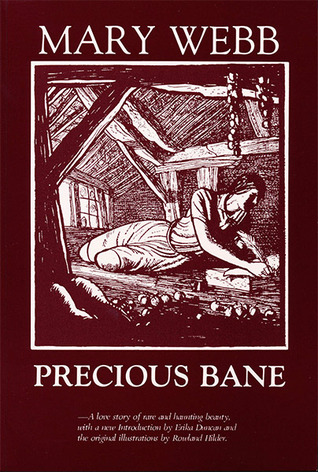
Precious BaneA the core of this story is a lesson about being kind and accepting of others who are physically different than what is considered to be society’s norm.  Prue Sarn is born with a hare lip and for the first third of the book the reader is not even made aware of her difference except for a few hints from her mother.  We are made painfully aware of Prue’s physical difference when she encounters other people from the village and they make cruel and mean comments about her lip.

In the 19th century, not only was a person with a physical deformity treated cruelly but they were viewed as cursed.  Prue is accused of witchcraft and having something wicked in her soul that caused her lip to be “hare-shodden.”  But Prue is the kindest, wisest and most patient soul in the novel.  Even when her friends and family members make offhand and hurtful comments about her lip she immediately forgives them.

The most maddening figure in the book is Gideon, Prue’s brother.  When Gideon and Prue’s father dies, Gideon inherits the family farm and he has visions of working the land night and day and making enough money for them to buy a fancy house and live in the lap of luxury.  He makes his sister Prue swear that she will work herself to the point of exhaustion in order to help him achieve his goal.  Prue doesn’t care for money or wealth or status but she agrees to help Gideon because she wants to do what will make him happy.

Gideon’s focus on producing extra crops and becoming a wealthy man is so strong that it becomes a detriment to others around him.  He will not marry Jancis, his long-time sweetheart and she is pawned off by her father as a dairy maid instead.  He even harms his ailing mother because he sees her as a drain on his income when she needs the doctor more and more.  Prue aptly begins to call Gideon’s goal and his crop his “precious bane” which foreshadows his eventual downfall.

In the end we are left wondering whether or not any man has enough honor in his spirit to look beyond Prue’s face and into the depths of her soul and see her for the good and kind person she truly is.  You will have to read PRECIOUS BANE for yourself to find out if it has a fairy tale ending.


About The Author:
Mary WebbMary Webb (1881-1927) was an English romantic novelist of the early 20th century, whose novels were set chiefly in the Shropshire countryside and among Shropshire characters and people which she knew and loved well. Although she was acclaimed by John Buchan and by Rebecca West, who hailed her as a genius, and won the Prix Femina of La Vie Heureuse for Precious Bane (1924), she won little respect from the general public. It was only after her death that the Prime Minister, Stanley Baldwin, earned her posthumous success through his approbation, referring to her as a neglected genius at a Literary Fund dinner in 1928. Her writing is notable for its descriptions of nature, and of the human heart. She had a deep sympathy for all her characters and was able to see good and truth in all of them. Among her most famous works are: The Golden Arrow (1916), Gone to Earth (1917), and Seven for a Secret (1922).


5 Comments

Filed under British Literature, Classics, Literary Fiction

Review: Greenery Street by Denis Mackail

The purpose of my blog has been to connect with like-minded readers and share great books.  This title was recommended to me by one such like-minded reader whose recommendations of books for me always seem to be spot on.  For a full list of wonderful titles from Persephone Books please visit their website: http://www.persephonebooks.co.uk/

My Review:
Original-Greenery-Street-cover-422x600Greenery Street is the perfect place in London for the blissfully happy newlyweds with its “thirty-six narrow little houses.”  The street is so charming that every couple moves in with the intention of staying there forever, but as soon as the first baby arrives each couple realizes that Greenery Street is too small to contain a growing family.  This book treats us to the first several months in the life of the charming and adorable newlywed couple, Ian and Felicity Foster.

Ian and Felicity’s courtship and engagement is not an easy road for them especially since Felicity’s father, “Old Humphrey” objects to his daughter’s marriage.  It’s not that he doesn’t like Ian, but it just seems to him that Felicity would never have to do something as complicated as getting married and leaving home.  Old Humphrey is famous for dodging touch decisions and he does this by getting a fever and having to lie in bed for several days whenever a pivotal moment in life arises.

Some readers might this this book mundane since it is the chronicle of a happy marriage.  Mackail’s sense of humor and witty dialogue make ordinary matters like shopping, having lunch, dealing with the servants and paying bills funny and entertaining.  Ian and Felicity are so nice and polite of a couple that when their servants are taking advantage of them and drinking on the job, they can’t even bring themselves to fire them.  The house-parlor maid, who is particularly cranky and awful at her job, is affectionately and secretly called “The Murderess” by the newlyweds.

I was truly delighted by the happiness of this couple and the little ways in which they found to show their love and devotion to each other.  Felicity waits eagerly on their little balcony everyday to greet Ian when he gets home; Ian apologizes and soothes Felicity even when he is not sure what he has done wrong; Felicity secretly sells her grandmother’s pearls when she wants to pay the builder’s bill and not worry Ian over money.

I highly recommend GREENERY STREET as a charming, witty and well-written book.  I could not put this book and read it in only a few sittings.  I am eager to read other titles from Persephone Books.

About The Author:
Denis MackailDenis Mackail was born in Kensington, London to the writer John William Mackail and Margaret Burne-Jones, daughter of the painter Edward Burne-Jones. Educated at St Paul’s School, Hammersmith, he went to Balliol College, Oxford, but failed to complete his degree through ill-health after two years.

His first work was as a set designer, notably for J. M. Barrie’s The adored one and George Bernard Shaw’s Pygmalion (1914). The outbreak of World War I interrupted this promising start, however, and Denis, not fit enough for active service, worked in the War Office and the Board of Trade.

In 1917 he married Diana Granet, only child of the railway manager Sir Guy Granet, who was a director-general for railways in the War Office. The couple had two children, Mary (born 28 March 1919) and Anne (born 12 January 1922) and lived in Chelsea, London. It was the necessity of supporting his young family that led Denis to write a novel when office jobs became insecure after the end of the war.

With his novel published, his first short-story accepted by the prestigious Strand Magazine and the services of a literary agent, A. P. Watt, Denis was soon earning enough from his writing to give up office work. He published a novel every year from 1920 to 1938 and among his literary friends were P. G. Wodehouse and A. A. Milne.

During the 1930s Mackail lived at Bishopstone House, Bishopstone near Seaford, Sussex

As therapy from a nervous breakdown, Denis agreed to write the official biography of J. M. Barrie, which appeared in 1941. He went on to produce seven more novels and some books of reminiscences, but after the early death of his wife in 1949, he published no more and lived quietly in London until his death.


3 Comments

Filed under Classics, History, Literary Fiction, Persephone Books

Review: A View of the Harbour by Elizabeth Taylor

I received an advanced review copy of this title from The New York Review of Books.  Please visit their website for a full list of their classics collection of which I am a big fan: http://www.nybooks.com/books/browse/all/?imprint=classics

My Review:
A View of the HarbourThis novel is about a group of year-round inhabitants of a small harbor town in England.  The main focus of the book is on Beth and Robert and their mundane, tired marriage.  They have fallen into a routine that Robert feels is boring and lifeless and Beth is so absorbed writing novels that she hardly seems to notice.  Beth is also not observant enough to detect the growing attraction between Robert and Beth’s best friend, Tory, who lives next door to them.

Tory and Robert are prone to stolen moments of kisses, embraces and meaningful looks and we are kept in suspense throughout the book as to whether or not they will consummate their relationship.  The matter becomes even  more complicated when Robert’s teenage daughter, Prudence, discovers that Robert and Beth have feelings for one another.  The mounting tension of this love triangle and Prudence’s knowledge of it prove for a page-turning read in which, no matter the outcome, someone is going to be left miserable and heartbroken.

The cast of characters that Taylor provides in this novel are multifaceted.  Bertram is an older man who has retired from the navy and lives above the town pub.  He has a way of charming himself into everyone’s life and he is especially drawn towards Tory; he has visions of himself finally settling down by marrying her.  Taylor hints that Bertram’s life has been itinerant and wandering and when the local gossip is dying he vows, for once, to sit by her deathbed and give her comfort until the bitter end.

Lily Wilson is a young widow who lives alone in a creepy wax museum that she inherited from her husband.  She is terribly lonely and afraid at night and spends a lot of time in the pub looking for company.  Taylor mentions her more at the beginning of the novel and Lily gradually drops out of site.  We are never completely sure what happens to her but there are hints that she finds sordid ways to deal with her grief.

We are also treated to the story of the town gossip, Mrs. Bracey, who has been an invalid for years and relies on her daughters Iris and Maisie to wait on her hand and foot.  Maisie has feelings for Eddie, a town fisherman, but her mother keeps interfering in her daughter’s attempt at any time of marriage or happiness.  It seems that no one in this small town has any hope of finding peace or love or a “happily-ever-after.”

I highly recommend A VIEW OF THE HARBOUR for your summer reading list.  The seaside setting, an interesting cast of characters and Taylor’s lovely prose make this another great read from The New York Review of Books.

About The Author:
Elizabeth TaylorElizabeth Taylor (née Coles) was a popular English novelist and short story writer. Elizabeth Coles was born in Reading, Berkshire in 1912. She was educated at The Abbey School, Reading, and worked as a governess, as a tutor and as a librarian.

In 1936, she married John Micael, a businessman. She lived in Penn, Buckinghamshire, for almost all her married life. Her first novel, At Mrs. Lippincote’s, was published in 1945 and was followed by eleven more. Her short stories were published in various magazines and collected in four volumes. She also wrote a children’s book.

Taylor’s work is mainly concerned with the nuances of “everyday” life and situations, which she writes about with dexterity. Her shrewd but affectionate portrayals of middle class and upper middle class English life won her an audience of discriminating readers, as well as loyal friends in the world of letters. She was a friend of the novelist Ivy Compton-Burnett and of the novelist and critic Robert Liddell. Elizabeth Taylor died at age 63 of cancer.

8 Comments

Filed under Classics, Literature/Fiction, New York Review of Books, Summer Reading
