Tag Archives: Literature in Translation

Review: Guys Like Me by Dominique Fabre

I received an advanced review copy of this book from the publisher through Edelweiss.

My Review:
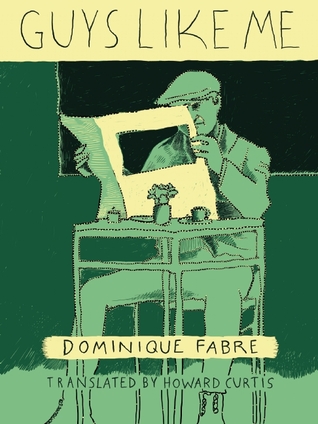
Guys Like MeWhat surprised me most about this brief novel is how emotionally invested I became in the unnamed narrator.  Fabre creates a man who describes for us his everyday existence as a fifty-four year old man, living in Paris, divorced for 15 years, with a grown son.  He works a lot to pass the time and spends most nights alone in his small apartment.  He has two close friends he sees on a regular basis and has had a few casual relationships with women he has met on dating websites.  He continually and sadly says to himself throughout the first part of the narrative, “There are no second acts.”

He likes to reminisce about his past life and speaks about the anger he had for his ex-wife after she divorces him; their separation is so nasty that they haven’t stepped foot in the same room or spoken for 5 years.  But now that so much time has passed, he begins to wonder why he was ever so angry.  The best thing in his life that has come out of his marriage is his son Benjamin with whom he has a close, supportive and touching relationship.

The narrator’s two close friends serve as an interesting contrast to his own life.  His friend Jean, with whom he has just reconnected after many years, has been out of work and on welfare for years and he suffers from long bouts of depression.  Although the narrator is oftentimes lonely, his life is never as sad or miserable as Jean’s.  Marc Andre is the narrator’s other friend who is also divorced, but is happily remarried and has a large blended family.  The narrator’s relationship with Marco proves that as we get older, it is not the number of friends that becomes so important to us, but the depth of the relationships with the few people we keep close.

About halfway through the book, the narrator meets a woman online named Marie and it is hard to tell if he really cares about her or if she just fills up some of his lonely hours.  But as the story goes on, he subtly stops saying “There is no second act.”  He seems to really turn a corner in his life and be able to declare that good things still can happen to “guys like me.”

GUYS LIKE ME is a fast and emotional must-read; it will keep you wondering if F. Scott Fitzgerald was wrong and that second acts are possible for all of us.

About The Author:
Dominique-Fabre-Dominique Fabre, born in 1960, writes about people living on society’s margins. He is a lifelong resident of Paris. His previous novel, The Waitress Was New, has also been translated into English.

I love to support small presses that provide us with wonderful books like Guys Like Me.  Please support New Vessel Press and visit their website for more titles: newvesselpress.com.

1 Comment

Filed under France, Literary Fiction, Literature in Translation

Review: The Scapegoat by Sophia Nikolaidou

I received an advanced review copy of this book from Melville House through Edelweiss.  This book was originally published in Greek in 2012 and it has been translated into English by Karen Emmerich.

My Review:

The ScapegoatI thought that from the description of this book the major focus of the plot would be a murder mystery.  And while the murder of an American journalist is the main event that affects many of the characters in this book, the novel is about so much more than this case.

In 1948, the lifeless and bullet riddled body of an American radio journalist is found floating in the bay of Thessolaniki.  At the time, Greece is entangled in political and economic turmoil and depends a great deal on American aid and money.  When the Americans demand that journalist’s murderer be found and punished immediately, the leaders in Greece look for an easy scapegoat; they beat a confession out of a poor, innocent, and hardworking immigrant named Gris.

The most tragic parts of the book deal with Gris and the affects that his arrest and torture have on his family, especially his mother and sisters. Gris has no one to protect him and even the lawyer that is assigned to defend him realizes that there is a political game to be played and Gris is just a sacrificial lamb.  It is a given from the beginning that Gris is innocent, but the amount of people involved in his arrest, torture, and imprisonment is astonishing and tragic.

The narrative shifts to the current time period in Greece which is also suffering from economic upheaval. My favorite character in the book is 18 year old Minas Georgiou who has been a good student throughout school until his senior year.  All students are expected to take a difficult test called the Panhellenic exams which determine their ability to enter university.  Minas is tired of memorizing facts, studying for tests, and conforming to what the adults in his life want from him.  I admired Minas for not following the crowd, not caring what other people think about him and digging his heels in and deciding that he will not be stressed out anymore by a standardized test.

Minas’ eccentric yet tough history teacher decides to motivate him with an unusual assignment: research and present his findings about the Gris trial.  Minas takes on the challenge and not only does he learn a lesson about the gray area of justice, but he also learns that the political and economic issues facing Greece are cyclical.

THE SCAPEGOAT is a well-narrated and tragic story that teaches us that history is never as straightforward or black an white as the history books oftentimes make it seem.  I hope that more of Nikolaidou’s works will be translated into English.

1 Comment

Filed under Literary Fiction, Literature in Translation

Review: While The Gods Were Sleeping by Erwin Mortier

I have been reading and enjoying a raft of literature in translation lately.  I was thrilled to receive an ARC of this book that was originally written and published in Dutch in 2008.  This version has been translated into English by Paul Vincent.

My Review:
Gods Were SleepingHelena is a very old woman who has outlived all of her friends, acquaintances and relatives.  She is homebound and needs round-the-clock care which is provided by a kind young woman named Rachida.  We get the feeling that Helena is waiting for death which she feels is imminent and while she waits she writes down the memories of her life, especially those that revolve around the period of World War I.

Helena’s father is Belgian and her mother is French, so she grows up living between these two countries.  She spends the summers in her mother’s family home in France, and when World War I breaks out Helena is forced to wait out the war with her mother, brother, uncle and aunts in their French countryside home.  Helena’s father is left back in Belgium and the family suffers this long separation.

The main characters in Helena’s memoir are her mother, brother and husband.  She has an uneasy relationship with all three.  Throughout her life Helena feels that, as a young woman growing up in a European bourgeois family, she is deprived of many freedoms.  Her mother, who still wears the stiff corsets of the 19th century and is always acutely aware of the gossip from the neighbors, will not let Helena wander out of their home unaccompanied.  Helena resents her mother for keeping her prisoner under these strict, and what she views as, old-fashioned mores.

Helena loves her brother Edgar and is very close to him yet she is jealous of the freedom he is allowed.  As a stark contrast to Helena, he can walk through the city streets at his leisure, have countless affairs, and travel off to war.  When Edgar is wounded during the Great War, he is finally sent home and Helena listens in horror to his vivid details of trench warfare.  One of the aspects of this book that is most impressive is the writer’s ability to graphically describe the tragedies of the war suffered by everyone who witnessed it; sounds, colors, textures, smells, and ruined landscapes are all described in order to capture the scale and destruction of The Great War.

When Helene marries a British soldier named Matthew who has a penchant for wandering and being on the open road, she admires his sense of adventure and his freedom.  But it is his wanderlust that keeps her separated from him for long periods of time.  When they have a child together, a daughter, I was surprised that Helena’s relationship with her was just a contentious as Helena’s relationship with her own mother.

The language and prose of the book feels disintegrated, as Helena jumps from one period of time to the next.  It is almost as if we are looking through an album of old photographs with Helena and she tells us stories of her life as they pop up in her mind.  She oftentimes goes on tangents as one story will remind her of another which she will launch into.  I think some readers will find this writing style confusing and disruptive, but it is appropriate for the setting of the book.  Helena is a very old woman, reflecting back on a long life and as images and narratives randomly appear in her memory she writes them down for us to read.

I have read quite a few historical fiction novels set during World War I this past year and WHILE THE GODS WERE SLEEPING is among the best for capturing the emotions, heartache, lasting effects of this war.

About The Author:
Erwin Mortier is a Dutch-language Belgian author. Spending his youth in Hansbeke, he later moved to nearby Ghent, where he became city poet (2005-2006).He wrote as a columnist for newspapers like De Morgen and has published several novels including Marcel, My Fellow Skin, Shutter Speed, and While the Gods Were Sleeping.


1 Comment

Filed under Historical Fiction, Literature in Translation, World War I

Review: The Door by Magda Szabo

The Door was originally published in 1987 in the original Hungarian. The New York Review of Books has released this edition which has been translated by Len Rix.

My Review:
The DoorEmerence was the sole inhabitant of her empire-of-one, more absolute than the Pope in Rome.”

The Door is about the unlikely relationship forged between two very different women.  Magda is a writer and an intellect and the pressures of her schedule force her to seek out a cleaning lady who will keep her home in order while she pursues her career.  Emerence, an old woman who lives in their neighborhood in Budapest, is well-known for her intense work ethic as well as her singular personality.

As the book progresses, one wonders why Magda puts up with some of Emerence’s eccentricities.  Magda at several points suffers from extremely harsh words and criticism when she argues with Emerence.  The housekeeper actually mocks Magda’s faith and religion to the point where Magda sneaks off to Church on Sunday so she will not have to endure Emerence’s verbal attacks.  As time goes on it is evident that, although they fight and argue, Magda and Emerence cannot live without each other; their lives are entangled together to the point that they cannot stand to be apart.

Emerence has a plethora of eccentricities, all of which are gradually explained throughout the book.  She has an intense fear of thunderstorms, she will only sleep in a loveseat, and she completely objects to religion or faith of any kind.  Emerence has also made a lot of money which she is saving up to buy an elaborate crypt in which to be buried.  But the most mysterious quirk of hers is the fact that she will not allow anyone, under any circumstances to enter her home.  Her door is permanently barred to her family, her close friends and her employer of 20 years.

Throughout the novel, Magda comes to truly care for the old woman and she tries to figure out what is behind the door to Emerence’s apartment.  Magda also attempts to get behind the figurative doors that Emerence has put up in order to emotionally protect herself from other people.  Can Magda ever truly break down these barriers and obtain the close and tender relationship with Emerence that she so desires?  Or will Magda’s attempts to break down these literal and figurative doors end up destroying this woman whom she has come to love as family?

THE DOOR is a unique and intense novel about relationships, loyalty, and love which I highly recommend.  Thanks to the New York Review of Books for bringing this brilliant Hungarian author to our attention.

About The Author:
Magda Szabó was a Hungarian writer, arguably Hungary’s foremost woman novelist. She also wrote dramas, essays, studies, memories and poetry.

Born in Debrecen, Szabó graduated at the University of Debrecen as a teacher of Latin and of Hungarian. She started working as a teacher in a Calvinist all-girl school in Debrecen and Hódmezővásárhely. Between 1945 and 1949 she was working in the Ministry of Religion and Education. She married the writer and translator Tibor Szobotka in 1947.

She began her writing career as a poet, publishing her first book Bárány (“Lamb”) in 1947, which was followed by Vissza az emberig (“Back to the Human”) in 1949. In 1949 she was awarded the Baumgarten Prize, which was – for political reasons – withdrawn from her on the very day it was given. She was dismissed from the Ministry in the same year.

During the establishment of Stalinist rule from 1949 to 1956, the government did not allow her works to be published. Since her unemployed husband was also stigmatized by the communist regime, she was forced to teach in an elementary school within this period.

Her first novel, Freskó (“Fresco”), written in these years was published in 1958 and achieved overwhelming success among readers. Her most widely read novel Abigél (“Abigail”, 1970) is an adventure story about a schoolgirl boarding in eastern Hungary during the war.

She received several prizes in Hungary and her works have been published in 42 countries. In 2003 she was the winner of the French literary prize Prix Femina Étranger for the best foreign novel.


5 Comments

Filed under Classics, Literature in Translation, New York Review of Books

Review: For They Have Sown The Wind by Alessandro Perissinotto

I received an advanced review copy of this book from the publisher through NetGalley. It is translated into English from the original Italian novel.

My Review:

For they have sown the windGiacomo Musso finds himself in an Italian prison, accused of having a role in the violent death of his wife.  Giacomo’s lawyer, in order to help prove his client’s innocence, asks Giacomo to write his story down on paper.  The story that he writes while he is incarcerated does not begin just before his wife’s death. Giacomo asks his lawyer for a box of old photographs and through these photos he retraces his marriage all the way back to the first time his met his wife when they were living in Paris.

The first half of the story is the best part as it describes Giacomo as a shy man who gradually wins Shirin’s love.  They live in her apartment in Paris for about a year and then they decide to move back to Giacomo’s small hometown which is high in the mountains in Northern Italy.  Giacomo takes job a as an elementary school teacher in his hometown where he teaches 12 children of all different grades in a one room schoolhouse.

Giacomo and Shirin’s life, however, is completely changed by their decision to live in this small town.  Although they are charmed by the scenery, the history of Giacomo’s ancestral home and the childhood friends who welcome Shirin, racism soon rears its ugly head.  Events soon occur that prove this isolated part of Italy is rife with prejudice against Muslims and although she is a French citizen, Shirin’s Iranian descent makes her the target of racial bigotry.

This book made me think, once again, about marriage and relationships.  At the first sign of trouble, Giacomo and Shirin’s marriage begins to crumble.  They are portrayed by Giacomo in his writing as a happy pair who never argue or even bicker.  But when a serious situation arises that tests their love, they turn on each other and take out their resentment on the very person who should be offering succor.

Shirin’s response to the isolation she suffers as a result of racism is one of  extreme, and even violent, retaliation.  This reminds me of the recent events in Ferguson, Missouri which city had a rash of violent protests, burnings and lootings.   When a group of people become victims of racial profiling, bigotry and persecution, the reaction of these victims is oftentimes that of violence and outrage.  But in both the case of Shirin and the looters in Ferguson, is violence really a reaction that will bring about an end to racial tension and bigotry?  I am not saying we can blame these victims for such a reactive response, but in the end what does it really solve?

FOR THEY HAVE SOWN THE WIND is for those readers who like a thought-provoking book about marriage, relationships, racism and small town life.

add-to-goodreads-button3


2 Comments

Filed under Literary Fiction, Literature in Translation