Tag Archives: Literary Fiction

Review: Love Maps by Eliza Factor

I received an advanced review copy of this book from Akashic books through Edelweiss.

My Review:
Love MapsSarah is an artist living in New York City in the 1980’s.  Even though she gets her own show at a New York gallery, she is always living in the shadow of her older sister, Maya, who is not only a famous singer but has also made a name for herself as a real estate tycoon.

Maya is self-centered and she is not a likeable character from the beginning of the story.  She seems focused on outward appearances and receiving constant attention and applause. Her disingenuous nature comes through even when she is trying to take an interest in Sarah’s life and career.  Sarah follows Maya around the world organizing the details for Maya’s singing engagements.

Maya is all set to go to Europe for an extended tour, but Sarah tells Maya that she wants to stay in Manhattan and finish a series of paintings which she has been hard at work on.  But when Sarah decides, for once, to put her own career first, Maya has a violent and outrageous reaction to Sarah’s decision.  This event foreshadows what Maya will do in the future to break up Sarah’s happy marriage with Philip.

Sarah meets Philip, of all places, at a funeral of a mutual friend.  It takes some time for them to get together in the book because they are both unsure of themselves and lacking in confidence.  But once they are together they have a loving and supportive marriage and the only thing that is a source of discomfort between them is the presence of Sarah’s overbearing sister, Maya.  Philip is not impressed with her opulent lifestyle and dramatic performances and mannerisms.

Philip is one of the few people, if not the only person, whom Maya is not able to impress and put under her spell.  Maya takes this as a challenge and plays a very cruel joke on Philip that ends in tragedy and alters Philip and Sarah’s happy life forever.  Philip is not able to mentally recover and he declares, in defeat, that Maya has won and he leaves New York, Sarah, his job and the life they have made together.  I was upset throughout the novel that Sarah was so passive when it comes to making important decisions; but growing up in the shadow of her sister conditioned her to living this way.  Can Sarah ever escape the grip of her overbearing sibling?

When the book opens, Sarah has a seven-year-old son named Max who has never met his father.  We discover that Sarah never told Philip that he had a son.  Philip has sent Sarah a letter stating that he will be on her doorstep the next day; we are left in suspense until the end of the book wondering if father and son and husband and wife will ever be united.

LOVE MAPS is a quick and absorbing read that deals with love, relationships, and art and I highly recommend this brief yet intense novel.  I have to admit that when I flipped to the last page I was disappointed that the story had ended.

About The Author:
ElizaFactor-131x200ELIZA FACTOR is a writer and the founder of Extreme Kids & Crew. She lives in Brooklyn, New York, with her husband and three children. Her debut novel, The Mercury Fountain, was published in 2012. Love Maps is her latest novel.

Leave a comment

Filed under Literary Fiction

Review: Dancing in the Dark-My Struggle Book 4 by Karl Ove Knausgaard

I received an advanced review copy of this book from Archipelago Books through NetGalley. It was published in the original Norwegian in 2009 and has been translated for this English edition by Don Bartlet.  Knausgaard has published his autobiographical novel in six parts and this is the fourth installment that has been translated into English.  You do not have to read the other books in the series first as this book stands on its own.  But after you do read Book 4 you will be clamoring to pick up the first three.

My Review:
My Struggle 4Music. Sex. Drinking.  These are the three main topics on eighteen-year old Karl Ove’s mind at any given time.  He has just graduated from high school, or gymnas as it is called in Norway, and has accepted a temporary teaching position at a school in a remote fishing village in the northern part of Norway.  Karl Ove wants to get as far away from his hometown as possible and he also wants the opportunity to write since this is what he forsees as his future career.

The first third of the book deals with Karl Ove’s settling into his new home in Norway and trying to teach a variety of subjects to middle school students.  He feels a certain sense of freedom while he is living by himself and earning his own way for the first time in his life.  A lot of music is mentioned in the book as it is one of his main areas of interest.  Karl Ove writes music reviews for a local paper and begins to appear on a radio program that discusses music. If you are nostalgic for pop and rock music from the mid to late 1980’s you will appreciate the discussion of Karl Ove’s collection of albums.

A large part of the book is a flashback to Karl Ove’s last two years in high school where he slowly begins to distance himself from life as a child, an existence that is constantly reliant on his parents.  A large part of his growing up has to do with the separation of his parent’s and the dissolution of their marriage.  Karl Ove’s father is a distant, cold and harsh man who beat and scared his children when they were younger.  Now that he father has moved out of their home, Karl Ove attempts to get beyond the issues he had with his father in the past and become his own independent man.

One incident in the book, in particular, that demonstrate Karl Ove’s struggles as he is coming of age is his attempt to keep in touch with his father.  One day when he has gotten out of school and has nothing to do he pays a surprise visit to his father.  When he arrives, his father is cold and distant and scolds Karl Ove for not calling first.  As a sixteen-year-old high school student, Karl Ove still craves a relationship with his father, despite their dysfunctional past.  Reading about his father’s reject of him in such a heartless way is distressing but this incident does not deter Karl Ove from still trying to forge a relationship with this undeserving and cruel man.

One of the things that surprised me is the amount of autonomy he has throughout the book.  His mother works full-time as a teaching nurse so he comes and goes as he pleases.  He only visits his father, who has developed a rather severe drinking problem and has gotten remarried, once in a while. Karl Ove starts to smoke and drink in excess, to the point where he blacks out and loses large chunks of time.  His mother finally catches on to how serious his problem has become and she throws him out of their home.  This has the opposite effect she intended and instead causes him to go on a drinking and hash binge for days on end.   Throughout the book I worried for him, I was concerned that no one keeps a better eye on this sixteen-year-old who is really still a boy and I felt his constant, underlying sadness and loneliness

Karl Ove also wants, more than anything, to be in some sort of a relationship with a girl but the situations involving his romantic life never quite work out.  He is desperately in love with a girl named Hanne who pays Karl Ove quite a bit of attention to the point of leading him on, but she never actually intends to start a relationship with him.  It seems that all of his friends have girlfriends, or are at least having sex, and Karl Ove is very self-conscious of the fact the he is still a virgin.  Time and again in the book he has an opportunity to be with a girl, but he has a severe case of premature ejaculation.  It is tragic that he is too young and immature to understand that patience and the right woman would solve all of his problems.

The style of the book is very unusual and does not read like a traditional novel.  The experience of feels more like perusing the very detailed diary of a teenage boy; there are minute descriptions of what he eats, where he goes, and his daily activities. I did not find this boring or mundane, but instead it helped to vividly set the scene of his life for me.  The only completely developed character in the novel is Karl Ove himself.  He has interactions with countless people but what he describes is his own reactions to them and their effect on him; we never get to know other characters that show up in his life in any depth.

What I enjoyed, and even admired the most about this autobiographical novel is that the author’s experiences are raw, unfiltered and completely honest.  Knausgaard could have censored some of his feelings and most embarrassing moments.  I think that by laying it all out there for the world to see is brave and makes MY STRUGGLE BOOK 4 an absorbing and emotional read.

About The Author:
Karl OveKarl Ove Knausgaard was nominated to the 2004 Nordic Council’s Literature Prize & awarded the 2004 Norwegian Critics’ Prize. He made his literary debut in 1998 with the widely acclaimed novel OUT OF THE WORLD, which was a great critical and commercial success and won him, as the first debut novel ever, The Norwegian Critics’ Prize. He has since received several literary prizes for his books.

2 Comments

Filed under Literary Fiction, Literature in Translation

Review: The Last Word by Hanif Kureishi

I received an advanced review copy of this book from the publisher through NetGalley.

My Review:
Last WordMamoon Azam is an Indian born British writer who is now in his seventies and living a quiet and unassuming life in the bucolic English countryside.  Although he has produced many thought-provoking and award-winning books in his career, it has been several years since he has been relevant in the publishing world.  Mamoon, his wife Liana and a major publishing house decide that a biography of the writer would be just the thing to make Mamoon important again as well as rich.

Harry Johnson, a struggling writer himself, is hired by the publisher to write a scintillating, scandalous and lascivious biography of Mamoon.   The first half of the book is a hilarious satire not only of authors, but of everyone involved in the publishing industry.  The old novelist is portrayed as an acrimonious,  self-absorbed recluse who has not written anything worthwhile in years.  Harry, Mamoon’s biographer, is a bottom-feeder in the publishing industry because he is trying to make a living by writing about another man’s career.  Rob, the editor at the publishing company, is greedy for a tell-all biography which will unveil shocking and unseemly secrets about Mamoon’s life.

At a party given him by his overly emotional and needy wife, Mamoon is awkwardly asked to deliver an impromptu speech for his friends, family and fans.  His remarks about writers and their role in the world of publishing is a sad, yet accurate commentary on what this industry has become: “These days a writer without bodyguards can hardly be considered serious. A bad review is the least of our problems.  Every idiot believing any insanity has to be humored: it is their human right.  The right to speech is always stolen, always provisional.  I fear the game is almost up for truth.  People don’t want it; it doesn’t help them get rich.”

The most interesting character in the novel is Harry himself who has a heavy load of emotional baggage over his paranoid, sex-crazed, suicidal mother.  Harry has a fiancé but he cannot seem to stay faithful to her.  His own life is a mess and in a state of crisis while he is chasing a reluctant, and at times recalcitrant, Mammon around his home trying to pry details out of the novelist about his life.  Harry’s personal affairs are presented as a ridiculous farce and, much like the author whose life he is trying to capture, he has a tumultuous history of relationships with women.

Overall, THE LAST WORD is an entertaining and starkly vivid satire about what the state of the publishing world has become in the 21st century.  Mamoon knows that he has an important life and career which ought to be documented, but at the same time he is running away from that very corrupt and profit-focused industry that is in charge of illustrating his life.

About The Author:
Hanif KureishiHanif Kureishi is the author of novels (including The Buddha of Suburbia, The Black Album and Intimacy), story collections (Love in a Blue Time, Midnight All Day, The Body), plays (including Outskirts, Borderline and Sleep With Me), and screenplays (including My Beautiful Laundrette, My Son the Fanatic and Venus). Among his other publications are the collection of essays Dreaming and Scheming, The Word and the Bomb and the memoir My Ear at His Heart.

Kureishi was born in London to a Pakistani father and an English mother. His father, Rafiushan, was from a wealthy Madras family, most of whose members moved to Pakistan after the Partition of India in 1947. He came to Britain to study law but soon abandoned his studies. After meeting and marrying Kureishi’s mother Audrey, Rafiushan settled in Bromley, where Kureishi was born, and worked at the Pakistan Embassy.

Kureishi attended Bromley Technical High School where David Bowie had also been a pupil and after taking his A levels at a local sixth form college, he spent a year studying philosophy at Lancaster University before dropping out. Later he attended King’s College London and took a degree in philosophy. In 1985 he wrote My Beautiful Laundrette, a screenplay about a gay Pakistani-British boy growing up in 1980’s London for a film directed by Stephen Frears. It won the New York Film Critics Best Screenplay Award and an Academy Award nomination for Best Screenplay.


3 Comments

Filed under Humor, Literary Fiction

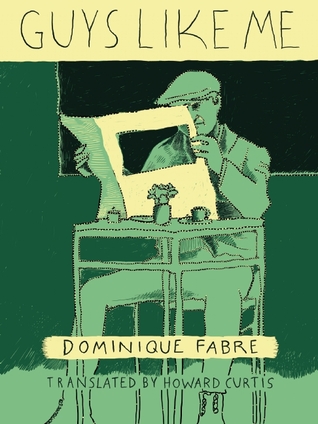
Review: Guys Like Me by Dominique Fabre

I received an advanced review copy of this book from the publisher through Edelweiss.

My Review:
Guys Like MeWhat surprised me most about this brief novel is how emotionally invested I became in the unnamed narrator.  Fabre creates a man who describes for us his everyday existence as a fifty-four year old man, living in Paris, divorced for 15 years, with a grown son.  He works a lot to pass the time and spends most nights alone in his small apartment.  He has two close friends he sees on a regular basis and has had a few casual relationships with women he has met on dating websites.  He continually and sadly says to himself throughout the first part of the narrative, “There are no second acts.”

He likes to reminisce about his past life and speaks about the anger he had for his ex-wife after she divorces him; their separation is so nasty that they haven’t stepped foot in the same room or spoken for 5 years.  But now that so much time has passed, he begins to wonder why he was ever so angry.  The best thing in his life that has come out of his marriage is his son Benjamin with whom he has a close, supportive and touching relationship.

The narrator’s two close friends serve as an interesting contrast to his own life.  His friend Jean, with whom he has just reconnected after many years, has been out of work and on welfare for years and he suffers from long bouts of depression.  Although the narrator is oftentimes lonely, his life is never as sad or miserable as Jean’s.  Marc Andre is the narrator’s other friend who is also divorced, but is happily remarried and has a large blended family.  The narrator’s relationship with Marco proves that as we get older, it is not the number of friends that becomes so important to us, but the depth of the relationships with the few people we keep close.

About halfway through the book, the narrator meets a woman online named Marie and it is hard to tell if he really cares about her or if she just fills up some of his lonely hours.  But as the story goes on, he subtly stops saying “There is no second act.”  He seems to really turn a corner in his life and be able to declare that good things still can happen to “guys like me.”

GUYS LIKE ME is a fast and emotional must-read; it will keep you wondering if F. Scott Fitzgerald was wrong and that second acts are possible for all of us.

About The Author:
Dominique-Fabre-Dominique Fabre, born in 1960, writes about people living on society’s margins. He is a lifelong resident of Paris. His previous novel, The Waitress Was New, has also been translated into English.

I love to support small presses that provide us with wonderful books like Guys Like Me.  Please support New Vessel Press and visit their website for more titles: newvesselpress.com.

1 Comment

Filed under France, Literary Fiction, Literature in Translation

Review: A Legacy by Sybille Bedford

I received an advanced review copy of this novel from the publisher through Edelweiss.

My Review:
A LegacyThis is the satirical yet poignant story of two wealthy European families living in Pre-World War I Germany.  The first cast of characters that are described are from the Merz family, who are of Jewish descent and live together in an opulent home in Berlin.  In addition to the matriarch and patriarch of the family, sons, daughters, uncles and in-laws all live under the same roof.  Their youngest daughter, Melanie, marries an older man named Julius who is originally from the countryside and whose family is Catholic.  As one can image, many comical discussions about religion and family matters involving religion, take place as a result of this Jewish-Catholic marriage.

Julius’ family, the Feldens, are the other family described at length in A LEGACY.  The Feldens are landed gentry living in the South and their Catholic roots go back for generations; there are a total of four sons in the family including Julius.  A lot of the story about the Feldens involves a description of Johannes, the youngest brother, who, at the age of 15, is sent off to a brutally abusive German military camp for young boys.  Johannes escapes and a political battle ensues between the Felden family and the German government.  When Johannes is threated with being returned to the military camp he loses his mind and is never right for the rest of this life.

There are many themes and plots in the book that Bedford describes which readers from any time or place can appreciate.  Even though these families believe that they are vastly different because of their religions, they are actually very similar in how they view family, wealth and society.  Although both families claim they are staunch believers in their respective religions, none of them actually ever sets foot in a church or a synagogue.  The sons, especially the eldest in each family, expect to have vast amounts of income with which to gamble and engage in their eccentric hobbies; but each man has no intention, whatsoever, of working for a living.

The language of the book is very different and might not be what many readers are used to as far as dialogue is concerned.  Oftentimes characters launch into a dialogue and neither speaker is specifically identified until well into the conversation.  It is as if we are sitting at the dinner table with the Merzes, or any large family, and conversations are happening all at the same time around us.  It might take us a while to catch up with the various dialogues going on simultaneously in the room, but we try to catch bits and pieces of discussions as best we can.

When there is a death, a marriage or a birth, all of which inevitably entail a consideration of religious practices, some type of an argument arises among the Felden and Merz families.  A sister-in-law, who is on the fringe of this family dynamic describes the situations she witnesses among these families best when she says that there is a “Theological dead-lock between non-practicing members of two religions.”

A LEGACY is an entertaining novel, especially for those readers who understand the intricate workings and dynamics of an extended family.  It also made me a little sad to think that this time period that is described is the last of its kind for such families as these in Germany before that country is ravaged by two world wars.  In the end, Bedford makes us ask ourselves if any of the petty differences that exists among families really matter?  What kind of a legacy will we leave for posterity?  What does fighting over religion or money or property really leave us in the end?

Thanks so much to the New York Review of Books Classics series for bringing another great novel to our attention.

About The Author:
Sybille Bedford, (16 March 1911 – 17 February 2006) was a German-born English writer. Many of her works are partly autobiographical. Julia Neuberger proclaimed her “the finest woman writer of the 20th century” while Bruce Chatwin saw her as “one of the most dazzling practitioners of modern English prose.


1 Comment

Filed under Classics, Historical Fiction, Literary Fiction, New York Review of Books