Tag Archives: German Literature

Review: Goethe Dies by Thomas Bernhard

I received a review copy of this title from Seagull Books.  This book was published in 2010 in the original German and this English version has been translated by James Reidel.

My Review:
Layout 1This slim volume of four short stories by Bernhard is difficult to describe in a brief review.  I experienced them and reacted to them as I would poetry and as a result my instinct is to analyze just about every line in these stories; but then my review would be the same length as this edition of stories.  One must really read Bernhard for oneself in order to fully grasp what is the Bernhard literary experience.  The stories are dripping with dark satire and are laden with a rebellion against his native home of Austria.  No topic related to his homeland is off limits as he pokes fun at the Austrian government, Catholicism, Austrian literature and even his relationship with his Austrian parents.

The rhetorical devices that Bernhard uses in his prose give a lyrical feeling to the text.  The persistent repetition of words or phrases, for instance, enhances the level of biting satire in the stories.  The incredibly long sentences give the stories a meandering and aimless feel to them;  we are never sure when or if Bernhard is getting to the point of his story.  In the title story, “Goethe Dies”, Goethe is nearing the end of his life and he insists to his aids and secretaries that he must meet Wittgenstein before he slips away.    The idea of this anachronistic meeting is funny in and of itself but the silliness of the meeting is enhanced by the characterization of Goethe who is a cantankerous old man that will not take no for an answer.  Why his secretaries and assistants object to Goethe’s meeting with Wittgenstein is never clearly articulated by any of them.  Bernhard’s use of indirect speech increases the ridicule of this famous German philosopher and his inner circle.

With time Goethe allegedly worked himself up over notion, as Krauter confirmed, of summoning Wittgenstein from England to Weimar under any circumstance and as soon as possible and Krauter would in effect be bringing Wittgenstein to see Goethe oddly enough on this, the twenty-second; the idea of inviting Wittgenstein to Weimar occurred to Goethe at the end of February, thus said Riemer presently, and not at the beginning of March, as Krauter maintained, and it was Krauter who learnt from Eckermann that Eckermann would prevent Wittgenstein from travelling to Weimar to see Goethe at all costs.

The next two stories, “Montaigne: A Story in Twenty-Two Installments” and “Reunion” ruthlessly mock the parent-child relationship.  Bernhard highlights the codependent nature of the family dynamic which oftentimes serves very little purpose other than to make the parents and child miserable.  In Montaigne, the narrator, similar to the philosopher Montaigne, is trying to lock himself up in his tower so that he can finally have peace from his family.  His family is more interested in business and the narrator wants to be left alone to read good books.  What bibliophile would not be able relate to this?  Bernhard begins the tale of “Montaigne” with:

From my family and thus from my tormentors, I found refuge in a corner of the tower and had, without light and thus without the mosquitoes driving me insane, brought with me a book from the library after I had read a few sentences in it, by Montaigne as it turned out, to whom I am related in such a close and truly enlightening way as I am to no one else.

“Reunion” extends this dysfunctional family dynamic by describing the young narrator as he desperately struggles to free himself from his annoying, hateful parents.  The hyperbole that Bernhard employs in this story made it, for me, the funniest narrative in the collection.  The narrator believes that his parents mission in life is to make him miserable and blame him for all of their problems.  He writes:

Essentially everything about our parents was rough, they were rough and ruthless to our whole lives, I said, whenever they should have always been circumspect with us, caring.  Mother slammed the doors behind her all the time, Father trampled through the house in his old climbing boots.

The parents are in constant search of “peace and quiet” and to him, the narrator, his parents are the antithesis of peace and quiet.  Wherever they go, they disrupt and destroy any chance of peace and quiet.  While on vacation in the Alps, the family hikes to a quiet alcove in the mountains and when they reach the quiet peak the parents rupture the “peace and quiet” by playing instruments.  Anyone who has gone on a family vacation in search of rest and relaxation, but instead has come home more aggravated and anxious,  will most certainly laugh uncomfortably at this story.

These four stories were an excellent introduction to the literary style and talent of Bernhard.  I ordered three more of his longer novels after I finished this volume.  I am very eager to experience his unique writing techniques in a full length book.


About the Author:
T BernhardThomas Bernhard was an Austrian author, who ranges among the most distinguished German speaking writers of the second half of the 20th century.

Although internationally he’s most acclaimed because of his novels, he was also a prolific playwright. His characters were oftenly working in a lifetime and never-ending major work while they deal with themes such as suicide, madness and obsession and, as Bernhard did, they use to have a love-hate relation with Austria. His prose was tumultuous but sober at the same time, philosophic in the background, with a musical cadency and plenty of black humor.

He started publishing in the year 1963, with the title “Frost”. His last published work, appeared in the year 1986, was “Extinction”. Some of his most well known works include “The loser” (where he ficitionalizes about Glenn Gould), “Correction” and “Woodcutters”.  To read more about his works visit: http://www.thomasbernhard.org/.


14 Comments

Filed under German Literature, Humor, Literature in Translation, Seagull Books

Review: Someday We’ll Tell Each Other Everything by Daniela Krien

My Review:
SomedayMy tour of post-Soviet literature continues with a book that describes the last few months of life in the German Democrat Republic (G.D.R.).  The story is told from the point of view of Maria, a seventeen year old girl who is trying to find her way in the world while living through some very tough circumstances.  This book has three important aspects to explore, the first and foremost of which is a coming-of-age storyline.  Maria is on the cusp on adulthood and has never had much guidance or supervision in her life.  She has never known her father very well because he keeps leaving on trips to Russia throughout her childhood.  She finds out that this distant father is about to marry a Russian woman that is Maria’s own age.
Maria’s mother is not someone she can rely on because of her constant sadness and depression that is the result of her failed marriage. Maria doesn’t hesitate to leave her mother’s home when she is given the chance to live with her boyfriend Johannes and his family on their farm.  For the first time in her life Maria feels at home on the family farm; as she begins to help with the cooking and the daily chores on the farm her life suddenly has meaning and value and she is genuinely happy.

The next aspect of the book, which is arguably the most interesting,  is the intense love story.  But it is not a love story between Maria and her boyfriend Johannes.  There is a man named Henner, a loner with a reputation for excessing drinking who lives on the farm next door, that attracts Maria’s attention.  Henner is enigmatic and handsome and although he is twice her age, Maria is inexplicably drawn to him.  Their love affair is passionate and intense and Henner is even rough when he makes love to Maria.

But Henner also has a tender side and as they spend time together he slowly reveals his story and his personality to Maria.  Maria knows that what she feels for Henner is true love and she is living a double life.  Maria has a much deeper and more mature connection with Henner despite their differences in age.  She is torn apart trying to decide whether or not she should leave the comfort and safety of Johannes, his family and their farm in order to try to make a real life with Henner.  Living with Henner as his lover will surely shock the whole town and Maria will be shunned for it.

Finally, this story is about a very interesting time period in German history as the G.D.R. falls and the country is once again reunited.  The contrast between east and west in the novel is stark.  Johannes has an uncle who, as a young man twenty years earlier, managed to escape to the west and get an education and work as an engineer.  When the uncle comes to visit Maria feels frumpy and backwards compared to the uncle and his western-born and sophisticated wife.  Maria is excited but also nervous about the anticipation of being able to experience all of the exotic things that the west has to offer.

This book is an intense and quick read that I highly recommend.  This was actually the first book I read from Maclehose Press and I look forward exploring more of their catalog.

About the Author:
Daniela Krien was born in 1975 in what was then East Germany and lives in Leipzig, where she is an editor and scriptwriter for Amadelio Film. Someday We’ll Tell Each Other Everything is her first novel.

9 Comments

Filed under German Literature, Historical Fiction

Review: Epitaph for a Working Man by Erhard von Büren

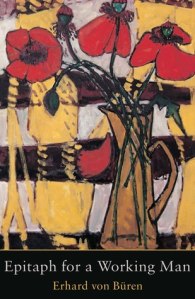
I received a review copy of this book from the translator, Helen Wallimann.  The book was published in the original German in 1990 in Switzerland and this English version was released in 2015.  I invite you to read my review and scroll down to the end of the post to win your own copy of Epitaph for a Working Man.

My Review:
EpitaphHaller resides in a nursing home in Switzerland where he still participates in a very full and active life.  He visits the local pub, he continues doing some work as a stone mason and he entertains his roommates with his quick, sarcastic wit.  This book is the story of the last year of his life as told by his only child, his son.

When the story begins, Haller’s son, who is never given a name, is picking up his father’s belongings from the nursing home at which he had resided for the last twelve years of his life.  His father’s only earthly possessions are contained in two small boxes.  His son slowly begins to recount his father’s illness which began as an odd mole on his back that at first only caused him some minor discomfort.  We guess from the description of this growth that Haller has melanoma and as the story progresses this diagnosis is confirmed.

Haller has to make three trips a week to the hospital in order to undergo radiotherapy treatments for his back.  At first the prognosis seems quite good and the doctor is optimistic that the treatments will take care of the growth on the old man’s back.  Haller’s son meets him at the hospital for all of his father’s appointments and waits for him while he receives his treatments.  Haller and his wife divorced when their child was very young so Haller and his son have never been very close.  It is Haller’s illness and his time at the hospital that bring the father and son together into a closer relationship and connection.

Haller’s son has lost his job as a typesetter and has been living on unemployment for many months now.  He has lost his sense of purpose and his only task during that day is that of “house husband.”  He makes meals for his wife, picks up around the house and does laundry while his wife is at work all day.  He takes the news that his wife is having an affair with her boss in a rather emotionally detached way.  He wonders where they meet to have their trysts and he also wonders if he should leave her.  He doesn’t seem to be all that upset about this development in their marriage so we are left to speculate if he wasn’t all that emotionally attached to the relationship in the first place, or if he is just numb with shock and depression.

The last few days of his life, which are very painful for Haller, are related to us in some detail.  Haller’s son never shares with his father when the cancer reaches his organs.  He struggles with his decision not to be honest with his father about his diagnosis.  He also struggles with how to make his father the most comfortable in his final days.  The strength of this story lies in its subtle commentary on how we struggle as human beings to deal with our final days.  Helen’s translation beautifully renders the heartwarming relationship between father and son into English for us.

About the Author and Translator:
Erhard von Büren was born near Solothurn, Switzerland, in 1940. After a PhD in Psychology and German philology from Zurich University (Zur Bedeutung der Psychologie im Werk Robert Musils. Atlantis, Zürich) and study stays in France he worked as a teacher in advanced teacher training. He lives in Solothurn, Switzerland.     He has had three novels published in Switzerland: Abdankung. Ein Bericht (Zytglogge Verlag, Bern 1989), Wespenzeit (Rotpunktverlag, Zürich 2000), Ein langer blauer Montag (verlag die brotsuppe, Biel/Bienne 2013).     Erhard von Büren has won various literary awards including the Canton of Solothurn Prize for Literature in 2007.     Homepage: http://www.erhard-von-bueren.ch

Helen Wallimann was born in 1941 and grew up in Cheltenham. She received her MA from Edinburgh University in 1963.She has worked in publishing in Munich, Paris and London. From 1973 to 2001 she was a teacher of French and English at the Kantonsschule Solothurn.  Her literary translations in book form include Legends from the Swiss Alps. MCCM Creations, Hong Kong 2009 (translated from German); Leung Ping-kwan, The Visible and the Invisible. Poems. MCCM Creations, Hong Kong 2012 (translated from Chinese).

Giveaway:
The translator put together a fun little multiple choice quiz about Switzerland for my readers.  Whoever gets the most answers correct will win a paperback copy of the book.  If there is a tie I will randomly choose a winner.  The quiz will be open until Friday, Feb. 19th.  This giveaway is open internationally.  Good luck!


8 Comments

Filed under German Literature, Literature in Translation

Review: My Mother’s Lover by Urs Widmer

My Review:
My Mother's LoverThis is another gem that I discovered from Seagull Books; I seem to be particularly fond of their German literature in translation offerings.

Clara is young, beautiful and rich in the early years of the 20th century.  Her father, who is from Italy, has shaken off his poor beginnings and after getting an education has become an engineer and has made a very comfortable life for his family.  The story of Clara’s upbringing, family and her relationship with a famous orchestra conductor is told to us by Clara’s son on the very day that Clara’s lover dies.

When Clara is a little girl she is prone to fits of anger that paralyze her.  The fits that the narrator describes appear to actually be epileptic seizures; when Clara has these episodes she can’t move, her fists are clenched and she retreats inside her own head and into a fantasy world.  As Clara gets older these fits subside, but we can’t help but wonder if they have a lingering effect on her mental health.

Clara’s mother dies when she is a teenager and Clara is left to live alone with her stern, regimented and emotionally detached father.  Clara gets up every morning to prepare her father’s breakfast in the exact way in which he demands; she runs the household and follows the same routine day after day.  Her life changes, however,  when she meets a man named Edwin who is a conductor of a Young Orchestra that he has formed on his own.  Edwin’s group of musicians are mostly students and poor, but they participate in the orchestra because of their genuine love of music.  It is also evident to everyone in the music world at this time that Edwin is a talented conductor who will one day be well-known for his musical genius.

Edwin asks Clara to become the secretary for the Young Orchestra and Clara throws herself into this job with the utmost enthusiasm.  Like many of the musicians in the group, Clara idolizes Edwin and does whatever she can to make Edwin’s orchestra a success.  She does her job magnificently and she takes no salary for her hard work.  But when her father dies in 1929 of a sudden heart attack, he leaves her alone and penniless and her entire life and fortune change dramatically.

Clara is lucky enough that, by this time, the Orchestra is starting to make money and she can draw a salary from her job on which to live.  Edwin also offers her his modest apartment which he is moving out of because he can afford a much better place to reside.  It is also at this point in time when Edwin starts having a sexual relationship with Clara.  But the relationship is emotionally one-sided and after he satisfies himself  Edwin leaves Clara feeling alone and empty.  But throughout all of this Clara still holds Edwin on a pedestal and accepts whatever scraps of attention that Edwin throws at her.

Clara’s devotion to Edwin is sad and difficult to understand.  It is the classic situation of a woman being in love with a man who doesn’t deserve her.  Long after Clara and Edwin are both married to other people, Clara still has feelings for him that run very deep.  Clara’s son tells us that his mother is constantly whispering Edwin’s name right up until the very end of her life.  Clara becomes so mentally unstable that she needs to be checked into an institution where she undergoes electro-shock therapy.  Clara also tries to commit suicide several times throughout the years.  Even at the end of her life, when she is in her eighties and living in a nursing home, she cannot let go of her thoughts of Edwin.

My Mother’s Lover is a short but powerful book about love, devotion, and mental health.  I am so glad to discover that Seagull Books has an extensive backlist of fantastic books that I will enjoy making my way through for a long time to come.

About the Author:
Urs Widmer was born in Basel in 1938. He studied German, Romance languages and History in Basel, Montpellier and Paris. In 1966 he completed his doctoral thesis on German postwar prose, and then worked as an editor for Walter Publishing House in Olten, Switzerland, and for Suhrkamp Publishing House in Frankfurt. In Frankfurt he stayed for 17 years, though with Suhrkamp only until 1968. Together with other editors he founded the ›Verlag der Autoren‹. Until his death Urs Widmer lived and worked as a writer in Zurich.

5 Comments

Filed under German Literature, Literary Fiction, Literature in Translation, Seagull Books

Review: My Marriage by Jakob Wassermann

I received an advanced review copy of this title from The New York Review of Books.  The original novel was published in German in 1934 and this English translation has been done by Michael Hofmann

My Review:
My MarriageWassermann presents us with the story of Alexander Herzog and his disastrous marriage to a woman from a middle-class German family named Ganna.  Alexander begins his tale with a history of Ganna’s childhood which seems to have a profound effect on her mental stability as an adult.  Ganna is one of six daughters, fifth in line, and is described as a duckling among swans.  She is not as pretty, graceful or demure as her sisters.  Her disobedience and lying often result in brutal beatings from her father.  No one ever thinks that Ganna could attract a man to marry; but Alexander, a young and up-and-coming writer, enters the scene and Ganna is smitten with him.


The beginning of the story has a light and funny tone as Alexander tells us about Ganna’s devotion to him and his writing.  She follows him around like a puppy and adores anything and everything he writes.  During this time Alexander is not able to make a successful living from the sales of his books so he is often in debt and wondering where his next meal will come from.  It starts to wound his pride when he is forced to rely heavily on the charity and pity of his friends.  Ganna suggests marriage to him because her rather sizeable dowry would mean the end of his financial woes.  Alexander dismisses Ganna’s suggestion of marriage as ridiculous, first and foremost because is not the one- woman, settling-down type of man.  But Ganna is relentless and finally wears him down, even threating to jump off a balcony if Alexander doesn’t agree to marry her.

Alexander lets Ganna and her world wash over him and he accepts his fate as her husband and a member of her extended family.  But Alexander’s passivity is his greatest flaw and he ignores the many warning signs of his impending misery and doom.  I kept reading the book and cringing because of all the gloomy foreshadowing.  The marriage starts to unravel rather quickly because it is evident that Ganna is mentally unstable, volatile, paranoid, and quite possibly psychotic.  She yells at the servants and then plays the part of the victim; she makes quick and intimate friends with various people in society and just as quickly makes them her mortal enemy.  Ganna and Alexander fight constantly and all the while Alexander keeps believing that he can change Ganna, calm her down, make her see reason.

After about ten years of marriage Alexander has many affairs which Ganna accepts as something that Alexander needs to do;  she is content with the fact that she is the lawful wife and that he will always come home to her.  But when Alexander meets and falls in love with a woman named Bettina, all of this changes.  Bettina is kind and patient and happy and Alexander, possibly for the first time in his life, falls deeply in love with her.  After carrying on their affair for several years, Alexander finally decides that he must ask Ganna for a divorce.  This divorce pushes Ganna over the edge to the point at which she is completely obsessed with making Alexander’s life miserable.  She employs one lawyer after another to ring more  and more money out of him and to drag out the divorce for years.  At one point it is estimated that she has a team of forty lawyers working to make Alexander’s  life miserable.  The last third of the book goes on for pages about the awful mess that Ganna makes out of everyone’s life and the horrible stress she causes to Alexander and Bettina.

I really should not have finished reading this book before bed because I laid awake for quite awhile thinking about it.  The combination of Alexander’s passivity and Ganna’s mental instability causes a perfect storm of misery for both of them.  The book is also an interesting commentary on mental illness and the far-reaching effects it has on a family.  How does one deal with a person who is so completely irrational, paranoid and volatile?  I think if Ganna were written about in the 21st century should would probably be diagnosed with a personality disorder or a psychosis.

The New York Review of Books has reissued another great classic from the German Language which I highly recommend if you enjoy books that explore marriage, psychological issues and unforgetable characters.


About the Author:
J WassermannBorn in Fürth, Wassermann was the son of a shopkeeper and lost his mother at an early age. He showed literary interest early and published various pieces in small newspapers. Because his father was reluctant to support his literary ambitions, he began a short-lived apprenticeship with a businessman in Vienna after graduation.

He completed his military service in Nuremberg. Afterward, he stayed in southern Germany and in Switzerland. In 1894 he moved to Munich. Here he worked as a secretary and later as a copy editor at the paper Simplicissimus. Around this time he also became acquainted with other writers Rainer Maria Rilke, Hugo von Hofmannsthal, and Thomas Mann.

In 1896 he released his first novel, Melusine. Interestingly, his last name (Wassermann) means “water-man” in German; a “Melusine” (or “Melusina”) is a figure of European legends and folklore, a feminine spirit of fresh waters in sacred springs and rivers.
From 1898 he was a theater critic in Vienna. In 1901 he married Julie Speyer, whom he divorced in 1915. Three years later he was married again to Marta Karlweis.

After 1906, he lived alternatively in Vienna or at Altaussee in der Steiermark where he died in 1934 after a severe illness.
In 1926, he was elected to the Prussian Academy of Art. He resigned in 1933, narrowly avoiding an expulsion by the Nazis. In the same year, his books were banned in Germany owing to his Jewish ancestry.

Wassermann’s work includes poetry, essays, novels, and short stories. His most important works are considered the novel Der Fall Maurizius (1928) and the autobiography, My Life as German and Jew (Mein Weg als Deutscher und Jude) (1921), in which he discussed the tense relationship between his German and Jewish identities.

12 Comments

Filed under Classics, German Literature, Literature in Translation, New York Review of Books