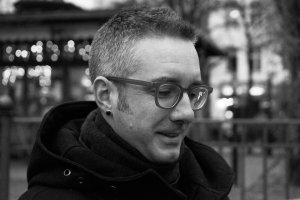
© K. Redondo
Alexander Booth is a writer and translator who lives in Berlin. A recipient of a 2012 PEN Heim Translation Fund Grant for translations from the German poetry of Lutz Seiler, his poems and translations have appeared online and in print at Asymptote, Dear Sir, FreeVerse, Konundrum and Modern Poetry in Translation. In addition, when he lived in Rome he kept a weblog on (mostly) Rome in literature and Roman literature, Misera e stupenda città. His work can also be found on his website Wordkunst. His translation of Lutz Seiler’s collection of poetry entitled in English in field latin was published in 2016 by Seagull Books. I conducted this interview via e-mail in March and April of 2017.
Melissa Beck (MB): How did you come to translate Lutz Seiler’s collection of poetry for publication by Seagull Books?
Alexander Booth (AB):I began translating Seiler’s poetry in 2011, just a few days after first reading his work. I was still living in Rome at the time and was in the old Herder Bookshop on Piazza Montecitorio and picked up his first collection of poetry for Suhrkamp, pech & blende. It was electrifying. I read the whole thing through on my bus ride home. I felt such an affinity to the work that I knew I had to try. And so I looked for his latest, which was in felderlatein (in field latin), ordered it, and got started. After having some of those first translations published by the UK journal Modern Poetry in Translation rather early on, I decided to keep going and then applied for a PEN/Heim Translation Fund grant, which, to my great surprise, I was awarded in 2012. And from there I went on to complete the whole collection. However, being a complete unknown and not having any connections to any publishers at the time, it was impossible for me to get through to anyone. As you can well imagine, poetry in translation is a much harder sell than a novel in translation, indeed almost impossible, and I was attempting to do so completely on my own. Be that as it may, around the end of 2014 (I’d relocated to Germany the previous year), I got an email from Lutz (whom I had gotten to know by then) and one from Nora Mercurio, Suhrkamp’s foreign rights manager, saying that they had exciting news: the wonderful and wonderfully unexpected gift that Naveen Kishore of Seagull Books was interested in taking on the manuscript! I couldn’t believe it. I really had more or less given up on finding in field latin a home anywhere. And now here we are in 2017 and I’m working on my fourth book for Seagull, which still surprises me when I think about it. I am very lucky, humbled, and honored to be, and to have been, able to work with such great people.
MB: What in particular about Seiler’s poetry compelled you to translate it?
AB: Well, again, I felt such an immediate affinity to his whole approach, his musicality, his eye, and felt that it just had to be available to an Anglophone audience and, rather selfishly too, that my own poems might benefit from doing the work; furthermore, I wanted to live in that world for a spell, there was something there I needed to touch, something there seemed familiar somehow. Something perhaps in that “concentrated absence” as he calls it. It is indeed an extremely rare occurrence to read something and physically feel it surge through you. Its singular song. Reading Seiler’s poems was one of those moments. “The ear knows” as the poet George Oppen said. Here I’d add the heart too.

MB: You have a lovely mention of your mother in the acknowledgements. How did she influence your decision to become a translator? Do you work with her often?
AB: That is kind of you to say, thank you. Well, I never really made any conscious decision to be a translator, as is the case with most translators I think, it just kind of happened. In fact, as a child, many people said that I had no real talent for foreign languages, and, to be honest, I don’t think I showed all that much interest either! That changed with my discovery of Italian, however, and, in particular, Lawrence Ferlinghetti’s translations of a selection of poems by the great Pier Paolo Pasolini. Some years later I began to translate poetry on my own, poets with whom I felt an affinity, poets I felt might help me with my own work (especially when, to paraphrase the poet Charles Wright, I was in between poems) or just plain excited me (for example, Hölderlin, the later Marie Luise Kaschnitz, Friederike Mayröcker, Sandro Penna); then, for extra money, I would do academic translations. Moving to Germany at the end of 2013, for various reasons I found myself doing more and more translation work and now find myself even doing novels!
But to return to my mother: over the years we have developed a lovely relationship through my work with some rather challenging writers; in Seiler’s case, she helped a lot with some of the rural and/or East German expressions/language that has remained fairly similar over time (my mother originally comes from Upper Silesia, in Prussia, and grew up in the country as her father was a forester; Lutz Seiler also comes from a rural environment). She is such an inquisitive person and loves to have me ask her questions and over the last few years in particular, since the death of my father, we have developed an even closer relationship through my translations. In fact, having been a witness to my work over the last fifteen years or more, she says she actually reads differently now, thinks about the written word differently, which is an immense compliment. When I get to visit her in the States or she comes back here to Europe, we get the tea ready, then she sits down with her crosswords or journals or what-have-you, and I get to translating and when something comes up, I ask her. Of course I send emails too if need be. In ways, through translating, I was able to get closer to my mother and to some of her interior landscape and, I think, she was able to get to closer to me and mine. That in itself makes the process worthwhile, no? How many people get that kind of opportunity? And it is this aspect of translation, this sometimes disorienting, sometimes rather unsettling sense of inhabitation (and, at times, possession), that intensity, that remains one of the most intriguing and rewarding aspects of the whole process for me. I hope it is so for the reader too.
MB: Are there one or two poems in the collection that you found particularly difficult to translate into English? Are there any pieces of the poems that you felt got lost in the translation?
AB: Oh goodness, yes, there are a few and there are certainly some things that got lost. I think with someone like Seiler, in particular the poetic nexus of individual words, certain phrases, their echoes are so numerous and reverberate not only throughout German culture and history but much of Seiler’s other work that there is no possible way they can be carried over. Furthermore, the point/port of entry into some of the poems is very difficult to locate indeed. So, in the end, I added some notes where I thought it might help and simply let it go where I saw little point.
MB: Is there anything particularly interesting or surprising that you found out about Seiler as you were translating his poetry?
AB: I learned that he was a Pink Floyd fan when he was younger! That was a real shock. Sorry, in all seriousness: learning that one of his favorite poets was Ernst Meister (Graham Foust and Samuel Frederick have done excellent English translations of his work for Wave Books) certainly made a lot of sense though, in the end, I’m not sure if that surprised me too much. All the same, it’s an insight that helps to explain a fair amount, even though Seiler is a very different poet.
On a purely personal note that doesn’t really have anything to do with his poems, however, (though you’ll find an allusion to it in one of his stories), I was surprised to learn over a beer with him that he had been a bartender at one of the first bars to appear in East Berlin after reunification, a basement bar near the Museum Island on Oranienburger Straße called Assel (pill bug – sadly, no longer there). Now, that was a bar I used to love to go to whenever I was in Berlin. It was a strange connection. One of those times you think: “Of course he did.” And to realize that he had been in Rome at the Villa Massimo at the same time I was still living there and had begun translating his poems. It seemed to me then that our work together was fated!
One thing I really like about Seiler’s work is that, the deeper you go into it, the more you see how all of it really is connected: all the poems are woven into one another and into the short stories and here and there into the novel and each sheds a certain light on the other. There is no sense whatsoever of “the writer of the poem” as distinct from Seiler. The personal is universal and, as continues to be said, most certainly political. All these fragments making up the greater narrative of the man himself and the time, the place, of which he is part.
MB: Can you discuss some of the current stylistic trends in contemporary German poetry and how Seiler embraces or rejects these trends?
AB: Well, to be rather reductive, it seems to me that there are more or less two poles here (though you could probably say as much for the States too): the quiet, “straightforward” narrative (when not “nature”) poem and a more “experimental”, what I’d be tempted to call a kind of “neo-L=A=N=G=U=A=G=E” sort of approach to writing. Maybe this will seem evasive or intentionally vague, but I don’t think Seiler explicitly embraces or rejects either nor would he be particularly interested in championing any one tendency over another; acknowledging and incorporating all of his—not only—poetic inheritances he has created his own subtle and singular style: at times dark, it is ecologically aware, haunted, highly personal, historical, syntactically strange, and uniquely lyrical. In short, it is undeniably his own. I don’t think there are too many poets, or writers in general actually, you could say that about today. Before you even reach the end of the first line you know you are in a Lutz Seiler poem.
MB: What translation projects are you currently working on?
AB: My translation of the Gunther Geltinger’s neo-Gothic, experimental novel Moor was published last month by Seagull Books and my translation of Friedrich Ani’s dark, psychological “crime” novel The Nameless Day will be coming out with them this winter. I’ve also just finished translating an art book for Suhrkamp called Berlin Heartbeats: Stories from the Wild Years, 1990-Present, which contains photographs and interviews with a number of important cultural figures from around the time of German reunification (Klaus Biesenbach, Frank Castorf, Sasha Walz, etc.). In addition, I am translating two poems for a trilingual anthology (Chinese – English – German) responding to a poem by the (late) American poet C.D. Wright being put together by the young poet Dong Li. I have also just begun translating a novel by the German-Iranian writer and Orientalist Navid Kermani, which is very interesting indeed, suffused as it is with references to and quotes from Persian poets such as Attar, Ibn Arabi, and Nizami. Quite a challenge. And last but not least, I am working here and there on a fascinating, experimental novel of “journal sentences” by the writer Jürgen Becker, an excerpt of which appeared in the latest issue of Chicago Review.


 Kafka’s final novel describes a land surveyor, simply known as “K.” arriving in an unnamed village, over which looms a castle and its mysterious bureaucracy. Through K.’s attempt to find out why he has been sent and what he is supposed to do in the village, Kafka captures the feelings of alienation, anxiety, loneliness, pain and existential angst that are universal to the human condition. Conversations with the village mayor, the schoolteacher, the landlady of the inn and a woman to whom he becomes engaged never help K. feel settled or at home in this strange place which he refuses to leave.
 What more can really be said about Kafka’s writing? I feel almost embarrassed to share my thoughts about this new volume of translations by Michael Hofmann; there will be nothing new or earthshattering here, but I am hoping that fellow Kafka lovers will at least be happy to stumble across another devotee. Please go easy on me as I offer my humble observations on this collection!
 Aeschylus’s tragedy The Suppliant Women is a unique piece of Ancient Greek theater because the poet uses the chorus, normally reserved for a secondary role, as the protagonist of his play. The Danaides, the fifty daughters of Danaus, are refugees from Egypt where they were going to be forced into marriage with their cousins. Having chosen flight from Egypt instead of mandatory betrothal, The Danaides arrive in Argos seeking asylum. As the chorus/protagonist of this tragedy, these women tell us, with one, strong, loud, simultaneous voice, about the hardships they’ve suffered and they beg, as suppliants at the altar of Zeus, for protection.

 In this new translation of Kafka’s prose published by Archipelago Books last year, Peter Wortsman has chosen a wonderful selection of shorter writings that showcases the range of the author’s brilliance. Old favorites such as “The Metamorphosis,” translated in this collection by Wortsman as “Transformed” appear in the volume with fresh, updated language for a 21st century audience. For those who are new to Kafka’s writing, the inclusion of additional classic short pieces such as “The Penal Colony” and “A Report to an Academy” make this a perfect volume with which to be introduced to his writing.
 Peter Wortsman was a Fulbright Fellow in 1973, a Thomas J. Watson Foundation Fellow in 1974, and a Holtzbrinck Fellow at the American Academy in Berlin in 2010. His writing has been honored with the 1985 Beard’s Fund Short Story Award, the 2008 Gertje Potash-Suhr Prosapreis of the Society for Contemporary American Literature in German, the 2012 Gold Grand Prize for Best Travel Story of the Year in the Solas Awards Competition, and a 2014 Independent Publishers Book Award (IPPY). His travel reflections were selected five years in a row, 2008-2012, and again in 2016, for inclusion in The Best Travel Writing. He is the author of two books of short fiction, A Modern Way to Die (1991) and Footprints in Wet Cement(forthcoming 2017), the plays The Tattooed Man Tells All (2000) and Burning Words (2006), and the travel memoir Ghost Dance in Berlin: A Rhapsody in Gray (2013), and a novel Cold Earth Wanderers (2014). Wortsman’s numerous translations from the German include Telegrams of the Soul: Selected Prose of Peter Altenberg, Travel Pictures by Heinrich Heine, Posthumous Papers of a Living Author by Robert Musil, Peter Schelmiel, The Man Who Sold His Shadow by Adelbert von Chamisso, Selected Prose of Heinrich von Kleist, and Konundrum: Selected Prose of Franz Kafka, many of which are published by Archipelago Books. He edited and translated an anthology, Tales of the German Imagination: From the Brothers Grimm to Ingeborg Bachmann, from Penguin Classics. He works as a medical and travel journalist.


 The Book Binder's Daughter