
 Two Lives and a Dream, which includes three of Yourcenar’s novellas, was originally published in 1934 as La Mort conduit l’attelage (Death drives the cart). The English version I read was translated by Walter Kaiser and published in 1987 by Farrar, Straus & Giroux. The first two stories in the collection An Obscure Man and A Lovely Morning take place in mid 17th century Amsterdam and England and describe the rough and turbulent lives of a man named Nathanaël and his illegitimate son named Lazarus. My first impression of Yourcenar’s writing is that she was a master storyteller, especially in the genre of historical fiction.
We are introcuded to the character of Nathanaël in An Obscure Man with a description of his childhood in Greenwich, England to which place his Dutch parents have emigrated and live in a small community of expats. Nathanaël was “weak chested and afflicted with a slight lameness” so he was not sent to work on the docks with his father and his brothers. Instead he becomes an assistant to the town’s schoolmaster who educates him and teaches him Latin, which skill will come in very handy later in his life. As a teenager, Nathanaël falls in love with Janet, an apprentice to a tapestry maker, whom he defends against the violent advances of a local drunk. When Nathanaël fears that he has killed the intoxicated man he stows away on a ship bound for the Caribbean and later the primitive wilderness of Maine and Canada. When the rest of his crew perishes in a shipwreck off the coast of Canada, Nathanaël is saved by an older couple and their daughter, Foy, with whom he falls in love. Their life in the wilds of the New World is harsh as it is difficult to live such a primitive existence. But his time in this wilderness, with its simplicity and his uncomplicated love for Foy, comprise some of the happiest moments in his life.
After spending two years in the New World, Nathanaël loses Foy to consumption so he decides to make his way back to England and then to Amsterdam where he works for his uncle as a proofreader in his printing business. One night he meets a prostitute named Sarai in a local tavern and their sexual connection leads him to believe that he loves her. But he learns that Sarai is a liar and a thief and when she becomes pregnant he wonders if the child, a boy named Lazarus, is really his. Nathanaël eventually loses contact with Sarai and his son and he becomes a valet in the home of a wealthy politician. Throughout the story, Nathanaël’s health worsens as he is prone to fits of coughing and fever. His master sends him to the Frisian islands in the hopes that Nathanaël will regain his strength, but instead he dies alone on this island among the waves of the sea and the nesting, peaceful birds.
Nathanaël’s life is always in flux as the story moves from one interesting episode in this obsure man’s life to the next in rapid succession. One of the few constants in his life is death and loss. Death Drives the Cart would certainly be a fitting title for this collection had Yourcenar chosen to keep it. I don’t think I’ve ever read such a short book with so many death scenes. But Yourcenar uses this theme to reflect on the value of life, which actually serves to make the book uplifting and even thought provoking. Even though Nathanaël has endured the brutal hardships of an average, obscure man in the 17th century, every where he turns he encounters the kindness of others. A dying Jesuit priest, Foy’s parents, a coworker, an employer all demonstrate to him that kindness is not hard to come by in this world. And Nathanaël himself develops into a kind and compassionate man—he once saves a puppy from being fed to a lion which is a unique example of his good character. A Lovely Morning, the very short sequel to Nathanaël’s story shows that this kindness is extended to his son who escapes the streets of Amsterdam by being invited by generous strangers to act in a traveling theater group.
As Nathanaël is dying on the Frisian island, he takes stock of his life and decides that overall he has been a good and decent man. His tolerance for all people, regardless of race or religion, is a perfect example of how we all ought to live and is a timely message of tolerance that counters the violence and disgusting display of bigotry demonstrated by hate groups in my country this weekend. I will end with an apt quote from Yourcenar that includes some of Nathanaël’s thoughts during the last few hours of his life:
People falsify everything, it seemed to him, in taking such little account of the flexibility and resources of the human being, so like the plant which seeks out the sun or water and nourishes itself fairly well from whatever earth the wind has sown in it. Custom more than nature seemed to him to dictate the differences we set up between classes of men, the habits and knowledge acquired from infancy, or the various ways of praying to what is called God. Ages, sexes, or even species seemed to him closer to one another than each generally assumed about the other: child or old man, man or woman, animal or biped who speaks and works with his hands, all come together in the misery and sweetness of existence.
 The nine stories in this collection are Stendhal’s translations and retellings of historical records from Italy in the 16th century which depict the upper classes behaving very badly: forbidden love, murder, adultery, torture, poisoning are all found within the pages of Stendhal’s translations. Written between 1829 and 1840, most of the stories in this volume were not published until Stendhal’s death. He tells us himself, in the beginning of “The Duchess of Palliano”, why the stories from this time period and in this part of Europe so fascinated him. Stendhal believes that “Italian passion” is something that no longer exists in the literature and culture of his own era. Love, in particular, he observes, has given rise to so many tragic events among the Italians and Stendhal is fascinated with visiting Italy and searching through the archives of Rome, Florence and Siena to find stories of these “Italian passions”:
 The story of Samuel Ayyad, a Lebanese man who, in 1908 at the age of eighteen leaves his home in Beirut to become a civilian officer for the British army in the Sudan, is told many decades later by his grandson. The narrator states at the beginning of his tale that the stories of his adventurous grandfather’s life have been passed down through his family by word of mouth making some of this story read more like legend than biography. He begins his tale with a rhetorical question:
 Charif Majdalani, born in Lebanon in 1960, is often likened to a Lebanese Proust. Majdalani lived in France from 1980 to 1993 and now teaches French literature at the Université Saint-Joseph in Beirut. The original French version of his novel Moving the Palace won the 2008 François Mauriac Prize from the Académie Française as well as the Prix Tropiques.
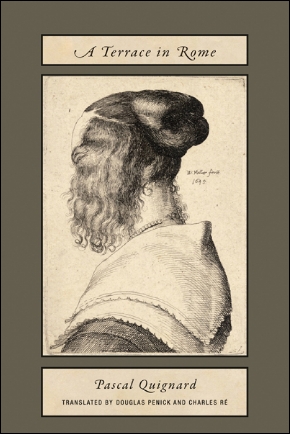 To read any work by Pascal Quignard whether fiction or non-fiction, is to experience philosophical and literary reflections on sex, love, shadows, art and death. A Terrace in Rome, his novella which won the Grand Prix du Roman de l’Académie Française prize in 2000, explores all of his most favored themes and images via the fictional story of Geoffroy Meaume, a 17th century engraving artist whose illicit love for a woman causes him horrible disfiguration, pain and suffering. The year is 1639 when twenty-one-year-old Meaume, serving an apprenticeship as an engraver, first lays his eyes on Nanni, the eighteen year-old blond beauty who is betrothed by her father to another man. For a while Meaume is happily absorbed in this secret affair and playing in umbra voluptatis (in the shadow of desire.)
 Compass takes place over the course of one, long night during which Franz Ritter, a Viennese musicologist, suffers from a terrible bout of insomnia. The symptoms from his recently diagnosed illness, the memories of an unrequited love, and the dissatisfaction at his mediocre academic career all contribute to his sleepless night. Instead of chapters, Énard uses time stamps to denote the hours that are slowly ticking away as Franz runs through years of memories. Sarah, a French Academic with whom Franz has spent many years in love, sends him an article she has written from Sarawak, in Malaysia, which is her current place of residence. It is unclear at the beginning what Franz and Sarah mean or have meant to each other, but Franz slowly unravels their complicated history throughout the course of his sleepless night.


 The Book Binder's Daughter