
 In this new translation of Kafka’s prose published by Archipelago Books last year, Peter Wortsman has chosen a wonderful selection of shorter writings that showcases the range of the author’s brilliance. Old favorites such as “The Metamorphosis,” translated in this collection by Wortsman as “Transformed” appear in the volume with fresh, updated language for a 21st century audience. For those who are new to Kafka’s writing, the inclusion of additional classic short pieces such as “The Penal Colony” and “A Report to an Academy” make this a perfect volume with which to be introduced to his writing.
For enthusiasts who are already devotees of Kafka, some surprising new translations of smaller pieces can also be found within the pages of Wortsman’s translation. Letters, aphorisms, and short stories that would today be classified as flash fiction are all included in this new volume. I especially enjoyed the short prose that Wortsman includes in order to highlight the different aspects of Kafka’s personal side—his sense of humor, his anxiety, his thoughts on writing and his loneliness. In his Afterword, Wortsman writes about his love of Kafka and his decision to attempt a translation of this legendary author:
Translating Kafka for me is a bit like looking back at a first love, an attachment saved from sentimentality and necrophilia by a corpus of work in need of no face-lifts or taxidermy to entice, still as alive and relevant as any musings of an elogquent insomniac committed to extreme particularity of expression. I give you these precious nuggets of a gold miner in the caves of the unconscious.
One of my favorite pieces that Wortsman translates, entitled “I can also Laugh,” appears to be in response to a comment made to Kafka by his fiancé Felice about his lack of a sense of humor. Kafka’s emphatic response to her begins:
I can also laugh, Felice, you bet I can, I am even known as a big laugher, even though in this respect I used to be much more foolhardy than I am now. It even happened that I burst out laughing —and how!—at a solemn meeting with our director— that was two years ago, but the incident has lived on as a legend at the institute.
Kafka goes on to describe in great detail how, having received a promotion at his job, was required to appear in front of the director of the insurance company in order to give thanks for his new position. Such an occasion was expected to have an atmosphere of solemnity but during the meeting Kafka developed a ranging case of the giggles. He tries to pretend that he is just coughing, but he begins laughing so hard that he can’t stop himself. It was fun to see that Kafka, whose writing is so often associated with feelings of existential angst, loneliness, and isolation actually had a good belly laugh every now and then:
The room went silent, and my laugh and I were finally recognized as the center of everyone’s attention. Whereby my knees trembled with terror, as I kept laughing, and my colleagues had no choice but to laugh along with me, though their levity never managed to reach the degree of impropriety of my long-repressed and perfectly accomplished laughter, and in comparison seemed rather sedate.

Kafka, 1923
Three additional works of short prose that particularly attracted my attention in this volume were the ones dealing with Greek mythology: “The Silence of the Sirens”, “Prometheus”, and “Poseidon” all showcased Kafka’s ability to take elements of the fantastic and put a realistic and even humorous spin on them. Kafka images Odysseus chained to his mast with wax stuffed in his ears to avoid the alluring songs of the Sirens. But Kafka goes on to describe the Sirens as being silent when Odysseus passes by so the Greek hero looks rather ridiculous with his blocked-up ears. In “Prometheus”, Kafka images the hero chained to a rock with his liver being continually eaten by eagles; but how long can this really last? Kafka points out the absurdity of Prometheus’s punishment by concluding, “…the world grew weary of a pointless procedure. The gods grew weary, the eagles grew weary, the wounds closed wearily.”
My favorite of the three myth-based stories is the one that imagines the god Poseidon sitting at his desk under the waves and crunching numbers. Kafka presents us with a Poseidon whose job as god of the sea no one truly understands. Because he is so busy in his management position, he never gets to enjoy the sea over which he rules. Poseidon would love to find a new job, but what else is he really qualified to do? Kafka ironically and humorously concludes his story, “He liked to joke that he was waiting for the end of the world, then he’d find a free moment right before the end, after completing his final calculation, to take a quick spin in the sea.”
Wortsman concludes his translations with a series of notes that Kafka composed while very sick and unable to speak because of the pain he suffered due to his tuberculosis. The notes, entitled by Worstsman as “Selected Last Conversation Shreds,” are sad and tragic and show us the author’s painful last days:
To grasp what galloping consumption is: picture a bevel-edged stone in the idle, a diamond saw to the side and otherwise nothing but dried sputum.
—–
A little water, the pill fragments are stuck like glass shards in the phlegm.
—–
Might I try a little ice cream today?
—–
It is not possible for a dying man to drink.
—–
Lay your hand of my forehead a moment to give me courage.
Wortsman has put together and translated a truly enjoyable selection of Kafka’s prose that has wetted my appetite for more of the German-Jewish author’s writing. Stay tuned for more Kafka posts!
About the Translator:
 Peter Wortsman was a Fulbright Fellow in 1973, a Thomas J. Watson Foundation Fellow in 1974, and a Holtzbrinck Fellow at the American Academy in Berlin in 2010. His writing has been honored with the 1985 Beard’s Fund Short Story Award, the 2008 Gertje Potash-Suhr Prosapreis of the Society for Contemporary American Literature in German, the 2012 Gold Grand Prize for Best Travel Story of the Year in the Solas Awards Competition, and a 2014 Independent Publishers Book Award (IPPY). His travel reflections were selected five years in a row, 2008-2012, and again in 2016, for inclusion in The Best Travel Writing. He is the author of two books of short fiction, A Modern Way to Die (1991) and Footprints in Wet Cement(forthcoming 2017), the plays The Tattooed Man Tells All (2000) and Burning Words (2006), and the travel memoir Ghost Dance in Berlin: A Rhapsody in Gray (2013), and a novel Cold Earth Wanderers (2014). Wortsman’s numerous translations from the German include Telegrams of the Soul: Selected Prose of Peter Altenberg, Travel Pictures by Heinrich Heine, Posthumous Papers of a Living Author by Robert Musil, Peter Schelmiel, The Man Who Sold His Shadow by Adelbert von Chamisso, Selected Prose of Heinrich von Kleist, and Konundrum: Selected Prose of Franz Kafka, many of which are published by Archipelago Books. He edited and translated an anthology, Tales of the German Imagination: From the Brothers Grimm to Ingeborg Bachmann, from Penguin Classics. He works as a medical and travel journalist.
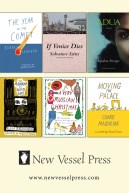 New Vessel Press: A subscription of New Vessel books includes all six of their books for the publication year. Subscribers also get to choose one book from their backlist. The cost is $80 which amounts to about 25% off of the cover prices. I haven’t read a book from New Vessel yet that I haven’t enjoyed. This year’s titles include If Venice Dies and A Very Russian Christmas so this subscription is definitely worth it.
  includes twelve of their titles is $170. A full-year of ebooks is $70 and a half year subscription for six books is also $70. They provide a lot of choices depending on one’s budget. Subscribers who are really passionate about their books and want to spend some money up front can also purchase two or three year subscriptions.
  The New York Review of Books: This press also specializes in reissuing lost classics from different countries around the world. They call their product a “book club” but it is essentially a subscription service. For $140 members receive a book every month for 12 months and the membership automatically renews. For a limited time NYRB is also offering a four issue subscription to The Paris Review when readers purchase a membership. I can’t get enough of the books from NYRB classics and I might have to buy a storage unit to house all of my books from their catalog. I will pretty much read anything they publish and $140 is a pretty good bargain for a year’s worth of their books.
 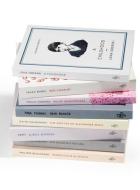 Pushkin online bookshop, and a free copy of Stefan Zweig’s novella Confusion. The Pushkin Collection is a series of paperbacks typeset in Monotype Baskerville, based on the transitional English serif typeface designed in the mid-eighteenth century by John Baskerville. It was litho-printed on Munken Premium White Paper and notch-bound by the independently owned printer TJ International in Padstow, Cornwall. The cover, with French flaps, was printed on Colorplan Pristine White paper.
  This is a challenging book to read for several reasons. It is a sad fact that women in Mozambique, even in the twenty first century, have extraordinarily tough lives and the author does not hold back from describing the hardships that women face on a daily basis in this country. The story is told from the point of view of a woman named Rami who is in her forties and is tired from trying to raise her five children alone. She is not divorced and but her husband of twenty years is the chief of police and doesn’t come home very often. Rami reaches her breaking point when one of her sons breaks the window of a car while playing ball and she has to take care of the situation by herself.
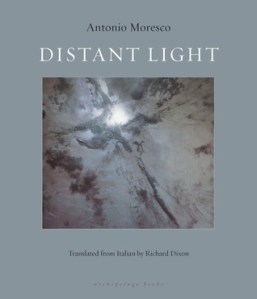 This is a short yet powerful book that raises many more questions about the mental state of the main character than it answers. We are led to understand from the beginning that the narrator is living alone in the mountains in what is now an abandoned village. The only time he has interaction with other human beings is when he drives his car down the mountain to another small village. He seems to do this only when he needs food or supplies.
 Antonio Moresco did not find a publisher until late in his career, after being turned down by several editors. His output is centred on the monumental trilogy L’increato, whose three volumes are: Gli esordi (Feltrinelli 1998, republished by Mondadori in 2011 – 673 pages), Canti del caos (part 1 by Feltrinelli in 2001, part 2 by Rizzoli in 2003; republished by Mondadori in 2009 – 1072 pages), and Gli increati (Mondadori 2015).


 The Book Binder's Daughter