Lethe’s Cool Floods: Poetic Fragments by Karoline von Günderrode

As I read the poems and two dramas included in this translation of Poetic Fragments, I couldn’t help but think of a letter that Karoline von Günderrode wrote to her lover Friedrich Creuzer, a German philologist and archaeologist:

I can’t understand the change in your feelings. How often have you told me that my love brightens, enlivens your whole existence, and now you find our relationship damaging. How much would you have given once to win this “damage” for yourself! But that’s the way you [men] are, what you’ve conquered always seems to be lacking….You seem to me like a boatsman to whom I’ve entrusted my whole life, but now the storms are raging, the waves rise up. The winds bring me scattered sounds; I listen and hear how the boatsman takes counsel with his friends whether he shouldn’t throw me overboard or put me ashore on the barren coast?

Although they had a loving, passionate affair and Creuzer was planning to leave his wife for Karoline, the hardships that their relationship caused launched both of them into a depression.  Günderrode committed suicide with a dagger in 1806 after Creuzer broke off their affair via a letter.  The themes of love and death pervade Günderrode’s writing and demonstrate her deep interest in these philosophical concepts. The last stanza of her poem “The Kiss of a Dream” explores that fine line between erotic love and death:

The day is meager in love-sweet delights,
Its light’s vain boats hurt me
And its sun’s blazes consumes me
So hide, eyes, from the luster of the earthly sun!
Wrap yourself in night, it slakes your longing
And heals the pain, like Lethe’s cool floods.

This poem is particularly reminiscent of her letter to Creuzer, although I find the poem more hopeful; Lethe’s floods are soothing and, because of its powers to erase memory, have the ability to ease suffering.

Another intriguing commonality that I found in the additional poems as well as the two plays in this collection are her descriptions of love involving trios.  In the poem entitled “Piedro,” a sailor launches his ship headlong into the waves to retrieve his love that was captured by another man.  In the battle that ensues, Piedro kills a youth with whom he instantly falls in love.  Even though Piedro gets his woman back, he can’t stop thinking about the youth he longs for and decides that the only way to be with him is to take his own life:

Darkness rests upon the waters
Deep silence all around
Piedro’s ship reaches the coast,
But he sleeps deep in the ocean.

The plays in this collection are enchanting in both language and topic.  In Hildgund, the Lord of the Burgundian’s daughter is captured by Attila the Hun and then rescued by her beloved fiancé, Walther of Aquitania.  When Attila threatens to conquer all of Europe unless Hildgund agrees to marry him, she sacrifices herself for the safety of her country.  The play ends abruptly when Hildgund is about to join a wedding party hosted by Attila at which event she has in mind to murder him.  Hildgund is brave, passionate and willing to put herself in danger for Walther.  Günderrode’s speech for Hildgund is courageous and showcases a woman who is not willing to be passive while a man decides her fate:

Oh Walther! Yet you will indeed one day be avenged
And he regret his robbery’s brief joy.
Why do I hesitate, is it, then, too monstrous,
For shy, pale lips to name it?
Murder! Ha, the name alone appalls,
the deed is just, and bold and great,
The peoples’ destiny rests in my breast;
I will free them, free me.
Banished are fear and childish hesitation,
Only a bold warrior wins a great goal.

The final play in this collection, the topic of which I found the most curious, is Muhammad, The Prophet of Mecca.  Günderrode was very interested in the East and chose the struggles of this prophet to write about the afterlife.  The choral odes Günderrode composes  are beautiful and lyrical and worth reading the play just for those interludes.  Muhammad, who is banished from Mecca because of his teachings about one god, tells one of his enemies about the fate of the soul in the afterlife.  Once again, I find the tone of Günderrode’s writing positive and uplifting:

Mohammand: The soul of man does not die with the death of the body; it abandons it when its life has ended, and if it is the soul of a pious person then it climbs aloft in the space of the stars and creates itself a body out o fair; this new body has all senses like the previous, only in a yet higher degree; it never gets tired, knows no pain and is full of eternal health, life and youth.

Most of the literature that has been written about Günderrode has focused on her love affair with Creuzer, her personal letters and her tragic end.  She was, however, a talented poet, philosopher and dramatist whose work is virtually unknown to the English speaking world.  This dual language edition of Poetic Fragments, translated with introductory essays by Anna Ezekiel, focuses on Günderrode’s contribution to philosophy and literature of the German Romantic movement.  I highly recommend this book for both the translations and Ezekiel’s insightful essays and comprehensive bibliography.  I am disappointed that most of Günderrode’s writing has not been translated into English as this publication has made me want to read all of her literature.
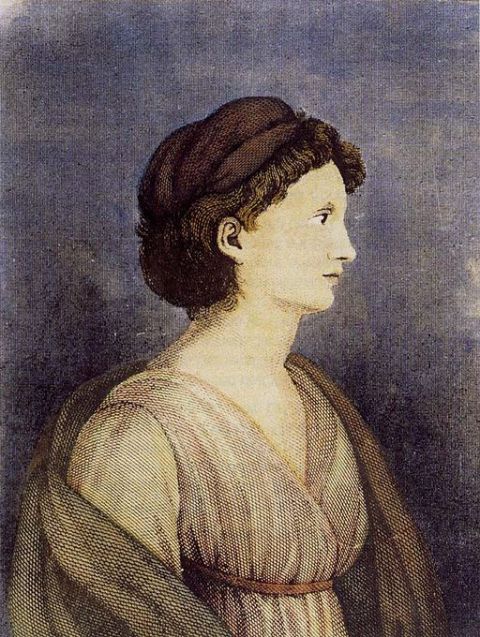
Karoline von Günderrode, c. 1800, by an anonymous painter; Historical Museum, Frankfurt am Main

5 Comments

Filed under Classics, German Literature

Review: The Proof by César Aira

Aira’s novella has three distinct parts to it, all of which display his masterful ability to play with time in his narrative. The story begins with a sixteen-year-old girl named Marcia walking down a street in Flores, observing other young people talking, hanging out and listening to music.  Marcia, a self-conscious, over-weight, slightly depressed, is shocked yet excited when two punk girls named Mao and Lenin yell out to her, “Wanna fuck.”  Aira’s chronicle of Marcia moving through the crowd of teenagers and her initial encounter with the punks takes up the first thirty pages of the book.  His detailed descriptions of young people gathered on the sidewalk, Marcia’s thoughts as she walks through these crowds and the impending twilight serve to stretch out the events in his downtempo narrative.  His lyrical prose and vivid elements of a night on the streets of Flores kept me earnestly turning the pages in this first part of The Proof:

She came up against floating signs: every step, every swing of her arms met endless responses and allusions…with its sprawling youthful world, arriving in Flores was like raising a mirror to her own history, only slightly further from its original location—not far, easily reachable on an evening walk.  It was only logical that time should become denser when she arrived.

Marcia decides that she is afraid of the foul-mouthed and overbearing punk girls, but she is also curious enough to find out more about these strange girls so she agrees to have a conversation with them at a nearby burger joint.  Aira slows down the tempo of the story in this second part of the book to the point where I was bored and almost gave up on the book.  The three girls attempt to have a ridiculous exchange about what it means to be a punk.  According to Marcia this means listening to The Cure, wearing dark clothes and sporting a wild, purple hairstyle.  The punks, however, reject any such labels.  Aira seems to be making fun of his characters and their ridiculous,  and at times cruel,  “fuck everyone” attitude.  This goes on for what seems like a very long, drawn out thirty five pages; he slows down time to the point of oblivion with a long, slow, nihilist discussion among his characters that goes around in circles:

…despite the strangeness of the two punks, she could make out a shallow depth to them: the vulgarity of two lost girls playing a role.  Once the play was over, there would be nothing left, no secret, they would be as boring as a chemistry class…And yet at the same time she could imagine the opposite, even though as yet she didn’t know why: maybe the world, once it has been transformed once, can no longer stop changing.

When the trio finally decides to leave the restaurant, the time in the narrative picks up speed to the point that the book feels like it goes by in an instant.  I am glad that I stuck with it until the end.  The punks decide that they want to prove their love for Marcia by a violent holdup of a grocery store which scene feels like something out of a big budget, action movie.  Explosions, shootings and decapitation are all packed into the last twenty-five pages of the novella.  By including so much action and description, to the point of shock and gore, Aira brings his narrative to a quick, unsettling and astonishing end:

That was when Mao appeared in a hole created by the broken glass, revolver in one hand and microphone in the other.  She looked calm, self-assured, an imposing figure, in no hurry.  Above all in no hurry, because she wasn’t wasting a single moment.  Things were happening in a packed continuum which they had perfect control of.  It was if there were two distinct times happening simultaneously: the one the two punks were in, doing one thing after another without any pause or waiting, and the other of the spectator-victims, where everything was pauses and waiting.

The final scene solidified for me the story as metaphor for the ridiculous things we sometimes do to prove our love for another person.  Mao claims that the depth of her love-at-first-sight for Marcia is worth creating such havoc and chaos.  Before robbing the cash registers, Mao shouts an interesting message to her victims in the grocery store: “Remember that everything that happens here, will be a proof of love!”  Not all of us rob and set fire to grocery stores to prove our love to another person, but some days the hell we put ourselves through in the name of this complex emotion makes us feel like we have gone to the same extremes as Mao.  As I was reading Aira’s final, astounding conclusion to The Proof I was reminded of a few lines of the poem “Asphodel, That Greeny Flower” by William Carlos Williams:

I cannot say
that I have gone to hell
for your love
but often found myself there
in your pursuit.

This is my first contribution to Spanish Literature Month hosted by Stu and Richard.  Please visit their blogs to see the list of the great selection of books being reviewed.

15 Comments

Filed under Spanish Literature

Cycle of a non-person: The Castle by Kafka

Kafka’s final novel describes a land surveyor, simply known as “K.” arriving in an unnamed village, over which looms a castle and its mysterious bureaucracy. Through K.’s attempt to find out why he has been sent and what he is supposed to do in the village, Kafka captures the feelings of alienation, anxiety, loneliness, pain and existential angst that are universal to the human condition. Conversations with the village mayor, the schoolteacher, the landlady of the inn and a woman to whom he becomes engaged never help K. feel settled or at home in this strange place which he refuses to leave.
As I was reading The Castle, a passage from an essay entitled, “Answers and Questions” written by the exiled  Cuban author Guillermo Cabrera Infante kept coming to mind. Initially a supporter of Fidel Castro and the revolution in his country, Cabrera Infante becomes disillusioned with the suppressive Communist regime that launches his people into poverty. The author decides that if he is to continue his career as a writer then his only option is to leave Cuba and go into exile. He describes the horrifying and sad fate of those who are trapped in Cuba and have become what he calls a non-person:

Cycle of a non-person: request for exit from the country, automatic loss of job and eventual inventory of house and household goods; without work there is no work card, without a work card there is no ration book; the permission for exit can take months, a year, two, following the rules more of political lottery than of socialist chess; meanwhile, the non-person finds himself obliged to live by using the money he has saved in the bank: to leave he must restore even the last cent that he had in the bank at the moment of requesting the exit visa; if the bank account is not in order the exit visa is automatically cancelled: new request for exit visa, etc., etc.

The Castle illustrates that there are many ways in which a man or woman can be made to feel like a “non-person”: politically, socially, emotionally, economically, etc. We oftentimes feel in life, despite our best efforts to settle down, like we don’t belong in a home, a country, a relationship, a job, etc.

Kafka’s female characters and his descriptions of various romantic relationships in The Castle also fascinated me.  Women seem to hold a certain amount of power and influence in the village.  The Landlady, for instance, is the reason for the success of The Inn and the mayor’s wife Mizzi has more influence over decisions that are made in the village than the mayor himself.  When K. arrives in town he meets Freida the barmaid and after a single night of passionate sex on the Castle Inn floor, he becomes engaged to her.  But women can also become a burden as relationships grow more and more complicated and the passion dissolves.  K. takes a menial job as a school janitor so that he and Freida will have a home and a source of income.  How many sacrifices and compromises can a man or woman make in a relationship before one loses his or her identity?  How often to we feel like a non-person, a shadow of our true selves, because of obligations to family, friends, spouses, etc.?  I’m not surprised that Kafka was engaged several times and never had the desire to make a final commitment to one woman.

I am interested to see what others have thought about The Castle.  Let me know your impressions in the comments!

9 Comments

Filed under Classics, German Literature

My Visit to the Rare Book Room at The Strand

The Rare Book Room at The Strand.

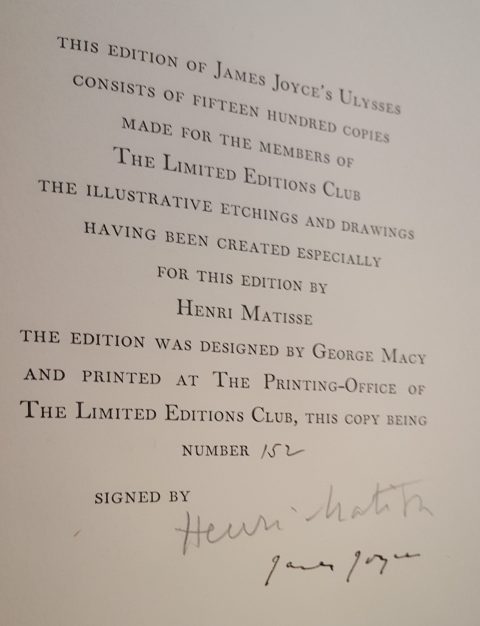
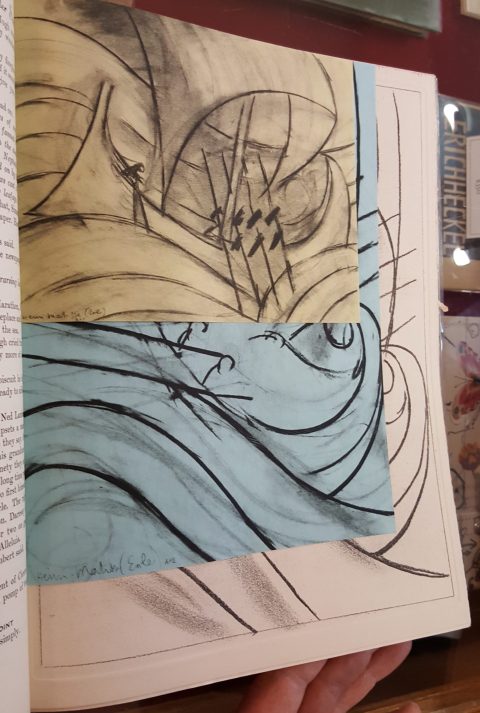
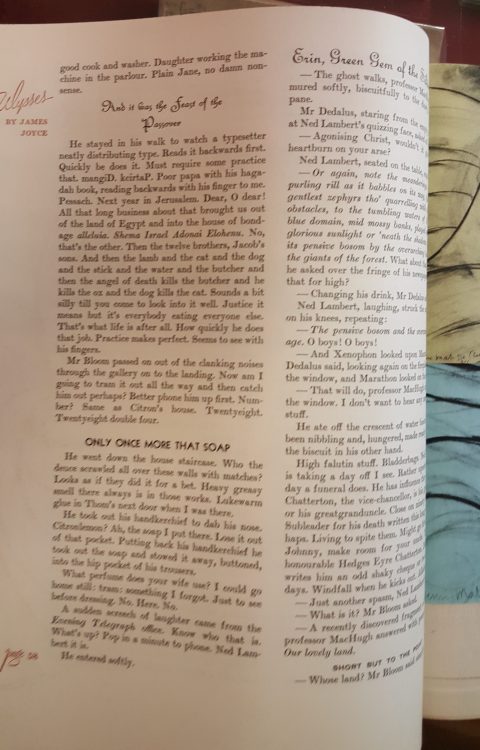
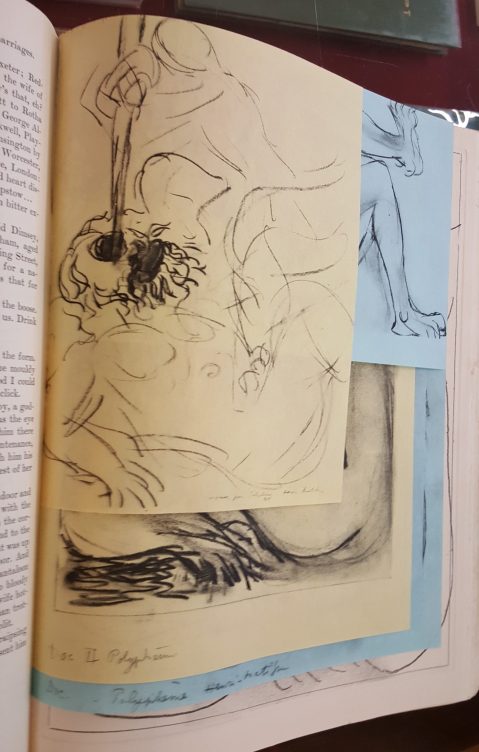
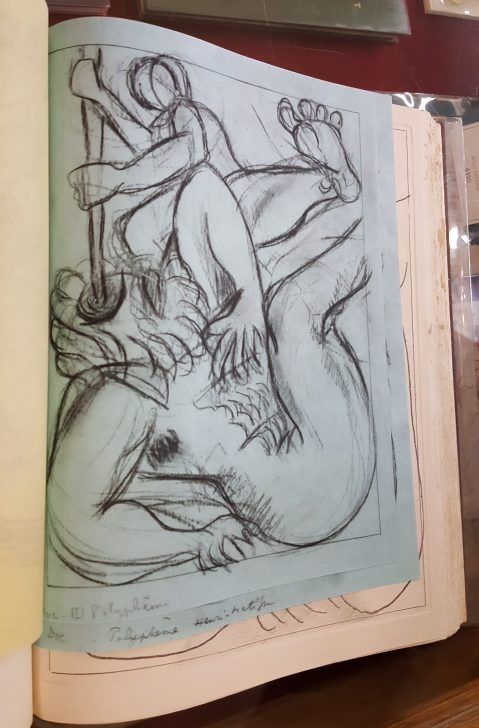
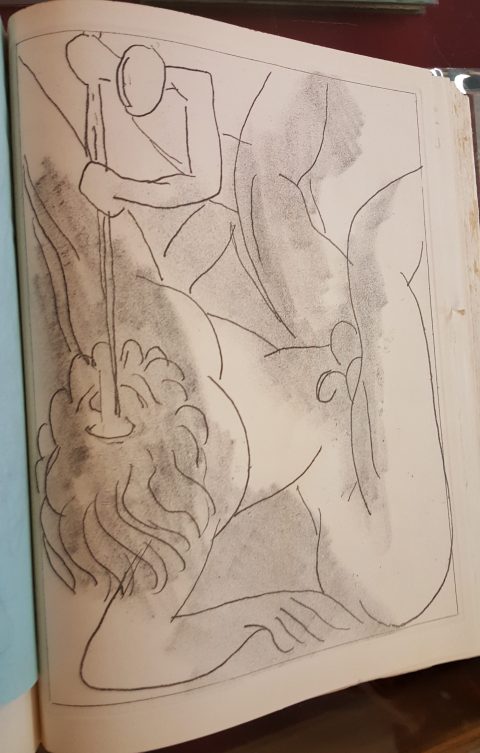
On my recent trip to New York City there was an article in the New York Times about The Strand celebrating its 90th year in business.  Not only does this bookstore have 18 miles of books located on four floors, but they also have rows and rows of sale books on the sidewalk on 12th st. just outside the store, and a kiosk fully stacked with fabulous books outside of Central Park.  The article in the Times mentioned The Strand’s most expensive book—a first edition copy of James Joyce’s Ulysses illustrated by Henri Matisse, signed by both authors.  The Limited Editions Club published 1500 copies in 1935; only 250 copies are signed by both Joyce and Matisse which are rare and very expensive.  The manager at The Strand said that the price tag on their copy is $45,000.    Matisse signed all 1500 copies and the ones with only his signature sell for a lot less—between $3500 and $5000, depending on the condition of the book.

The rare book room is housed on the third floor of The Strand and all of their customers are welcome to visit any time during business hours.  The staff was kind and willing to show me their most expensive and famous book for sale.  The manager extracted the book from a safe where their most precious books are kept and happily allowed me to look at the copy of Ulysses and let me take these photos.

Not all of their books are as rare or expensive as this copy of Ulysses. The rare book room has something for everyone’s budget. There are lots of signed and first edition books by modern authors openly available on their shelves to look at and to browse. I saw a first edition of Derek Walcott’s poetry inscribed by the author, for instance, that was being sold for $40. Some of their more expensive books, the ones that range from a few hundred to a few thousand dollars are under glass cases—for instance a first edition German copy of Kafka’s The Castle with a price tag of $2500. But the staff is friendly and helpful and willing to let customers hold and flip through any of their books.

The Strand, all four floors of it, is one of my favorite places to visit in the world and I can’t wait to go back.  I am thinking another trip in the fall is in order.  First, I have to recover from carrying almost 40 books on the train back home and find a place for my purchases.  In my next post I will share some of my NYC book haul.

12 Comments

Filed under Opinion Posts

NYC Reading Suggestions from Literary Twitter

Literary Twitter has come through for me once again.  I sent a Tweet asking if anyone would like to recommend some reading for my upcoming trip to New York City.  The response has been overwhelming and I thought I would share the suggestions I have gotten so far.  I have chosen to list them alphabetically by author.  If anyone has additional titles to add then please leave them in the comments:

The New York Trilogy by Paul Aster

The Cities (poems) by Paul Blackburn

Open City by Teju Cole

The Flea of Sodom by Edward Dahlberg

Manhattan Transfer by John Dos Passos

Time and Again by Jack Finney

Desperate Characters by Paula Fox

New York Revisited by Henry James

The Lonely City by Olivia Laing

Thieves of Manhattan by Adam Langer

Passing by Nella Larsen

Poet in New York by Federico Garcia Lorca

Faces in the Crowd by Valeria Luiselli.

The Assistant by Bernard Malamud

Brightness Falls by Jay McInerney

The Rosy Crucifixion Series by Henry Miller

Up in the Old Hotel by Joseph Mitchell

McSorley’s Wonderful Saloon by Joseph Mitchell

After Claude by Iris Owens

Harlem is Nowhere by Sharifa Rhodes-Pitts

Lillian Boxfish Takes a Walk by Kathleen Rooney

Low Life by Luc Sante

Last Exit to Brooklyn by Hubert Selby Jr.

A Tree Growns in Brooklyn by Betty Smith

In Dreams Begin Responsibilities and Other Stories by Delmore Schwartz

Down these Mean Streets by Piri Thomas

Rules of Civility by Amor Towles

Golem and the Jinni by Helene Wecker

The Age of Innocence by Edith Wharton

The Colossus of New York by Colson Whitehead


22 Comments

Filed under Opinion Posts