A Sense of Expectation and Agonizing Impatience: Some Thoughts on Dante’s Purgatory

Aeneas and the Shade of Creusa. Giuseppe Maria Mitelli. 1663. Engraving

Osip Mandelstam’s essay on the Divine Comedy, “Conversation about Dante” is a magnificent work of art in and of itself.  The Russian poet uses the most sublime language to describe the complexities of Dante’s poetic speech,  rhythm and structure; he compares various parts of the Divine Comedy to the intricate workings of a beehive, the elaborate geological structure of granite and marble, and the rich timbre of a cello:

Dante’s cantos are scores for a special chemical orchestra in which, for the external ear, the most easily discernible comparisons are those identical with the outbursts, and the solo roles, that is, the arias and ariosos, are varieties of self-confessions, self-flagellations, or autobiographies, sometimes brief and compact, sometimes lapidary, like a tombstone inscription: sometimes extended like a testimonial from a medieval university; sometimes powerfully developed, articulated and reaching a dramatic operatic maturity, for example, Francesca’s famous cantilena.

The density of the cello timbre is best suited to convey a sense of expectation and of agonizing impatience.  There exists no power on earth which could hasten the movement of honey flowing from a tilted glass jar.  Therefore the cello would come about and be given form only when the European analysis of time had made sufficient progress, when the thoughtless sundial had been transcended and the one-time observer of the shade stick moving across Roman numerals on the sand had been transformed into a passionate participant of a differential torture and into a martyr of the infinitesimal.  A cello delays sound, hurry how it may.  Ask Brahms—he knows it.  Ask Dante—he has heard it.

Mandelstam uses Inferno, Canto XXXIII and the description of the death of Ugolino and his sons by starvation at the hands of Archbishop Ruggieri of Pisa to prove his point about music and the cello.  But the scene in Purgatory, Canto II, of Dante’s attempted embrace of his beloved friend Cascella is, to me, equally “encased in a cello timbre, dense and heavy…”: (trans. Robin Kirkpatrick)

And one drew forward now, I saw to me
to take me in his arms with such great warmth
it moved me, so I did the same to him.
Ah shadows, empty save in how they look!
Three times I locked my hands behind his back
As many times I came back to my breast.
Wonder, I think was painted over me.
At which the shadow smiled, and so drew back,
while I, pursuing him, pressed further on.

Any good commentary will explain that these lines are an allusion to Aeneid 6 where Aeneas has traveled to the Underworld and sees and tries to embrace the spirit of his beloved father, Anchises: (All translations of Latin and Ancient Greek are my own)

Aeneas speaks to his father: “You, oh father, and the sad image of your spirit appearing to me so often are what drove me to seek out these thresholds. My ships wait on the Tyrrhenian sea. Allow me to grasp your hand, father, allow me father, and do not shrink away from my embrace. Speaking thus his face was soaked with large tears. Three times he tries to embrace his father’s neck with his arms; but three times the shade, grasped in vain, escapes his hands, similar to light winds or a winged dream.

As I was reading this Canto, however, what came to my mind, before the scene with Anchises, was a similar encounter earlier in the Aeneid between Aeneas and his lost wife Creusa in Book 2.  For me this double allusion increases the pathos of the futile attempts at embrace that occur in the Roman underworld and in Dante’s Purgatory.  As he is trying to escape Troy that is burning down around him, Aeneas loses his wife and tries to go back to the city to save her.  But he only finds Creusa’s spirit whose parting words to him are to continue loving their son and as a final gesture Aeneas tries to embrace her.  The lines in Latin are exactly the same as those in Aeneid 6:  “Three times he tries to embrace his wife’s neck with his arms; but three times the shade, grasped in vain, escaped his hands, similar to light winds or a winged dream.  The additional knowledge of the exchange between Aeneas and Creusa (it’s a shame that most commentaries don’t mention it)  makes a greater emotional impact when reading Dante’s reunion with Cascella and creates what Mandelstam describes as “a sense of expectation and agonizing impatience.”

The volucri somno—winged dream—is specifically Homeric and is Vergil’s allusion to Odysseus’s encounter with his mother in the underworld of the Odyssey.  Mandelstam’s concept of that delay of sound as applied to the Divine Comedy seems especially appropriate for these images of shades that reach back to Homer.  Homer and Ancient Greek were not available to Dante so it is only later generations of readers of Purgatory that truly hear the echoes from Book 11 of the Odyssey as Odysseus describes his attempts to embrace his mother, Anticleia:

After she spoke to me I was anxiously wishing to embrace the soul of my mother.  Three times my soul stirred me to embrace her, and I approached her, but three times she escaped from my hands like a shadow or a dream.  And the pain in my heart became even sharper to me.

The number three is often used in Ancient epics but I have always found it particularly fitting for this trope—three embraces are the perfect amount before a person becomes fully and painfully aware of loss and grief.  Any fewer than three would lessen the agony of each of these scenes and any more would make them melodramatic and overwrought.   The first is a naïve attempt to reach out and touch the person that was, in life, so important; the second attempt highlights a sense of denial and disbelief of the loss; the third and final attempt and failure to embrace brings about the painful reality of a physical absence.  This seems like a fitting metaphor for the grief one experiences with death or with any other loss we go through in life.  Cue the heavy, slow music of the cello…

12 Comments

Filed under Classics, Italian Literature, Literature in Translation

A Lofty, Old Oak Tree: Pompey in Lucan’s Pharsalia

My friend and I were having our daily lunchtime walk when we were discussing the fact that his is my 20th year of teaching secondary school—it hardly seems possible that I have been in my profession for that long! During the same conversation she also reminded me that next month is my birthday and she said out loud the age that I will be turning. I was so shocked to hear the number spoken out loud that I had the urge to slap her on the arm! I know that my birthday is coming up but I didn’t actually think about the age I am going to be. I told her all this, of course, and we had a good laugh about it. And this conversation brought to mind the image of the poet Lucan’s description of the Roman general Pompey who, compared to a younger and more vigorous Julius Caesar, is at a great disadvantage when they are at war with one another. Lucan says about Pompey’s former glory and advancing years (translation is my own):

Thus Pompey now stands as a shadow of his great name; similar to a lofty oak tree standing in a fertile field, bearing the old mementos of its people and the sacred gifts of its leaders, no longer fixed to the earth with strong roots, it remains upright merely because of its own weight; and lifting its naked branches into the air, it casts a shadow not with its leaves but with its trunk. And even though it shakes and threatens to fall with the first strong wind, while other trees with more robust trunks grow around it, this oak tree alone is still revered.

I, of course, exaggerate for humorous effect—I don’t feel quite that old. I also have Lucan on my mind because I am rereading Dante’s Divine Comedy and this underappreciated Roman poet figures prominently in the Inferno. His uncle was the famous stoic philosopher, Seneca, who had a great influence on him while he was growing up. Lucan wrote his most famous work, an epic poem entitled the Pharsalia, during the reign of the Emperor Nero with whom Lucan had a close alliance and friendship. The Pharsalia (in Latin De Bello Civile) tells the story of the civil war between Pompey and Caesar that took place during the waning years of the Roman Republic. Written as a poem in dactylic hexameter, Lucan is indebted to Vergil and Ovid for his literary style. Neither Pompey nor Caesar are portrayed as heroes—each man is greatly flawed—and Lucan does not shy away from describing the horrible consequences of a civil war.

The short section I translated above is from Book 1 and, I think, highlights Lucan’s talent as a poet and an astute critic of his own country’s history. It is a fairly quick read and I highly recommend it for those who want a better understanding of Dante’s poems.

8 Comments

Filed under Uncategorized

Fleeing and Trying to find Solace: Lyric Novella by Annmarie Schwarzenbach

I was first inspired to read Schwarzenbach by Mathias Enard’s book Compass which mentions this often neglected and overlooked journalist, novelist and traveler.  Lyric Novella is set in 1930’s Berlin among the unsavory, underground world of theater halls and bars.  The unnamed narrator is a young man who has become obsessed with a stage dancer named Sybille;  each night he watches her perform and then waits to have drinks with her and sometimes he drives her home.  He thinks he is in love with her—he even calls it a love affair–even though they have never had a physical relationship and Sibylle does not return his feelings.  The narrator’s obsession with Sibylle wears him down to the point of exhaustion and illness.  What I found remarkable is that he never articulates his feelings for Sibylle—we have no idea what he sees in her physically or mentally—and yet he can’t break away from her.  He is clearly a lost, lonely, naïve young man who just wants to belong to someone or something.
The narrator eventually escapes from the city to the country where he tries to forget Sibylle and once again to take up writing which he seems to enjoy.  The author spends a great deal of time on contrasting descriptions of city versus country and autumn versus spring.  But a change of season and scenery do not cure him of his malady: he is clearly unhappy with his own life and is feeling lost—fleeing to a another place, no matter how different,  doesn’t fundamentally change what is going on inside him.  In the translator’s preface, Lucy Renner Jones points out that the young narrator’s struggle reflects the author’s own guilt, struggle and repression of her sexuality.  After the book’s publication, Schwarzenbach even admits that she meant her narrator to be a young woman and not a young man.  The translator’s concluding words provide keen insight into the author’s background and mindset and as a result the themes she explores in Lyric Novella become clearer:

Schwarzenbach’s real-life restlessness and constant travelling was undoubtedly a flight forward from her mother’s control.  She too, like the young man in Lyric Novella, spends her life fleeing and trying to find solace, often in foreign places and nature.  Chaste and in solitude, the young man in Lyric Novella writes about the story of his failure dare to love Sibylle openly, however, peace eludes him and he turns to loathing himself ‘because I have no obligations.’  Removing himself from his obsession does not remove the obsession itself but leads to another kind of torment. The paradox of Schwarzenbach’s obsessive travelling throughout her life was that it represented the promise of freedom and being in control, by literally putting herself in the driving seat.  But, much like the narrator in Lyric Novella, she had her emotional turmoil packed in her luggage.

This short book has piqued my interest in Schwarzenbach’s life of wanderlust and solitude.  I also have a copy of her non-fiction book All the Roads are Open which I will try next.


11 Comments

Filed under Uncategorized

To Reach the Opposite Side of the Shore: Dante’s Inferno

Dante’s Inferno Canto 3 lines 107-108, drawn by Gustave_Doré 1861-1865

Reading Eliot’s Daniel Deronda recently has inspired me to do a complete reread of Dante’s Divine Comedy which she brilliantly alludes to in her novel. It has been far too many years since I have looked at any part of that Italian masterpiece and I felt I ought to revisit it. I had three immediate, intense reactions to the first few Cantos of The Inferno, in Robert Kirkpatick’s translation, which I will share here. There is nothing new or earthshattering in my thoughts, these are simply my gut, instinct reactions to a text which I have come back to after many years.

First—how can I even put this–*Vergil. Yes, Vergil. I knew he was lurking everywhere in The Inferno but when I was younger and less experienced in translating The Aeneid I had no real appreciation for Dante’s reworking of and allusions to that Roman poet and his Epic. As I was slowly making my way through the Cantos, I kept thinking that—and I truly do not mean to offend with this statement—it is just not possible to have a deep appreciation for Dante without reading The Aeneid, or at least reading Books 1, 4 and especially 6 of The Aeneid. I highly recommend the Fagles, Fitzgerald or Ferry translations; or better yet, find a friend, neighbor, colleague, long lost family member or a lover who knows Latin and make them translate it for you from the original. Trust me—it will enhance your admiration for and understanding of the Divine Comedy like nothing else.

Secondly, as Vergil is showing Dante around the place before they get to the circles of Hell proper, they come upon a kind of limbo in which all of the important ancient authors dwell. This is Vergil’s own resting place (if you can call it that) and Dante specifically points out four other names he thinks are worthy of Vergil’s company: Homer, Horace, Ovid and Lucan. Yes, Lucan! I think that when I read The Inferno for the first time that I had no idea who Lucan was. But now that I am older and more experienced (certainly not wiser, just more experienced) his named jumped out at me and gave me such joy to see. Anyone who knows me well knows that I have a serious soft spot for Silver Age writing, especially Seneca and Lucan. I don’t think it’s necessary to read Lucan’s De Bello Civile to understand Dante’s references to this Roman epic, but I encourage you to read this masterpiece anyway. Dante has inspired me to pick up my Latin texts of Lucan and translate my favorite sections once again. More on Lucan in another post…

Finally, I was moved by Dante’s reworking of one of my favorite passages in Aeneid Book 6. When souls are lined up on the shores of the Styx, waiting for Charon to take them to their final resting place, Vergil describes them as a countless mob, desperate to reach the other side of the river where either the Elysian fields or Tartarus awaits them (3.305-312-translation is my own):

Here this entire, sprawling mob was rushing to the riverbanks—mothers and men and the bodies of great heroes devoid of any life, boys and unmarried girls, and young men placed on the funeral pyre before the very eyes of their parents: the number of souls standing there can be compared to the vast number of leaves in a forest, sliding from their places during the first frost of autumn, that fall to the ground; or to the many flocks of birds that are gathered on the land from the deep ocean, when the cold part of the season drives them across the sea and sends them to warmer climates. These souls stand there praying to be the first to make the crossing and stretching out their hands in great desire to reach the opposite side of the shore.

In Vergil’s underworld, however, an incalculable number of these souls will not be allowed to make the journey across the Styx and are doomed to roam about in a type of limbo; those whose bodies were never properly buried and any person that has committed suicide must tragically accept this fate of nothingness. Dante applies Vergil’s metaphor to his version of Hell in Canto 3 as Charon, too, is waiting to bring across a vast number of souls onto his raft to cross a black swamp. What I found chilling and brilliant and fascinating about Dante’s version is that these souls will all make it across, eventually, but this immense number of spirits are waiting to gain their entrance into The Inferno; this is not limbo, this is not a state of nothingness, this is a place where countless souls are waiting to enter into a state of pain, and suffering, pure Hell (106-118):

And then they came together all as one,
wailing aloud along the evil margin
that waits for all who have no fear of God.
Charon, the demon, with his coal-hot eyes,
glared what he meant to do. He swept all in.
He struck at any dawdler with his oar.
In autumn, leaves are lifted, one by one,
away until the branch looks down and sees
its tatters all arrayed upon the ground.
In that same way did Adam’s evil seed
hurtle, in sequence, from the river rim,
as bird’s that answer to their handler’s call.
They off they went, to cross the darkened flood.

I will conclude with a quote by George Steiner who says in his book Real Presences about the tradition of these epic masterpieces: “Virgil reads, guides our reading of, Homer as no external critic can. The Divine Comedy is a reading of The Aeneid, technically and spiritually ‘at home’, ‘authorized’ in the several and interactive senses of that word, as no extrinsic commentary by one who is himself not a poet can be.” Nothing has enhanced my reading of and awe for Vergil more, in recent memory anyway, than making my way slowly through the Divine Comedy.

*The Roman poet’s full name is Publius Vergilius Maro, so this name in English his name becomes Vergil. Gilbert Highet in The Classical Tradition, discusses the popularly of the misspelling, Virgil, which began early, possibly as the result of Vergil’s nickname Parthenias which was based on the poet’s sexual restraint. In the Middle Ages, the name Virgil was thought to refer to his magical (as in the virga magic wand) powers. For whatever reason, Virgil seems to be the popular way of spelling his name even today but I only use the original spelling of Vergil. I put this note here to stop anyone from correcting me on the spelling of his name which irks me to no end. I mean, come on. How can a classicist be accused of misspelling the name of one of antiquity’s most important authors! (It’s happened more times than I care to discuss.)

14 Comments

Filed under Classics, Italian Literature

Look at his Hands: Some Concluding Thoughts on Eliot’s Daniel Deronda

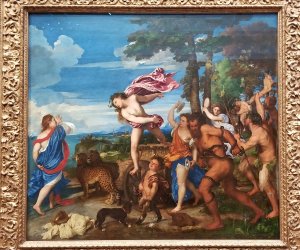
Titian. Bacchus and Ariadne. Oil on Canvas. 1520-3.

It is difficult to discuss Eliot’s eponymous hero in Daniel Deronda without giving away key aspects of her plot.  But I will share one of the most extraordinary passages in the novel that captures the strength, dignity and grace of Eliot’s hero:

Look at his hands: they are not small and dimpled, with tapering fingers that seem to have only a deprecating touch: they are long, flexible, firmly-grasping hands, such as Titian has painted in a picture, where he wanted to show the combination of refinement with force.  And there is something of a uniform pale-brown skin, the perpendicular brow, the calmly penetrating eyes.  Not seraphic any longer: thoroughly terrestrial and manly; but still of a kind to raise belief in a human dignity which can afford to acknowledge poor relations.

Time and again Deronda’s strong, graceful hands are extended to help those in need.  When he is rowing his boat along the Thames one evening, he finds a woman named Mirah in great distress and he does not hesitate to soothe her and to save her life:  “She stepped forward close to the boat’s side, and Deronda put out his hand, hoping now that she would let him help her in.  She had already put her tiny hand into his which closed round it, when some new thought struck her, and drawing back she said– ‘I have nowhere to go—nobody belonging to me in all this land.'”  Needless to say, Deronda does all he can to ensure not only Mirah’s safety but her happiness.

But Deronda does not discriminate when helping those in need.  He is capable of the most selfless kind of empathy and sympathy and extends kindness and compassion to those whom others might judge as undeserving.  Gwendolen, in her new marriage to Grandcourt, feels herself stuck in a miserable existence.  References to Dante abound in Eliot’s text and sometimes Gwendolen is depicted in a type of purgatory and at other times her life is described as pure hell.  It is just at the point of feeling like she will be pulled into the abyss of pain and sorrow that Deronda offers his steady hand:

Her hands which had been so tightly clenched some minutes before, were now helplessly relaxed and trembling on the arm of her chair.  Her quivering lips remained parted as she ceased speaking. Deronda could not answer; he was obliged to look away.  He took one of her hands, and clasped it as if they were going to walk together like two children: it was the only way in which he could answer, ‘I will not forsake you.’  And all the while he felt as if he were putting his name to a blanck paper which might be filled up terribly.  Their attitude, his averted face with its expression of a suffering which he was solemnly resolved to undergo, might have told half the truth of the situation to a beholder who had suddenly entered.

That grasp was an entirely new experience to Gwendolen: she had never before had from any man a sign of tenderness which her own being had needed, and she interpreted its powerful effect on her into a promise of inexhaustible patience and constancy.

I end my summer vacation of reading “loose, baggy monsters”  on a very high note with this remarkable book.  Middlemarch is still my favorite Eliot novel, but Daniel Deronda is a close second.  Tomorrow begins my twentieth year of teaching secondary school and I am as nervous, anxious, and excited as ever to face a new group of students.  I shall continue my reading of epic books into the autumn as Mann’s The Magic Mountain and Dante’s Divine Comedy have both caught my attention.  It seems fitting that today, for the first time in months, the humidity has broken and the air has a lightness and coolness to it that is refreshing and hopeful.


10 Comments

Filed under Uncategorized
