Category Archives: Literary Fiction

Review: Circling the Sun by Paula McLain

I received an advanced review copy of this title from the publisher through NetGalley

My Review:
Circling the Sun Few people know that Beryl Markham was the first female to fly solo across the Atlantic Ocean from east to west.  I had no idea what a trailblazer she was for women’s accomplishments in the 20th century until I read McLain’s book.  Some might know her because of her friends, Karen Blixen and Denys Finch Hatton who were made famous in the movie Out of Africa.

Beryl’s father, Charles Clutterbuck,  buys a plot of land on which to raise and train race horses in the British colony of Kenya at the turn of the century.  Beryl’s mother leaves the Colony after a year and Beryl is raised by her father and has an unconventional childhood as far as British, aristocratic children are concerned.  Despite his best efforts to educate her and make her become a “proper” English girl, Beryl is most content to ride horses on her father’s farm and hunt with the local tribes.  Throughout the novel she is constantly striving to regain the freedom she had as a child but which is so elusive for a female in the early 20th century.

When the Clutterbuck farm fails, seventeen year old Beryl feels lost and is not sure what to do with her life.  She can follow her father to Cape Town but she desperately wants to stay in Kenya, the only home she has ever truly known.  She feels that her only choice is to marry a local farmer and horse trainer named Jock who is twice her age and whom she barely knows.  Beryl seems to be looking for love, companionship and someone who truly understands her and will let her be herself.  When she doesn’t conform to Jock’s idea of a domestic wife, the marriage fails and ends in divorce.  Beryl marries two more times; her failed second marriage to a British aristocrat named Mansfield Markham, is also chronicled in the book.  The one man that she seems to truly love and want to be with is Denys Finch Hatton, a man who himself cannot be tamed and whom she can never truly possess.

Even though her personal life and numerous love affairs end up in failure, Beryl seems to put her energy into succeeding as a horse trainer.  Most of the book deals with her early life as she trains horses and works among men on farms.  When her first marriage fails she is determined to make her own way in life and lives and works on a friend’s horse farm in her attempt to become the first licensed female horse trainer.  She is trying to break through in a field dominated by men and she is subjected to constant disappointments and setbacks because of her gender.

One final aspect of the book that must be mentioned is the author’s beautiful and detailed descriptions of colonial Kenya.  The topic of big game hunting has been a prominent topic in the news lately and McLain’s descriptions of British aristocrats going out on safari so they can possess one of these beautiful animals is an interesting glimpse into the origins of this sport.  At one point in the book the British royal family goes out on a safari to hunt animals and the press glorifies this barbaric activity.

CIRCLING THE SUN is a great summer read for its lush settings and inspiring tale of a little-known female trailblazer from the early 20th Century.

About The Author:
Paula McLainPaula McLain has published two collections of poetry, “Less of Her” and “Stumble, Gorgeous,” both from New Issues Poetry Press, and a memoir entitled “Like Family: Growing Up in Other People’s Houses” (Little, Brown, 2003). “A Ticket to Ride,” is her debut novel from Ecco/HarperCollins. She received her MFA in poetry from the University of Michigan in 1996, and has since been a writer-in-residence at Yaddo, The MacDowell Colony, and The Ucross Foundation Residency Program, and received fellowships from the National Endowment for the Arts and the Ohio Arts Council. Individual poems and essays have appeared in numerous journals, including the Gettysburg Review, Antioch Review, and The New York Times Sunday Magazine. As well as teaching part-time at John Carroll University, she is a core faculty member in the low-residency MFA Program in Poetry at New England College


7 Comments

Filed under Historical Fiction, Literary Fiction

Review: The Anger Meridian by Kaylie Jones

I received an advanced review copy of this title from Askashic Books through Edelweiss.

My Review:
Anger MeridianMerryn Huntley is prone to anxiety attacks, has constant headaches,  and hasn’t slept well for years.  When the police knock on the door at her Dallas home and inform her that her husband Beau has died in a car accident, Merryn feels nothing but relief.  She has been married to Beau for over ten years and he was always disconnected from and disinterested in his wife and their nine year old daughter, Tenney.  In fact, when Beau crashed his car, a local waitress with whom he was having yet another affair was also in the car.

Merryn packs up her daughter and immediately flees to San Miguel, Mexico where her mother has a plush home with fabulous views.  One of the greatest strengths of the book are the descriptions of San Miguel’s  intense, blazing sun, its dusty streets and its markets full of local people and tourists. But when Merryn gets to Mexico, comfort is the last thing she gets from her mother.  Merryn’s mother, whom they call Bibi, drinks too much, gossips about her so-called friends, and belittles Merryn every chance she gets.  Throughout the book Merryn struggles to deal with her strained relationship with her mother.  Bibi is not a likeable character and the degrading words she constantly hurls at her daughter makes us glad that she comes to a tragic end.

While Merryn is in San Miguel, she also has to deal with constant calls from the FBI.  It seems that Beau was making himself rich  by laundering enormous sums of money for terrorists.  Merryn had nothing to do with her husband’s business and she is very worried that she will not be able to convince the feds that she is innocent.  Merryn is already a nervous person but with her mother’s constant berating, the circumstances of her husband’s death and the FBI breathing down her neck she is at her breaking point.

To complicate her life even further, Merryn also meets an American doctor in Mexico that she is instantly drawn to.  But Dr. Fuller has a reputation for sleeping with wealthy American widows in order to raise money for his health clinic.  On the one hand his sexual promiscuity disgusts her, but on the other hand she is very attracted to him, especially since he is so kind to her daughter Tenney.

The best characters in the book are Tenney who is a chess prodigy and her stray dog, Sophia.  Tenney and Sophia seem to possess the strength that Merryn lacks and in the end Merryn makes the right decisions because she realizes that she has to be strong for her daughter.

THE ANGER MERIDIAN is a fun and quick summer read with an interesting and complex plot.  Takes this one to the beach for a good end-of-the-summer read.

About The Author:
Kaylie JonesKaylie was born in Paris, France and attended French schools until she returned with her family to the U.S. in 1974. Her father was the novelist James Jones.

Kaylie began to study Russian as her third language at age 8, and continued to study the language and literature through her four undergraduate years at Wesleyan University and her two years at Columbia University’s School of the Arts, where she received her MFA in Writing.

Kylie Jones has published six books, the most recent a memoir, Lies My Mother Never Told Me. Her novel A Soldier’s Daughter Never Cries was adapted as a Merchant Ivory film in 1998.

Jones has been teaching for more than twenty-five years, and is a faculty member in the Stony Brook Southampton MFA in Creative Writing & Literature program and in Wilkes University’s MFA in Creative Writing program. She is the author of Speak Now and the editor of Long Island Noir. Her newest endeavor is her publishing imprint with Akashic Books, Kaylie Jones Books

1 Comment

Filed under Literary Fiction

Review: Talk by Linda Rosenkrantz

I received an advanced review copy of this title from The New York Review of Books through Edelweiss.

My Review:
TalkThis is one of those books that is difficult to classify in a specific genre.  It is biographical, but it is does not take the form of a traditional narrative like most biographies.  The author taped the conversations of three people, Marsha, Vincent and Emily, during the summer of 1965 while they vacationed on the beaches of East Hampton and transcribed their dialogue into this book form.  The result is a straightforward, raw and, at times, shocking series of conversations on which we are “eavesdropping.”

There are several topics and themes that keep cropping up in the conversations of these three friends.  First and foremost is their many failed relationships.  None of them can sustain a long-term love interest and they all seem to have different reasons for being unlucky in love.  Emily is still hung up on an old boyfriend with whom she lived in France, Vincent is gay and can’t quite seem to find someone to confide in like he does with Marsha, and Marsha seems to be in love with her gay best friend Vincent.  All three of them are in psychotherapy trying to iron out their problems and they like to sit around an analyze their therapy sessions.

Another topic that keeps bubbling to the surface is their childhoods.  Marsha and Emily, in particular, like to share stories about their younger years and their parents.  Emily tells a particularly horrifying yet funny story about a neighbor’s doll which she covets and then ends up destroying so she doesn’t have to give it back.  There seems to be a contest among them as to whom has had the most twisted and ridiculous stories from their younger years.

The most common, and shocking topic among the three is sex.  They talk about anything and everything.  They talk about who they are attracted to, who they will and won’t sleep with; no aspect of sex is off the table–ménage, S&M, orgies, abortion, masturbation are all covered.  Marsha goes into great detail describing a boyfriend who like to tie her up, hang her on a wall, and whip her.  TALK can be considered the original 50 Shades of Grey, only Marsha is smart enough to realize that this is not a healthy relationship and she quickly moves on.  I had to keep reminding myself that this book was written fifty years ago because their conversations could have just as easily have taken place today.  All three friends are 30 years old and have come to a crossroads in their lives; will they ever find the right one and get married and settle down?  Is marriage really something that they could or should even consider?  Rosenkrantz was progressive and brave not to filter any of the talk among these friends.

The New York Review of Books Classics imprints are my favorites to read.  They have provided us with another fascinating, relevant and interesting book.  You will definitely want to grab this one for the beach.

About The Author:
Linda Rosenkrantz is the author of several books of fiction and nonfiction, including Telegram, a history of the telegraphic communication, and her memoir, My Life as a List: 207 Things About My (Bronx) Childhood, and the co-author of Gone Hollywood: The Movie Colony in the Golden Age. She was also the founding editor of Auction magazine, a long-time syndicated columnist, and a founder of the popular baby-naming site Nameberry.com. She currently resides in Los Angeles.

4 Comments

Filed under Classics, Literary Fiction, New York Review of Books

Review: Precious Bane by Mary Webb

This excellent, classic title was also recommended to me by a like-minded reader.  I downloaded it onto my Kindle but I will definitely buy a hard copy because it is one of those classic novels that I will reach for again and again.

My Review:
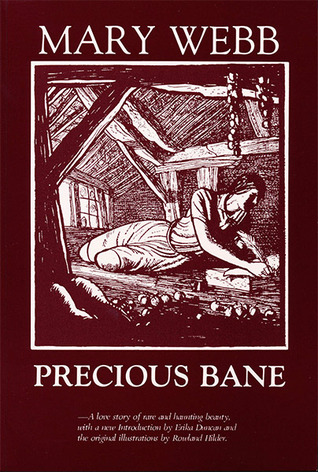
Precious BaneA the core of this story is a lesson about being kind and accepting of others who are physically different than what is considered to be society’s norm.  Prue Sarn is born with a hare lip and for the first third of the book the reader is not even made aware of her difference except for a few hints from her mother.  We are made painfully aware of Prue’s physical difference when she encounters other people from the village and they make cruel and mean comments about her lip.

In the 19th century, not only was a person with a physical deformity treated cruelly but they were viewed as cursed.  Prue is accused of witchcraft and having something wicked in her soul that caused her lip to be “hare-shodden.”  But Prue is the kindest, wisest and most patient soul in the novel.  Even when her friends and family members make offhand and hurtful comments about her lip she immediately forgives them.

The most maddening figure in the book is Gideon, Prue’s brother.  When Gideon and Prue’s father dies, Gideon inherits the family farm and he has visions of working the land night and day and making enough money for them to buy a fancy house and live in the lap of luxury.  He makes his sister Prue swear that she will work herself to the point of exhaustion in order to help him achieve his goal.  Prue doesn’t care for money or wealth or status but she agrees to help Gideon because she wants to do what will make him happy.

Gideon’s focus on producing extra crops and becoming a wealthy man is so strong that it becomes a detriment to others around him.  He will not marry Jancis, his long-time sweetheart and she is pawned off by her father as a dairy maid instead.  He even harms his ailing mother because he sees her as a drain on his income when she needs the doctor more and more.  Prue aptly begins to call Gideon’s goal and his crop his “precious bane” which foreshadows his eventual downfall.

In the end we are left wondering whether or not any man has enough honor in his spirit to look beyond Prue’s face and into the depths of her soul and see her for the good and kind person she truly is.  You will have to read PRECIOUS BANE for yourself to find out if it has a fairy tale ending.


About The Author:
Mary WebbMary Webb (1881-1927) was an English romantic novelist of the early 20th century, whose novels were set chiefly in the Shropshire countryside and among Shropshire characters and people which she knew and loved well. Although she was acclaimed by John Buchan and by Rebecca West, who hailed her as a genius, and won the Prix Femina of La Vie Heureuse for Precious Bane (1924), she won little respect from the general public. It was only after her death that the Prime Minister, Stanley Baldwin, earned her posthumous success through his approbation, referring to her as a neglected genius at a Literary Fund dinner in 1928. Her writing is notable for its descriptions of nature, and of the human heart. She had a deep sympathy for all her characters and was able to see good and truth in all of them. Among her most famous works are: The Golden Arrow (1916), Gone to Earth (1917), and Seven for a Secret (1922).


5 Comments

Filed under British Literature, Classics, Literary Fiction

Review: Greenery Street by Denis Mackail

The purpose of my blog has been to connect with like-minded readers and share great books.  This title was recommended to me by one such like-minded reader whose recommendations of books for me always seem to be spot on.  For a full list of wonderful titles from Persephone Books please visit their website: http://www.persephonebooks.co.uk/

My Review:
Original-Greenery-Street-cover-422x600Greenery Street is the perfect place in London for the blissfully happy newlyweds with its “thirty-six narrow little houses.”  The street is so charming that every couple moves in with the intention of staying there forever, but as soon as the first baby arrives each couple realizes that Greenery Street is too small to contain a growing family.  This book treats us to the first several months in the life of the charming and adorable newlywed couple, Ian and Felicity Foster.

Ian and Felicity’s courtship and engagement is not an easy road for them especially since Felicity’s father, “Old Humphrey” objects to his daughter’s marriage.  It’s not that he doesn’t like Ian, but it just seems to him that Felicity would never have to do something as complicated as getting married and leaving home.  Old Humphrey is famous for dodging touch decisions and he does this by getting a fever and having to lie in bed for several days whenever a pivotal moment in life arises.

Some readers might this this book mundane since it is the chronicle of a happy marriage.  Mackail’s sense of humor and witty dialogue make ordinary matters like shopping, having lunch, dealing with the servants and paying bills funny and entertaining.  Ian and Felicity are so nice and polite of a couple that when their servants are taking advantage of them and drinking on the job, they can’t even bring themselves to fire them.  The house-parlor maid, who is particularly cranky and awful at her job, is affectionately and secretly called “The Murderess” by the newlyweds.

I was truly delighted by the happiness of this couple and the little ways in which they found to show their love and devotion to each other.  Felicity waits eagerly on their little balcony everyday to greet Ian when he gets home; Ian apologizes and soothes Felicity even when he is not sure what he has done wrong; Felicity secretly sells her grandmother’s pearls when she wants to pay the builder’s bill and not worry Ian over money.

I highly recommend GREENERY STREET as a charming, witty and well-written book.  I could not put this book and read it in only a few sittings.  I am eager to read other titles from Persephone Books.

About The Author:
Denis MackailDenis Mackail was born in Kensington, London to the writer John William Mackail and Margaret Burne-Jones, daughter of the painter Edward Burne-Jones. Educated at St Paul’s School, Hammersmith, he went to Balliol College, Oxford, but failed to complete his degree through ill-health after two years.

His first work was as a set designer, notably for J. M. Barrie’s The adored one and George Bernard Shaw’s Pygmalion (1914). The outbreak of World War I interrupted this promising start, however, and Denis, not fit enough for active service, worked in the War Office and the Board of Trade.

In 1917 he married Diana Granet, only child of the railway manager Sir Guy Granet, who was a director-general for railways in the War Office. The couple had two children, Mary (born 28 March 1919) and Anne (born 12 January 1922) and lived in Chelsea, London. It was the necessity of supporting his young family that led Denis to write a novel when office jobs became insecure after the end of the war.

With his novel published, his first short-story accepted by the prestigious Strand Magazine and the services of a literary agent, A. P. Watt, Denis was soon earning enough from his writing to give up office work. He published a novel every year from 1920 to 1938 and among his literary friends were P. G. Wodehouse and A. A. Milne.

During the 1930s Mackail lived at Bishopstone House, Bishopstone near Seaford, Sussex

As therapy from a nervous breakdown, Denis agreed to write the official biography of J. M. Barrie, which appeared in 1941. He went on to produce seven more novels and some books of reminiscences, but after the early death of his wife in 1949, he published no more and lived quietly in London until his death.


3 Comments

Filed under Classics, History, Literary Fiction, Persephone Books