Category Archives: Humor

Review: The Librarian by Mikhail Elizarov

I received an advanced review copy of this title from publisher through NetGalley.  The original book was written and published in Russian in 2007 and this English version has been published by Pushkin Press.

My Review:
The LibrarianI recently read an article in The New York Review of Books by Ian Frazier in which he describes Russian satire and humor and the ways in which it differs from the rest of Europe and the United States.  Frazier writes, “Given the disaster Russian history has been more or less continuously for the last five centuries, its humor is of the darkest, most extreme kind. Russian humor is to ordinary humor what backwoods fundamentalist poisonous snake handling is to a petting zoo. Russian humor is slapstick, only you actually die.”  Elizarov’s The Librarian is a perfect literary example of  Frazier’s description of Russian humor.

The book opens with a description of a fictional Soviet-era writer named Gormov whose books were mass-produced but were of such poor quality that they were relegated to the bargain bin in used bookstores almost immediately.  After the fall of the Soviet Union, Gormov’s books are rediscovered and are also found to have magical effects on their readers.  The Book of Joy, for instance, puts readers into a temporary state of euphoria that is reminiscent of a drug high.  There are seven such magical books in the Gormov collection.  As groups acquire copies of these powerful books, they are called “Libraries.”  These libraries then engage in ridiculous, epic battles to fight for ownership of Gormov’s books.

The most absurd “library” of the bunch is a group of frail and senile old women living in a nursing home to whom the Book of Endurance is read.  All of a sudden their newly acquired strength turns these geriatrics into a fierce and bizarre army of warrior-like Amazons who kill people by the hundreds in order to protect their precious library.  There is an excessive amount of stabbing with knitting needles and pounding heads with hammers which ridiculous and droll scenes present us with the “slapstick” humor that Frazer describes but where characters “actually die.”

The main character of the book is a meek young man named Alexei whose only concern in life is to be an actor.  Of course, his acting career has never taken off so he finds himself divorced and living at home with his parents.  When his uncle dies he is asked to put his things in order and sell his uncle’s apartment.  The contents of the apartment contain one of Gormov’s books so naturally Alexei is drawn into the world of the libraries.  His lack of reaction as people are stabbed and killed around him in order to protect the book is ridiculous and comical.  He eventually dons his own armour, which consists of old truck tires, and launches himself headlong into the bloody fray.

The problems with Alexei’s own library and its inevitable clash with other libraries is the topic of the second half of the book.  There are many battle scenes where the rival libraries have more and more comical battles in which the clash of these book warriors resemble video games.  In the end, Alexei is saved by the brigade of geriatric warriors who lock him up and want to use him as their guinea pig to test out the effects of reading all seven books at once.  The ending has a more serious tone then the rest of the book and provides and interesting commentary on worshipping and overvaluing objects, blindly following leaders without questioning their motives and the sacrificing of one person for the safety of the whole community.  For a sampling of Russian humor and satire THE LIBRARIAN is a perfect choice, but I will warn you to be prepared for a wild ride.
3 Comments

Filed under Humor, Literature in Translation, Russian Literature

Review: Ending Up by Kingsley Amis

I received an advanced review copy from The New York Review of books. Please visit their website for the full collection of their classics series: http://www.nybooks.com/books/imprints/classics/.

My Review:
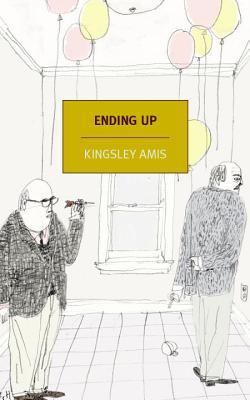
Ending UpIn this comedy about old age, Amis provides us with a geriatric cast of characters living under the same roof who are basically trying to stay as comfortable and happy as possible before they die.  There are five septuagenarians in total, three men and two women.  Although they want nothing put peace in their final years, they manage to annoy each other and bicker to the point where peace is the last thing that any one of them is going find.

Adela is the one who holds the whole operation together by paying the bills, doing all of the cooking and shopping and generally trying to make peace among her roommates.  She is not the most attractive woman and she has never been married but she is the caretaker to everyone in the house to the point that she ignores her own health issues.

Adela’s brother Bernand, the most cantankerous one of the bunch, is also the most amusing.  He has a bad leg which seems to be better or worse, depending on whether or not he is asked to do physical labor.  He provokes the others into arguments during conversation for his own amusement and he is very fond of attempting practical jokes.  His favorite weapons are stink bombs, feces, a squirt gun and urine.

A happy drunk named Shorty is also one of the residents of the cottage.  Shorty loves alcohol and he thinks he is fooling everyone about his habit by hiding bottles all over the house.  He is also the servant of the group and is always cleaning up and serving tea.  Shorty and Bernard are actually ex-lovers, which fact produces a few bawdy jokes throughout the book.

The other woman in the group is a flighty woman named Marigold.  Marigold loves to write letters, spend time with her grandchildren and do everything she can to avoid Bernard.  When Marigold starts losing her memory, she is desperate to keep this secret from Bernard whom she is sure will use this information against her.

The last member of the household is George, a former brother-in-law of Bernard.  George is a kindly old professor who has had a stroke and cannot get around on his own.  The group has taken him in because he has no where else to go and Bernard is not happy about this situation.

ENDING UP is a funny novel about the inevitability of growing old and dealing with the vast array of issues that come along with this mortal condition.  It is ironic and funny that each of these septuagenarians are responsible for his or her own demise at the end of the book.  Thanks again to the New York Review of Books for reviving another great classics.

About The Author:
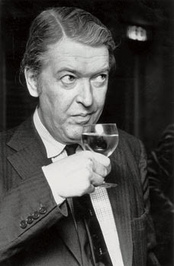
AmisSir Kingsley William Amis, CBE was an English novelist, poet, critic, and teacher. He wrote more than twenty novels, three collections of poetry, short stories, radio and television scripts, and books of social and literary criticism. He fathered the English novelist Martin Amis.

Kingsley Amis was born in Clapham, Wandsworth, Couty of London (now South London), England, the son of William Robert Amis, a mustard manufacturer’s clerk. He began his education at the City of London School, and went up to St. John’s College, Oxford April 1941 to read English; it was there that he met Philip Larkin, with whom he formed the most important friendship of his life. After only a year, he was called up for Army service in July 1942. After serving in the Royal Corps of Signals in the Second World War, Amis returned to Oxford in October 1945 to complete his degree. Although he worked hard and got a first in English in 1947, he had by then decided to give much of his time to writing.

7 Comments

Filed under Classics, Humor, Literary Fiction, New York Review of Books

Review: The Last Word by Hanif Kureishi

I received an advanced review copy of this book from the publisher through NetGalley.

My Review:
Last WordMamoon Azam is an Indian born British writer who is now in his seventies and living a quiet and unassuming life in the bucolic English countryside.  Although he has produced many thought-provoking and award-winning books in his career, it has been several years since he has been relevant in the publishing world.  Mamoon, his wife Liana and a major publishing house decide that a biography of the writer would be just the thing to make Mamoon important again as well as rich.

Harry Johnson, a struggling writer himself, is hired by the publisher to write a scintillating, scandalous and lascivious biography of Mamoon.   The first half of the book is a hilarious satire not only of authors, but of everyone involved in the publishing industry.  The old novelist is portrayed as an acrimonious,  self-absorbed recluse who has not written anything worthwhile in years.  Harry, Mamoon’s biographer, is a bottom-feeder in the publishing industry because he is trying to make a living by writing about another man’s career.  Rob, the editor at the publishing company, is greedy for a tell-all biography which will unveil shocking and unseemly secrets about Mamoon’s life.

At a party given him by his overly emotional and needy wife, Mamoon is awkwardly asked to deliver an impromptu speech for his friends, family and fans.  His remarks about writers and their role in the world of publishing is a sad, yet accurate commentary on what this industry has become: “These days a writer without bodyguards can hardly be considered serious. A bad review is the least of our problems.  Every idiot believing any insanity has to be humored: it is their human right.  The right to speech is always stolen, always provisional.  I fear the game is almost up for truth.  People don’t want it; it doesn’t help them get rich.”

The most interesting character in the novel is Harry himself who has a heavy load of emotional baggage over his paranoid, sex-crazed, suicidal mother.  Harry has a fiancé but he cannot seem to stay faithful to her.  His own life is a mess and in a state of crisis while he is chasing a reluctant, and at times recalcitrant, Mammon around his home trying to pry details out of the novelist about his life.  Harry’s personal affairs are presented as a ridiculous farce and, much like the author whose life he is trying to capture, he has a tumultuous history of relationships with women.

Overall, THE LAST WORD is an entertaining and starkly vivid satire about what the state of the publishing world has become in the 21st century.  Mamoon knows that he has an important life and career which ought to be documented, but at the same time he is running away from that very corrupt and profit-focused industry that is in charge of illustrating his life.

About The Author:
Hanif KureishiHanif Kureishi is the author of novels (including The Buddha of Suburbia, The Black Album and Intimacy), story collections (Love in a Blue Time, Midnight All Day, The Body), plays (including Outskirts, Borderline and Sleep With Me), and screenplays (including My Beautiful Laundrette, My Son the Fanatic and Venus). Among his other publications are the collection of essays Dreaming and Scheming, The Word and the Bomb and the memoir My Ear at His Heart.

Kureishi was born in London to a Pakistani father and an English mother. His father, Rafiushan, was from a wealthy Madras family, most of whose members moved to Pakistan after the Partition of India in 1947. He came to Britain to study law but soon abandoned his studies. After meeting and marrying Kureishi’s mother Audrey, Rafiushan settled in Bromley, where Kureishi was born, and worked at the Pakistan Embassy.

Kureishi attended Bromley Technical High School where David Bowie had also been a pupil and after taking his A levels at a local sixth form college, he spent a year studying philosophy at Lancaster University before dropping out. Later he attended King’s College London and took a degree in philosophy. In 1985 he wrote My Beautiful Laundrette, a screenplay about a gay Pakistani-British boy growing up in 1980’s London for a film directed by Stephen Frears. It won the New York Film Critics Best Screenplay Award and an Academy Award nomination for Best Screenplay.


3 Comments

Filed under Humor, Literary Fiction

Review: Cat Out of Hell by Lynne Truss

I received an advanced review copy of this book from Melville House through Edelweiss.

My Review:
Cat Out of HellHave you ever wondered what your pet’s voice would sound like if it could talk?  Oh come on, I can’t be the only one!  Well, Roger, the talking cat in CAT OUT OF HELL, has a voice that sounds like Vincent Price.  He is also intelligent, well-read, well-traveled and immortal.

Roger has had a very interesting life and he begins to tell this story to a man named Wiggy.  Wiggy, whose sister Jo has mysteriously disappeared, has inherited Roger from his sister and discovers within a few days that Roger, a tabby cat, can actually talk.  And when he does talk he has a lot of things to say.

Roger is not the only talking cat in the story.  Roger’s long-time best friend, Captain, who is an enormous black cat, can also communicate with humans but, unlike Roger, Captain is evil and sinister.  What else would one expect from a gigantic talking, black cat!

The other main, human, character in the book is Alec whose wife has unexpectedly died.  Together Alec and Wiggy discover that Captain is part of an evil group of cats who are ruled by a Cat Master and have caused more than a few human deaths.  Can Alec, Wiggy and Roger team up and defeat Captain and the evil Cat Master before this satanic and sinister duo can do any more damage?

If you are thinking that the premise of this book is ridiculous, you are correct.  But the writing is so clever and funny that I thoroughly enjoyed every page.  CAT OUT OF HELL is a quick read that will give you lots of good belly laughs.  It will also make you wonder what your pets are really up to when you are not around.

About The Author:
Lynne TrussLynne Truss is a writer and journalist who started out as a literary editor with a blue pencil and then got sidetracked. The author of three novels and numerous radio comedy dramas, she spent six years as the television critic of The Times of London, followed by four (rather peculiar) years as a sports columnist for the same newspaper. She won Columnist of the Year for her work for Women’s Journal. Lynne Truss also hosted Cutting a Dash, a popular BBC Radio 4 series about punctuation. She now reviews books for the Sunday Times of London and is a familiar voice on BBC Radio 4. She lives in Brighton, England.

Leave a comment

Filed under Humor, Literary Fiction

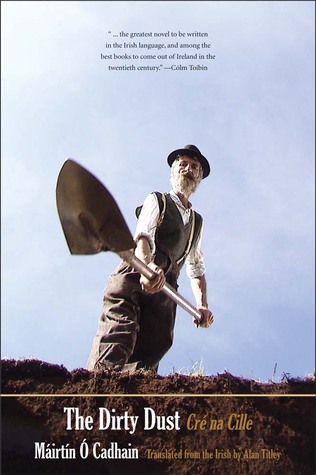
Review: The Dirty Dust by Máirtín Ó Cadhain

I received a review copy of this book from Yale University Press.  This book was published in Irish in 1949 and this is the first time it has been translated and published in an English edition.  The translator, Alan Titley has a well-written introduction at the beginning of the book that includes some interesting information about the history of Irish language and literature.

My Review:
Dirty DustThis book takes place in the cemetery of a small town in western Ireland where corpses engage in conversations that continue the pettiness and gossip that dominated their lives when they were still aboveground.   Caitriona Paudeen, the most outspoken, and the most foul-mouthed in the group has a severe dislike for her sister, Nell and her daughter-in-law.  Caitriona’s vehement dislike of her relatives stays with her on the other side and it seems to intensify when she hears news of their lives as they continue on without her.

THE DIRTY DUST is one of the most unique premises for a book that I have encountered.  The dialogue in the book is not the typical streamlined speech that one encounters in a more conventional narrative; the conversations on which the reader is eavesdropping are bits and pieces of information, complaints, and stories that the corpses are remembering from their former lives.  Because we are oftentimes launched into the middle of a conversation, it is not always clear who the speaker is in the narrative and one has to look for certain clues or turns-of-phrase that are uttered before a speaker can be identified.  The only time new information is introduced to the graveyard is when a fresh corpse is buried.  Each new corpse brings another opportunity for juicy gossip to be spread around the graveyard.

Through the course of their cacophony of conversations, we learn that this group of neighbors and family members are petty, jealous, bigoted, narrow-minded and foul-mouthed.  The town Postmistress opens everyone’s mail, Peter the Publican who owns the tavern waters down everyone’s drinks, and Huckster Joan who is the town merchant poisons everyone with her terrible coffee.  They bring up old arguments about football games, money and wills; they are constantly spying on each other and wondering about the goings on of their neighbors.

Ó Cadhain also demonstrates his writing versatility though the use of philosophical and poetic speeches that occur at the beginning of each chapter or interlude.  At the beginning of Interlude 5 he writes, “Here in the grave the spool is for ever spinning; turning the brightness dark, making the beautiful ugly, and imbricating the alluring golden ringlets of hair with a shading of scum, a wisp of mildew, a hint of rot, a sliver of slime, and a grey haunting of mizzle.” As contrast to what happens in the graveyard he writes, “Aboveground everything is bedecked in the garments of everlasting youth.  Every shower of rain creates a multitude of mushrooms miraculously in the grass.”

THE DIRTY DUST is a timeless and brilliantly funny satire of life in a small town where old grudges are not forgotten, even when neighbors are buried six feet under the ground.  The only difference between life and death is that in death the people in this small town are stuck next to their neighbors from whom they can never escape.

About The Author:
Máirtín Ó Cadhain (1906 – 18 October 1970) was one of the most prominent Irish language writers of the twentieth century.

Máirtín Ó Cadhain was born in Cois Fharraige in the Connamara Gaeltacht in 1906. He is best known for his major novel, Cré na Cille (Dublin, Sáirséal agus Dill, 1949). It has been translated into English as The Dirty Dust, and into many other languages, including Danish and Norwegian.

His short story collections include Idir Shúgradh agus Dáiríre, 1939, and An Braon Broghach, 1948, from which Eoghan Ó Tuairisc translated stories published under the title Road to Bright City (Dublin, Poolbeg Press, 1981); An tSraith ar Lár, (1967); and An tSraith Dhá Thógáil (1970).

A national school teacher in his early life, he was interned for his activities in the IRA during World War II. He became a lecturer in Irish in Trinity College Dublin in 1956, and became Professor of Irish there in 1969.

He died in 1970.

Leave a comment

Filed under Classics, Humor, Literature in Translation