Category Archives: History

Review: Greenery Street by Denis Mackail

The purpose of my blog has been to connect with like-minded readers and share great books.  This title was recommended to me by one such like-minded reader whose recommendations of books for me always seem to be spot on.  For a full list of wonderful titles from Persephone Books please visit their website: http://www.persephonebooks.co.uk/

My Review:
Original-Greenery-Street-cover-422x600Greenery Street is the perfect place in London for the blissfully happy newlyweds with its “thirty-six narrow little houses.”  The street is so charming that every couple moves in with the intention of staying there forever, but as soon as the first baby arrives each couple realizes that Greenery Street is too small to contain a growing family.  This book treats us to the first several months in the life of the charming and adorable newlywed couple, Ian and Felicity Foster.

Ian and Felicity’s courtship and engagement is not an easy road for them especially since Felicity’s father, “Old Humphrey” objects to his daughter’s marriage.  It’s not that he doesn’t like Ian, but it just seems to him that Felicity would never have to do something as complicated as getting married and leaving home.  Old Humphrey is famous for dodging touch decisions and he does this by getting a fever and having to lie in bed for several days whenever a pivotal moment in life arises.

Some readers might this this book mundane since it is the chronicle of a happy marriage.  Mackail’s sense of humor and witty dialogue make ordinary matters like shopping, having lunch, dealing with the servants and paying bills funny and entertaining.  Ian and Felicity are so nice and polite of a couple that when their servants are taking advantage of them and drinking on the job, they can’t even bring themselves to fire them.  The house-parlor maid, who is particularly cranky and awful at her job, is affectionately and secretly called “The Murderess” by the newlyweds.

I was truly delighted by the happiness of this couple and the little ways in which they found to show their love and devotion to each other.  Felicity waits eagerly on their little balcony everyday to greet Ian when he gets home; Ian apologizes and soothes Felicity even when he is not sure what he has done wrong; Felicity secretly sells her grandmother’s pearls when she wants to pay the builder’s bill and not worry Ian over money.

I highly recommend GREENERY STREET as a charming, witty and well-written book.  I could not put this book and read it in only a few sittings.  I am eager to read other titles from Persephone Books.

About The Author:
Denis MackailDenis Mackail was born in Kensington, London to the writer John William Mackail and Margaret Burne-Jones, daughter of the painter Edward Burne-Jones. Educated at St Paul’s School, Hammersmith, he went to Balliol College, Oxford, but failed to complete his degree through ill-health after two years.

His first work was as a set designer, notably for J. M. Barrie’s The adored one and George Bernard Shaw’s Pygmalion (1914). The outbreak of World War I interrupted this promising start, however, and Denis, not fit enough for active service, worked in the War Office and the Board of Trade.

In 1917 he married Diana Granet, only child of the railway manager Sir Guy Granet, who was a director-general for railways in the War Office. The couple had two children, Mary (born 28 March 1919) and Anne (born 12 January 1922) and lived in Chelsea, London. It was the necessity of supporting his young family that led Denis to write a novel when office jobs became insecure after the end of the war.

With his novel published, his first short-story accepted by the prestigious Strand Magazine and the services of a literary agent, A. P. Watt, Denis was soon earning enough from his writing to give up office work. He published a novel every year from 1920 to 1938 and among his literary friends were P. G. Wodehouse and A. A. Milne.

During the 1930s Mackail lived at Bishopstone House, Bishopstone near Seaford, Sussex

As therapy from a nervous breakdown, Denis agreed to write the official biography of J. M. Barrie, which appeared in 1941. He went on to produce seven more novels and some books of reminiscences, but after the early death of his wife in 1949, he published no more and lived quietly in London until his death.

 

3 Comments

Filed under Classics, History, Literary Fiction, Persephone Books

Review: In These Times – Living in Britain Through Napoleon’s Wars, 1793-1815 by Jenny Uglow

I received an advanced review copy of this book from the publisher.

My Review:
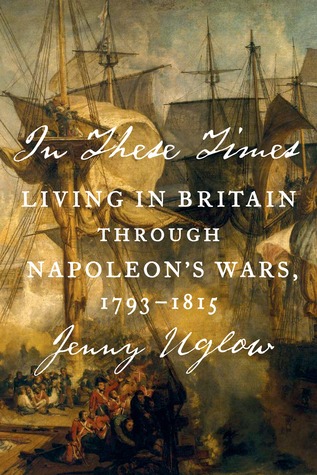
In These TimesUglow’s book is a comprehensive social history of Britain during the period of the Napoleonic Wars.  She makes extensive use of letters, journals and diaries from different social strata; we are given a first hand account of life in early 19th century Britian from clergymen, farmers, bankers, soldiers, mill owners and aristocratic women.  The only class from which we do not directly hear are obviously the illiterate poor.  But that is not to say she excludes them entirely; we are given descriptions about workhouses, wandering homeless and bread shortages from the diaries of the middle and upper  classes.

We do learn about the famous players in the wars like Pitt, Nelson, King George III, Wellington and Napoleon himself.  But they are not the focus of this history.  One will not find military battles, biographies of famous generals or copies of treaties in this book.  But the reader will discover how the daily lives and routines of British citizens were affected by this prolonged and costly war.

Uglow’s chapters are organized by themes and topics that occupied British citizens at home while soldiers were elsewhere in the world fighting the French.  At the beginning of the war, fear of invasion is a constant threat.  In order to make themselves feel more secure, local towns formed their own militia and proudly did drill practices in case the enemy ever landed on their shores.  We hear from coopers, bankers, shoemakers, farmers and men from all walks of life who were eagerly getting ready to defend their own borders from the likes of the French.

The themes of many of the chapters are related to money and economics.  Banking, bread prices, the running of mills and the national debt were all affected by the wartime economy.  Thousands of soldiers had to be given uniforms, shoes, and weapons.  The government had to pay for all of these supplies so taxes were constantly being raised.  The farmers felt a great impact from the demand placed on them for supplying food to the army and navy.  Farmer Randall Burroughes reports in his journal that he is dedicating the use of more and more land for planting oats and wheat.

The greatest strength of this book is Uglow’s extensive use of diaries, letters and journal entries that are woven throughout her narrative.  William Harness, who is serving in the British navy, writes longingly to his wife and children whom he is away from for extended periods of time.  He laments missing his children growing up and sharing in their childhood milestones.  Bessy, his wife, writes him back tenderly with news of home and their blossoming brood of children.

Randall Burroughes, a tough but fair old farmer, keeps a detailed journal which catalogs weather patterns, crop rotations, farm workers, and soil conditions.  He is the perfect example to remind the reader that, despite the fact that a global war is raging against the French, ordinary people are still farming their land, attending balls, gossiping and going to church.

In the Autumn of 1813, Uglow describes Napoleon’s defeat through the diary of John Oakes: “two Great Battles…at which The French and her Allies were totallyl routed, 30,000 taken Prisoner and 35,000 Killed & Sick taken. Bonaparte made his Escape wh. a party of Cavalry to Erfurt.”  Political and military events are recorded in the diaries of British citizens alongside weather reports, births, deaths and other family news.

This book also gave me a better appreciation for some of my favorite books that are set in the 19th century.  The chapter on “British Tars” chronicles in great detail the fear of the press gangs as they lurked around the British seaside looking for able bodied men to kidnap and force into naval service.  This reminded me of the vivid scenes in Gaskell’s Silvia’s Lovers in which one of characters is taken off by a press gang and not heard from again for years.  The discussions of the superior British navy and the opportunity for men to advance and get rich from prize money reminded me of Captain Wentworth in Austen’s Persuasion.  In the chapters about the brief pause in the war, the Peace of Amiens, Uglow describes the extended travel vacations that were enjoyed by the aristocracy; in the summertime a favorite destination was the Lakes region of Britain which, of course, reminds us of Lizzie’s journey with her aunt and uncle through this part of the country and her accidental meeting with Darcy.

Some of the transitions between topics in different chapters were rather abrupt.  A few times I became very interested in a particular story and the author would abruptly move on to another topic.  For example, the chapter “Going to the Show,” which describes the elaborate celebrations for the Jubilee of King George III and the types of theatrical events staged during the war, ends with an odd and out of place description of Napoleon’s separation from Josephine.

Overall, this is a comprehensive tome that will be appreciated by a wide variety of readers.  Those who take pleasure in British history, and social history in particular, will revel in the extensive use of primary source letters and journals.  Those who are fans of Austen, Burney and Gaskell will enjoy learning more about the time period in which their favorite books are set.  And finally, those who enjoy a well-written, thoroughly researched and interesting history will not want to miss reading IN THESE TIMES.

About The Author:
UglowJennifer Sheila Uglow OBE (née Crowther, born 1947) is a British biographer, critic and publisher. The editorial director of Chatto & Windus, she has written critically acclaimed biographies of Elizabeth Gaskell, William Hogarth, Thomas Bewick and the Lunar Society, among others, and has also compiled a women’s biographical dictionary.


4 Comments

Filed under History, Nonfiction
