Category Archives: Historical Fiction

Review: Circling the Sun by Paula McLain

I received an advanced review copy of this title from the publisher through NetGalley

My Review:
Circling the Sun Few people know that Beryl Markham was the first female to fly solo across the Atlantic Ocean from east to west.  I had no idea what a trailblazer she was for women’s accomplishments in the 20th century until I read McLain’s book.  Some might know her because of her friends, Karen Blixen and Denys Finch Hatton who were made famous in the movie Out of Africa.

Beryl’s father, Charles Clutterbuck,  buys a plot of land on which to raise and train race horses in the British colony of Kenya at the turn of the century.  Beryl’s mother leaves the Colony after a year and Beryl is raised by her father and has an unconventional childhood as far as British, aristocratic children are concerned.  Despite his best efforts to educate her and make her become a “proper” English girl, Beryl is most content to ride horses on her father’s farm and hunt with the local tribes.  Throughout the novel she is constantly striving to regain the freedom she had as a child but which is so elusive for a female in the early 20th century.

When the Clutterbuck farm fails, seventeen year old Beryl feels lost and is not sure what to do with her life.  She can follow her father to Cape Town but she desperately wants to stay in Kenya, the only home she has ever truly known.  She feels that her only choice is to marry a local farmer and horse trainer named Jock who is twice her age and whom she barely knows.  Beryl seems to be looking for love, companionship and someone who truly understands her and will let her be herself.  When she doesn’t conform to Jock’s idea of a domestic wife, the marriage fails and ends in divorce.  Beryl marries two more times; her failed second marriage to a British aristocrat named Mansfield Markham, is also chronicled in the book.  The one man that she seems to truly love and want to be with is Denys Finch Hatton, a man who himself cannot be tamed and whom she can never truly possess.

Even though her personal life and numerous love affairs end up in failure, Beryl seems to put her energy into succeeding as a horse trainer.  Most of the book deals with her early life as she trains horses and works among men on farms.  When her first marriage fails she is determined to make her own way in life and lives and works on a friend’s horse farm in her attempt to become the first licensed female horse trainer.  She is trying to break through in a field dominated by men and she is subjected to constant disappointments and setbacks because of her gender.

One final aspect of the book that must be mentioned is the author’s beautiful and detailed descriptions of colonial Kenya.  The topic of big game hunting has been a prominent topic in the news lately and McLain’s descriptions of British aristocrats going out on safari so they can possess one of these beautiful animals is an interesting glimpse into the origins of this sport.  At one point in the book the British royal family goes out on a safari to hunt animals and the press glorifies this barbaric activity.

CIRCLING THE SUN is a great summer read for its lush settings and inspiring tale of a little-known female trailblazer from the early 20th Century.

About The Author:
Paula McLainPaula McLain has published two collections of poetry, “Less of Her” and “Stumble, Gorgeous,” both from New Issues Poetry Press, and a memoir entitled “Like Family: Growing Up in Other People’s Houses” (Little, Brown, 2003). “A Ticket to Ride,” is her debut novel from Ecco/HarperCollins. She received her MFA in poetry from the University of Michigan in 1996, and has since been a writer-in-residence at Yaddo, The MacDowell Colony, and The Ucross Foundation Residency Program, and received fellowships from the National Endowment for the Arts and the Ohio Arts Council. Individual poems and essays have appeared in numerous journals, including the Gettysburg Review, Antioch Review, and The New York Times Sunday Magazine. As well as teaching part-time at John Carroll University, she is a core faculty member in the low-residency MFA Program in Poetry at New England College
 

7 Comments

Filed under Historical Fiction, Literary Fiction

Review: The Exchange of Princesses by Chantal Thomas

I received an advanced review copy of this title from the publisher, Other Press.  This was originally written and published in French and this English translation is by John Cullen

My Review:
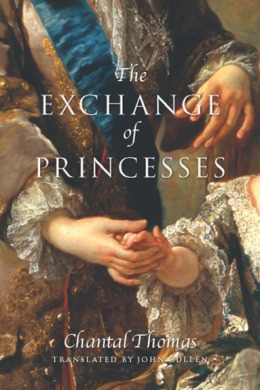
Exchange of PrincessesIn 1721, the regent of France, Philip D’Orleans, decides that the best alliance that the eleven-year-old King Louis XV can make with Spain is through marriage.  The regent proposes that Louis XV marry the princess of Spain, who is only four-years-old at the time of their betrothal.  The regent will also give his own daughter, Louise Elizabeth, a moody 11- year-old girl, to the Prince of Spain, also just a boy of 12,  as a show of good faith.  If you are already confused about names and ages then please don’t let that discourage from reading the book; I was confused in the beginning as well but the author does a good job of repeating the names and making the characters clear and distinct.  In 1722, both princesses set out on a long and arduous trek on the unpaved and rough roads between France and Spain.  The princesses are exchanged on the middle of the journey and each one proceeds to her new home and position.

My favorite part of the book is reading about the four-year-old Spanish princess;  like any little girl she loves her dolls, playing games, and being lavished with attention.  She is talkative and precocious and all of France and the French court becomes smitten with this charming little girl.  The author describes the very adult tasks that she must endure such as receiving ambassadors from foreign countries and attending balls in her honor.  At one such ceremony the little infanta is described as sucking on her thumb and clutching her favorite doll while a group of academics from the University of Paris pay their respects to her.  The only one who is not taken in by the charms of the princess is her own husband, King Louis XV.

Things do not go quite as smoothly as Philip D’Orleans had expected as far as these arranged marriages are concerned.  But, what did the regent expect when he decided to base political alliances on the lives of children?  Even though the little princess, Marianna Victoria, is a delightful four-year-old, her future husband, the king, is a jealous and petty eleven-year-old boy who is very upset that his nanny is now taking care of his future bride.  As he grows up he has no interest, whatsoever in spending any time with her or getting to know her.  The infanta, on the other hand, worships the king and is so thrilled whenever he is around her.

Meanwhile, in Spain the roles are reversed as Louise Elizabeth, the future Queen of Spain, wants nothing to do with her husband Don Luis.  The future King of Spain is so thrilled to have a pretty wife and he wants nothing more than to consummate their marriage.  But Louise Elizabeth does everything she can to keep the Prince away from her.  I don’t want to give too much away, but nothing works out in the end as the regent had intended.

The Exchange of Princesses actually reads more like a non-fiction history book than an historical fiction.  The author uses real letters from the characters involved as well as newspaper articles from the time period.  There are great details about ceremonies, details of palaces and descriptions of costumes.  If you are looking for a fast-paced, exciting historical fiction novel then this is not the book to read.  However, if you want to learn something about the political situation between France and Spain during the 18th century and the players involved then this well-researched novel is the perfect choice.


About The Author:
Chantal Thomas (born 1945 in Lyon) is a French writer and historian. Her 2002 book, Farewell, My Queen, won the Prix Femina and was adapted into a 2012 film starring Diane Kruger and Léa Seydoux.

Thomas was born in Lyon in 1945, and was raised in Arcachon, Bordeaux, and Paris. Her life has included teaching jobs at American and French universities (such as Yale and Princeton) as well as a publishing career. She has published nineteen works, including essays on the Marquis de Sade, Casanova, and Marie Antoinette.

In 2002, Thomas published Les adieux à la reine (Farewell, My Queen). The novel gave a fictional account of the final days of Marie Antoinette in power through the perspective of one of her servants. It won the Prix Femina in 2002, and was later adapted into the 2012 film Farewell, My Queen. The film stars Diane Kruger as the titular queen and Léa Seydoux as her servant Sidonie Laborde. Thomas co-wrote the screenplay,and it opened the 62nd Berlin International Film Festival. Helen Falconer of The Guardian called the work “a well written slice of history” with “evocative, observant prose,” but criticized it for creating a narrator who “merely provides us with a pair of eyes to see through rather than capturing our interest in her own right.” While disagreeing in its classification as a novel, Falconer did however add that Farewell, My Queen “generates in the reader a real sense of being a fly on the wall, eavesdropping on the affairs of the great and the not so good.”

Thomas is currently the director of research at the French National Centre for Scientific Research.


3 Comments

Filed under France, Historical Fiction, Literature in Translation, Spain

Review: Newport by Jill Morrow

I received an advanced review copy of this title from the publisher, William Morrow.

My Review:
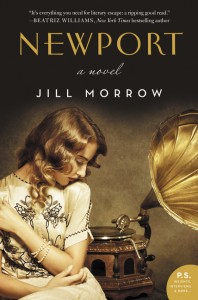
Newport-428x648-198x300What drew me to this book was the time period in which it is set, between the Great Wars in the Roaring Twenties when Prohibition is firmly entrenched and wealthy families vacation at their summer “cottages” in Newport.  Most of the drama takes place at the Chapman family’s sprawling estate in Newport and at the very core of this drama is a contested will.  Bennett Chapman is in his eighties but he is about to remarry a woman forty years his junior and change his will to make her the primary heir of his textile fortune.

Bennett’s two children, Nick and Chloe, stand to be mostly cut out of their father’s will if he manages to draft a new one.  Nick and Chloe think that their father is completely out of his mind and try to convince Bennett’s lawyers, Adrian and Jim, that Bennett is not mentally capable of making such a decision.  Nick and Chloe’s main evidence for their father’s mental instability is the fact that he has been having séances in which his first wife, dead for over thirty years, is the one who is telling him to remarry and change his will.  Are these séances a farce and an attempt to cheat Bennett out of his inheritance or are they legitimate messages from his wife from beyond?

The plot twist at the end was interesting and the descriptions of Newport in the twenties are the strongest aspects of this book.  The part of the story I had trouble with are the séances and the talking to dead people beyond the grave.  The author used this supernatural aspect to advance the plot which made the whole thing seem silly to me.  But that is just my particular preference for stories that do not involve the supernatural.  The historical setting, the bad behavior of spoiled, rich families and the contested will, in my opinion, could have all stood on their own to make an interesting story without inserting the ghost of a dead wife.

I would love to hear other reader’s opinion about this if you have read the book.  Are there certain additions or twists added to a novel that either distract you or cause you to give it a lower rating?

About The Author:
Jill-Morrow-200x300Jill Morrow has enjoyed a wide spectrum of careers, from practicing law to singing with local bands. She holds a bachelor’s degree in history from Towson University and a JD from the University of Baltimore School of Law. She lives in Baltimore.

6 Comments

Filed under Historical Fiction

Review: The Happy Tree by Rosalind Murray

My new favorite literary obsession is the wonderful novels from Persephone Books.  Please visit their website to learn more about this small press and the fabulous books they publish: http://www.persephonebooks.co.uk

My Review:
The Happy TreeFirst, I would like to mention that each Persephone book comes with beautiful endpapers and a matching bookmark.  Each endpaper and bookmark pattern that are chosen have a history of their own.  The picture here is the endpaper from The Happy Tree and is a replica of a 1926 printed woolen plush by TF Firth & Sons.

This novel shows us the devastating effects that World War I has on ordinary people who are trying to carry on in their daily lives while chaos and death have broken out around them.  The story is told from the point of view of Helen Woodruffe, who spends her childhood with her Cousin Delia and her two sons, Guy and Hugo.  Helen’s own father has died and Helen’s mother wants nothing to do with raising a child.  So Helen’s paternal relations step in and raise her.  She spends many happy days running around the family estate at Yearsly with Guy and Hugo.  Helen is particularly close to Hugo who is about her same age; they seem to have a special understanding of one another’s sensitive personalities and they share the same interests.

As Helen and Hugo develop into teenagers, it is evident that there is a strong attraction between them.  Everyone who is close to them assumes that they will eventually marry.  But when Hugo takes interest in another girl, Helen agrees to marry a man named Walter because she thinks Hugo is lost to her forever.  Walter is a good husband and loves Helen and it is sad that she comes to the conclusion that she has married the wrong person.  Helen has three children with Walter and she does seem happy for most of her married life with Walter.

The most interesting part of the book is reading about people’s reaction to the war; Helen and her family are at a dinner party when Franz Ferdinand is assassinated and no one believes that there will be a war and any fighting that does break out they believe it will be minor.  When Great Britain is pulled into the war and all of Helen’s young friends, including Guy and Hugo, join the fighting no one believes that the war will last for very long.  As the war drags on, Helen gets notice of one friend after another who has been wounded or killed in the fighting.  In the meantime, she has to deal with food rations, long lines and fuel shortages.  This begins to wear her down and she becomes very depressed, especially when her second child is born.

One of my favorite quotes from the book is one in which Helen describes the struggle of everyday existence during the war years:

This was not life, this daily drudgery, this struggle to keep going, to get through, to exist. I was marking time, we were all marking time, waiting and waiting for the strain to relax, for the war to end; and meantime our youth was going.

THE HAPPY TREE is a realistic view of World War I as see through the eyes of Helen and the everyday British citizens whose lives were worn down by this horrible conflict.  Persephone Books has given us another great classic that should go on the “must read” list for all those interested in World War I historical fiction.

About The Author:
rosalind-murray-copy_1Rosalind Murray (1890-1967) was the daughter of the well-known classical scholar Gilbert Murray and Lady Mary Howard. Brought up in Glasgow and Oxford, she was educated by governesses and at the progressive Priors Field School. She published her first novel, The Leading Note, in 1910 when she was 20, her second, Moonseed, in 1911 and her third, Unstable Ways, in 1914; this was the year after her marriage to the historian Arnold Toynbee, with whom she had three sons between 1914 and 1922. The Happy Tree came out in 1926; it was followed by another novel, Hard Liberty, and by a children’s history book.  During the 1930s Rosalind Murray’s interests turned to theology; although brought up agnostic, she was received into the Roman Catholic Church in 1933, and published several books about faith and religion. She parted from her husband in 1942 and spent the rest of her life farming in Cumberland.


3 Comments

Filed under British Literature, Classics, Historical Fiction, Persephone Books, World War I

Review: Wilfred and Eileen by Jonathan Smith

I am just in love with all of the books that I have read from Persephone Press.  This is another great classic based on a true story and deals with World War I and its affects on a loving and devoted couple.

My Review:
Wilfred and EileenThe first part of this novel deals with Wilfred Willet who is about to graduate from Trinity College, Cambridge and meets a beautiful woman named Eileen Stenhouse at a ball.  Even though they are from different social classes, they seem to hit it off right away and have lots of things to talk about.  Soon after he graduates,  Wilfred goes off to medical school and works as a resident in a hospital while Eileen sits at home with her aristocratic parents and does, well, not much of anything but wait for Wilfred to call.  In the first part of the book we are left wondering if Wilfred is as devoted to Eileen as she is to him; will Wilfred’s work at the hospital take precedence over having an engagement or eventually a marriage with Eileen?

As time goes on, Wilfred decides to defy the wishes of his parents, especially his mother, and marries Eileen in secret.  It is ironic that, although Wilfred’s family is of a lower social class, the Willets are the ones who strenuously object to the marriage.  Wilfred’s mother seems to be overly protective of her only child and I suspect that, in her eyes,  no woman would ever be good enough for him.

When World War I breaks out and Wilfred volunteers to go to the front, he decides that his secret marriage must be revealed to both families.  The author includes letters that Wilfred and Eileen write back and forth on almost a daily basis until he gets wounded.  The details he describes about the deplorable and inhumane conditions in the trenches are vivid and must have been heart-wrenching for Eileen to read.  She does manage to stay strong and put on a brave face for her husband and family and her sentiments of love and devotion in the letters are beautiful.

The real hero in the book is Eileen who travels to France in order to extract Wilfred from a makeshift army hospital and bring him back to Britain so he can receive the best medical care for his head wound.  Eileen eventually brings Wilfred back to the very hospital in which he served as an intern and his old mentor saves Wilfred’s life.  Eileen never waivers for a moment in her devotion to Wilfred despite the handicap he suffers for the rest of his life.  They make a home together in the countryside and even have two children.

If you love historical fiction set during World War I then I highly recommend giving WILFRED AND EILEEN a try.  I am completely smitten with these wonderful novels from Persephone Books.

About The Author:
Jonathan Smith was born in Wales in 1942 and went to Christ College, Brecon. He read English at Cambridge, taught at Loretto School, Edinburgh and in Melbourne, and from the late 1960s onwards at Tonbridge School, where he was head of English for 17 years. He is married and lives in Kent.


4 Comments

Filed under British Literature, Classics, Historical Fiction, Persephone Books, World War I