Category Archives: Historical Fiction

Review: Clinch by Martin Holmén

I received an advanced review copy of this title from Pushkin Press.  This was published in 2015 in the original Swedish and this English version has been translated by Henning Koch.

My Review:

ClinchHarry Kvist is an former boxer who lives in the decrepit, dirty and seedy city of Stockholm in the 1930’s.  The city is full of tramps, prostitutes, and bootleggers as well as poor and destitute citizens who have been affected by the economic collapse of this decade.  Kvist himself leads a hard life by serving as a collector of debts to those who have defaulted on payments.  His specialty is repossessing bicycles which is easy money for him.  When the novel begins Kvist is collecting on a debt from a man named Zetterberg who owes a few thousand kronor.  Kvist scares Zetterberg by giving him a good beating that is not enough to kill him, but enough to leave him with a few scars as a “reminder” to pay the money he owes.  When Zetterberg is found dead the next day, Kvist is the prime suspect and he is immediately picked up by the police.

Kvist spends a few rough nights in a disgusting jail cell covered in urine and lice.  He is given a working over by the detectives and after they don’t get any information out of him he is released.  He spends the next few days hunting downs leads about Zetterberg’s murder and trying to find a prostitute named Sonja who is the only person who can provide him with an alibi for the time of the murder.  Kvist’s detective work takes him to bars, gangster hideouts, slums and brothels.  The best part of the book is the author’s ability to fully capture the squalid, dingy and oftentimes dangerous city.  The streets are an interesting mix of pre-industrial Europe and the slow progress towards modernization.  Horse carts still plow the streets and deliver coal, but cars are also driven through the crowded and dirty city.

The plot about the murder is slow to advance throughout the course of the book.  However, Kvist’s contact with the seedy underbelly of the city make for some thrilling scenes.  His always has a desire to use his boxing skills and he gets into several fist fights with other gritty characters.  He is also shot at and chased after and there is rarely a dull moment in Kvist’s life.  But even though there is an undercurrent of violence throughout the book, Kvist is not a murderer or a psychopath.  He can be sensitive to the needs of others, especially women who are in a tough spot or emotionally distraught.  He is even nice to animals and feeds the starving strays on the streets of Stockholm.  All of these details give us a multi-dimensional character with whom, even when he is violent, we can sympathize.

Kvist’s sexuality and his experimentation with both males and females gives the book an added layer of interest and sophistication.  Kvist has several encounters with different men at the beginning of the book which is very dangerous for him since any type of homosexual act is illegal at the time.  But Kvist’s sexual preferences are not an “either, or” choice.  He also hints at the fact that he has a daughter and makes comments about the type of woman that attracts him.  He spends quite a bit of time in the second part of the book sleeping with an actress who was trying to contract him for his collection serves.  The exploration of his sexuality, which is not usually done in Noir fiction,  adds another brilliant dimension to his character.

I am excited that this is supposed to be the first book in a trilogy about Harry Kvist and I am eager to read the next two installments which are coming out in the next year.  This is noir writing as its best and you won’t want to give this book a miss if you are a fan of this genre.

About the Author:
M HolmenMartin Holmén is a Swedish writer based in Stockholm. He was orn in 1974. He teaches History, Swedish and History of Culture and Ideas at an upper secondary school in Stockholm two days a week. He is the author of the Harry Kvist trilogy.


9 Comments

Filed under Historical Fiction, Literature in Translation, Mystery/Thriller, Scandanavian Literature, Summer Reading

Review- The Honeymoon: A Novel About George Eliot by Dinitia Smith

I received an advanced review copy of this title from the publisher, Other Press.

My Review:
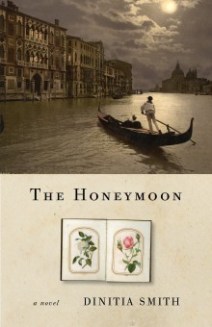
The HoneymoonThe most upsetting aspect of this fictional biography of George Eliot was the message forced upon her by her family that she was not a beautiful person and never would be.  From the time she was a five-year-old girl she was told that she was physically ugly and that no man would ever marry her.  Her mother favors her other two children over her; her father dotes on her but it seems that he pays her extra attention out of a sense of pity for his ugly child.  It was difficult and sad to read that from an early age the emphasis on her physical appearance greatly affected every aspect of her life.  Her father provided her with the best education because no man would marry her and she would have to be able to support herself.

When the book opens, Marian Evans, which is the famous author’s real name, is on her honeymoon in Venice;  she has just married a man twenty years her junior and it is evident that this is a platonic marriage which is void of any physical pleasures.  Marian and her husband Johnnie seem uneasy for a variety of reasons and most of the book is a flashback to earlier times in her life.  In her younger years, Marian has several affairs with married men which make her feel lonely and guilty.  Her low self esteem, due to what she perceives is her “ugly” exterior, makes her vulnerable to these men when they show her any type of attention.

Marian is depicted as an intelligent, curious, and kind woman.  She has learned several languages including German, Italian and Hebrew.  Whenever she is at a party and around a group of people, the most famous minds among them are attracted to her because of her sharp mind and intellect.  She first has an affair with a good family friend, Charles Bray,  but he casts her off for a young maid.  She is then seduced by the publisher John Chapman who owns the literary magazine she works for.  But when his wife and his other mistress get jealous he ends the affair.  After this string of empty affairs, Marian is dejected and feels that she is doomed to a life of loneliness without the love of a man.

Marian meets George Lewes through a mutual friend and their relationship is built on an appreciation for all things intellectual.  They read the same books, share their writing pieces and go to the theater together.  When they do become lovers George reassures her that, despite the fact that he is legally married, he has every intention of being with her for the rest of his life.  They do stay together and live together as man and wife for over twenty years.  Their deeply emotional and intimate relationship is the best aspect of the book; even though they never have any children together she treats George’s children as her own.  It is George who encourages her to start publishing her writings and he gives her valuable feedback on her manuscripts.

When George dies Marian is absolutely lost.  She begins to rely on Johnnie, a family friend, especially to sort out her finances.  At this point in the book she is a very rich woman because of the success of her novels and Johnnie protects her assets and watches over her like a doting son.  When Johnnie proposes marriage to Marian it is shocking because they have had no hint at any romantic feelings for one another.  It is subtly suggested in the book that Johnnie is gay and he is marrying Marian to try to act like a normal, British man.   He is emotionally struggling but we are never given the exact details of his inner turmoil.  During their honeymoon Johnnie starts to mentally unravel and he attempts suicide by jumping into the canal.

The Honeymoon is an interesting look at the life of this prolific, female, British writer.  I always knew that George Eliot lived with Lewes but were never legally married.  The details in the book about their arrangement were enlightening.  The book also provides an important message: beauty is much deeper than a person’s outward, physical appearance.

About the Author:
D SmithDinitia Smith is novelist, Emmy award-winning filmmaker, and journalist. She worked as a correspondent for The New York Times, specializing in literature and the arts, for 12 years. She has taught at many institutions, including Columbia University.

8 Comments

Filed under Historical Fiction

Review: Someday We’ll Tell Each Other Everything by Daniela Krien

My Review:
SomedayMy tour of post-Soviet literature continues with a book that describes the last few months of life in the German Democrat Republic (G.D.R.).  The story is told from the point of view of Maria, a seventeen year old girl who is trying to find her way in the world while living through some very tough circumstances.  This book has three important aspects to explore, the first and foremost of which is a coming-of-age storyline.  Maria is on the cusp on adulthood and has never had much guidance or supervision in her life.  She has never known her father very well because he keeps leaving on trips to Russia throughout her childhood.  She finds out that this distant father is about to marry a Russian woman that is Maria’s own age.
Maria’s mother is not someone she can rely on because of her constant sadness and depression that is the result of her failed marriage. Maria doesn’t hesitate to leave her mother’s home when she is given the chance to live with her boyfriend Johannes and his family on their farm.  For the first time in her life Maria feels at home on the family farm; as she begins to help with the cooking and the daily chores on the farm her life suddenly has meaning and value and she is genuinely happy.

The next aspect of the book, which is arguably the most interesting,  is the intense love story.  But it is not a love story between Maria and her boyfriend Johannes.  There is a man named Henner, a loner with a reputation for excessing drinking who lives on the farm next door, that attracts Maria’s attention.  Henner is enigmatic and handsome and although he is twice her age, Maria is inexplicably drawn to him.  Their love affair is passionate and intense and Henner is even rough when he makes love to Maria.

But Henner also has a tender side and as they spend time together he slowly reveals his story and his personality to Maria.  Maria knows that what she feels for Henner is true love and she is living a double life.  Maria has a much deeper and more mature connection with Henner despite their differences in age.  She is torn apart trying to decide whether or not she should leave the comfort and safety of Johannes, his family and their farm in order to try to make a real life with Henner.  Living with Henner as his lover will surely shock the whole town and Maria will be shunned for it.

Finally, this story is about a very interesting time period in German history as the G.D.R. falls and the country is once again reunited.  The contrast between east and west in the novel is stark.  Johannes has an uncle who, as a young man twenty years earlier, managed to escape to the west and get an education and work as an engineer.  When the uncle comes to visit Maria feels frumpy and backwards compared to the uncle and his western-born and sophisticated wife.  Maria is excited but also nervous about the anticipation of being able to experience all of the exotic things that the west has to offer.

This book is an intense and quick read that I highly recommend.  This was actually the first book I read from Maclehose Press and I look forward exploring more of their catalog.

About the Author:
Daniela Krien was born in 1975 in what was then East Germany and lives in Leipzig, where she is an editor and scriptwriter for Amadelio Film. Someday We’ll Tell Each Other Everything is her first novel.

9 Comments

Filed under German Literature, Historical Fiction

Review: William – an Englishman by Cicely Hamilton

My Review:
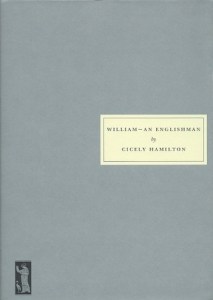
William EnglishmanI was not surprised to find out the author composed this novel in a tent on the front lines of World War I.  The novel is a gruesome, starkly honest portrayal of the horrors of war.  The author, however, draws the readers in at first with a light and satirical description of its gentle, naïve and optimistic main characters, William and Griselda.

When the story begins, William is twenty-six years old and still lives with his mother.  He has an extremely ordered and monotonous life working at a clerk’s office and handing over most of his weekly paycheck to his mother.  He doesn’t seem to have any genuine affection for his parent and when she suddenly dies he realizes that he never really loved her.  Her death means freedom for him; not only does he now have financial freedom since she left him a sizeable inheritance but he also has the freedom to make his own decisions about the course his life will take.

William asks some advice from one of his fellow clerks about what he should do with his time and money and it is through this interaction with Farraday that William becomes involved with political and social reform.  William leaves the tedious office where he has worked for many years and embarks on full-time career as a social activist who writes about, protests and goes to meetings about the suffragette movement, pacifism, and other socialist topics.

It is at these meetings that William meets Griselda, a feisty suffragette who shares the same ideals as William.  The tone in the book that describes these two is one of gentle parody as William and Griselda appear to fight for mostly vague causes.  They believe all government is evil and any attempt of a government to raise a military and train it is simply “playing” at warfare.  They love to go to meetings and hand out pamphlets and consider themselves strong and tough for fighting against social injustices.  They see themselves as the perfect couple and their courtship and devotion to each other is a sweet love story.

When William and Griselda take their honeymoon in the remote mountains of the Belgian Ardennes, they are uneasy with the slow-paced, quiet life of the village in which they are staying. But they settle in for a few weeks and enjoy each other’s company.  It is on the very last day of their vacation that things take a horrible and tragic turn for the worst.  They encounter a regiment of invading German soldiers who treat them brutally and inhumanely.  I have to say that the violence in this book shocked me and Hamilton does not gloss over or sugarcoat the atrocities of war.

William, the once naïve and optimistic Englishman who lived in his happy little bubble of bliss, now becomes the disillusioned and distraught victim of real warfare.  It is not a game or a joke when men are being blown apart and people’s lives are destroyed by gunfire and bombs.  I don’t want to give away the plot and the fate of William and Griselda.  But I will say that William’s story comes full circle and in the end his life becomes equally as monotonous and numb as it was when we first meet him living under the thumb of his mother.  What starts out as an amusing story about two naïve lovebirds becomes a harsh commentary on the gory realities of warfare.

I encourage anyone who enjoys World War I historical fiction to pick up this book.  Thanks to Persephone Press for reissuing another brilliant book from an important 20th century female author.

About the Author:
C HamiltonCicely Mary Hamilton (born Hammill), was an English author and co-founder of the Women Writers’ Suffrage League.

She is best remembered for her plays which often included feminist themes. Hamilton’s World War I novel “William – An Englishman” was reprinted by Persephone Books in 1999.

She was a friend of EM Delafield and was portrayed as Emma Hay in “A Provincial Lady Goes Further.”


6 Comments

Filed under British Literature, Classics, Historical Fiction, Persephone Books, World War I

Review: Winter by Christopher Nicholson

I received an advanced review copy of this book from the publisher, Europa Editions.

My Review:
WinterI always thought it was sad that the Roman Stoic philosopher Cicero, in his moral treatise De Senectute (On Old Age), argues that not only do old men not engage in the pleasures of a lover any longer, but they are actually relieved to be free from such sensations.  Seneca, in one of his Stoic epistles, agrees with Cicero’s sentiment by telling Lucilius that it is a relief to have tired out one’s appetites and be done with such things.


Christopher Nicholson, in his fictional autobiography about the last few years of Thomas Hardy’s life, greatly disagrees with Cicero and Seneca’s views on old age.  Nicholson gives us an example, through the life of this famous author, of an old man enjoying love and fantasizing about pleasure even though such enjoyments are not necessarily attainable.  The focus of the book is the winter of Hardy’s eighty-fourth year when he decides to become involved in an amateur production of Tess.  He has resisted turning what is his most famous novel into a staged production, but when he meets Gertrude Bulger, a local townswoman, he believes she is the only one that can do his heroine justice.

Hardy lives a very quiet life in the small town of Wessex where he was born.  He doesn’t go out and socialize very much, so it is truly remarkable when he agrees to become involved with the local theater company to stage this production of Tess.  He develops a heart-warming relationship with the lead actress, whom he affectionately refers to as “Gertie.”  He enjoys having her over for tea and talking to her about books, philosophy and life in general.  He realizes that, even though he is in the winter of his life, he still has strong feelings of love and desire for this twenty-eight year-old woman.  She inspires him to write love poems again and he produces over twenty such poems in the course of a few months.

The imagery and backdrop of winter is appropriate for Hardy’s reflections on what he feels could be the last few months, weeks or days of his life.  The cold and ice and bleak landscape reflect what he feels is going on in the natural progression of his life.  He, however, is not sad or bitter about this .  And when he has the opportunity to interact with Gertie he embraces the opportunity and does not deny himself feelings of love, pleasure and desire just become of his advanced age.  One of the sweetest moments of the book is when he finds one a piece of her hair and tucks it into one of the books in his library as a keepsake.

The other forceful character in the book is Hardy’s wife who is about forty years his junior.  Although Florence is much younger than her husband she acts like she is the octogenarian in the relationship.  She is obsessed with her health, paranoid, whiny and jealous.  When she sees that Thomas has developed feelings for Gertie she is relentless in her nagging at him and does everything she can to make sure that they do not see each other again.  I understand that Hardy could be a quiet, brooding, stubborn man and was not the easiest person to live with.  But Florence’s constant obsession about her health and the perceived wrongdoings against her made it difficult to have any sympathy for her.

The reader should be warned that the ending is not necessary a happy one.  There is, however,  a larger message in the book to be found which is that Cicero and Seneca did not quite have the correct perceptions on old age.  Human beings have the capacity to experience love, desire and pleasure right up until our final days.  Cicero and Seneca most definitely would have judged Hardy to be a bad Stoic.

About the Author:
C NicholsonChristopher Nicholson was born in London in 1956 and brought up in Surrey. He was educated at Tonbridge School in Kent, and read English at Gonville and Caius College, Cambridge. After university he worked in Cornwall for a charity encouraging community development. He then became a radio scriptwriter and producer, and made many documentaries and features mainly for the BBC World Service in London. He was married to the artist Catharine Nicholson, who died in 2011. He has two children, a son and a daughter. For the past twenty-five years he has lived in the countryside on the border between Wiltshire and Dorset.


8 Comments

Filed under British Literature, Historical Fiction