Category Archives: German Literature

Review: Narcissus and Goldmund by Hermann Hesse

This is my first contribution to German Literature Month, hosted by Lizzy’s Literary Life and Beauty is a Sleeping Cat.  Please visit their blogs for more great German Literature in translation and to see the full list of blogs that are participating.

My Review:
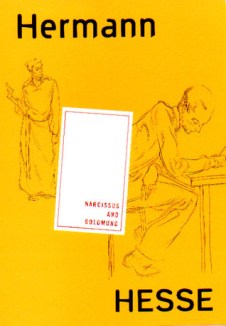
Narcissus and GoldmundThis is one of those classic books that is very difficult to review and do it justice because there are so many ideas contained within the book.  It is a coming-of-age story, a commentary on existential philosophy and a beautiful description of a life long friendship.  Narcissus is a teacher’s assistant in the cloister of Mariabronn and fully intends to take his vows as a monk.  Narcissus is a very talented scholar and it is evident that he will one day serve the church and even become the Abbot of the cloister.  He is a cerebral man who values the intellect but his emphasis on the rational also prevents him from having any real friendships or meaningful love in his life.  But this all changes when a young boy by the name of Goldmund is dropped off at the cloister by his father.

Goldmund has been raised solely by his father and his father has done everything in his power to erase Goldmund’s memories of his gypsy mother.  Goldmund’s father drops him off at the cloister with the intention of Goldmund being a pupil and eventually taking a vow to become a monk.  Goldmund’s father tells him that he must dedicate his life to God in order to make up for his mother’s sins.  But Goldmund does not possess the intellectual detachment of Narcissus and love and art and seduction are things which he cannot deny himself in order to become a monk.  Narcissus helps Goldmund realize that cloister life is not for him and when Goldmund learns the pleasures of sex from a gypsy woman he knows that Narcissus is right and he immediately flees the cloister.

Most of the book is a description of Goldmund’s restless journey as a wanderer.  Wherever he stays, whether it be in a modest farmhouse, the castle of a knight or a large city, he manages to satisfy his sexual desires by seducing countless women.  Goldmund is kind and loving and handsome so oftentimes a single look or a caress is enough for a woman to fall in bed with him.  But he never stays in one place long enough to have a lasting and deep friendship like the one he had with Narcissus.  The longest he stays at any place is the Bishop’s city where he becomes an apprentice to a master artist named Niklaus.  Niklaus teaches Goldmund the finer points of sculpting and Goldmund’s greatest masterpiece is a sculpture of St. John that is done in the likeness of his greatest friend Narcissus.  Even though Narcissus and Goldmund are very far apart for many years, their friendship still has a great influence on Goldmund’s life.

Narcissus does come back into Goldmund’s life at a critical point in the book when Goldmund is most in need of help.  Goldmund eventually goes back to live in the cloister as the artist in residence and he works on many sculptures with which to grace the beloved halls of his boyhood home.  Goldmund has had many hardships while on his travels and he puts all of his experiences into his artwork.  There is a heavy emphasis in the book on the close relationship between ecstasy and suffering.  When we give our heart to someone, whether it be a friend, a lover or a relative, we always run the risk of being harmed.  Goldmund had a deep fondness with his mother whom he barely remembers and throughout the book he is looking for that mother-relationship again that made him feel so safe during his very early years.    His culminating sculpture at the monastery, one that he wants to keep to himself and not share, is a mother figure done in the likeness of one of his most influential lovers named Lydia.

Narcissus and Goldmund is a classic novel that I will reach for again and again on my bookshelf.  It is a novel with so many layers that I a sure that each time I reread it I will have new insights and thoughts about this plot.  I look forward to reading another Hesse novel for German Literature month.  What German Literature have you read that you would highly recommend?
German Lit Month


About The Author:
HesseHermann Hesse was a German-Swiss poet, novelist, and painter. In 1946, he received the Nobel Prize in Literature. His best known works include Steppenwolf, Siddhartha, and The Glass Bead Game (also known as Magister Ludi) which explore an individual’s search for spirituality outside society.

In his time, Hesse was a popular and influential author in the German-speaking world; worldwide fame only came later. Hesse’s first great novel, “Peter Camenzind”, was received enthusiastically by young Germans desiring a different and more “natural” way of life at the time of great economic and technological progress in the country.

Throughout Germany, many schools are named after him. In 1964, the Calwer Hermann-Hesse-Preis was founded, which is awarded every two years, alternately to a German-language literary journal or to the translator of Hesse’s work to a foreign language. There is also a Hermann Hesse prize associated with the city of Karlsruhe,Germany.
28 Comments

Filed under Classics, German Literature

Review: The Last Weynfeldt by Martin Suter

I received an advanced review copy of this title from New Vessel Press through Edelweiss.  This book was originally written and published in German and this English translation has been done by Steph Morris.

My Review:
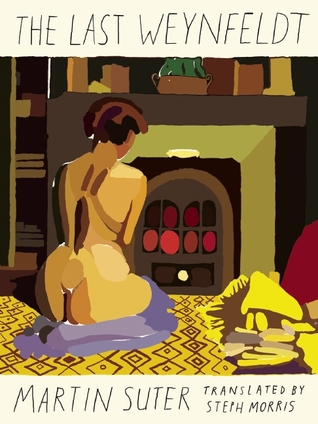
The Last WeynfeldtNew Vessel Press will publish the English translation of this book in February of 2016, but the book was so good that I couldn’t wait that long to review it.  The central figure of the book, Adrian Weynfeldt, is just what the title suggests: he is the last of his family and he is not married and has no children.  Adrian’s parents had him later in life and when they died they left Adrian an extensive inheritance which includes two buildings that are prime real estate in Zurich.

Fifty-year-old Adrian lives alone on the top floor of one of his opulent buildings.  His massive apartment is filled with costly art work and antique furniture.  Because of his family’s wealth Adrian doesn’t have to work, but he does because he loves his occupation as an expert art historian for an auction house in Zurich.  The descriptions of various artwork and the process of art auctions is a fascinating aspect of the book that captivated my attention.

Adrian is mannered to a fault.  He doesn’t ask questions when he should and he is always paying for his friends’ lavish dinners and funding their attempts at careers.  Every Thursday is lunch with his younger friends and Adrian always excuses himself towards the end of the meal and quietly pays the very expensive bill.  Adrian is kind, polite and unassuming and it as very sad to see his so-called friends take advantage of his good nature.

This book is one of those page turners that grabs you right from the first scene.  Adrian is sitting at one of his favorite bars in Zurich when in walks an interesting woman, in her mid-thirties who basically invites herself up to Adrian’s apartment.  He realizes that she is rather intoxicated, so in true Adrian fashion, he feels it would be wrong to sleep with her.  In the middle of the night, Adrian wakes up to find this woman, whose name he figures out is Lorena, standing on his balustrade and ready to jump to her death.  After he talks her off the ledge, Adrian finds that he can’t stop thinking about Lorena even though he doesn’t know very much about her.

It turns out that Lorena has tried to barely squeak out a living by modeling for small companies and catalogues.  She has had a tough life and her latest relationship ended disastrously when she found out her boyfriend had a wife and three children.  Lorena teams up with a small-time con artist named Pedroni and together they decide to try and swindle Adrian out of some of his money.  But Lorena seems to have fallen for Adrian, more so than she is willing to admit to herself, and we are left wondering if she can really cheat him after all.

Adrian and Lorena also become involved in an attempted art forgery and a great part of the suspense of the book lies in wondering whether or not Adrian’s keen eye for art will be able to detect the forgery and stop the sale of this piece before it ruins his career.  But Lorena’s influence has most definitely thrown some chaos into his otherwise ordered and neat life.  The circumstances surrounding the forged art, the sexual tension between Adrian and Lorena and the fascinating character of Adrian himself kept me wondering what was going to happen and wanting more.

I highly recommend that everyone put this on their “to read” pile for 2016.  There are just so many interesting aspects to this story-from the strong characters to the intricate descriptions of art to a mystery of an art fraud.  New Vessel Press has quickly become one of my favorite independent presses and with THE LAST WEYNFELDT they have chosen another fantastic book to bring us in translation.

About The Author:
M SuterMartin Suter (b. February 29, 1948, Zürich) is a Swiss author. He became known for his weekly column Business Class in the Weltwoche newspaper (1992–2004), now appearing in the Tages-Anzeiger, and another column appearing in “NZZ Folio”. Suter has published seven novels, for which he received various awards. He is married and lives in Spain and Guatemala.


8 Comments

Filed under German Literature, Literary Fiction, Literature in Translation

Review: Confusion by Stefan Zweig

I have not been very active on the blog this week, but I have a great excuse.  Classes have started again so that means I am back in the classroom.  I have a record number of students who have signed up for Latin this year.  So when someone makes the comment that Latin is a “dead language” I reference my robust numbers of enthusiastic students.  Confusion is the perfect book to review for back-to-school since it highlights a rather unusual relationship between a student and teacher.  This book was originally published in the German in 1929 and this English translation is done by Anthea Bell.

My Review:
ConfusionWhen the novella opens, Roland is celebrating his sixtieth birthday and his thirtieth anniversary of teaching in the Department of Languages and Literature.  His colleagues and students have presented him with a book that is a complete biography of his academic career.  The only thing missing is an account of how he was inspired to begin his career in academics.  The rest of the story is an account of Roland’s youth and his experience with the teacher that inspired his career.

Roland first attends university in Berlin where he is bored and uninspired and as a result he does not take his studies seriously.  He spends months lounging around in coffee-houses and sleeping with many women and not tending to his studies at all.  One day his father shows up unannounced and this incident makes for a very funny and awkward scene in the book.  Roland is so embarrassed by his behavior that he agrees to leave Berlin and attend university in a small provincial town in central Germany.  This is where he encounters the teacher that will change his life and infuse in him a lifelong passion for literature.

When he first arrives at his new university, Roland stumbles into a lecture on Shakespeare which is being given by a passionate and well-spoken professor.  All of the students listening are captivated by this teacher and Roland is instantly inspired as well.  He finds the professor and enlists his help in mapping out a plan for his academic future.  Roland lives in the same building as the teacher and his wife so he quickly becomes very close with the couple.  Roland eats meals with the couple, spends evenings in the teacher’s study, and even goes on various social outings separately with the wife.

From the beginning it becomes clear that the teacher and his wife have a very strange marriage.  They never display an affection for each other and seem to be more roommates than husband and wife.  As Roland spends time with the wife, she drops hints here and there that they are not happily married and that the teacher is rather a difficult person to live with.  But the true details about the non-traditional relationship between husband and wife are not revealed until the very end of the book.

Throughout his time with the teacher, Roland is plagued by the constant mood swings of his mentor.  Sometimes his teacher is encouraging and kind and then all of a sudden he is insulting, distant and cold.  Roland works hard at his studies to impress his teacher, even to the detriment of his mental and physical health.  Roland feels like he is walking on eggshells because he never knows if his teacher will be kind or cruel.  The teacher’s feelings and reasons for his changeable behavior are not revealed until the end of the book.

As a teacher this book was interesting to read because it reminded me that we oftentimes never know what kind of an impact we can have on students’ lives and careers.  Roland has this one man to thank for his long and successful career but he never gets to tell the teacher about his inspiration.  It is significant that the teacher is never given a name; he remains a nameless entity even though he has such an amazing impact on Roland’s fate.   Furthermore, there could not be a more apt title for this book than the word “confusion.”  Roland is confused about his relationship to his teacher, and he is also confused about the relationship between the teacher and his wife.  And until the very end, the reader is confused about what, exactly, is going on with the teacher.

This is a touching, powerful and short read that I highly recommend.  I look forward to reading more of Zweig’s works.  Thanks to the New York Review of Books for reviving another fantastic classic work in translation.

About The Author:
Stefan Zweig was one of the world’s most famous writers during the 1920s and 1930s, especially in the U.S., South America and Europe. He produced novels, plays, biographies and journalist pieces. Among his most famous works are Beware of Pity, Letter from and Unknown Woman and Mary, Queen of Scotland and the Isles. He and his second wife committed suicide in 1942.

Zweig studied in Austria, France, and Germany before settling in Salzburg in 1913. In 1934, driven into exile by the Nazis, he emigrated to England and then, in 1940, to Brazil by way of New York. Finding only growing loneliness and disillusionment in their new surroundings, he and his second wife committed suicide.

Zweig’s interest in psychology and the teachings of Sigmund Freud led to his most characteristic work, the subtle portrayal of character. Zweig’s essays include studies of Honoré de Balzac, Charles Dickens, and Fyodor Dostoyevsky (Drei Meister, 1920; Three Masters) and of Friedrich Hlderlin, Heinrich von Kleist, and Friedrich Nietzsche (Der Kampf mit dem Dmon, 1925; Master Builders). He achieved popularity with Sternstunden der Menschheit (1928; The Tide of Fortune), five historical portraits in miniature. He wrote full-scale, intuitive rather than objective, biographies of the French statesman Joseph Fouché (1929), Mary Stuart (1935), and others. His stories include those in Verwirrung der Gefhle (1925; Conflicts). He also wrote a psychological novel, Ungeduld des Herzens (1938; Beware of Pity), and translated works of Charles Baudelaire, Paul Verlaine, and mile Verhaeren.

Most recently, his works provided inspiration for the 2014 film ‘The Grand Budapest Hotel’

12 Comments

Filed under Classics, German Literature, Literature in Translation, New York Review of Books, Novella
