Author Archives: Melissa Beck

Melissa Beck's avatar

About Melissa Beck

My reading choices are rather eclectic. I enjoy reading a wide range of books especially classics, literature in translation, history, philosophy, travel writing and poetry. I especially like to support small, literary presses.

Review: The Household Spirit by Tod Wodicka

I received an advanced review copy of this title from the publisher through Edelweiss.

My Review:
The Household SpiritI finished reading this book last week and I kept thinking about what to write for my review.  On the one hand I absolutely loved the characters in this book, but on the other hand the ending was disappointing.  But I think in the end it is a worthwhile book to read because of the strong characters and relationships that are developed throughout the course of the novel.

Howie Jeffries has been living in the same house in rural upstate New York for thirty years.  After a few years of marriage, Howie’s wife moved out with their young daughter and so Howie has been living in his house alone for most of those thirty years.  He is a very shy and unassuming man and his shyness has been such a hindrance to him that it keeps him from making friends with his only neighbors, the Phanes.  Even though he has lived next to Mr. Phane and his granddaughter, Emily, for thirty years, he cannot bring himself to say anything more to them than a cursory greeting.  Howie’s life is mostly occupied with his job at GE and his favorite hobby, fishing.

Howie is also very kind and loving to his only daughter, Harri, with whom he only gets to visit once in a while.  His favorite thing to do with her is to take her to the mall and to dinner at an Italian restaurant.  When Harri calls him in the middle of the night to pick her up on the roadside, he does so without judgment or very many questions.  Howie is also not bitter towards his ex-wife, whom he understands did not want to spend her life living quietly on rural Route 29.

Emily is Howie’s neighbor and the occupant of the only other house on Route 29.  Emily’s mother and grandmother die when she is an infant, so Emily is raised by her elderly grandfather.  The relationship between Emily and her grandfather is very sweet as they are they only two people in the world for each other.  The book also highlights a serious issue that is not oftentimes spoken about, that of night terrors and sleep paralysis.   Throughout her childhood and early teen years, Emily wakes up every night with horrifying night terrors.  When she is in middle school, she goes to a sleepover at a friend’s house and has to go home in the middle of the night because she has one of her episodes.   As Emily grows older her night terrors fade but they are replaced by sleep paralysis, a very scary condition which I did not know existed until I read this book.

When Emily’s grandfather has a stroke, Emily comes home from college to take care of him.  Once her grandfather passes away, she is left alone in the house and develops agoraphobia and only comes out of her house at night.  Emily and Howie are aware of each other’s existence, but their individual neuroses keep them from connecting. One day Emily accidentally causes a small chimney fire in her house and Howie finds her passed out on her front lawn.  Howie has to overcome his social anxiety to carry her over to his house and take care of her.  When Emily wakes up on Howie’s sofa, she is a little freaked out at being inside Howie’s house but she eventually decides that she likes not being alone for once.  The best part of the book is the development of Emily and Howie’s relationship and how they come not only to rely on each other for comfort but also to help each other overcome their anxieties;  Emily encourages Howie to go on a date with a woman he has been friends with for years and Howie is soothing to Emily when she has her sleep episodes.

As I mentioned at the beginning of the review, I thought that the ending of the book was rather unsatisfactory.  It felt rushed and incomplete.  The worst part about it was that in the end once Howie and Emily help each other they move on with their lives and no longer have contact with one another.  This felt very disappointing, especially since so much time in the novel was spend on developing their very special and unique relationship.

What books have you read that you have enjoyed but felt let down by the ending?


About The Author:
WodickaTod Wodicka lives in Berlin. His second novel, THE HOUSEHOLD SPIRIT was published by Pantheon and Jonathan Cape in June 2015.

His first novel, ALL SHALL BE WELL; AND ALL SHALL BE WELL; AND ALL MANNER OF THINGS SHALL BE WELL has been translated into Spanish, Dutch and German. It was shortlisted for The Believer Book Award. Wodicka’s writing has appeared in the Guardian, Granta, Amuse, Tank Magazine, South as a State of Mind, the National, Art Papers, AnOther Magazine and the New Statesman.

5 Comments

Filed under Literary Fiction

Review: Confusion by Stefan Zweig

I have not been very active on the blog this week, but I have a great excuse.  Classes have started again so that means I am back in the classroom.  I have a record number of students who have signed up for Latin this year.  So when someone makes the comment that Latin is a “dead language” I reference my robust numbers of enthusiastic students.  Confusion is the perfect book to review for back-to-school since it highlights a rather unusual relationship between a student and teacher.  This book was originally published in the German in 1929 and this English translation is done by Anthea Bell.

My Review:
ConfusionWhen the novella opens, Roland is celebrating his sixtieth birthday and his thirtieth anniversary of teaching in the Department of Languages and Literature.  His colleagues and students have presented him with a book that is a complete biography of his academic career.  The only thing missing is an account of how he was inspired to begin his career in academics.  The rest of the story is an account of Roland’s youth and his experience with the teacher that inspired his career.

Roland first attends university in Berlin where he is bored and uninspired and as a result he does not take his studies seriously.  He spends months lounging around in coffee-houses and sleeping with many women and not tending to his studies at all.  One day his father shows up unannounced and this incident makes for a very funny and awkward scene in the book.  Roland is so embarrassed by his behavior that he agrees to leave Berlin and attend university in a small provincial town in central Germany.  This is where he encounters the teacher that will change his life and infuse in him a lifelong passion for literature.

When he first arrives at his new university, Roland stumbles into a lecture on Shakespeare which is being given by a passionate and well-spoken professor.  All of the students listening are captivated by this teacher and Roland is instantly inspired as well.  He finds the professor and enlists his help in mapping out a plan for his academic future.  Roland lives in the same building as the teacher and his wife so he quickly becomes very close with the couple.  Roland eats meals with the couple, spends evenings in the teacher’s study, and even goes on various social outings separately with the wife.

From the beginning it becomes clear that the teacher and his wife have a very strange marriage.  They never display an affection for each other and seem to be more roommates than husband and wife.  As Roland spends time with the wife, she drops hints here and there that they are not happily married and that the teacher is rather a difficult person to live with.  But the true details about the non-traditional relationship between husband and wife are not revealed until the very end of the book.

Throughout his time with the teacher, Roland is plagued by the constant mood swings of his mentor.  Sometimes his teacher is encouraging and kind and then all of a sudden he is insulting, distant and cold.  Roland works hard at his studies to impress his teacher, even to the detriment of his mental and physical health.  Roland feels like he is walking on eggshells because he never knows if his teacher will be kind or cruel.  The teacher’s feelings and reasons for his changeable behavior are not revealed until the end of the book.

As a teacher this book was interesting to read because it reminded me that we oftentimes never know what kind of an impact we can have on students’ lives and careers.  Roland has this one man to thank for his long and successful career but he never gets to tell the teacher about his inspiration.  It is significant that the teacher is never given a name; he remains a nameless entity even though he has such an amazing impact on Roland’s fate.   Furthermore, there could not be a more apt title for this book than the word “confusion.”  Roland is confused about his relationship to his teacher, and he is also confused about the relationship between the teacher and his wife.  And until the very end, the reader is confused about what, exactly, is going on with the teacher.

This is a touching, powerful and short read that I highly recommend.  I look forward to reading more of Zweig’s works.  Thanks to the New York Review of Books for reviving another fantastic classic work in translation.

About The Author:
Stefan Zweig was one of the world’s most famous writers during the 1920s and 1930s, especially in the U.S., South America and Europe. He produced novels, plays, biographies and journalist pieces. Among his most famous works are Beware of Pity, Letter from and Unknown Woman and Mary, Queen of Scotland and the Isles. He and his second wife committed suicide in 1942.

Zweig studied in Austria, France, and Germany before settling in Salzburg in 1913. In 1934, driven into exile by the Nazis, he emigrated to England and then, in 1940, to Brazil by way of New York. Finding only growing loneliness and disillusionment in their new surroundings, he and his second wife committed suicide.

Zweig’s interest in psychology and the teachings of Sigmund Freud led to his most characteristic work, the subtle portrayal of character. Zweig’s essays include studies of Honoré de Balzac, Charles Dickens, and Fyodor Dostoyevsky (Drei Meister, 1920; Three Masters) and of Friedrich Hlderlin, Heinrich von Kleist, and Friedrich Nietzsche (Der Kampf mit dem Dmon, 1925; Master Builders). He achieved popularity with Sternstunden der Menschheit (1928; The Tide of Fortune), five historical portraits in miniature. He wrote full-scale, intuitive rather than objective, biographies of the French statesman Joseph Fouché (1929), Mary Stuart (1935), and others. His stories include those in Verwirrung der Gefhle (1925; Conflicts). He also wrote a psychological novel, Ungeduld des Herzens (1938; Beware of Pity), and translated works of Charles Baudelaire, Paul Verlaine, and mile Verhaeren.

Most recently, his works provided inspiration for the 2014 film ‘The Grand Budapest Hotel’

12 Comments

Filed under Classics, German Literature, Literature in Translation, New York Review of Books, Novella

Review: Rock, Paper, Scissors by Naja Marie Aidt

I received an advanced review copy of this title from Open Letter Press through Edelweiss.  This book was originally published in Danish and this English translation is done by K.E. Semmel

My Review:
Rock Paper ScissorsAt the core of the book is the complex character of Thomas who has never really dealt with or gotten over his terrible childhood.  Thomas’ mother walked out on their family when he was a young boy and left Thomas and his sister, Jenny, to be raised by a physically and emotionally abuse father.  When Thomas’ father, with whom he has not had contact in years, dies in prison, all of his unpleasant childhood feelings and memories come crashing in on his life.

Thomas owns and runs a successful stationery store with his best friend and partner, Maloney.  A lot of the book describes Thomas everyday life while he works, goes out for lunch and drinks and spends time with his live-in girlfriend, Patricia.  It seems that Thomas has a good life, a steady income, and is surrounded by stable friends and family.  Thomas is close to his sister, Jenny, and even though she is emotionally needy and dramatic he still feels the need to always protect her.  But when Thomas has to deal with his father’s funeral, he slowly begins to unravel and come apart at the seams.

The sentences and language of the book are oftentimes short, even choppy or staccato, which style fits well with the ever-changing moods of Thomas.  One minute he is enraged and punching a heap of boxes and the next he is calm and happy. There is a long stretch of time in the book, after his father’s funeral, during which Thomas wants to do nothing but sleep.   He becomes distant from Patricia and he won’t even consider having a family with her.  His rage also has sexual manifestations and this is what ultimately drives his girlfriend Patricia away.

A large section of the book is dedicated to a family trip that Thomas takes with Patricia as they go and visit Thomas’ aunt, cousins, sister and niece.  The setting in the rustic countryside and the meals shared together seem to put Thomas at ease and the reader is lured into thinking that Thomas’ rough patch is finally over.  But there is one guest at the party, a young man named Luke, who was an old acquaintance of his father’s.  Thomas doesn’t quite trust Luke or Luke’s supposed relationship with Thomas’ father.  Even when Thomas has some peace like on the weekend vacation, there is always a discomfort or an uneasiness lurking in the background.

One final aspect of the story worth mentioning is Thomas’ encounter with his father’s old business partners.  Thomas accidentally finds a large sum of money at his father’s abandoned apartment and he tries to ask his partners about his father’s criminal past.  But the partners are reluctant to speak about their business at all and it is never even revealed why his father was in prison.  Thomas’ stationery business is vandalized, his home is broken into and his girlfriend is attacked at one point.  Thomas assumes that all of these incidents are related to his father’s illegal business but, despite his theories, Thomas never really gets to the bottom of this mystery.

ROCK, PAPER, SCISSORS is a dark, complex look into the psyche of a man who has had a traumatic childhood; it is also a look into what can happen to that man’s life if these issues are never dealt with.   I will warn you that the book ends on a bit of a cliff hanger.  We can only wonder and hope that Aidt has another episode of Thomas’ story in the works for us.

About The Author:
N AidtNaja Marie Aidt is a Danish poet and writer. She was born in Greenland, and spent some of her childhood there. She published her first book of poetry in 1991, and in 2008 she was awarded the Nordic Council’s Literature Prize.

4 Comments

Filed under Literary Fiction, Literature in Translation

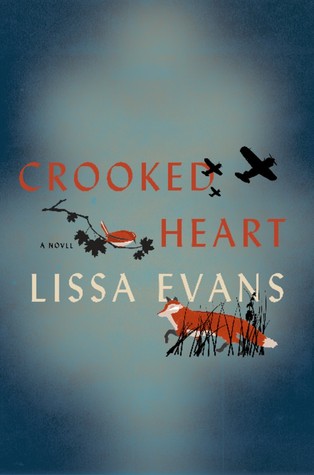
Review: Crooked Heart by Lissa Evans

I received an advanced review copy of this novel from the publisher through TLC Book Tours.

My Review:
Crooked HeartThis is the heartwarming tale of two lonely people that find each other amidst the turmoil of World War II in London.  Noel is an orphan living with his godmother when the novel opens and, although she is a tough old woman and a former suffragette, dementia is taking its toll on her health.  Due to her increasing confusion, she walks out of her home at night and dies in a sand pit.  Noel is then left with some of his godmother’s distant relatives who really don’t care to have the ten-year-old boy around.

When children are evacuated from London, Noel is placed with a woman named Vee who has an interesting and sad story of her own.  Vee got pregnant when she was seventeen, only to be abandoned by her lover.  Vee has raised her son as a single parent, not an easy thing to do in 1940’s London, and she also cares for her mute mother.  Vee is always trying some small scan to bring in money and put food on the table for her son and mother.  When she hears that she will be given a stipend for taking in Noel as an evacuee, she decides that any small inconvenience is worth the extra income.

The strength of this book lies in the development of the relationship between Vee and Noel.  Noel has pretty much been abandoned and is alone in the world.  At the same time, Vee”s mother remarries and her son Donald runs away because a scam of his own making has gone awry.  Vee has spent the better part of her life taking care of her mother and son, only to be left behind by both of them without so much as a thank you.

But Noel proves to be great company for Vee and together they run some minor scams to have a decent income.  When Noel disappears overnight, Vee misses him dearly and does everything she can to find him.  It is evident that this child has grown on her and she wants him in her life permanently.  The plot really pulls at the heartstrings as Noel realizes that there is suddenly a person in his life that cares about him and he has the potential for a true parent and a lasting home.

CROOKED HEART is a novel with a serious backdrop of World War II but the author manages to make the story heartwarming and funny.  For those who love World War II historical fiction, this book is a must read.


About The Author:
L EvansAfter a brief career in medicine, and an even briefer one in stand-up, Lissa Evans became a comedy producer, first in radio and then in television. She co-created Room 101 with Nick Hancock, produced Father Ted, and co-produced and directed The Kumars at Number 42. Her first novel, Spencer’s List, was published in 2002. Lissa Evans lives in north London.

2 Comments

Filed under Historical Fiction

Review: Henri Duchemin and His Shadows by Emmauel Bove

I received an advanced review copy of this collection of short stories from The New York Review of Books.  The stories were written in 1928 in French and this English version has been translated into English by Alyson Waters

My Review:
Henri DucheminThis collection of short stories all feature men who are unhappy and looking for someone or something with which to identify.  In the first story entitled “Night Crime,”  Henri Duchemin, a forty-year-old man,  is alone on Christmas Eve in a pub lamenting over his poverty and loneliness and the last thing he wants to do is to go back to his cold, empty flat.  He wanders around the streets in the rain until he really has no choice but to go home.  But before he goes home, a woman whome he meets on the streets notices his sadness and abrasively suggests that he kill himself.  As he drifts off to sleep, thoughts of suicide and murder haunt his restless dreams.

My favorite story in the collection is written in the epistolary style.  “What I saw” is a letter written by Jean to an unnamed friend; Jean desperately wants his friend’s opinion about something that he saw involving his girlfriend that disturbed him greatly.  Jean’s letter begins with a description of his girlfriend, Henrietta, and her devotion to Jean.  One thinks she is the model woman until, one day, Jean sees her sitting in a taxi and kissing another man.

When Jean confronts Henrietta about the liaison, Henrietta adamantly denies ever being with another man.  Henrietta and Jean’s other friends try to convince Jean that he must have been mistaken and only saw someone who resembled Henrietta.  Jean wants so much to continue his relationship with Henrietta and as he finishes his tale he begs the recipient of the letter to tell Jean his true opinion about Henrietta’s alleged indiscretion.  Jean, like the other characters in the story, has a tenuous grasp on an important relationship in his life and he is eager and even desperate not to lose it.

Another story worth mentioning is “The Story of a Madman.”  Fernand, the narrator, makes it a point at the beginning of his tale to address the reader and inform him or her that he is not, in fact, crazy or out of his mind.  He goes on for a few pages giving us some background about his activities and frame of  mind so that when he carries out his plan, the reader will think he is perfectly sane in doing so.

Fernand then proceeds to have a meeting with his father and tells his parent that he never wants to see him again.  Fernand then makes his way to his girlfriend, Monique’s apartment;  He assures us that he is deeply in love with Monique and they have a fantastic relationship, but he informs her that he never wants to see her again either.  The next stop on Fernand’s list is his best friend, with whom he also breaks off all contact.

Fernand’s final stop on his break-up tour is with his sister and brother-in-law.  After a friendly conversation, he also informs them that he never wants to see them again.  So, we are left wondering why Fernand would alienate all of the people in his life that he loves.  There are hints throughout the story that Fernand is exercising his willpower and that he is attempting to make a plan and adhere to it no matter what others may think.  But the last few sentences of the story leave us with a haunting suggestion that maybe his motives for leaving are a bit more depressing and sinister.

This is a small yet powerful collection of stories that will leave you thinking about these men and their feelings of alienation and unhappiness.  Bove’s language is sometimes curt and sometimes poetic.  He weaves these small tales in such a way that we are never sure where they will end.  I highly recommend this brilliant collection of writing brought to us by The New York Review of Books classics collection.
About The Author:
E BoveEmmanuel Bove, born in Paris as Emmanuel Bobovnikoff, died in his native city on Friday 13 July 1945, the night on which all of France prepared for the large-scale celebration of the first ‘quatorze juillet’ since World War II. He would probably have taken no part in the festivities. Bove was known as a man of few words, a shy and discreet observer. His novels and novellas were populated by awkward figures, ‘losers’ who were always penniless. In their banal environments, they were resigned to their hopeless fate. Bove’s airy style and the humorous observations made sure that his distressing tales were modernist besides being depressing: not the style, but the themes matched the post-war atmosphere precisely.

9 Comments

Filed under France, Literature in Translation, New York Review of Books, Short Stories