Author Archives: Melissa Beck

Melissa Beck's avatar

About Melissa Beck

My reading choices are rather eclectic. I enjoy reading a wide range of books especially classics, literature in translation, history, philosophy, travel writing and poetry. I especially like to support small, literary presses.

Review: Her Father’s Daughter by Marie Sizun

I received a review copy of this title from Peirene Press.  This English version has been translated from the French by Adriana Hunter

My Review:
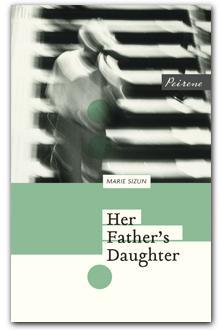
Her Father's DaughterFrance is a four and a half year old little girl, growing up in war time France with her mother.  Her father left to fight in World War II when she was an infant, so she only knows him through photographs.  In fact, the very concept of a father is alien to her because there are no other examples of fathers to which she is exposed.   I was immediately captivated by this short book and drawn into this small child’s recollections about the war and its lasting effects on her family.

Despite the fact that there is war raging on around her, France’s world is very small and happy.  She lives with her mother in a two room apartment in occupied Paris and as a spoiled and indulged child she does whatever she pleases.  She draws on the walls of her apartment, draws in books, sings at the top of her lungs and has awful table manners.  Her mother showers her with constant attention and affection and calls her “my darling.”  Her grandmother, who seems to the chid like a cold-hearted disciplinarian, visits France and her mother often but the child has no affection for her.  In fact, the child gets rather jealous when her mother and grandmother are talking privately to each other the child does everything she can to interrupt them.

One day France’s mother causally mentions that daddy is coming home.  France goes into a panic because she knows, rightly so, that her cozy world with her mother will never be the same.  When she meets daddy for the first time she is reticent and fearful.  Her father was captured by the Germans and spent years in a German prisoner of war camp.  When he is finally able to come home from the hospital, all of France’s routines are completely shattered.  Her father loses his temper easily at the ill manners of his small child.  When she refuses to finish her dinner he slaps her and when she throws a fit he makes her sit out in the hallway of the apartment by herself.  France develops a contempt for her mother for her once beloved who does not intervene on her behalf.  But at the same France gradually develops a fondness for her father.

Once he is able to settle his anger and impatience, France’s father is able to show her affection and attention.  He begins painting with her and telling her stories.  The transformation of this heartwarming father-daughter relationship was my favorite part of the book.  As France begins to trust her father, she confides in him a secret about her mother that has been bothering her for a long time.  This secret is what finally manages to break apart what was already a fragile marriage.  When France’s father moves out and remarries, she must once again navigate the world without a consistent father figure in her life.

I found this book to be clever in its dealing with the point of view of a child.  The entire story is seen through the child’s eyes, yet the narrator also interprets for us the underlying feelings and emotions of the child, so we get a deeper glimpse into the thoughts of her life and her surroundings.  The sentences are short and sometimes only a word or two which is fitting for a narrator who is a small child.  And throughout the book she is rarely called by her name but instead she is referred to as “the child,” as if she were unimportant, a non-entity to the adults around her.  This is another beautiful and powerful book from Peirene Press and it gave me a new perspective about the tragedies of war and how they affect the youngest and most vulnerable among us.

This is the second book in the Peirene Fairy Tale series.  I am always eager to read another Peirene and this book was absolutely fantastic.  I can’t wait for the third, and final book, in the Fairy Tale selections.  Please visit the Peirene website for more information on this book and to read a sample: http://www.peirenepress.com/books/fairy_tale/peirene_no_20/PLINK

About the Author:
M SizunMarie Sizun is a prize-winning French author. She was born in 1940 and has taught literature in Paris, Germany and Belgium. She now lives in Paris. She has published seven novels and a memoir. Marie Sizun wrote her first novel, Her Father’s Daughter, at the age of 65. The book was long-listed for the Prix Femina

 

9 Comments

Filed under France, Historical Fiction, Novella

Review: Clinch by Martin Holmén

I received an advanced review copy of this title from Pushkin Press.  This was published in 2015 in the original Swedish and this English version has been translated by Henning Koch.

My Review:
ClinchHarry Kvist is an former boxer who lives in the decrepit, dirty and seedy city of Stockholm in the 1930’s.  The city is full of tramps, prostitutes, and bootleggers as well as poor and destitute citizens who have been affected by the economic collapse of this decade.  Kvist himself leads a hard life by serving as a collector of debts to those who have defaulted on payments.  His specialty is repossessing bicycles which is easy money for him.  When the novel begins Kvist is collecting on a debt from a man named Zetterberg who owes a few thousand kronor.  Kvist scares Zetterberg by giving him a good beating that is not enough to kill him, but enough to leave him with a few scars as a “reminder” to pay the money he owes.  When Zetterberg is found dead the next day, Kvist is the prime suspect and he is immediately picked up by the police.

Kvist spends a few rough nights in a disgusting jail cell covered in urine and lice.  He is given a working over by the detectives and after they don’t get any information out of him he is released.  He spends the next few days hunting downs leads about Zetterberg’s murder and trying to find a prostitute named Sonja who is the only person who can provide him with an alibi for the time of the murder.  Kvist’s detective work takes him to bars, gangster hideouts, slums and brothels.  The best part of the book is the author’s ability to fully capture the squalid, dingy and oftentimes dangerous city.  The streets are an interesting mix of pre-industrial Europe and the slow progress towards modernization.  Horse carts still plow the streets and deliver coal, but cars are also driven through the crowded and dirty city.

The plot about the murder is slow to advance throughout the course of the book.  However, Kvist’s contact with the seedy underbelly of the city make for some thrilling scenes.  His always has a desire to use his boxing skills and he gets into several fist fights with other gritty characters.  He is also shot at and chased after and there is rarely a dull moment in Kvist’s life.  But even though there is an undercurrent of violence throughout the book, Kvist is not a murderer or a psychopath.  He can be sensitive to the needs of others, especially women who are in a tough spot or emotionally distraught.  He is even nice to animals and feeds the starving strays on the streets of Stockholm.  All of these details give us a multi-dimensional character with whom, even when he is violent, we can sympathize.

Kvist’s sexuality and his experimentation with both males and females gives the book an added layer of interest and sophistication.  Kvist has several encounters with different men at the beginning of the book which is very dangerous for him since any type of homosexual act is illegal at the time.  But Kvist’s sexual preferences are not an “either, or” choice.  He also hints at the fact that he has a daughter and makes comments about the type of woman that attracts him.  He spends quite a bit of time in the second part of the book sleeping with an actress who was trying to contract him for his collection serves.  The exploration of his sexuality, which is not usually done in Noir fiction,  adds another brilliant dimension to his character.

I am excited that this is supposed to be the first book in a trilogy about Harry Kvist and I am eager to read the next two installments which are coming out in the next year.  This is noir writing as its best and you won’t want to give this book a miss if you are a fan of this genre.

About the Author:
M HolmenMartin Holmén is a Swedish writer based in Stockholm. He was orn in 1974. He teaches History, Swedish and History of Culture and Ideas at an upper secondary school in Stockholm two days a week. He is the author of the Harry Kvist trilogy.


9 Comments

Filed under Historical Fiction, Literature in Translation, Mystery/Thriller, Scandanavian Literature, Summer Reading

Review: Grand Hotel by Vicki Baum

I received a review copy of this title from the New York Review of Books.  The original book was published in 1929 in German and this English version has been translated by Basil Creighton.

My Review:
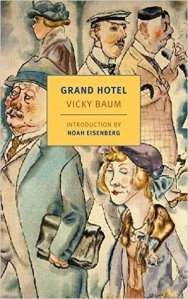
Grand HotelThe Grand Hotel is the place to stay for anyone who wishes to be surrounded by luxury and high society in 1920’s Berlin.  The guests that have all checked into the hotel in March of 1929 are an interesting mix of misfits whose stories all collide in a cleverly intertwined plot.

The first character to whom we are introduced is Dr. Otternschlag.  He sits for hours each day reading the paper and watching people go in and out of the revolving doors of the hotel.  He asks the porter several times if a letter has come for him and it is sad that no letters ever arrive for this lonely man.  He suffered a horrible injury during World War I which has left his face horribly scared.  He is utterly lonely, sad and has no zest for life.  He is the absolute opposite of Baron Gaigern who is also a guest at the hotel.

The Baron wears the finest clothes, has impeccable manners, is charming and extremely handsome.  He enjoys life to its fullest with gambling, fast cars, and lots of women.  But little does everyone know that the Baron is actually a petty thief and has no money other than that which he steals from his unsuspecting victims.  He latest mark is an aging ballerina named Grusinskaya whose famous string of pearls are said to be worth over 500,000 marks.  He has been secretly following the dancer around so that he can best ascertain how to get his hands on those pearls without being caught.  His plan for the heist is one of the most amusing and thrilling parts of the plot.  In the course of carrying out his carefully laid out plan, the unexpected happens to the normally cool and collected Baron–he falls in love with the woman who is supposed to be his victim.

The next person to check into the Grand Hotel is Otto Kringelein who is a lowly and badly paid clerk from a small town.  He is very sick and has only been given a few weeks to live so he gathers up all of his life savings, leaves his miserable wife and books a room at the hotel where he intends to have an exciting adventure before he passes away.  When his boss, Mr. Preysing, also checks into the hotel, he won’t let this angry and horrible bully spoil his fun. Kringelein finds a companion in the doctor for a while and even goes to the ballet with him.  But it is not until Kringelein meets up with the Baron that he really starts to feel alive.  The adventures that the Baron takes this provincial and naïve man on, which include boxing, gambling and flying, are absolutely hilarious.

The final adventure that Kringelein takes is of his own making as he comes to the aid of a beautiful young woman.  The story ends well for Kringelein even though it is still likely that he doesn’t have long to live.  He, like many others, checked into the Grand Hotel, as a solitary misfit.  But his exploits with the other guests turn him into a more worldly and confidant man who yearns to experience all that life has to offer.  The New York Review of Books has managed to reissue another fantastic classic that I devoured in just a few sittings.  I can’t recommend this book highly enough.

About the Author:
Vicki BaumVicki Baum (penname of Hedwig Baum) was born in a Jewish family in Vienna, Austria. She moved to the United States in 1932 and when her books were banned in the Third Reich in 1938, she started publishing in English. She became an American citizen in 1938 and died in Los Angeles, in 1960.

24 Comments

Filed under Classics, German Literature, Literature in Translation, New York Review of Books, Summer Reading

Review: Goethe Dies by Thomas Bernhard

I received a review copy of this title from Seagull Books.  This book was published in 2010 in the original German and this English version has been translated by James Reidel.

My Review:
Layout 1This slim volume of four short stories by Bernhard is difficult to describe in a brief review.  I experienced them and reacted to them as I would poetry and as a result my instinct is to analyze just about every line in these stories; but then my review would be the same length as this edition of stories.  One must really read Bernhard for oneself in order to fully grasp what is the Bernhard literary experience.  The stories are dripping with dark satire and are laden with a rebellion against his native home of Austria.  No topic related to his homeland is off limits as he pokes fun at the Austrian government, Catholicism, Austrian literature and even his relationship with his Austrian parents.

The rhetorical devices that Bernhard uses in his prose give a lyrical feeling to the text.  The persistent repetition of words or phrases, for instance, enhances the level of biting satire in the stories.  The incredibly long sentences give the stories a meandering and aimless feel to them;  we are never sure when or if Bernhard is getting to the point of his story.  In the title story, “Goethe Dies”, Goethe is nearing the end of his life and he insists to his aids and secretaries that he must meet Wittgenstein before he slips away.    The idea of this anachronistic meeting is funny in and of itself but the silliness of the meeting is enhanced by the characterization of Goethe who is a cantankerous old man that will not take no for an answer.  Why his secretaries and assistants object to Goethe’s meeting with Wittgenstein is never clearly articulated by any of them.  Bernhard’s use of indirect speech increases the ridicule of this famous German philosopher and his inner circle.

With time Goethe allegedly worked himself up over notion, as Krauter confirmed, of summoning Wittgenstein from England to Weimar under any circumstance and as soon as possible and Krauter would in effect be bringing Wittgenstein to see Goethe oddly enough on this, the twenty-second; the idea of inviting Wittgenstein to Weimar occurred to Goethe at the end of February, thus said Riemer presently, and not at the beginning of March, as Krauter maintained, and it was Krauter who learnt from Eckermann that Eckermann would prevent Wittgenstein from travelling to Weimar to see Goethe at all costs.

The next two stories, “Montaigne: A Story in Twenty-Two Installments” and “Reunion” ruthlessly mock the parent-child relationship.  Bernhard highlights the codependent nature of the family dynamic which oftentimes serves very little purpose other than to make the parents and child miserable.  In Montaigne, the narrator, similar to the philosopher Montaigne, is trying to lock himself up in his tower so that he can finally have peace from his family.  His family is more interested in business and the narrator wants to be left alone to read good books.  What bibliophile would not be able relate to this?  Bernhard begins the tale of “Montaigne” with:

From my family and thus from my tormentors, I found refuge in a corner of the tower and had, without light and thus without the mosquitoes driving me insane, brought with me a book from the library after I had read a few sentences in it, by Montaigne as it turned out, to whom I am related in such a close and truly enlightening way as I am to no one else.

“Reunion” extends this dysfunctional family dynamic by describing the young narrator as he desperately struggles to free himself from his annoying, hateful parents.  The hyperbole that Bernhard employs in this story made it, for me, the funniest narrative in the collection.  The narrator believes that his parents mission in life is to make him miserable and blame him for all of their problems.  He writes:

Essentially everything about our parents was rough, they were rough and ruthless to our whole lives, I said, whenever they should have always been circumspect with us, caring.  Mother slammed the doors behind her all the time, Father trampled through the house in his old climbing boots.

The parents are in constant search of “peace and quiet” and to him, the narrator, his parents are the antithesis of peace and quiet.  Wherever they go, they disrupt and destroy any chance of peace and quiet.  While on vacation in the Alps, the family hikes to a quiet alcove in the mountains and when they reach the quiet peak the parents rupture the “peace and quiet” by playing instruments.  Anyone who has gone on a family vacation in search of rest and relaxation, but instead has come home more aggravated and anxious,  will most certainly laugh uncomfortably at this story.

These four stories were an excellent introduction to the literary style and talent of Bernhard.  I ordered three more of his longer novels after I finished this volume.  I am very eager to experience his unique writing techniques in a full length book.


About the Author:
T BernhardThomas Bernhard was an Austrian author, who ranges among the most distinguished German speaking writers of the second half of the 20th century.

Although internationally he’s most acclaimed because of his novels, he was also a prolific playwright. His characters were oftenly working in a lifetime and never-ending major work while they deal with themes such as suicide, madness and obsession and, as Bernhard did, they use to have a love-hate relation with Austria. His prose was tumultuous but sober at the same time, philosophic in the background, with a musical cadency and plenty of black humor.

He started publishing in the year 1963, with the title “Frost”. His last published work, appeared in the year 1986, was “Extinction”. Some of his most well known works include “The loser” (where he ficitionalizes about Glenn Gould), “Correction” and “Woodcutters”.  To read more about his works visit: http://www.thomasbernhard.org/.


14 Comments

Filed under German Literature, Humor, Literature in Translation, Seagull Books

Review: Party Headquarters by Georgi Tenev

I received a review copy of this title from Open Letter Books.  The book was written in 2006 in Bulgarian and this English version has been translated by Angela Rodel.  This review is my first contribution to Bulgarian Literature month which is being hosted by Thomas at Mytwostotinki.  Click on the following link for more reviews and to learn how to participate.

Bulgarian Literature Month 2016 – How to participate

My Review:
Party HeadquartersThe narrative of this book takes places during the 1980’s and 1990’s as the communism regime in Bulgaria collapses and the government goes through a transition to democracy.  The narrator jumps from one time period to another in an erratic and almost frantic method.  The book opens when his father-in-law, a man named K-Shev who is the cruel dictator of Bulgaria, has fled to Germany.  The narrator is visiting the now sick and dying old man in the hospital and delivering a giant suitcase of money that K-Shev stashed away before his hasty retreat.

The narrator spends his youth in a state of disarray and aimlessness.  For a time he joins the army where he learns physical discipline and to be mute for long periods of time.  He pushes himself by running to the point of pain and exhaustion in an effort to become a Cosmonaut or a pilot.  During this time period when Bulgaria’s communist regime is falling apart, the narrator experiences his own identity crisis as he is trying to decide what to do with the rest of his life.  He ends up in medical school where he meets his wife.  But even medical school isn’t something that is able to ground him for very long since he is kicked out after his second year.  It is in medical school that he meets and falls in love with his wife.

But his wife is not just any ordinary woman; he happens to fall in love with the notorious dictator’s daughter.  She refuses to talk about her father and there are hints that she has had her own unpleasant and traumatic experiences with him.  Her most unpleasant and disturbing memory of him is how he chose to deal with the aftermath of the Chernobyl disaster.  He keeps the news of the reactor’s meltdown from his people and continues to let them eat the food and drink the milk and water that might be contaminated by radiation.  K-Shev sends his daughter to the local medical facility to be tested for radioactive poisoning but he never does anything to help the rest of his people.  It seems a fitting punishment from the powers that be in the universe that he dies of a disease that has essentially poisoned his blood.

K-Shev is a figure that constantly looms over the narrator’s life and gives him a never ending sense of unease. He writes, “The Boss’s circulatory system envelops us, every one of us.”  When he is delivering the money to K-Shev he spends a significant amount of time jogging even to the point of vomiting.  In his attempt to ease his mental anguish with physical exercise he also seeks out prostitutes during his time in Germany.  He writes that even K-Shev’s death won’t offer any real emotional release: “To tell you the truth, I know that in the end his death will rob me of everything.  It will leave me only the monuments, from which you can’t demand accountability, not for anything.”  There is nothing the narrator can do to calm his roving thoughts; there is nothing he can do to erase the unpleasant memories of the past.  Is there any way forward for him?

In the meandering and poetic prose, there is a larger message to be found in this novel about the lasting effects of a totalitarian regime.  Even though the Party Headquarters are burned down, the dictator is exiled and his sprawling home is boarded up, the people will not automatically forget decades of oppression.  The transition from oppression to freedom is not an easy one and the emotional scars never truly disappear.

About the Author:
G TenevGeorgi Tenev, before penning the Vick Prize-winning novel Party Headquarters, had already published four books, founded the Triumviratus Art Group, hosted The Library television program about books, and written plays that have been performed in Germany, France, and Russia. He is also a screenwriter for film and TV.

6 Comments

Filed under Literary Fiction, Literature in Translation, Novella