Author Archives: Melissa Beck

Melissa Beck's avatar

About Melissa Beck

My reading choices are rather eclectic. I enjoy reading a wide range of books especially classics, literature in translation, history, philosophy, travel writing and poetry. I especially like to support small, literary presses.

Guest Post: Author Marie Savage On How to Begin An Historical Fiction Novel


Today I welcome Marie Savage to The Book Binder’s Daughter who is writing about her new book Oracles of Delphi and her process of beginning an historical fiction novel.  I invite you to read her interesting guest post, enter to win your own copy of her book and visit the other stops on the tour.

Great beginnings: Setting the historical scene to keep the reader turning the pages

As a writer, editor, publisher, and avid reader, I think a lot about how to draw a reader into a story and keep them turning the pages. All good stories must have a powerful beginning that not only hooks the reader immediately, but also sets the mood and gives tantalizing clues about what is to come. In historical fiction, the beginning has to do even more work—it has to transport the reader to a time and place that may be completely unfamiliar.

9780989207935-Perfect.inddThere are many ways to grab a reader from the very first line and first paragraphs, and in writing ORACLES OF DELPHI, set in 340 BCE, I think I tried them all before I got it “right.” I probably rewrote the first chapter fifty times, and that’s no exaggeration. Ultimately, I believe, a successful beginning boils down to a deft use of tension and in ORACLES, the first paragraph plunges the reader directly into the story, gives a sense of the time period, and sets up the tension between two characters:

Nikos’s heart pounded against his rib cage like a siege engine. He pressed his back into the stone wall, closed his eyes, and tried to calm his breathing. He couldn’t believe he’d been such a fool. “Next time I’ll surrender the prize,” Charis had always promised. Next time he would claim it, he always hoped. But instead….

He pulled himself to the top of the wall and lay flat. The moment of escape calmed him. The gates of the Sacred Precinct were locked, and he’d had to climb out the same way he’d climbed in. On the way out, though, he wasn’t carrying a body.

He glanced to his side, toward the theater, and then down to the Temple of Apollon where he’d left Charis’s body for the priests to find. Stars winked in and out as clouds drifted across the black dome blanketing the night sky. He crouched, reached for a nearby branch, and swung down to land on the ground with a soft thud.

Does it work? With references to the siege engine, the Sacred Precinct, and the Temple of Apollon, does it put you in the scene and in the time period? Will it keep you reading? I hope so. Here’s one of my favorite beginnings, this one by Deborah Lincoln whose book, AGNES CANON’S WAR, I edited and published.

Agnes Canon saw a woman hanged on the way to the Pittsburgh docks. The rope snapped taut, and a hiss rose from the watching crowd like steam from a train engine. The woman dangled, ankles lashed together, hooded head canted at an impossible angle, skirt flapping lazily in the breeze. A sharp pang of sorrow shot through Agnes though she knew little of the woman’s story.

I love this first paragraph because it puts you right into the story. In the first line, we read “Agnes Canon saw a woman hanged on the way to the Pittsburgh docks” but we don’t know why she was going to the docks—does she work there? Is she meeting someone there? Or is she going on a journey, leaving from the docks to parts unknown? Second, we know immediately that the story is set in a time during which hangings were done in public and steam engines were common. Third, the description of the woman’s body dangling with “ankles lashed together, hooded head canted at an impossible angle, skirt flapping lazily in the breeze” grabs the reader and immediately begs the question: what was this woman’s crime? Last, we discover that although Agnes knows little of the woman’s story, she knows enough to feel sorry for her, and that sympathy tells the reader something of Agnes’s character.

A good beginning should not be loaded down with adjectives and adverbs, but careful use of descriptive language can be effective in setting the mood, anchoring a story in time and place, and evoking a particular atmosphere. Below is the first paragraph from SLANT OF LIGHT, an award-winning Civil War-era novel from Steve Wiegenstein.

The keelboat moved so slowly against the current that Turner sometimes wondered if they were moving at all. Keeping a steady rhythm, Pettibone and his son worked the poles on the quarter-sized boat they had built to ply the smaller rivers that fed the Mississippi. Whenever the current picked up, Turner took the spare pole and tried to help, but although he was tall and muscular, with a wide body that didn’t narrow from shoulders to hips, poling a boat wasn’t as simple as it looked. He pushed too soon, too late, missed the bottom, stuck the pole in the mud, all to the amusement of Pettibone’s son, Charley. And with every stroke, Turner asked himself: What in all creation am I doing here?

In this paragraph, we know immediately that the story is set in the past as keelboats are not common modes or transport these days. And we know that Turner, who is tall and muscular, is unused to working the poles—something even a young boy can do. Turner is clearly a guest on the keelboat or has hired Pettibone and Charley to transport him. But transport him where? We know the boat is plying a tributary of the Mississippi, but what is Turner doing there and where is he going? The last line sets up the rest of the novel, hinting that discovering why Turner is on that keelboat in the first place is at the heart of the story.

What are your favorite first paragraphs and what elements draw you in and keep you turning the pages?

-Marie Savage

About The Author:

02_Marie Savage_Author PhotoMarie Savage is the pen name of Kristina Marie Blank Makansi who always wanted to be a Savage (her grandmother’s maiden name) rather than a Blank. She is co-founder and publisher of Blank Slate Press, an award-winning small press in St. Louis, and founder of Treehouse Author Services. Books she has published and/or edited have been recognized by the Independent Book Publishers Association (IBPA), the Independent Publisher Book Awards (IPPY), the Beverly Hills Book Awards, the David J. Langum, Sr. Prize in American Historical Fiction, the British Kitchie awards, and others. She serves on the board of the Missouri Center for the Book and the Missouri Writers Guild. Along with her two daughters, she has authored The Sowing and The Reaping (Oct. 2014), the first two books of a young adult, science fiction trilogy. Oracles of Delphi, is her first solo novel.

Giveaway:

Marie is giving away one copy of her book (US/CAN).  Just leave me a comment below and let me know you want to win.  It’s that easy!  One winner will be chosen on Jan.9th and notified via email.  The winner will have 48 hours to respond.

Click on the Tour Banner below to view the full list of blogs participating in the tour!

04_Oracles of Delphi_Blog Tour Banner_FINAL


3 Comments

Filed under Author Interviews, Historical Fiction

Review-Far and Near: On Days Like These by Neil Peart

I was thrilled when I received a review copy of this book from the publisher, ECW Press.  Travel writing is one of my favorite genres and I have read, and enjoyed, a few of the other travel memoirs written by this author.  And as a further disclaimer, I have enjoyed listening to and going to Rush concerts for many, many years.  However, as far as Rush’s music is concerned, I tend to be more of a Geddy Lee fan (sorry Neil).

My Review:

Far and NearIn the intro to his work, Neil Peart makes it a point to discuss the art of writing and the special attention he gives to his craft.  Although the writings which are contained in this book first appeared as a series of pieces on his blog, Neil puts quite a bit of effort in perfecting this collection for his audience.  He sites the Roman poet Ovid: “If the art is concealed, it succeeds.”  The passage to which Neil refers is actually from Ovid’s story about the artist Pygmalion from his epic poem The Metmorphoses. 

Pygmalion cannot find the perfect woman, who is chaste and wholesome and faithful and matches his ideal of what a perfect woman should be.  So as an artist and sculptor he decides to make his own “woman.”  As he is working with the ivory, the figure of a woman he sculpts is so flawless that one would think she is alive.  The brilliance of Pygmalion’s art hides the fact that his sculpture is indeed art and not actually alive.

Like Pygmalion, Neil strives to perfect his art, whether it be drumming or writing, so that all the listener or reader sees is the seamless, finished product. Far and Near is first and foremost a travelogue of Neil Peart’s trips on his motorcycle from venue to venue while he is on tour with his band.  His narratives take place over a three year period of time, on the second leg of the band’s “Time Machine Tour” and on all three legs of the band’s “Clockwork Angel’s Tour.”  When the book opens, Neil is on the road in April with his longtime friend and riding partner, Michael.  I have lived on the east coast of the United States all my life but Neil’s detailed description of springtime in this part of the country, as different flowers are resurrected and animals start to peak out of their winter hibernation, makes me appreciate it all the more.  The vivid depictions of every place he travels, whether it be in the extreme heat of the desert or perilous roads of the British countryside or the brutal cold of a Canadian winter, makes one want to visit and experience these places for oneself.  Isn’t this the true mark of a successful travel memoir?

Far and Near is so much more than a travelogue.  It is also a book of wonderful photography, a brief history of many small towns in North American and Europe and a history of the flora and fauna of those places as well.  The book further serves as a personal memoir of the author as he reminisces about previous experiences at each place he visits. Not only are pictures of the various touring destinations included in the book, but there are also descriptions of the photographic techniques that are employed for different situations.

A point is made to capture many of the small towns where these “shunpikers” (those who purposely avoid the most direct roads from one point to another) ride and oftentimes an interesting history is provided about these out-of-the-way places.  As a classicist, I was particularly impressed that Neil gives a bit of the history of Roman occupation of Britain as he is riding around the English countryside.

Finally, the book captures the life of a musician both on the road and off.  The band’s triumphant introduction into the Rock-And-Roll Hall of Fame is related at length in one of the entries.  Neil would not be “on the road” going from place to place, after all, if it were not for his job with a touring rock band.  Although this is certainly not the sole focus of the book, the reader is led to understand what the emotional and physical effects of constant touring and months on the road can cause.  The stories about his young daughter, Olivia, who doesn’t quite understand that “Daddy is at work” are particularly touching.  It is also entertaining to read about the many other crew members that all contribute to making a successful show possible; from the drum technician, to Neil’s riding partners, to the bus driver, to the crew members who entertain the band by dressing up in a chicken suit, it truly takes a small village to put on a show every night.  The sum of all these moving parts means that, once again, the art conceals the art.

Far and Near appeals to a very broad audience of readers; if you enjoy travel writing, memoirs, photography, or the music of Rush you will want to read this book.  In the end, the gods grant Pygmalion his wish and they make his statue become a live woman.  Neil Peart, through his book, makes the art of traveling, writing, playing music and his quest to live his life to the fullest come fully alive to his readers.

About The Author:

Neil PeartNeil Peart is a Canadian musician and author. He is best-known as the drummer and lyricist for the rock band Rush.

Peart grew up in Port Dalhousie, Ontario, Canada (now part of St. Catharines) working the occasional odd job. However, his true ambition was to become a professional musician. During adolescence, he floated from regional band to regional band and dropped out of high school to pursue a career as a full-time drummer. After a discouraging stint in England to concentrate on his music, Peart returned home, where he joined local Toronto band Rush in the summer of 1974.

Early in his career, Peart’s performance style was deeply rooted in hard rock. He drew most of his inspiration from drummers such as Keith Moon and John Bonham, players who were at the forefront of the British hard rock scene. As time progressed, however, he began to emulate the jazz and big band musicians Gene Krupa and Buddy Rich. Peart is also a pupil of jazz instructor Freddie Gruber. Peart has received many awards for his musical performances and is known for his technical proficiency and stamina.

In addition to being a musician, Peart is also a prolific writer, having published several memoirs about his travels. Peart is also Rush’s primary lyricist. In writing lyrics for Rush, Peart addressed universal themes and diverse subject matter including science fiction, fantasy, and philosophy, as well as secular, humanitarian and libertarian themes. In contrast, his books have been focused on his personal experiences


3 Comments

Filed under Travel Writing

Review- Lorna Doone: A Romance of Exmoor by R.D. Blackmore

This book has been on my “to read” list for a long time.  When someone, whose opinion I highly value, recommended that I read the book, I immediately picked it up.  My only regret is that I waited so long to finally read Lorna Doone.  Originally published in 1869, R.D. Blackmore sets his book on the wild frontier of Exmoor, England where the Crown does not have complete control over the land.

My Review:

Lorna DooneThe plethora of interesting aspects to this book makes it difficult to decide about which ones to write.  John Ridd is a young boy living in the wilds of western England in the 17th century, when his father is murdered by a band of outlaws who torment, bully and rob the farmers and good people of Exmoor.  The Doones occupy their own outlaw village and not only survive by robbing those around them but also prey on the their neighbors for sport.  When John Ridd’s father stands up to these bullies, he is murdered and leaves behind his widow, Sarah Ridd, his prosperous farm, and his three children.

Although John grows up without the guidance of his father, he develops into an upstanding, strong and honest man.  Never for a minute does John harbor resentment or a grudge against the Doones.  If he had let hate and vengeance consume him, his heart would never have been open to receive the love of Lorna Doone and he would have missed out on the greatest love of his life.  What impressed me most about these star-crossed lovers is that they refuse to let the sins of their families ruin their happiness.  R.D. Blackmore has created a character in John Ridd that is an enduring moral example for all ages.

Despite unfortunate circumstances and countless obstacles, the zeal of John and Lorna’s love never wanes.  John’s thoughts and actions are always carried out with his love in mind, no matter how long it has been since he has beheld her face.  This romance is an interesting lesson for those of us in the 21st century who are accustomed to social media, Skype, text messaging, and any number of gadgets that keep us constantly in connection with one another.  We do not have to wait days and weeks for a letter from a loved one or travel on an extended and tedious journey to reach our beloved.  In this age of “out of site, out of mind,” would a man and woman be so patient, faithful and enduring in their love as John and Lorna?

oare_church

Oare Church in Exmoor

The plot is also one of the factors that made me devour this book.  The reader is kept in constant suspense wondering whether or not the evil villians, in the form of the Doones, and especially their leader Carver Doone, will get their just deserts.  Will anyone come to the aid of the innocent people of Exmoor to stomp out these bullies, or will John Ridd and his neighbors take matters into their own hands?  John’s cousin, Tom Faggus, who is also a highway robber, has many interesting parts in the storyline.  Although, as a counterexample to the Doones, he robs the rich and gives the spoils to the poor.  R.D. Blackmore kept me guessing the various fates and outcomes of his characters until the very end.

R.D. Blackmore’s tale has the perfect formula for a great novel: romance, adventure, a bucolic setting, and indelible characters.  The tale of John Ridd has truly captured my heart and like all my favorite classic books, it will be one of those that I will reread again and again.

2 Comments

Filed under Classics, Historical Fiction, Literary Fiction

Happy Holidays

Christmas MessageThis time of year is one to reflect on and learn from what the what the year has brought us.  Although I had been writing book review on various sites, this was the first year I decided to put my thoughts down in a specific place for people to read.  It is a daunting task, since one is essentially putting one’s thoughts, tastes and ideas in a very public place for the whole world to see.  Believe it or not, I have always been a naturally shy person so exposing my thoughts and a small piece of my life on a place like The Internet has been a great personal challenge.

My goal has been to spread the love of reading, connect with likeminded lovers of books, and to give away a few books in the process.  I could never have anticipated how much I would learn through this endeavor or make such meaningful connections that would enhance my life.  There are a few special people in particular whose acquaintance I have made through my blog for which I am eternally grateful.  Thanks to everyone who has made a comment, read a post or even picked up a book because of my recommendation.  May your holiday season be happy and merry and bright.  -Melissa

4 Comments

Filed under Opinion Posts

Guest Post: Author Carol M. Cram talks about Medieval Italy


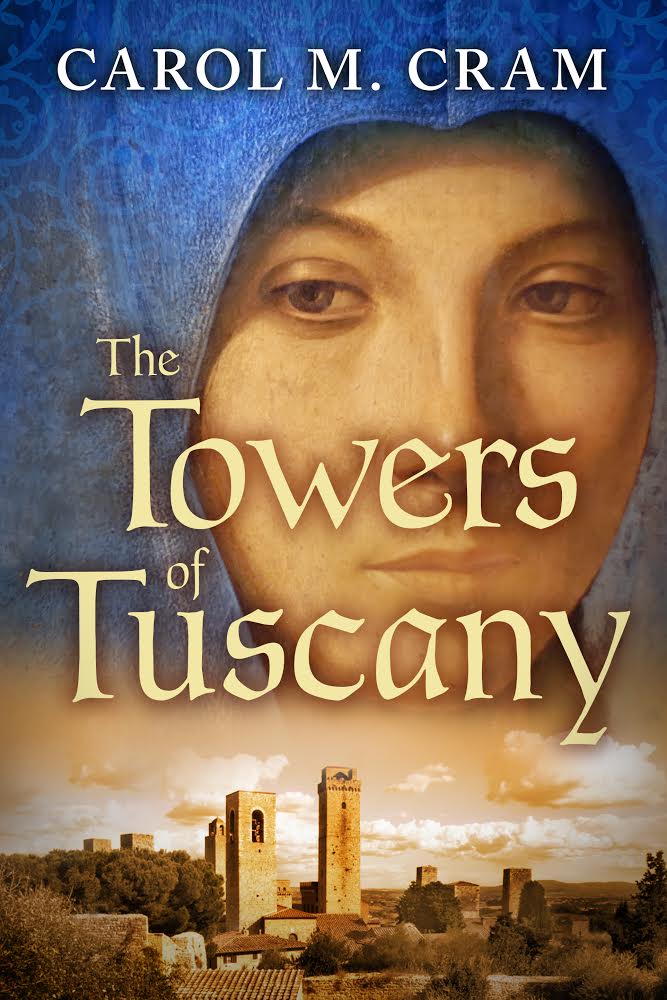
I invited author Carol M. Cram to talk about why she chose to set her historical fiction novel The Towers of Tuscany in Medieval Italy.  Here is her response:

01_The-Towers-of-Tuscany-CoverI have visited Italy several times over the past two decades and was particularly drawn to the medieval towns such as San Gimignano, Montalcino, and Siena. At night when the streets were quiet, I was easily transported back to a time when life was short and harsh and at the same time produced so much wonderful art.

The Italian Renaissance, with its Michelangelo and da Vinci and a host of other artists is considered—and rightly so—as the era that produced some of the world’s most magnificent art. However, I was intrigued by the art that preceded that Renaissance and led to it. In the 14th century, painters were struggling with perspective, experimenting with fresco and tempera (no oil paints yet!), and starting to explore non-religious themes. I wanted to dig deeper into the psyche of a 14th century painter to reveal their passions and their struggles.

I decided to make my painter a woman because I was also intrigued by the fact that, so far as we know, none of the art produced during the first half of the 14th Century when the novel takes place, was produced by a woman. The key phrase here is “so far as we know.” In the 14th Century, painting was very much a family affair. The master who ran a workshop passed his knowledge down to his sons and brothers and nephews. But what if a master had no sons or brothers or nephews? What if he had only a daughter—a bright, precocious child fascinated by the tools of the painter’s trade? I contacted an expert in art of the period, the wonderful Dr. Efrat El-Hanany who later became my historical advisor on the novel, and asked her if it was plausible that a man could teach his daughter how to paint. She thought that yes, the idea was plausible. That’s all I needed to dive in and invent Sofia Barducci—a young, spirited woman who makes a very big mistake.

Unlike most girls of her era, Sofia is allowed to marry a man who she chooses. Unfortunately, she chooses wrong. How many women have made that mistake? Sofia’s plight, although rooted in the prejudices and customs of 14th Century Tuscany, is not so different from the plight of many women all over the world in our own time.  Sofia wants to follow her passion and paint. The world and her own choices conspire against her.

Regarding my research for “The Towers of Tuscany,” I was very fortunate to have a translation of “Il Libro dell’Arte, an amazing handbook for painters written in the late 14th Century by Cennino d’Andrea Cennini. Most of the references to painting techniques come for Cennin’s wonderful book. In it, he advises painters in all aspects of the trade—from grinding pigments to making sizing from goat’s hooves to painting haloes. Cennini acknowledges the need for the painter to have “passion and enthusiasm” for the work. A painter in the 14th Century did not consider himself an “artist” as we would use the word. A painter was a craftsman who served a long apprenticeship to learn the skills of his trade. Painters were also businesspeople who, with their painted panels and frescoes, made important contributions to religious and secular life in the 14th Century.

Thanks so much to Carol for her thoughtful response.  Carol is on tour with her book until January.  Click on the tour banner below to see reviews of her book.

Towers Tour Banner


2 Comments

Filed under Author Interviews, Historical Fiction