Tag Archives: Pushkin Press

Review: Soft in the Head by Marine-Sabine Roger

I received a review copy of this title from Pushkin Press via Netgalley.  The book was first published in the original German in 2008 and this English version has been translated by Frank Wynne.

My Review:
Soft in the HeadThis story is told in the first person by a forty-five year old man named Germain who describes himself as being “soft in the head.”  Germain tells us about his current circumstances and his life as well as his childhood and early years.  He vividly describes his experiences in primary school with his teacher, “The strong get off on walking all over other people, and wiping their feet while they’re at it, like you would on a doormat. This is what I learned from my years at school.  It was a hell of a lesson.  All that because of some bastard who didn’t like kids.  Or at least he didn’t like me.  Maybe my life would have been different if I’d had a different teacher.  Who knows?  I’m not saying it’s his fault I’m a moron, I’m pretty sure I was one even before that.  But he made my life a misery.”  I don’t include very many quotes in my reviews, but when I read this part of the book I had tears in my eyes and I felt like someone punched me in the stomach.

Germain has been treated like he is a worthless moron his whole life, not only by his cruel teacher, but also by his mother and some of the other kids at school.  Germain tells us that his mother get pregnant when she had a one time tryst with a much older man at a summer carnival.  Germain’s mother was labeled a “slut” and an outcast; she takes out her unwanted pregnancy on her poor son, Germain.  She is never affectionate, kind or motherly to him and she hits him at the slightest provocation.  Although Germain is very forthright about his mother’s treatment of him, he never uses her as an excuse for not accomplishing what he wants to do in life.

Germain does, indeed, carve out for himself a rather happy path in life.  He moves out to the caravan in his mother’s backyard so he doesn’t have to deal with her and argue with her everyday.  He feels autonomous and quite content living in a caravan even though it is rather small.  He spends his days tending his large, bounteous garden, visiting with his friends at the local pub, and spending time with his girlfriend, Annette.  One of his favorite daily activities is spending time in the local park where he counts the pigeons.  It is a chance meeting on one of these outings that has a profound impact on Germain’s life.

While on his usual visit to the park one day Germain meets a small and kind elderly woman named Margueritte.  As they start talking they realize that they both enjoy feeding and counting the pigeons.  Margueritte always has a book with her and one day she decides to start reading it outloud to Germain.  His bad experiences at school have made him hate and dread anything to do with reading.  But Margueritte’s book, The Plague, by Camus captivates Germain and it plants the seed of learning in him like nothing else has before.  Margueritte never treats Germain like a moron so he starts to gain some confidence by asking questions and discussing and reading more books with her.  Germain says, “When people are always cutting you down, you don’t get a chance to grow.”  It is Margueritte who serves at the compassionate and encouraging teacher that Germain has been yearning for all of his life.

This is a great read for those who love books about books.  Germain and Margueritte read several books together as they explore the world of literature.  Margueritte also gives Germain a dictionary which becomes his prize possession.  A good part of the story further describes Germain’s growth in other areas of his life.  His experiences with Margueritte have made him a more compassionate and confident friend and boyfriend.  This book serves as a reminder that each and every day we all have the capacity and the choice  to either cut someone down or build someone up.  I absolutely loved this book and was smitten with Germains story and for this reason I think it should be on everyone’s “must-read” summer book list.

About the Author and Translator:
Roger-Marie-Sabine-NB-Libre-de-droits-Cécile-Roger-copy-e1467216344165-1024x1024Born in Bordeaux in 1957, Marie-Sabine Roger has been writing books for both adults and children since 1989. Soft in the Head was made into a 2010 film, My Afternoons with Margueritte, directed by Jean Becker, starring Gerard Depardieu. Get Well Soon won the Prix des lecteurs de l’Express in 2012 and will be published by Pushkin Press in 2017.

Frank Wynne is an award-winning translator from French and Spanish. He has won the IMPAC Award, the Independent Foreign Fiction Prize and the Scott Moncrieff Prize. He has translated a number of Spanish and Latin American authors, including Tomás Eloy Martínez, Isabel Allende, Arturo Pérez-Reverte and Tomás Gonzalez, whose In the Beginning Was the Sea is published by Pushkin Press .
9 Comments

Filed under France, German Literature, Summer Reading

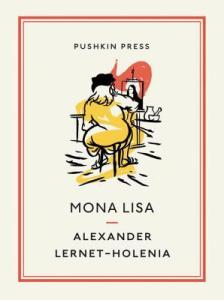
Review: Mona Lisa by Alexander Lernet-Holenia

I received a review copy of this title from Pushkin Press.  The book was originally published in German in 1937 and this English version has been translated by Ignat Avsey

My Review:
Mona LisaThis book is a very slim volume and can be read in an hour or so.  It attempts to answer the question that has been nagging historians and artists for centuries: Who, exactly, was the woman Mona Lisa that Da Vinci made so famous in his painting?  In this plot it is a French aristocrat that becomes obsessed with the mysterious woman in Da Vinci’s painting.

In 1502, King Louis XII of France has dispatched his Marshal Louis de La Trémouille and a small army of men to Florence in order to acquire fine art.  They, of course, stop at Leonardo’s famous home and workshop on their artistic quest.  Leonardo is a humorous figure in the brief plot as he is portrayed as a man with a very short attention span.  He goes from one project to the next without ever completely finishing anything.   As Trémouille and his men are wandering around Leonardo’s home, one of them discovers a painting of a woman behind a curtain.  Leonardo assures the young nobleman,  Bougainville, that the painting is unfinished and not worth so  much attention.  But Bougainville is instantly obsessed with the woman in the painting and has convinced himself that he is desperately in love with her.

The only facts about Mona Lisa that Bougainville can get out of Leonardo is that she was the wife of a man named Giocondo and died a couple of years ago when there was an outbreak of plague in the city.  Bougainville cannot believe that this amazing woman is dead so he goes to visit her grave at Santa Croce.  The small size of the space in which she is supposed to be buried convinces him that she could not possibly be buried in this tomb.  He gathers together a few of his men and comes back to the church under the cover of darkness and digs up Mona Lisa’s grave.

When Bougainville finds that her tomb is in fact empty he is determined to figure out this mystery and is convinced that she is still alive.  His efforts to find her cause mayhem and fighting between the Florentines and the French.  Bougainville believes that Giocondo, Mona Lisa’s husband, is holding her hostage somewhere in the city and the French nobleman does some rash and brazen things to find her.  He is certain beyond a doubt that she will be his lover either in this life or the next.

I thoroughly enjoyed this short book because of the characterization of Da Vinci and the little mystery surrounding the empty tomb of Mona Lisa.  When written records and archaeological evidence are scarce it is amusing to project our own stories onto the lives of famous men from generations past.

About the Author:
A LernetAlexander Lernet-Holenia was an Austrian poet, novelist, dramaturgist and writer of screenplays and historical studies who produced a heterogeneous literary opus that included poesy, psychological novels describing the intrusion of otherworldly or unreal experiences into reality, and recreational films.

5 Comments

Filed under Classics, German Literature, Novella

Review: The Man in a Hurry by Paul Morand

I received an advanced review copy of this title from Pushkin Press through Edelweiss.  This book was originally written and published in French in 1941 and this English translation has been done by Euan Cameron.

My Review:
The Man In A HurryPierre has been in a hurry for all of his life.  He does multiple tasks at a time in order to speed up his life.  He shaves, gets dressed and brushes his teeth simultaneously; he drives too fast and he takes stairs three and four at a time.  There is no task for which Pierre will slow down.  The parts of the book that describe his lightening fast lifestyle are humorous.  For example, there is an incident in which his car breaks down after an accident and instead of waiting for help, Pierre abandons the car with his friend in it and proceeds to his destination on foot.

But Pierre’s fast life has not allowed him to slow down and forge any true or lasting relationships.  His closest friend and partner, the one whom he abandons with his care, decides he has had enough and severs their business relationship.  His manservant who has worked for Pierre for many years is tired of being yelled at and almost run over by Pierre so he quits.  Pierre is essentially alone in his life until he meets Hedwige.

Hedwige, her two sisters and her mother are the opposite of Pierre.  Their favorite activity is lounging around on their mother’s bed; they are never in a hurry for anyone or anything.  When they meet Pierre they are amused by this quirky man and his swiftness.  Pierre is immediately attracted to Hedwige and proposes marriage.  But can the love of a good woman really slow Pierre down and make him appreciate his life?

When Hedwige marries Pierre, the most beautiful gift that he decides he can give her is to delay the conjugal relations on their wedding night.  Pierre arranges for separate bedrooms in their apartment and decides to wait six weeks to get to know Hedwige before he has sex with her.  What better gift can he possibly give her than his patience, especially when it comes to putting off one of the most basic human drives.

When Hedwige becomes pregnant, the old pull of always being in a hurry starts to draw Pierre back in.  How can he possibly wait for nine months to see his child?  Hedwige begins to find comfort again in her mother’s bedroom with her other sisters and she slowly shuts Pierre out.  The matter comes to an ugly head when Pierre wants Hedwige to induce labor when she is only seven months pregnant.

This book has a humorous side as we read all of the ridiculous things Pierre does to hurry up.  But there is also an important social commentary about appreciating what we have and living in the moment.  If we are always in a hurry and worrying about what is happening next then we don’t appreciate those who are most important to us.

About The Author:
Paul MorandPaul Morand was a French diplomat, novelist, playwright and poet, considered an early Modernist.

He was a graduate of the Paris Institute of Political Studies (better known as Sciences Po). During the pre-war period, he wrote many short books which are noted for their elegance of style, erudition, narrative concision, and for the author’s observation of the countries he visited combined with his middle-class views.

Morand’s reputation has been marred by his stance during the Second World War, when he collaborated with the Vichy regime and was a vocal anti-Semite. When the Second World War ended, Morand served as an ambassador in Bern, but his position was revoked and he lived in exile in Switzerland.

Post-war, he was a patron of the Hussards literary movement, which opposed Existentialism. Morand went on to become a member of the Académie française; his candidature was initially rejected by Charles de Gaulle, the only instance of a President ever exercising his right to veto electees to the academy. Morand was finally elected ten years later, though he still had to forgo the official investiture).

Paul Morand was a friend of Marcel Proust and has left valuable observations about him.

11 Comments

Filed under Classics, France, Literature in Translation, Literature/Fiction

Review: Rendezvous in Venice by Philippe Beaussant

I received an advanced review copy of this title from Pushkin Press through NetGalley.  This title was originally written and published in French and the translators of this English version are Paul Buck and Catherine Petit.

My Review:
Rendezvous in VenicePierre has been an assistant to his uncle for fifteen years, learning about art and the world’s famous masterpieces.  His uncle Charles is very meticulous about his work as an art history professor as he catalogues and studies the portraits of famous artists from all over Europe.  Pierre is Charles’ only surviving relative and, as far as Pierre is concerned, Charles never had much of a personal life or any significant romantic relationships.  Pierre’s knowledge about the life of his uncle all changes when his uncle dies and Pierre finds a very personal diary among his uncle’s private papers.  This diary includes the intimate details of Charles’ affair when he was a middle-aged man with a woman named Judith; one of the highlights of their relationship is a trip to Venice where they have intricate discussions about Italian art.

The elegant writing of the book really drew me in and I read over half of it in the first sitting.  The first part of the book alternates between Charles’ diary and Pierre’s thoughts about his uncle’s secret love affair.  Beaupassant makes us contemplate how well we really know those who are supposed to be closest to us.  Pierre worked side by side with his uncle for years and never knew about such an important aspect of his life.  Pierre wonders how long they were together for and why his uncle never mentioned what must have been a heartbreaking love affair. While Pierre is still contemplating his uncle’s secret, he meets Judith at an art history conference.

It is clear from Pierre’s memories of his uncle and from Charles’ own diary that Charles chose to reject love and lead a solitary life and dedicate himself to his work.  Pierre seems to be moving in the same direction of loneliness until he meets Judith and her daughter, Sarah.  Will Pierre, unlike his uncle, choose love and contentment and happiness or will he continue on as a bachelor for the rest of his life?

I must mention that there are several detailed discussions about painting, and portraiture in particular, that gave me a better appreciation for some famous masterpieces; I enjoyed their descriptions so much that I actually looked up the ones that are mentioned in the book (I won’t mention them here to keep potential readers in suspense). Discussions of art, a venetian setting, and a hidden love affair all combine to make this a lovely French novella that I thoroughly enjoyed and highly recommend.

About The Author:
Philippe Beaussant is a prominent and award-winning French musicologist and writer. Born in 1930, he is a founder of the Centre for Baroque Music at Versailles and a Member of the Académie Française. Beaussant has written numerous books on the history of Baroque art and music, as well as several novels. He has won many awards, including the Grand prix du roman de l’Académie française for his novel Heloise.

6 Comments

Filed under France, Literature in Translation, Novella

Review: While The Gods Were Sleeping by Erwin Mortier

I have been reading and enjoying a raft of literature in translation lately.  I was thrilled to receive an ARC of this book that was originally written and published in Dutch in 2008.  This version has been translated into English by Paul Vincent.

My Review:
Gods Were SleepingHelena is a very old woman who has outlived all of her friends, acquaintances and relatives.  She is homebound and needs round-the-clock care which is provided by a kind young woman named Rachida.  We get the feeling that Helena is waiting for death which she feels is imminent and while she waits she writes down the memories of her life, especially those that revolve around the period of World War I.

Helena’s father is Belgian and her mother is French, so she grows up living between these two countries.  She spends the summers in her mother’s family home in France, and when World War I breaks out Helena is forced to wait out the war with her mother, brother, uncle and aunts in their French countryside home.  Helena’s father is left back in Belgium and the family suffers this long separation.

The main characters in Helena’s memoir are her mother, brother and husband.  She has an uneasy relationship with all three.  Throughout her life Helena feels that, as a young woman growing up in a European bourgeois family, she is deprived of many freedoms.  Her mother, who still wears the stiff corsets of the 19th century and is always acutely aware of the gossip from the neighbors, will not let Helena wander out of their home unaccompanied.  Helena resents her mother for keeping her prisoner under these strict, and what she views as, old-fashioned mores.

Helena loves her brother Edgar and is very close to him yet she is jealous of the freedom he is allowed.  As a stark contrast to Helena, he can walk through the city streets at his leisure, have countless affairs, and travel off to war.  When Edgar is wounded during the Great War, he is finally sent home and Helena listens in horror to his vivid details of trench warfare.  One of the aspects of this book that is most impressive is the writer’s ability to graphically describe the tragedies of the war suffered by everyone who witnessed it; sounds, colors, textures, smells, and ruined landscapes are all described in order to capture the scale and destruction of The Great War.

When Helene marries a British soldier named Matthew who has a penchant for wandering and being on the open road, she admires his sense of adventure and his freedom.  But it is his wanderlust that keeps her separated from him for long periods of time.  When they have a child together, a daughter, I was surprised that Helena’s relationship with her was just a contentious as Helena’s relationship with her own mother.

The language and prose of the book feels disintegrated, as Helena jumps from one period of time to the next.  It is almost as if we are looking through an album of old photographs with Helena and she tells us stories of her life as they pop up in her mind.  She oftentimes goes on tangents as one story will remind her of another which she will launch into.  I think some readers will find this writing style confusing and disruptive, but it is appropriate for the setting of the book.  Helena is a very old woman, reflecting back on a long life and as images and narratives randomly appear in her memory she writes them down for us to read.

I have read quite a few historical fiction novels set during World War I this past year and WHILE THE GODS WERE SLEEPING is among the best for capturing the emotions, heartache, lasting effects of this war.

About The Author:
Erwin Mortier is a Dutch-language Belgian author. Spending his youth in Hansbeke, he later moved to nearby Ghent, where he became city poet (2005-2006).He wrote as a columnist for newspapers like De Morgen and has published several novels including Marcel, My Fellow Skin, Shutter Speed, and While the Gods Were Sleeping.


1 Comment

Filed under Historical Fiction, Literature in Translation, World War I
